by Daniel Stefanski | Sep 13, 2023 | Economy, News
By Daniel Stefanski |
An internet search engine giant is making a significant investment in the Grand Canyon State.
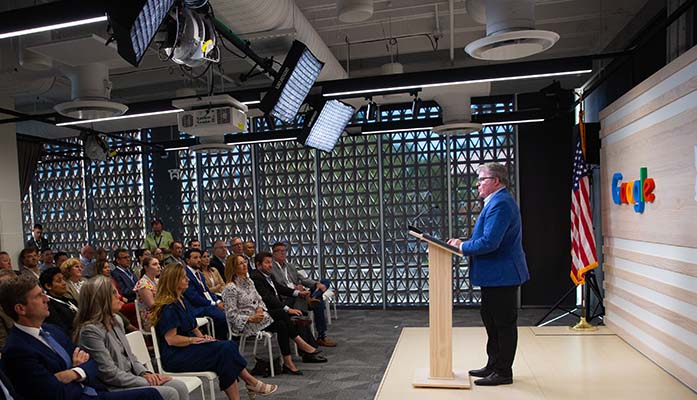
Last week, Google unleashed a significant announcement, revealing that it would soon be constructing a $600 million data center in Mesa, marking the first time the company has put down physical roots in Arizona.
Governor Katie Hobbs, who attended the event with Google executives and other local leaders, issued the following statement to commemorate the news for her state: “Google’s investment in Arizona will be critical for the Mesa community and our state’s economy. Arizona continues to attract global technology leaders due to our skilled workforce, dynamic economy and focus on innovation. We are proud to welcome Google to Arizona and look forward to the many opportunities this partnership will bring.”
Mesa Mayor John Giles added, “The City of Mesa is thrilled to welcome Google to our community. Google’s decision to designate Mesa as the home for its first facility in Arizona underscores its profound confidence in our city and residents.”
According to a release published by the City of Mesa, “the new Mesa data center will help power popular digital services – like Google Search, Gmail, Maps, Google Cloud, and others – for people and organizations worldwide.”
The Vice President for Google’s Data Centers, Joe Kava, said, “We are proud to put down roots in Arizona with both the data center in Mesa and the Phoenix cloud region. Not only do data centers help keep digital services up and running for people and businesses, they are economic anchors in the communities where we operate. We are appreciative of the continued partnership with the local leadership across the state.”
In addition to the multi-million-dollar infrastructure project, Google revealed that the Phoenix area would soon be welcoming “a new Google Cloud region to complement its existing network of regions around the world, bringing Google Cloud technologies closer to local customers – ranging from small, medium and large businesses to public sector entities and other organizations – to help them deliver digital services to their own users more reliably and at higher speeds.”
The Arizona Governor’s Office stated that “Google’s Mesa facility is the first data center in the United States to use zero-water cooling and has announced plans to be completely carbon-free and pursue net-zero emissions across its operations by 2030.”
Per an internal economic report, Google “helped provide $11.43 billion of economic activity for tens of thousands of Arizona businesses, publishers, nonprofits, creators and developers in 2022,” and “more than 367,000 Arizona businesses used Google’s free tools to receive phone calls, bookings, reviews, requests for directions and other direct connections to their customers.” Google also “provided $15.55 million of free search advertising to Arizona nonprofits through the Google Ad Grants program in 2022.”
Daniel Stefanski is a reporter for AZ Free News. You can send him news tips using this link.
by Corinne Murdock | Sep 11, 2023 | Education, News
By Corinne Murdock |
Mesa Public Schools (MPS) board member and National Association for the Advancement of Colored People (NAACP) East Valley chapter president Kiana Sears says more discussions about race need to occur.
Sears issued the remarks in an interview with The Mesa Tribune regarding the recent Supreme Court decision effectively ending the practice of affirmative action in college admissions. Sears advocated for the use of equity in policy, rather than equality, to make up for systemic racial inequalities. She acknowledged that people may have the same capabilities, but that circumstances should be mitigated to equalize outcomes.
“There is a local angst about the [ruling], especially in the climate where you have seen,” said Sears. “There’s no difference in the capacity of people to learn and to grow and to actually learn[,] but you have unnatural and man-made barriers and institutional barriers that make it harder for some people.”
According to Sears, avoidance of prioritizing race in conversations is due in part to the demonization of Critical Race Theory (CRT) and related concepts like “inclusivity.” Upon taking office in January, Arizona Department of Education (ADE) Superintendent Tom Horne disavowed the presence of CRT in schools and launched a hotline for parents to report inappropriate lessons on racial, gender-based, sexual, and social and emotional ideologies.
Over the summer, ADE reported receiving numerous valid complaints of inappropriate materials at schools, including MPS. Horne reported at the time that MPS was working with ADE to resolve the complaint.
“A teacher reported through the hotline that the Mesa school district has a training program for teachers that clearly states that certain Americans are ‘living under a system of white supremacy.’ That is a divisive and bigoted statement that has no place in education,” said Horne. “We are individuals, entitled to be judged by what we know, what we can do, our character, and not the color of our skin.”
During this most recent interview, Sears accused the hotline of creating a climate of “fear and intimidation.”
Sears also implied that race-conscious interactions and practices result in a greater good for everyone.
“[It’s important] to make sure if we have a population that is not doing as well, for whatever reason, we remove those barriers,” said Sears. “We know we’re as strong as our weakest link. No matter who, what, when, why, let’s remove all of those barriers.”
Sears was twice chosen as the MPS representative to attend the National School Boards Association (NSBA). MPS opted to remain with NSBA despite the national controversy over their 2021 letter to President Joe Biden requesting a federal investigation into parents attending school board meetings.
In addition to attending the NSBA events, Sears was elected the secretary/treasurer of NSBA’s National Black Council of School Board Members Board of Directors. Two other Arizonans serve on that board: chair Devin Del Palacio with the Tolleson Union High School District, and regional director Lindsay Love with Chandler Unified School District.
Following the SCOTUS decision, Sears’ NAACP branch held an event, “Affirming Black Brilliance,” to discuss strategies for ensuring racial equity in education. It appears that Sears runs the publicity for the branch as well, since she is the only point of contact for all press, media, and public comment requests.
Sears became the NAACP branch president in 2021. Last January, STN featured Sears for her roles as an NAACP president and MPS governing board member. Similarly to her recent call to action, Sears called for a greater focus on race.
Arizona List, a committee for pro-abortion Democratic women, endorses Sears in her role as an MPS Governing Board member.
In addition to her role as an NAACP president and MPS board member, Sears serves as the program director for Arizona State University (ASU) Faith Based Outreach and Community Partnerships.
Sears was the 2018 Democratic nominee for the Arizona Corporation Commission (ACC). The Arizona Attorney General’s Office launched and later dropped an investigation into Sears for failing to disclose dormant businesses when she launched her campaign, upon a referral by the Secretary of State’s Office. Sears said at the time that these were name-only businesses, meaning she and her husband filed for business names to reserve them with the intent to one day turn them into actual businesses.
Last year, Sears’ campaign was again mired in controversy. Sears faced bribery accusations for her hire of former Democratic State Rep. and Minority Leader Reginald Bolding, through his political consulting firm “Blue Wave Victory.” Sears paid Bolding’s company over $18,000 in a contract that Bolding’s then-opponent, now-Secretary of State Adrian Fontes, alleged was influence peddling.
Bolding managed the firm alongside the former first vice chair for the Arizona Democratic Party and former congressional candidate, Jevin Hodge, to provide services for Sears’ campaign. In a complaint letter to former Attorney General Mark Brnovich, Fontes’ campaign accused Bolding and Hodge of having “sold their positions as a means of access to others in exchange for monetary gain.”
As Fontes’ letter noted, Bolding’s political consulting firm operated out of the same building and suite as his controversial nonprofits.
Corinne Murdock is a reporter for AZ Free News. Follow her latest on Twitter, or email tips to corinne@azfreenews.com.
by Daniel Stefanski | Aug 14, 2023 | News
By Daniel Stefanski |
A Mesa, Arizona native is being highlighted by the U.S. Navy for his service.
The Navy Office of Community Outreach recently published a story, featuring Mesa’s Rylan Sweigart, a Petty Officer 3rd Class. Sweigart graduated from Desert Ridge High School in 2020 and has spent three years (so far) in the Navy. He is an electronic’s technician on the USS Charlotte – a submarine. Sweigart’s job aboard the submarine makes him part of an exclusive class of Navy personnel – only ten percent of Navy personnel are submariners.
This nuclear-powered attack submarine is the fourth “Charlotte” to be christened with that name in American history. It was commissioned in September 1994 and is based out of Pearl Harbor, Hawaii.
Sweigart’s father also served in the Navy, and he credits his parents for instilling values and characteristics vital for his future success. He said, “I learned in school how to study well and my parents taught me professionalism. My dad was previously in the Navy and he taught me a lot as well.”
The Petty Officer 3rd Class enlisted with his brother – an action he points to as key to his start: “I would like to thank my parents and my brother for helping me in my Navy career. I joined with my brother and it made the process of joining easier.”
Sweigart will undoubtedly gain more experience as he serves in the Navy, but he has already accomplished feats that make him proud of what he has come through to reach this point in his career. He told the Navy Office of Community Outreach, “My proudest accomplishment would be receiving my submarine qualifications, also known as ‘dolphins.’ It provided that I know the systems on the boat and I can be trusted in tough situations.”
The Mesa native is laser focused on his mission and his service to his nation, saying, “The Navy contributes to national security because our presence at sea deters our adversaries and provides access to free trade and safety on our shores.”
According to the Navy Office of Community Outreach, “strategic deterrence is the nation’s ultimate insurance program; and as a member of the submarine force, Sweigart is part of a rich history of the U.S. Navy’s most versatile weapons platform, capable of taking the fight to the enemy in defense of America and its allies.”
Admiral Mike Gilday, Chief of Naval Operations, also weighed in for the story, adding, “Our mission remains timeless – to provide our fellow citizens with nothing less than the very best Navy: fully combat ready at all times, focused on warfighting excellence, and committed to superior leadership at every single level. This is our calling. And I cannot imagine a calling more worthy.”
Daniel Stefanski is a reporter for AZ Free News. You can send him news tips using this link.
by Corinne Murdock | Jul 26, 2023 | News
By Corinne Murdock |
More of Arizona’s municipalities are increasing their water conservation efforts, leading taxpayers to pay more for less.
Preexisting sustainability goals and the burgeoning Colorado River drought have offered justification for these municipalities’ efforts, which have now resulted in lawn bans, increased water rates, and restricted water usage over the last few years.
Multiple cities recently traded in their Colorado River water rights in exchange for federal funding: Tucson, Phoenix, Peoria, Glendale, Scottsdale, Gilbert, Mesa, Surprise, Queen Creek, along with the state, Apache Junction Domestic Water Improvement District, Central Arizona Groundwater Replenishment District, Metropolitan Domestic Water Improvement District in Tucson, Salt River Project, and EPCOR.
Last month, Gov. Katie Hobbs announced the Arizona Department of Water Resources (ADWR) ban on the construction of new Phoenix homes that would rely on groundwater.
These progressive restrictions and charges also continue despite noted successes in conservation in comparison to past years with smaller populations.
The answer may lie with other developments in the state over the years. Big Tech’s data centers may be one of the major drains on water supply outweighing the net savings of residents’ water conservation efforts.
Mesa
In comparison to the other cities, Mesa doesn’t impose major water conservation restrictions. It does offer $1,000 in rebates for grass removal, with an additional $100 maximum for planting native trees.
However, the city may be contributing to the water burdens faced by its neighbors. In 2019, it approved the development of a data center for Google that could use one to four million gallons of water daily. Arizona residents average about 146 gallons daily currently.
Yet, as Time pointed out, Arizona Municipal Water Users Association (AMUA) — an organization that Mesa helped found — chastised Arizona residents several weeks after the deal between Mesa and Google for using 120 gallons on average daily.
Meta (formerly Facebook, which also owns Instagram) is now building a data center there as well. The year they broke ground in Arizona, they promised to be “water positive” — meaning, restoring more water than they consume — by 2030.
Like Google centers, data centers could use around one to five million gallons of water a day according to Texas Tech University’s Water Resources Center director, Venkatesh Uddameri.
Microsoft also operates data centers out of El Mirage and Goodyear. They made the same promise to be water positive by 2030.
Over 30 percent of the world’s data centers are located in the U.S.
Scottsdale
Scottsdale banned lawns on new builds earlier this month.
The city also offers to pay residents up to $5,000 for lawn removals, and up to $1 per square foot of water surface area plus $400 for pool or spa removals. For multifamily properties, homeowner associations (HOAs), and commercial businesses, the city offered up to $40,000 to remove their lawns, with an additional $10,000 bonus for grass strips adjacent to streets.
Since Scottsdale launched its rebate program in 1992, total rebates amounted to over $4.7 million; about half of which came from grass removals. The city has removed 94 acres of grass since the program’s launch. This fiscal year’s rebate budget sits at $450,000.
Last September, Scottsdale banned HOAs from requiring overseeding lawns.
Residents surpassed the city’s goal of 10 percent water conservation, achieving 12 percent over the last two years.
Tucson
Last month, Tucson banned lawns and reduced water flow in new constructions. The city also required all new residential dwelling units to include piping for a separate discharge of gray water for direct irrigation: the untreated, leftover water from washing machines, bathtubs, and sinks.
In 2008, Tucson required all commercial development and site plans to include a rainwater harvesting plan that provided for 50 percent of the annual landscape water supply.
In 2014, Tucson passed a water waste ordinance fining individuals $250 on the first offense and $500 on subsequent offenses up to $2,500 for allowing water to escape or pool onto public property; washing driveways, sidewalks, parking areas with a hose (unless a residential customer); operating a misting system in unoccupied non-residential areas; having an irrigation head or emitter that’s broken or spraying more than 10 percent onto a street, parking lot, or sidewalk; failing to control a leak; and failing to meet the 50 percent rainwater harvesting requirement for landscape irrigation.
Tucson also offers multiple rebates: $100 per residential, multi-family, or commercial premium high-efficiency toilet; $150 for a flushometer valve/bowl combination; $200 for high-efficiency or water-free urinal installation; $100 or $200 for a residential high-efficiency clothes washer; up to $2,000 for a residential rainwater harvesting system; and up to $1,000 for a gray water system. The city also offers special incentives for low-income residents: free high-efficiency toilets, grants up to $1,000 and loans up to $2,000 for a rainwater harvesting system, grants and loans up to $500 for a gray water harvesting system, discounted high-efficiency clothes washers, and free plumbing repairs.
Each year, Tucson makes available up to $250,000 in grant money to establish stormwater harvesting in neighborhoods.
Phoenix
Last month, the Phoenix City Council approved the Sustainable Desert Development Policy, requiring rezoning cases on new developments to satisfy city-approved standards on EPA WaterSense efficiency certifications; drought tolerant and/or native landscaping; restrictions on turf usage; outdoor irrigation efficiency standards; green infrastructure or low-impact development provisions for surface parking areas, streets, and sidewalks; participation in the city’s Efficiency Checkup program; new swimming pool standards; new wet-cooling system standards; and preservation of natural open spaces.
Additionally, the policy will require any entities that use over 250,000 gallons of water per day to submit a water conservation plan, approved by city staff. Any entities that use over 500,000 gallons of water per day must derive 30 percent of their water consumption from a recycled or conserved water source.
Entities dubbed “large water users,” may be denied operation even if their conservation plan is acceptable to the city. The policy stated that the city may reject the large water user if there’s inadequate water resource availability in their proposed location, inconsistency with the city’s planning documents; undesirable economic value and impact of their proposed water use; undesirable impact to water rates; or incompatibility with the city’s definition of a key industry beneficial to the economy.
The city doesn’t offer any rebate programs, though last December city officials expressed a desire to launch one to incentivize lawn removals. The city signed a joint pledge between locales in California and Nevada to remove ornamental turf.
The city also imposes an ordinance onto new developers, the Water Resources Acquisition Fee (WRAF) ordinance, which may be mitigated via credit if the developer provides a permanent reduction in annual water demand on the city.
The city has promised that it won’t institute mandatory water use restrictions in the near future, though it warned that severe or worsening drought conditions within the next 10-15 years may warrant such restrictions. Policy changes could include water waste punishments similar to Tucson’s, requiring child safe pool covers to reduce evaporation, banning turf irrigation, and banning car washing.
Flagstaff
Flagstaff has stricter water use requirements than some of the other Arizona cities.
The city has a watering allowance schedule during which residents may water their landscape: even-numbered addresses on Sundays, Wednesdays, and Fridays, and odd-numbered addresses on Tuesdays, Thursdays, and Saturdays. Nobody may water on Mondays, and the city prohibits watering between 9 am and 5 pm. Gardeners wishing to water by hand — “incidental hand watering” — may do so on any day, except from 9 am to 5 pm. However, vehicle washing is not subject to the water schedule restrictions.
The schedule is only permitted to be used when the city is at the first stages of burdened water demand. At level two, the city bans irrigation; car washing at home; driveway, sidewalk, and tennis court washing; filling of fountains, ponds, streams, or pools over 100 gallons. The city also increases water rates for those using over 6,400 gallons, and potable standpipe rates increase by 130 percent. At level three, potable water use is banned outside.
Those who violate the rules within any of the three levels are subject to fines starting at $25, doubling with each violation.
The city implements a diverse set of rebate programs. Commercial properties may receive free high-efficiency sink aerators, free high-efficiency shower heads, free pre-rinse spray valves, $86 rebate or 50 percent of project cost for commercial toilets, $158 or 50 percent of project cost for hotel toilets; and $157 or 50 percent of the project cost for commercial urinals.
Both residential and commercial properties may receive a rebate at 25 cents per square foot for converting to low-water landscaping. They may also receive a $100 rebate on installation of a rainwater harvesting system with 1000-gallon minimum capacity, and free 55-gallon rainwater harvesting barrels.
The city reported that their conservation efforts, beginning in 1988, have yielded a 50 percent water use reduction.
Gilbert
The town of Gilbert is offering up to $800 to residents and up to $3,000 to non-residential customers who swap their lawns for desert landscaping that uses less water. The city set aside $60,000 for the residential program, and $15,000 for the non-residential program.
A Gilbert spokesperson told AZ Free News that they have a total of $120,000 per year to issue on their rebate programs, and that the allocated funding within that budget may change from year to year based on the popularity of each program.
Anyone who receives $600 or more in water bill credits must complete a W9 for the Gilbert Water Conservation, as per the Biden administration IRS reporting requirement enacted last year.
Those aren’t the only water conservation financial incentives that Gilbert has offered. The town introduced rebates up to $250 for residential, $400 for non-residential properties to install smart irrigation controllers.
In May, the town applied for a $3 million grant from the Water Conservation Fund to replace grass on government property with desert-tolerant landscaping. The grant money ultimately comes from federal COVID-19 relief funds.
Gilbert announced that it saved 254 million gallons due to its conservation efforts in 2019, and 375 million in 2018.
Corinne Murdock is a reporter for AZ Free News. Follow her latest on Twitter, or email tips to corinne@azfreenews.com.