by Terri Jo Neff | Jan 9, 2022 | Economy, News
By Terri Jo Neff |
When all of the investment income earned by Maricopa County residents is combined, the county ranks #13 in the United States with an Investment Index of 26.48. By comparison, Pima County ranked 79th in the nation with an Investment Index of 4.93.
That’s the findings of SmartAsset, which used data sourced from the Internal Revenue Service’s Statistics of Income County Data to compare the 3,006 counties in the U.S. on three metrics: Net Capital Gains, Ordinary Dividends, and Qualified Dividends*. The rankings are based on countywide totals without a per capita adjustment.
“We calculated an Investment Index for all U.S. counties based on a combination of these three statistics and ranked them accordingly to provide a holistic view of what areas of the U.S. are generating the most investment income,” SmartAsset announced Friday.
The Top 10 counties by Investment Income are:
New York County (NY), Investment Index of 100.00
Los Angeles County (CA), Investment Index of 80.03
Cook County (IL), Investment Index of 57.25
Palm Beach County (FL), Investment Index of 45.24
Santa Clara County (CA), Investment Index of 44.64
King County (WA), Investment Index of 41.81
Harris County (TX), Investment Index of 34.25
San Francisco County (CA), Investment Index of 31.78
Miami-Dade County (FL), Investment Index of 30.17
Orange County (CA), Investment Index of 30.11
*Ordinary Dividends are payments made by a company to their shareholders and are taxed as regular income, whereas Qualified Dividends are dividends that meet certain requirements set by the IRS and are taxed at a lower capital gains tax rate. Net Capital Gains refers to the amount an asset has increased or decreased in value realized when the asset is sold.
A nationwide map is available at https://smartasset.com/investing/capital-gains-tax-calculator?year=2021#us
by Terri Jo Neff | Jan 2, 2022 | News
By Terri Jo Neff |
A Maricopa County company that pays back taxes on properties across Arizona in hopes of one day securing deeds to the properties is asking the Arizona Supreme Court to restore its deed to a commercial property in Nogales.
It is estimated more than 2,000 investors hold nearly 90,000 back tax liens in Arizona. In Maricopa County alone, tax liens could be issued for more than 10,000 parcels during the county’s next auction on Feb. 8, 2022.
By law, Arizona property taxes have the highest lien priority, and about 98 percent of liens are eventually paid off by property owners within the three-year redemption period. But sometimes an investor is able to go through the lengthy legal process to foreclose on a property and obtain the deed.
That is what Advanced Property Tax Liens Inc. did in 2019 on a tax lien it obtained from the Santa Cruz County Treasurer’s Office in February 2015 for a commercial property in Nogales. Now, the company is hoping the Arizona Supreme Court will reverse a local judge’s ruling which voided the deed issued to APTL when the property owner did not redeem the tax lien.
Court records show the material facts of the APTL case are undisputed, such as the verbal agreement between Victalina Carreon and Jorge Othon in late 2014 or early 2015 for Othon to purchase a vacant building Carreon owned in Nogales. The property’s purchase price was $450,000 minus an amount Carreon owed for unpaid property taxes.
The sales agreement was never put into writing, but Othon made payments to Carreon using money “on which he had avoided paying taxes,” according to court records. Soon after the commercial property was “a fully occupied commercial property” with normal business hours, according to court records.
But Carreon never applied any of Othon’s payments to the delinquent property taxes. As a result, APTL purchased a tax lien on the property during a February 2015 auction by Santa Cruz County and paid the outstanding property taxes and accrued interest.
Fast forward to September 2017 when Othon finished paying Carreon and received a notarized deed listing himself as the new property owner. He chose to not record the deed with the Santa Cruz County Recorder, nor did he inform the county’s assessor or treasurer of his ownership of the property. Othon also failed to provide county officials a mailing address for tax bills or valuation notices.
Instead, Othon allowed the property to remain in Carreon’s name.
In January 2018, and with the three-year tax lien redemption period near expiration, APTL mailed Carreon two notices that the company intended to foreclose on its 2015 tax lien. The 30-day notices, one mailed to the physical address of the commercial property and one to Carreon’s last known residence, were returned by the U.S. Postal Service as unclaimed.
Eventually APTL filed a foreclosure action in Santa Cruz County Superior Court naming Carreon as the property owner. A process server hired by APTL attested that service was attempted at Carreon’s last known address, an empty residence.
With no forwarding address from the post office, APTL published a notice of its tax lien foreclosure action in a Nogales newspaper. The company then filed a court notice in December 2018 allegedly Carreon had been properly served via the newspaper and had failed to answer.
A default judgment was entered by the court against Carreon, allowing the county to issue a treasurer’s deed conveying the Nogales property to APTL in March 2019. The company immediately recorded the deed as the new owner, but there was a sticking point – Othon and his 2017 unrecorded deed.
APTL filed a complaint for quiet title of the property while Othon filed a counterclaim seeking to void the treasurer’s deed and have his deed from Carreon recorded. In the end, Judge Denneen Peterson voided the default judgment but not because of Othon.
Instead, she ruled APTL failed to adequately comply with state law when notifying Carreon, as the property owner of record, that the company intended to pursue foreclosure of the 2015 tax lien. APTL attempted to serve the notices on particular addresses instead of a specific person as required by state law, Peterson ruled.
The judge’s ruling voiding APTL’s deed to the property was recently affirmed by the Arizona Court of Appeals. The appellate opinion described APTL’s deficiency:
“After both notices were returned unopened and unclaimed, APTL never approached personnel at the Property—the situs address—or at neighboring buildings to seek additional information regarding Carreon’s whereabouts,” the opinion states.
Now the company has filed a petition for review to the Arizona Supreme Court.
It could be weeks or months before the Arizona Supreme Court decides whether to consider APTL’s petition for review. If Peterson’s ruling holds up, APT still owns the original 2015 tax lien and can begin the process again to assert its interest.
by AZ Free Enterprise Club | Nov 17, 2021 | Opinion
By the Arizona Free Enterprise Club |
People are fed up. And parents, in particular, are frustrated with school boards across the state. Now, they are starting to speak up. But it’s not just with their voices at local school board meetings. Last week, they spoke up at the ballot box.
Across Maricopa County, multiple bond and override elections were held affecting various school districts. And in a year that didn’t include a midterm or presidential election, you would expect a low-turnout election like this one to benefit the funding proponents.
But the results were very telling.
Most of the bonds and overrides affecting school districts in suburban areas failed. And in many cases, they weren’t even close.
Override continuations were voted down in the Buckeye, Agua Fria, Liberty, and Litchfield school districts while bonds went unapproved in the Higley, Cave Creek, and Queen Creek school districts. A budget increase for the school district in Fountain Hills also failed.
The only suburban areas that were exceptions were Kyrene and Chandler. This must have the left in a tizzy.
>>> CONTINUE READING >>>
by Corinne Murdock | Oct 13, 2021 | News
By Corinne Murdock |
Several more Arizona voters have come forward to AZ Free News to report they’ve been receiving ballots for voters that should’ve been removed from the rolls years ago – in at least one case, several decades. This report is not to say that this is a widespread issue, but to reflect the fact that AZ Free News has received more reports of this issue from concerned voters.
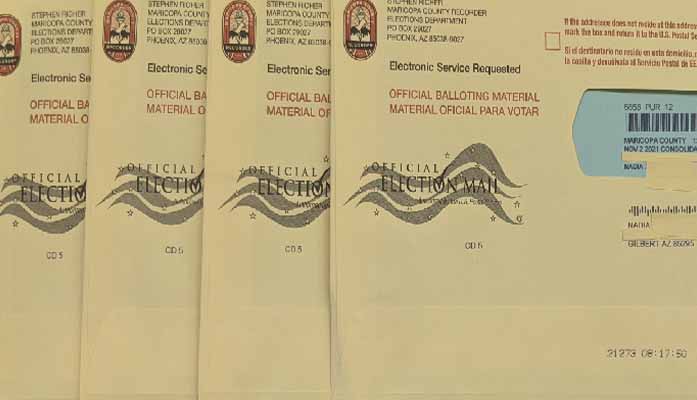
One voter, Christine Accurso, told AZ Free News that her cousin, Nadia, had moved from her residence to Kuwait a decade ago. Despite her and Nadia both telling Maricopa County for years that Nadia no longer resides in Arizona, the county has continued to send ballots in Nadia’s name to Accurso’s address. Now, Accurso has another ballot for her cousin for Maricopa County’s jurisdictional elections.
The struggles began several years after Maricopa County purportedly removed Nadia from the voter rolls in 2011 at Nadia’s request. As expected, no ballots arrived for Nadia in the 2012 and 2014 election cycles. (However: even if the county had neglected to remove Nadia from their voter rolls initially, Accurso added that Nadia wouldn’t have gotten a mail-in ballot. Nadia had only ever voted in person, and confirmed with Accurso that she’d never signed up for the Permanent Early Voting List (PEVL) or any opt-ins to receive her ballot by mail.)
Then in 2016, Accurso said that she received a mail-in ballot for her cousin. They both contacted the Maricopa County Recorder’s Office. At first, they were relieved to hear from the office that Nadia would be removed immediately. Then 2018 came – and with it, another ballot for Nadia.
“The weirder thing is that we didn’t get [ballots] in 2012 or 2014 – for those other elections we didn’t get one for her. Then all of a sudden in 2016 we got one,” said Accurso. “The thing that bothers me the most is the fact that [Maricopa County has] been told multiple times [to remove her], and we’ve called and confirmed multiple times [that she was removed]. Then this year I got another one. Something is just wrong.”
AZ Free News was also informed that another individual received a ballot in 2020 for her husband, who’d been deceased for 20 years. That was the first year the deceased individual received a ballot, and for some of the family members it reportedly opened up old wounds connected to the loss.
Yet another concerned voter told AZ Free News that she received ballots for her son in 2018 and 2020 – despite the fact that he moved out of the state in 2017. She marked and returned the ballots to Maricopa County election officials both times to indicate that he no longer lived there.
“I haven’t checked [this year] to see if he still hasn’t been taken off of the [registered voter] list,” explained the voter. “I just remember thinking – how easy to cheat!”
Corinne Murdock is a reporter for AZ Free News. Follow her latest on Twitter, or email tips to corinne@azfreenews.com.
*Correction – An earlier version of this article incorrectly listed Accurso’s cousin as her sister.
by Corinne Murdock | Oct 11, 2021 | News
By Corinne Murdock |
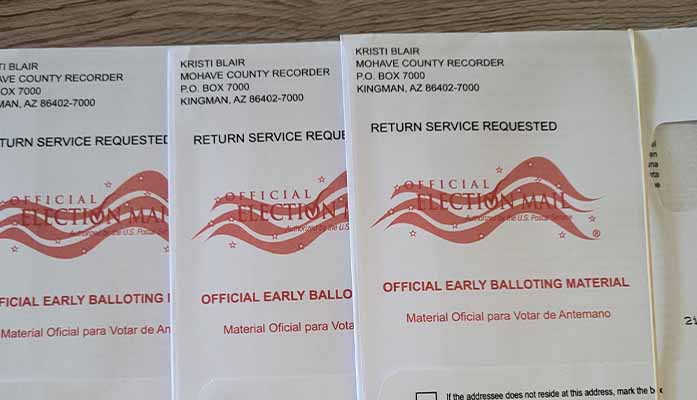
Voters are reporting on social media that they’ve received multiple ballots with different names at their address. This is not to say that these issues have been widespread, but that there are instances of voters receiving three to four different ballots addressed to different individuals.
One Maricopa County voter, Anthony Massara, told the Arizona Daily Independent that he’s received mail for multiple different voters since 2017, despite notifying the post office that none of the voters lived there. This year, the multiple misaddressed ballots he received were for a special election in Scottsdale.
State Representative Leo Biasiucci (R-Lake Havasu City) tweeted pictures of those ballots after Massara reached out to him.
“So the Arizona Secretary of State and Dems say our elections are secure,” wrote Biasiucci. “Here are 3 ballots showing up to a home in Scottsdale, Arizona that has had the same single owner for 5 years. None of those names below are his.”
The state legislature recently passed a law further refining process for resolving ballots addressed incorrectly. Voters may now check a box on a flawed ballot to reflect that the addressee doesn’t reside at their address, and then mail it back to the U.S. Postal Service (USPS).
Then, USPS should return the ballot to the recorder’s office of the affiliated county. At that point, the county recorder would notify the voter that the address they’d listed was incorrect, and offer them 35 days to respond.
If the voter doesn’t respond after 35 days, their voter file would be marked “inactive” and no early ballots would be mailed to that voter until they update their registration. If the voter doesn’t update their registration after two federal election cycles, then they are removed from the voter rolls.
A Mohave County voter, Sherrie Row, tweeted that her daughter received two ballots in addition to hers.
“Arizona is just handing out ballets. Only one of these people live here. And mine isn’t one of these. My democratic daughter got hers +2,” wrote Row.
The Arizona Senate’s Cyber Ninjas-led audit discovered over 23,300 ballots that were voted on from a prior address, according to their report last month. Maricopa County explained that these numbers likely included those that may have cast a “federal only ballot,” those who recently moved, or those who requested a temporary address.
“EXPLANATION: 1) Military and overseas voters can cast a ‘federal only ballot’ despite living outside the U.S. The address tied to their ballot would be their prior address in AZ. 2) People are allowed to move from one house to another (or even one state to another) in October and November of an election year (yes, shocking!). If the driver’s license address matches the voter registration address, they are still allowed to vote. 3) For the November General Election Maricopa County had 20,933 one-time temporary address requests. In addition, snowbirds and college students tend to have forwarding addresses when they are out of the county. 4) Mail-in ballots are not forwarded to another address.”
Corinne Murdock is a reporter for AZ Free News. Follow her latest on Twitter, or email tips to corinne@azfreenews.com.