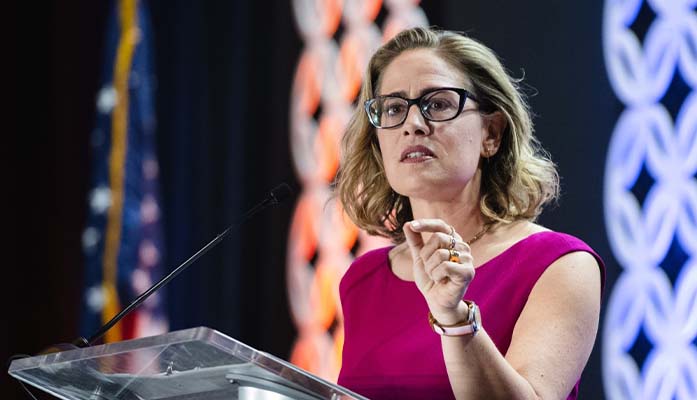
Former U.S. Sen. Kyrsten Sinema told Arizona business and political leaders she voted for Republican congressional candidate Jay Feely in the primary.
Citing two people present for the conversations, Axios reported that Sinema described Feely as “commonsense” and a “fiscal conservative.” The outlet said the discussions occurred during informal meetings over the preceding month and that Sinema indicated she was likely to support him in November.
According to one source cited by Axios, Sinema indicated that she viewed Feely as the best person to help address Arizona’s water crisis, including cutbacks to the state’s share of the Colorado River.
Feely, a former NFL kicker backed by President Donald Trump, faces Democrat Amish Shah in Arizona’s First Congressional District. The seat is open following Republican Rep. David Schweikert’s unsuccessful bid for governor. Shah, an emergency physician, defeated Marlene Galán-Woods for the Democratic nomination.
The National Republican Congressional Committee (NRCC) highlighted the Sinema report, arguing that her reported support strengthens Feely’s appeal to voters who split their tickets. The committee also noted that former Republican Gov. Doug Ducey had endorsed Feely.
“Arizonans of all parties trust Jay Feely to fight for lower taxes, a stronger Valley economy and protecting our water,” NRCC spokesman Ben Petersen said. “In stark contrast, Socialist Amish Shah vowed to raise taxes an average of over $4,000 and impose socialized government health care while reopening the border and going easy on sex offenders.”
Sinema announced her departure from the Democratic Party on Dec. 9, 2022. She subsequently received her seniority and committee assignments through the Democratic Conference for purposes of organizing the Senate, while declining to participate in either party’s caucus.
Scoop: Sinema quietly boosting Republican Jay Feely for Arizona House seat https://t.co/mgTLdZM6Hs
Arizona permits voters registered as independent or without a party designation to select a recognized political party’s ballot in state primary elections. Participating in the Republican primary therefore does not, by itself, establish that a voter has registered as a Republican.
The congressional contest has included disagreements over water use and economic development. Shah criticized Feely’s support for data centers while citing Arizona’s drought and potential Colorado River reductions. His campaign said he opposes building the facilities within the First Congressional District because of water shortages and utility costs.
During his legislative service, Shah supported a 2021 measure extending Arizona’s data center tax incentive application deadline and a 2023 measure addressing the program’s refund provisions. Feely has defended data center development as important to American competitiveness in artificial intelligence, while calling for developers to address water and electricity demands through measures including recirculated water and off-grid operation.
Former U.S. Senator Kyrsten Sinema revealed more details into her affair with a married veteran who had been her bodyguard while in office.
A new narrative of the affair was made available through depositions filed in the ongoing lawsuit initiated by the bodyguard’s ex-wife under North Carolina’s homewrecker law, which enables an individual to sue the person they believe to be the cause of their divorce.
Matthew Ammel (Ammel), Sinema’s former bodyguard, had been married to the plaintiff, Heather Ammel (Heather), for 14 years. The Ammels had three children together. Ammel began working for Sinema in the spring of 2022.
Sinema admitted in her July 31 deposition that despite knowing Ammel was married with children, she and Ammel had sex for the first time on May 27, 2024, while on a Memorial Day trip in Napa, California. Prior to that date, Sinema denied having ever flirted with him, let alone held or touched him in any way that could be considered romantic in nature.
The former senator is seeking to dismiss the lawsuit on the claim that the affair never took place in North Carolina, physically or electronically.
At one point in Sinema’s deposition, evidence was discussed which reflected that Sinema’s phone registered her location in Southern Pines, North Carolina, when she called Ammel on the afternoon of Nov. 1, 2024. Sinema denied having been in that location on that date and insisted that she was in New York City.
Both Ammel and Sinema admitted to their affair occurring in Arizona, Washington, D.C., and other states — including New York and Colorado — but not North Carolina.
Heather admitted in her deposition that she possessed no evidence that Ammel and Sinema engaged in their affair in North Carolina, and that she didn’t believe they had a sexual encounter in the state. However, Heather stated that she didn’t acquire a computer forensics expert to investigate if there was anything deleted or hidden that would prove otherwise.
According to the latest court filings, Sinema and Ammel often communicated through Signal, an encrypted messaging app which allows for automatic message deletion according to user settings. Ammel stated in his deposition that their messages were deleted after eight hours.
Sinema denied that she caused or directed the Signal messages to be deleted, automatically or manually.
However, Heather testified in her deposition that Ammel and Sinema’s messages weren’t set to auto-delete prior to the discovery of their affair.
Ammel claimed in his deposition that he was a victim of “domestic abuse violence,” and that was the reason for initiating his affair with Sinema and later separating from his wife. Despite conflicting testimony from his ex-wife, Ammel denies continuing his relationship with her following their separation date in October 2024.
Ammel also disclosed in his deposition — which he took from “his home office” in a house in Arizona where Sinema was also present — that prior to sitting down for questions, he and Sinema had prayed together beforehand. Ammel testified that he presently works as a “cowboy” at Cross Creek Ranch in San Luis Obispo, California.
AZ Free News is your #1 source for Arizona news and politics. You can send us news tips using this link.
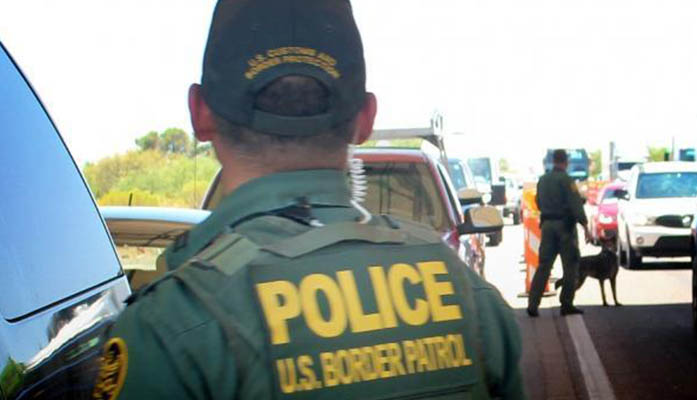
The federal government says delays are bound to occur with impending construction on Arizona’s second-busiest border entry point.
The 16-acre San Luis I Land Port of Entry, established in 1984, will undergo another series of renovations beginning June 20 to improve its operations and infrastructure. Construction on this leg of the project will last approximately four to five months per Customs and Border Protection (CBP).
The forthcoming construction is part of a greater $356 million expansion and modernization project which pledges to make San Luis I Land Port of Entry an “eco-friendly gateway” as the “first fully electric, net-zero energy land port of entry” in the country. Construction work on the port of entry began in 2023 and is scheduled to conclude in the spring of 2029.
The port expansion and modernization project was announced in 2024 under former President Joe Biden as a major “green expansion” initiative for his Investing in America agenda. Nearly $100 million of the total project funding came from the Inflation Reduction Act (IRA) subsidies for “low-embodied carbon construction materials and emerging and sustainable technologies.”
IRA funds also went to 37 other land port of entry projects. Sen. Mark Kelly (D-AZ) and former Sen. Kyrsten Sinema (I-AZ) both endorsed the project and its net-zero approach.
The IRA appropriated $3.4 billion for GSA to institute net-zero emissions infrastructure reforms in federal facilities across America by 2045.
The General Services Administration (GSA) has stated in its public project summary for the port of entry that the current infrastructure has proven inadequate to handle traffic volumes and CBP mission requirements.
“The modernization and expansion project will improve efficiencies and traffic flows, reduce wait times, increase CBP processing capacity and operational security by effectively deploying the latest technology to identify high risk activity and shipments and combat drug trafficking,” stated the GSA.
In March, the GSA announced the San Luis I Land Port of Entry opened 16 new northbound vehicle lanes, doubling the previous capacity, covered with two shade canopies spanning 16,000 square feet.
The expansion and modernization project also includes a secondary vehicle processing area, additional pedestrian inspection lanes, and a new administrative facility. It further expands southbound privately owned vehicle operations with upgraded primary and secondary inspection and processing buildings, as well as expanded employee parking.
Last July, the Office of the Inspector General notified the GSA that contractors who hadn’t undergone the required security screening had worked on the port of entry expansion and modernization project.
Travelers seeking passage through the San Luis I Land Port of Entry should review border wait times on the CBP website or the mobile app, Border Wait Times.
The San Luis I Land Port of Entry encounters three million drivers and 2.5 million pedestrians annually, per GSA data.
The GSA awarded the design-build contract for the expansion and modernization effort to Hensel Phelps Construction Company in 2022, which is based out of Colorado and one of the biggest general contractors and construction managers nationwide.
Community stakeholder and civic leader briefings on the port of entry occurred in the spring of 2024.
AZ Free News is your #1 source for Arizona news and politics. You can send us news tips using this link.
Kyrsten Sinema admitted to the allegations of an affair with her security personnel, per a new court filing.
However, the former senator says she shouldn’t be held accountable in court on the technicality that the affair didn’t occur in the state where the wife lived.
The filing was first reported on by Brian Anderson of FOIAzona.
The former senator faces a “homewrecker” lawsuit in North Carolina for her affair with Army veteran Matthew Joseph Ammel (Ammel) filed by his estranged wife Heather Ammel — Ammel v. Sinema.
North Carolina allows the victim of a marital affair to sue the individual who engaged in the affair with their spouse. The Ammels were married for 14 years and had three children prior to their separation.
Sinema believes the lawsuit no longer has grounds since she and Ammel conducted their affair outside of North Carolina. Sinema documented that she and Ammel were physically intimate in Washington, D.C. and other states — California, New York, Colorado, and Arizona — but never North Carolina.
On Thursday, Sinema filed a motion to dismiss the lawsuit for lack of personal jurisdiction. Sinema denied that the communications and physical contact constituting her affair with Ammel occurred while Ammel was domiciled and present in his home state of North Carolina. Sinema also denied having any knowledge that Ammel was present in North Carolina with his wife and children when she was contacting him concerning their affair.
Sinema said the affair began at the end of May 2024. Sinema claimed that she believed Ammel had ended his marriage to his wife and had plans to move into a new apartment.
In his declaration, Ammel said his marriage didn’t end until October 2024. According to the deposition of his wife, she attempted to salvage their marriage during those initial months that Sinema and Ammel carried out their affair.
Amid those beginning weeks of separation and prior to an official divorce, Sinema treated Ammel, his wife, and children to a Taylor Swift concert in Florida. Just prior to the first sexual encounter that Sinema admitted, Sinema treated the Ammel family to a U2 concert in late 2023.
The senator denied that certain message exchanges between her and Ammel discussing sexual intimacy leading up to their first tryst were indicative of romantic or intimate involvement, especially since the two hadn’t yet had physical intimacy at the time. In one exchange, Sinema responded to Ammel’s text about starting a “f**k the troops” chant that she would “f**k the hot ones.” In another, Ammel discussed missionary style sex which Sinema called “boring.”
Sinema also denied sending a picture of herself “wrapped in a towel.”
Sinema and Ammel often corresponded using Signal, the encrypted messaging app that has the option to automatically delete messages after a certain period of time.
As reported previously, Ammel’s time as Sinema’s security marked serious security expenditures that far surpassed her colleagues and even presidential candidates. Sinema spent over $1.7 million on her security.
After Sinema left office, Ammel didn’t stray far from her side. The pair have toured together to lobby for the legalization and funding for psychedelic treatment, namely ibogaine: the compounded derivative of an African shrub called the iboga tree.
Ammel was arrested and placed on a psychiatric hold in North Carolina last November for assaulting an officer at a hospital.
AZ Free News is your #1 source for Arizona news and politics. You can send us news tips using this link.
Former U.S. Senator-turned-lobbyist Kyrsten Sinema is facing a lawsuit alleging an affair with her formerly married bodyguard, Matthew “Matt” Ammel.
Ammel’s ex-wife filed the lawsuit against Sinema based on North Carolina’s “homewrecker law” back in September with a superior court in North Carolina. The lawsuit became public after the case was moved to the District Court for the Middle District of North Carolina.
The Ammels were married for 14 years and had three children together prior to their separation in November 2024.
Ammel joined Sinema’s security detail in early 2022. The lawsuit alleged that the adulterous relationship between Sinema and Ammel began at some point between late 2023 and early 2024.
The lawsuit also accused Sinema of giving gifts to Ammel, including psychedelic treatment. Sinema was further accused of directing Ammel to bring MDMA drugs, which are illegal, on a work trip so she could guide Ammel through a psychedelic experience.
During Sinema’s last year in the Senate while their alleged affair was well underway, Sinema allegedly hired Ammel to her staff as a Defense and National Security Fellow in addition to his security guard duties.
The two were alleged to have attended multiple concerts together: U2, Taylor Swift, Green Day, were among those listed.
The lawsuit claims Sinema’s former head of security allegedly even warned Ammel about Sinema having affairs with other security members upon her resignation in the fall of 2023.
During those last two years when Ammel was on board, Sinema’s security expenditures outpaced those by her colleagues and presidential candidates: over $1.7 million.
Sinema continued spending campaign funds into summer 2025. Expenditures amounted to over $390,000 over the course of three months; much of it went to similar expenses alleged in the lawsuit: private security and jet-setting.
One unusual expenditure noted by media reports involved several hundred dollars given to a middle school PTO in North Carolina. It appears that payment may have been in connection to Sinema’s alleged affair and Ammel’s children.
Ammel, an Army veteran, served over 17 years as a paratrooper and Green Beret before leaving the service in 2020.
Last February, Sinema had Ammel testify before the House Appropriations Committee in favor of ibogaine research as part of her lobbying effort for funding psychedelic clinical studies. Ibogaine is a psychoactive compound derived from an African shrub, the iboga tree. It is not currently legal in the country and does not have FDA approval. Certain clinics within the country do use ibogaine for treatments.
After growing closer with Sinema, Ammel was appointed to a fellowship within the Office of University Affairs at Arizona State University.
Last September, Ammel was a guest speaker at the screening of a 2024 Netflix documentary about Navy SEALs treating mental illness with psychedelics, “In Waves and War.” Ammel was presented as a North Carolina Special Operations Veteran and Ibogaine VETS Grant Recipient.
It appears the psychedelic treatments weren’t having their desired effect.
Ammel was arrested in November for assaulting an officer while at a hospital in North Carolina.
Ammel was placed on psychiatric hold for allegedly strangling a medic, per documents discovered by Fox 10 Phoenix.
CRAZY update involving @kyrstensinema lover saga and lawsuit. @FOX10Phoenix just obtained documents involving her former head of security who is charged with felony crimes in Nov. 2025. He was on an Involuntary Commitment Hold in NC. Matthew Ammel allegedly attacked a medic. pic.twitter.com/BZY3UwVe62