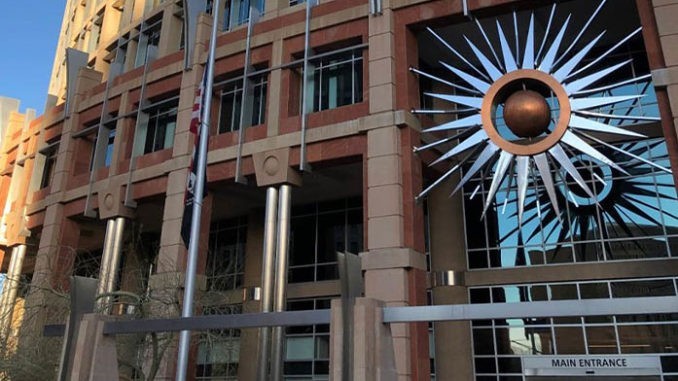
During Tuesday’s policy meeting, the Phoenix City Council approved a resolution permitting the Phoenix Police Department (PPD) to deprioritize investigations of abortion law violations. It doesn’t distinguish between early-term and late-term abortions.
“The proposed resolution also declares Council’s support for City officials in establishing law enforcement priorities that consider the need to protect the physical, psychological, and socioeconomic well-being of pregnant persons and their care providers, and make the enforcement of laws that restrict or deny abortion and abortion-related care the lowest priority for law enforcement,” stated the resolution.
The resolution also decried the Supreme Court (SCOTUS) Dobbs v. Jackson ruling that no constitutional right to abortion exists. Despite being the only item on the agenda, the resolution inspired over an hour and a half of discussion and public comment.
The people of Phoenix share a core value – the right to make their own personal decisions. Today, the Phoenix City Council and I honored that by passing a resolution declaring opposition to the Supreme Court decision in Dobbs v. Jackson criminalizing abortion. (1/3)
The resolution deviates from previous promises by the council to prohibit city resources and personnel from enforcing abortion bans or restrictions, as reflected in a draft copy of the resolution shared with the Arizona Republic. It appears the council changed their mind based on a legal assessment by City Attorney Cris Meyer.
“City resources and personnel will not be used to enforce any state ban or restrictions,” read the draft resolution. “[This resolution] directs the City Manager to implement the resolution including necessary changes to policies and procedures and bring changes to the City Council as necessary.”
Council in favor of the resolution lamented that they couldn’t do more to prevent the enforcement of abortion restrictions and bans. They passed the resolution 6-2.
Those who continued to provide abortions after the SCOTUS ruling, such as Camelback Family Planning, told the Arizona Republic that they likely wouldn’t continue to provide abortions even if Phoenix made itself a sanctuary city for abortion.
Public commentary reflected a divide in the community on the acceptability of abortion. Those who spoke in favor of the resolution represented the establishment, by and large: activists, state legislative candidates, and a former PPD leader. Those who opposed the resolution were avowed Christian citizens.
The ACLU of Arizona Victoria Lopez said that the council’s resolution would protect women’s “right” to abortion. Lopez encouraged the council to work around the legal issues presented by Meyer in order to limit city resources and personnel when enforcing abortion law.
Democratic state representative candidate Analise Ortiz, a former ACLU strategist and mainstream media journalist, urged the council to undertake that effort as well. Ortiz claimed that she and other women would be incarcerated for getting an abortion. Neither the total abortion ban or the 15-week abortion restriction punish the mother for getting an abortion. Likewise, Democratic state senator candidate Anna Hernandez advocated for the council to do more beyond the resolution.
Dianne Post, an activist lawyer, compared pregnancy to slavery. She claimed that SCOTUS decided to overturn Roe v. Wade because of Christianity, not constitutional law.
“We have no morality police in the United States,” asserted Post.
Planned Parenthood of Arizona (PPAZ) Board Member Parris Wallace said that she decided to have two of her children, and one aborted. Wallace reminded the council that PPAZ endorsed the majority of them.
“You owe it to your constituents and ours to hold the line,” said Wallace.
At last night's @CityofPhoenixAZ meeting: @ppazaction board member Parris Wallace: "I've had three pregnancies and I've chosen to have two children." *crowd gasps; Wallace laughs, points at crowd* "Yeah! That means I had an abortion, y'all." pic.twitter.com/QIrF7OfMPN
Retired PPD Assistant Chief Sandra Renteria stated that PPD would waste their time enforcing state law restricting or banning abortions. Renteria said there were more important crimes to address.
“Police officers do not want to be the immigration police and certainly don’t want to be the abortion police,” said Renteria.
A 16-year-old girl named Addison Walker opposed the resolution. She questioned why the council would vindicate the morality of ending an unborn child’s life based on whether the mother wants her or not.
“If your closest friend was murdered, what would you say if the police were instructed to ‘deprioritize’ the investigation of that murder? Would you not be outraged?” said Walker. “Remember: if you deprioritize this law, their blood is on your hands. Your names will go down in history as those who willingly promoted the holocaust of infants in Arizona. More importantly, on Judgment Day, when God judges the righteous and unrighteous, you will be held guilty and be punished for what you have failed to do.”
A woman named Ashley testified that her miscarriage experience convicted her that abortion is a great evil that kills an unborn child, not “a clump of cells.”
“If you vote ‘yes’ on this resolution, you aren’t doing anything noble. Certainly not the babies, nor the bereft mothers, nor even the abortion doctors who cauterize their own consciences with every baby they rip apart,” stated Ashley.
A husband and wife, Christopher and Candace Samuels, both spoke against the resolution. Christopher admonished the council for deprioritizing policing on the most violent crime being committed, while Candace said the resolution encouraged people to break the law. The couple described themselves as refugees of California.
“This is absolutely, as my husband said, abominable,” said Candace. “Please stand up for what our state’s law is, instead of trying to do a sneaky little back-door resolution to get your way.”
Watch the entire Phoenix City Council policy meeting below:
Corinne Murdock is a reporter for AZ Free News. Follow her latest on Twitter, or email tips to corinne@azfreenews.com.
The latest Phoenix Police Department (PPD) data indicates that violent crime has increased while property crimes have decreased from last year.
There was an average increase of over 2 percent for violent crimes, and 3 percent decrease for property crimes. Below are the overall crimes year to date, comparing last January to July to this January to July.
According to separate PPD data, there’s also been a decrease in bias crimes from last year. Last January through August, there were 116 crimes motivated by bias. This year, there have only been 13 in total from January through March.
The drop in bias-motivated crimes has been consistent since 2020, when there was a peak of 204 bias-motivated crimes that year. The greatest number of bias-motivated crimes occurred in 2017, reaching a total of 230.
The rise in crime accompanies PPD’s staffing shortages. On Wednesday, the Phoenix City Council discussed the PPD’s efforts to increase hiring. PPD affirmed that they continue to experience net losses: more officers retiring or resigning than being hired.
Currently, PPD has about 2,600 sworn field positions, 80 in academy, 1,000 working and patrolling officers, 20 in training, and 80 in transitional duty assignment. Current retirements and resignations this year are just under 200. Last year, there were 275 retirements and resignations.
However, PPD Assistant Chief of Police Bryan Chapman said that PPD expected to see a turnaround in the near future.
“If you look at a year ago in terms of where we are today, we are in a much better position. Next year we’ll be back to some normalized numbers or an even better position than where we are,” Chapman.
Officer shortage last year resulted in PPD not responding to certain 911 calls.
Watch the Phoenix City Council policy meeting on public safety and justice below:
Corinne Murdock is a reporter for AZ Free News. Follow her latest on Twitter, or email tips to corinne@azfreenews.com.
This week, Google made its driverless vehicles available to the East Valley public through its ride-hailing company, Waymo One. The artificial intelligence taxi service is available in Chandler, Gilbert, Mesa, and Tempe.
Phoenix Mayor Kate Gallego was one of the driverless car’s first passengers.
In a promotional video, Gallego said she appreciated that the vehicles are electric, and expressed hope that it would make the city more inclusive.
“There are many people in this community who can’t drive or choose not to,” said Gallego.
This isn’t the East Valley’s first experience with these driverless cars. Google has tested them over the past five years in the area.
One of those test runs went viral last year after the car stalled in a Chandler intersection, blocked three lanes of traffic, and attempted to escape company handlers. The car became confused and stopped because it needed to take a right turn and construction closed off the turn lane with cones. At one point, the car began to back up into oncoming traffic.
The passenger noted that he’d been stranded multiple times before in Waymo’s driverless cars.
Downtown Phoenix will also have driverless cars, but only for Waymo employees and “Trusted Testers,” which are select individuals participating in approved test drives. Unlike the East Valley, the downtown driverless cars will have a Waymo “autonomous specialist” in the front seat.
Waymo is also developing driverless freight transportation through its other initiative, Waymo Via.
Google isn’t the only company testing driverless cars and trucks in Arizona. The Arizona Department of Transportation (ADOT) has approved multiple driverless trucking test runs for the company TuSimple, which has ties to the Chinese government.
According to the American Trucking Associations (ATA), there are about 3.6 million professional truck drivers in the country. Government estimates report about 8 million people involved in the entire trucking industry. Globally, the industry is worth $4 trillion, and truckers make up about 40 percent of operating costs.
Corinne Murdock is a reporter for AZ Free News. Follow her latest on Twitter, or email tips to corinne@azfreenews.com.
On Sunday afternoon, the city of Phoenix rolled out its draft roadmap to ready the city for widespread electric vehicle use. The city projected that there would be up to 280,000 electric vehicles in the area by 2030, and noted that total adoption of electric vehicles would align with their climate action plan. In order to accommodate that quantity of electric vehicles, the roadmap cited U.S. Department of Energy projections that the city would require around 3,500 charging ports.
The city presented a five-step plan. First, prioritize equity by maximizing restorative investments in underserved communities, achieving transformational change with bottom-up decision-making, and helping institutionalize equity and justice from the inside. Second, educate and outreach by engaging in qualitative and quantitative information gathering, designing and launching an education and awareness campaign, and monitoring and tracking consumer attitudes and behaviors. Third, leading by example by growing the city’s electric vehicle fleets and installing electric vehicle charging for the city fleet and employees. Fourth, growing public charging by identifying locations for electric vehicle charging networks and installing base amounts of electric vehicle charging annually. Fifth, standardizing electric vehicle charging access by streamlining permits and updating the zoning ordinance and building codes by 2025.
One of the core principles for forming the roadmap was equity — affordability and accessibility for the underserved and disadvantaged communities. One of their first proposed actions for achieving equity was to either hire or assign a current staff member to focus on equity throughout the electric vehicle rollout. Then, the city would adopt an “Environmental Justice” screening tool.
The plan projected that the cost of electric vehicles would reduce at some point in the future.
The City's Electric Vehicle Roadmap is out, and we want to hear what you think!
— City of Phoenix, AZ (@CityofPhoenixAZ) May 15, 2022
The city also asked Arizonans to take a survey on electric vehicles. The survey asked individuals about their knowledge, attitude towards, and current use of electric vehicles. It also asked individuals whether they supported new homes and buildings to be required to have electric vehicle charging stations.
The roadmap is the latest effort of the Ad Hoc Committee on Electric Vehicles, formed by Phoenix Mayor Kate Gallego last June.
The infrastructure bill gives Phoenix/Arizona a mighty push forward, and matches my priorities for Phoenix: EVs/climate, transit, roads, and JOBS! Congrats @POTUS and deep gratitude to AZ Congressional delegation that backed this important work. #BuildBackBetter. pic.twitter.com/EjyzrzZ4bg
Members of the committee are Councilwoman Yassamin Ansari; Autumn Johnson, Tierra Strategy Public Interest Policy Advocate; Caryn Potter, Southwest Energy Efficiency Project Utility Program Manager; Catherine O’Brien, Salt River Project Electric Vehicle Lead; Clark Miller, Arizona State University (ASU) professor; Court Rich, Rose Law Group Renewable Energy and Regulatory Law Department; Delbert Hawk, International Brotherhood of Electrical Workers Local Union 640 President; Jason Smith, Arizona Public Service (APS) Energy Innovation Program Consultant; Katherine Stainken, Electrification Coalition (EC) Senior Director of Electric Vehicle Policy; Kathy Knoop, General Motors Vehicle Grid Integration Solutions Manager; Lisa Perez, Public Affairs Consultant; Omar Gonzales, Nikola Corporation State and Local Government Affairs Manager; Tim Sprague, Habitat Metro Owner; and Vianey Olivarria, CHISPA Arizona State Co-Director.
Corinne Murdock is a reporter for AZ Free News. Follow her latest on Twitter, or email tips to corinne@azfreenews.com.
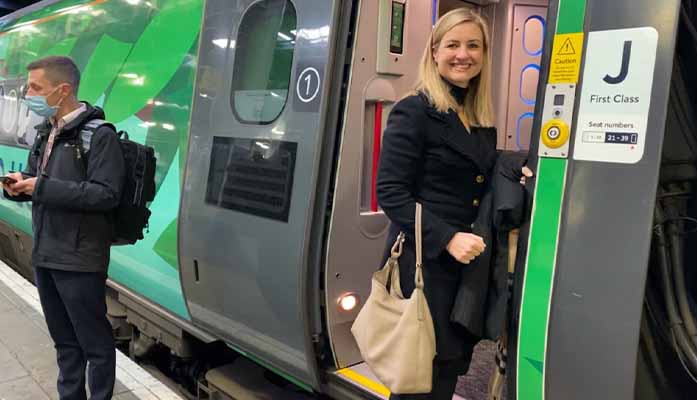
This week, Phoenix Mayor Kate Gallego and Councilwoman Yassamin Ansari are attending the United Nation’s (UN) COP26 Climate Change Conference in Glasgow, Scotland. The conference began Sunday and will last until next Friday. The attendees are meeting with the objective of realizing the Paris Agreement through finalization of the Paris Rulebook and acting on the UN Framework Convention on Climate Change.
Gallego’s spokespersons informed AZ Free News that the city didn’t pay for Gallego’s trip – the C40 Cities Climate Leadership Group paid, a global network of nearly 100 mayors that collaborate on climate solutions. In May, Gallego was elected the vice chair for C40’s steering committee.
Ansari’s spokespersons didn’t respond by press time.
Gallego told Business Journal that she would be networking with companies who may potentially invest in the city. In a statement posted to Twitter, Gallego explained that this conference would bring fresh ideas on climate change initiatives to Phoenix, as well as serve as an opportunity to share some of Phoenix’s initiatives, like their cool pavement installations. “Excited to be attending the UN #COP26 Climate Summit. Phoenix is an innovative leader on climate solutions,” wrote Gallego. “We’ll share our success, and learn about successes from cities around the globe. #TogetherForOurPlanet”
Excited to be attending the UN #COP26 Climate Summit. Phoenix is an innovative leader on climate solutions. We’ll share our success, and learn about successes from cities around the globe.#TogetherForOurPlanetpic.twitter.com/q5GkipooHL
Ansari’s message concerning her attendance reflected more urgency, claiming that lives were at stake. “After spending years working to get elected officials to commit to bold climate solutions, I’m heading to Glasgow for #COP26 proud to represent District 7 in Phoenix,” wrote Ansari. “We just passed our #climateaction plan. Lives are at stake— it’s time to implement.”
After spending years working to get elected officials to commit to bold climate solutions, I’m heading to Glasgow for #COP26 proud to represent District 7 in Phoenix.
Prior to her election to city council, Ansari served as a climate advisor for the UN. She attributed her work as crucial to delivering the Paris Agreement in 2015.
6 yrs ago, I helped deliver the #ParisAgreement. Today, I arrived at the @UN#COP26 summit as an elected official from Phoenix, AZ— once dubbed “the world’s least sustainable city.”
Excited to showcase the work we’re leading now & to bring back lessons from cities everywhere. pic.twitter.com/1goMHS4DJx
The pair will discuss Phoenix’s climate initiatives, including their $2.8 million Heat Response and Mitigation Office. The purpose of the office is to reduce the effects of urban heat, a phenomenon in which urbanization causes higher temperatures. Phoenix is the only city that has an office dedicated to these efforts.
Phoenix’s latest climate action plan was approved last month. The city pledged to certain goals, such as becoming 100 percent carbon-neutral by 2050, eliminating all food deserts, and establishing 100 years of clean and reliable water supplies.
The COP26 conference claims that climate change is the greatest threat facing the world. Two of the goals listed were reaching net zero for emissions and limiting global warming by 1.5 degrees. The UN claimed in their promotional video for COP26 that “Earth is sending a message that we must not ignore.” They showed pictures of various natural disasters, mixed with happy scenes from nature.
“What is COP? The potential threat to the surrounding natural environment, what the UN is calling the world’s first climate change famine,” said the conference promotional video. “Even on our warming planet there are reasons for hope. We need to have the courage to try. There are going to be a lot more jobs created in the economy. Climate change is not the problem, climate change is the expression of the problem.”
Corinne Murdock is a reporter for AZ Free News. Follow her latest on Twitter, or email tips to corinne@azfreenews.com.