by Corinne Murdock | Apr 24, 2023 | News
By Corinne Murdock |
Leftist activists beat an effigy of Phoenix Mayor Kate Gallego during her annual address last week. The effigy was a piñata filled with candy; on the front was the mayor’s name, and on the back was written “Kate (Sinema) Gallego,” referencing controversial Sen. Kyrsten Sinema (D-AZ).
The activists situated themselves outside of the venue for her State of the City address, the Sheraton Phoenix Downtown Hotel. They protested the evictions of the residents of several mobile home parks — Periwinkle, Las Casitas, and Weldon Court — as well as their general discontent with Gallego’s administration.
Fueling the activists’ discontent with Gallego was the city’s rejection of a proposal to rezone the contested properties last month. Instead, the city approved $2.5 million to help the displaced residents find new homes.
Two of the principal organizers behind the protest and the effigy beating were residents impacted by the evictions, Alondra Patricia Ruiz Vazquez and Salvador Reza. The protestors livestreamed the beating of Gallego’s likeness to Facebook. The protesters spoke and chanted mainly in Spanish.
“¡Pégale, pégale por la lucha, pégale!” chanted the protestors, which translates roughly to, “Hit it, hit it, for the fight, hit it!”
Members of Maricopa County Young Democrats were also present at the protest.
In a post following the protest, Reza responded to an alleged offense that Gallego took to the destruction of the effigy in her likeness. Reza said that the effigy was symbolic, and that she shouldn’t take offense to it.
“Breaking a piñata with the image of Kate Gallego is not only against her character flaws, but against the greed of large corporations and large universities that [are] not satisfied with what they have, lash out against vulnerable families who only ask for a home to live,” stated Reza. “Breaking a piñata is symbolic. However, losing a home is catastrophic and traumatic for the families who are living it firsthand. Neither the state’s $5,000 nor a handful of piñata candy will be able to compensate them. So, looking at things clearly, who has the most to lose? A politician offended by a piñata, or 150 families thrown with their belongings into the street.”
Symbolic violence against effigies of contested public figures has been a popular move for leftist activists over the past several weeks.
On Tuesday, rioters protesting an event featuring Daily Wire pundit Michael Knowles burned an effigy of him at the University of Pittsburgh.
Knowles was at the university to engage in a debate on transgenderism.
Corinne Murdock is a reporter for AZ Free News. Follow her latest on Twitter, or email tips to corinne@azfreenews.com.
by Corinne Murdock | Apr 22, 2023 | News
By Corinne Murdock |
Phoenix City Council declared Indigenous Peoples’ Day an official city holiday, replacing the traditional Columbus Day commemoration.
The holiday, which will take place annually on the second Monday in October, was approved by the council during Wednesday’s meeting.
“Phoenix is proud to recognize the roots on which our city was founded,” stated Mayor Kate Gallego.
The city’s resolution falls in line with the recent precedent set by President Joe Biden. The president first declared the replacement of Columbus Day with Indigenous Peoples’ Day in 2021.
Biden’s resolution followed up on a memorandum honoring Native Americans that he issued within the first week of his inauguration. The 2021 resolution declared that Indigenous communities had contributed greatly to American history and culture, and had been disproportionately impacted by the COVID-19 pandemic. Biden’s resolution also commended Native Americans for having some of the highest rates of COVID-19 vaccinations.
“History demonstrates that Native American people — and our Nation as a whole — are best served when Tribal governments are empowered to lead their communities and when Federal officials listen to and work together with Tribal leaders when formulating Federal policy that affects Tribal nations,” wrote Biden. “The Federal Government has a solemn obligation to lift up and invest in the future of Indigenous people and empower Tribal Nations to govern their own communities and make their own decisions.”
Biden’s presidential proclamation exists without holiday privileges like bank closures, however. Only a congressional act could establish Columbus Day as an official federal holiday.
Former President Franklin D. Roosevelt announced Columbus Day a national holiday in 1937 to commemorate Italian explorer Christopher Columbus’ landing in the Americas on October 12, 1492, attributed as the discovery of the “New World,” as the Americas were then known.
Christopher Columbus garnered controversy in recent decades for enslaving some of the Native Americans he encountered, as well as the perspective that he encroached and overtook land that wasn’t rightfully his. Efforts to replace Columbus Day with Indigenous Peoples’ Day trace back to post-Sexual Revolution movements. In 1977, a United Nations-sponsored conference combating discrimination against Native Americans discussed replacing the holiday.
It wasn’t until the 1990s that cities and states began to recognize Indigenous Peoples’ Day over Columbus Day.
While former Gov. Doug Ducey signed a proclamation in 2020 announcing Columbus Day as Indigenous Peoples’ Day, Phoenix is the first Arizona city to celebrate Indigenous Peoples’ Day. However, Ducey didn’t renew the proclamation by signing another in 2021 or last year.
Some local leaders across the state, such as Pima County Recorder Gabriella Cázares-Kelly, have wished to see greater local support for the holiday. The recorder told KOLD in 2021 that only her husband, who isn’t Native American, was able to take the day off.
“They had school, I had work, the only person in our household who had today off for Indigenous Peoples’ Day, is my husband, who is not Indigenous,” said Cázares-Kelly.
Corinne Murdock is a reporter for AZ Free News. Follow her latest on Twitter, or email tips to corinne@azfreenews.com.
by Corinne Murdock | Apr 15, 2023 | News
By Corinne Murdock |
Phoenix Mayor Kate Gallego is urging the Biden administration to declare Arizona’s heat a federal emergency in an effort to unlock more federal funding and resources.
Gallego disclosed this effort during her city of the state address on Wednesday, “The Future of Phoenix.” Gallego called on the Federal Emergency Management Agency (FEMA) to include “extreme heat” into its national emergency declarations categorization, which would qualify Arizona summers as a disaster.
“We need to meet the moment to support our most vulnerable. We need national action,” said Gallego. “I’m calling on FEMA to revise their declared disasters list to include extreme heat. Resources from pop-up shelters, to additional outreach to our vulnerable residents could help us successfully navigate unforgiving summers.”
If Phoenix is successful in its petition, federal assistance would likely come through something like a funding pathway established by the Disaster Recovery Reform Act of 2018. That measure allowed six percent of federal disaster grants’ annual aggregate amount to go to pre-disaster hazard mitigation.
Phoenix has already rolled out projects designed to mitigate heat-related illnesses and deaths, such as “cool corridors,” areas with manufactured shade and drinking water access,” and “cool pavement,” which reflects rather than absorbs sunlight to keep the ground and air cool.
Gallego also urged state lawmakers to support Proposition 400, a county regional transportation tax to expand infrastructure. Gallego also urged voter approval of a general obligation bond: $500 million for public developments like parks and fire stations. Gallego said that the bond funding would allow the establishment of semiconductor and medical device development centers.
Gallego explained that the city’s main focuses included water conservation and restoration; federal funding to support infrastructure development, specifically public transit expansion; and investment into semiconductor facilities.
Gallego insisted that the city was handling the homeless crisis well, despite what the Maricopa County Superior Court said in a preliminary injunction handed down last month.
The mayor insisted that homelessness isn’t unique to Phoenix, but that Phoenix is unique in that it has a better approach for managing its homeless. Gallego talked at length about the city’s affordable housing initiatives, a focal point of their “housing first” approach that, in part, earned them the unfavorable court ruling last month.
“Homelessness is not unique to Phoenix,” said Gallego. “What is unique to Phoenix is that our city is putting every solution on the table to lift people out of homelessness.”
Gallego said it was her desire to create a city where her son would choose to live as an adult.
“Raising a six-year-old and running a city have more in common than you might expect,” said Gallego.
Common themes of Gallego’s address were sustainability and equity efforts.
Gallego said that Phoenix surpassed its “zero waste” goal when it hosted the Super Bowl earlier this year. Gallego highlighted technology advancements in travel, such as Apple Watch check-ins at Phoenix Sky Harbor airport and driverless electric cars roaming the downtown.
Gallego highlighted the city’s free tuition program, “Route to Relief,” similar to what later launched last September — both using American Rescue Plan Act (ARPA) funding.
Gallego said that they would develop 50,000 affordable housing units, noting that they’ve already built or preserved 26,000 units. The mayor cited “critical, systemic inequities” as the root of housing issues. The city has also established a community land trust program with NewTown.
The mayor also cited their “eco-friendly” shipping containers turned into affordable housing. The city will also establish a housing complex of shipping container housing units. Gallego said that the city plans to issue 7,000 housing vouchers and managing over 5,000 housing units.
Phoenix also invested $10 million into mental health treatment for the underinsured and uninsured. In the first seven months of a newly launched pilot, behavioral health engagement teams to address the opioid crisis contacted 200 individuals and connected 57 individuals.
Gallego then said that stronger law enforcement and progressive ideals weren’t mutually exclusive.
“To those who say it is not possible: we can and will be both progressive and practical on policing,” said Gallego.
Corinne Murdock is a reporter for AZ Free News. Follow her latest on Twitter, or email tips to corinne@azfreenews.com.
by Corinne Murdock | Dec 15, 2022 | News
By Corinne Murdock |
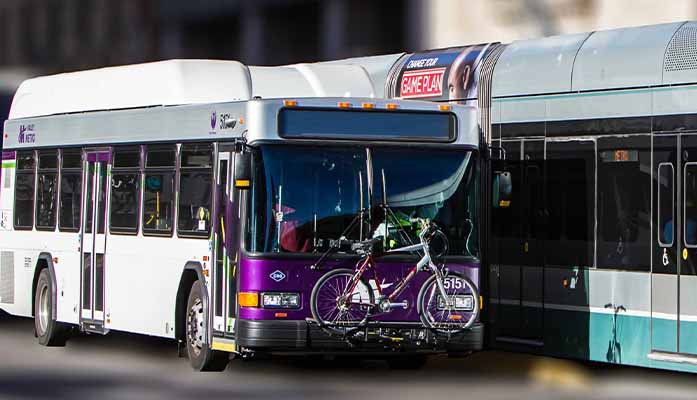
The Phoenix City Council unanimously approved a plan to spend $102 million to replace its bus fleet with electric vehicles. Outgoing councilmember Sal DiCiccio wasn’t present.
Over $86.7 million (85 percent) comes from federal funding; over $15.3 million (15 percent) comes from regional funding. The initiative is part of the council’s goal of achieving a total zero-emissions bus fleet by 2040. The current fleet consists of 500 buses.
The city will procure a variety of electric buses: battery, hybrid, and hydrogen fuel cell. The council waived standard competition in its procurement process to award the five-year contract due to supply chain issues; reportedly, the city learned it couldn’t acquire its first round of zero-emissions buses until after 2025, well after its planned timeline. The city selected a supplier who could meet their timeline: the Washington State Transit Bus Cooperative.
Mayor Kate Gallego indicated that their goal of true zero-emissions would come from future negotiations with power companies. Gallego noted that the plans to create an electric charging grid launched by the Biden administration and state would facilitate their efforts.
“It cannot be zero-emission if the power going in is not zero-emission,” stated Gallego.
READ THE COUNCIL’S BUS FLEET PLAN
Councilwoman Yassamin Ansari noted that this plan put the city on the same timeline to zero-emissions as New York City and California. Ansari promised that the council would accelerate their plan even further once the supply chain stabilizes and inflation costs reduce.
Ansari credited the Sierra Club, Arizona Public Interest Research Group (PIRG), Southwest Energy Efficiency Project (SWEEP), American Lung Association (ALA), and CHISPA AZ for allowing their plan to come to fruition.
“We will only be ordering hybrid and zero-emission buses after 2024, which will completely then end our dependence on fossil fuel transit in terms of new purchases,” stated Ansari. “This is a public health win, a quality of life win, a climate win, and a very big win for Phoenix.”
Public comment came from two organizations that advocated heavily for the $102 million expenditure:
Joanna Struther, ALA senior director of advocacy, cited ALA data ranking Phoenix as the fifth-most polluted city in the nation. Struther stated that the city’s air pollution presented a severe harm to circulatory systems.
The ALA claimed that electrification of city fleets would result in 38,000 less asthma attacks and $15.1 billion in public health benefits. ALA asserted that its polling revealed 70 to 80 percent support among Arizonans for electric vehicles.
PIRG’s executive director, Diane Brown, noted that not only would residents benefit from improved air quality from bus electrification, but the city would increase its access to federal funding.
The city rejected a plan last year to renew their current fleet powered by fossil fuels for another five years.
Corinne Murdock is a reporter for AZ Free News. Follow her latest on Twitter, or email tips to corinne@azfreenews.com.
by Corinne Murdock | Dec 4, 2022 | News
By Corinne Murdock |
The operative whose political action committee (PAC) received $27 million from fallen crypto giant FTX also received over $1 million from committees for Senator Mark Kelly and governor-elect Katie Hobbs.
The operative, Dacey Montoya, also served as the treasurer for these committees. Montoya has been behind numerous other political committees and PACs in Arizona and across at least 16 other states. Usually, those committees also pay her consulting firm, The Money Wheel (TMW).
Montoya serves as the treasurer for the Mark Kelly Victory Fund and Mark Kelly For Senate. TMW received over $832,000 from the two committees over the past two years.
Katie Hobbs’ secretary of state and gubernatorial committees paid TMW about $188,500 over the past four years, with the greatest payouts occurring over the last year. Although Montoya wasn’t listed as the treasurer for either of Hobbs’ campaigns, her firm’s email was listed in the contact information.
That combined $1 million doesn’t include payouts from other political action committees (PACs) and political candidates. (Note: AZ Free News discovered that Montoya’s PACs didn’t always file timely reports, so funds like expenditures, income, and TMW funding may be underreported).
Arizona-based PACs or campaign committees that paid TMW: Outlaw Dirty Money, $61,900; Arizona Pipe Trades 469, $54,000; Invest in Phx, $10,700; Rural Arizonans For Accountability, $10,500; Arizonans For a Just Democracy, $5,500; No On Proposition 126 Committee, $1,200; Solutions for Arizona, $500.
Arizona-based PACs that Montoya ran, and how much they paid TMW: Invest in Education, $504,400; Protect Our Future PAC, $134,500; Way to Lead PAC, $67,800; Moms Fed Up, $52,000; Way to Lead State Power Committee, $49,600; Invest in Education Committee, $40,700; Arizonans For Fair Elections, $40,000; Arizona Families First, $38,900; Change for Arizona 2024 PAC, $31,000; Arizonans For Fair Lending, $27,000; Arizona Future Fund, $25,000; Invest in Arizona, $25,000; Guarding Against Pandemics PAC, $16,000; Families United For Freedom, $15,000; Opportunity For Tomorrow, $11,000; Lead the Way 2022, $9,800; Not Our Faith, $9,200; Liftoff PAC, $3,500; E Pluribus PAC, $9,100; Win the West 2020, $3,100; Win Blue 2020, $2,600; Restore Hope, $2,500; Arizona Washington Victory Fund, $1,800; Arizona Maine Victory Fund, $1,800; Arizona New Jersey Victory Fund, $1,800; Kelly, Cisneros, Rouda, Smith Victory Fund, $1,700; Yes For Phx, $1,400; Saguaro Victory Fund, $1,100; and Arizona New Mexico Victory Fund, $800.
Political candidates for whom Montoya served as treasurer, and how much they paid TMW: Mayor Kate Gallego, $76,300; Reginald Bolding, $51,800; and Jevin Hodge, $42,000.
Political candidates whose campaigns paid TMW: Kirsten Engel, $46,900; Judy Stahl, $11,500; Ann Kirkpatrick, $118,500; and Heather Ross, $36,000.
At minimum, Montoya’s firm has made over $2.7 million over the past few years through Arizona political candidates, committees, and PACs.
Montoya also founded and ran an influential PAC that didn’t pay TMW: Will of the People Arizona, a PAC dedicated to defeating Propositions 128, 129, and 132. In their tweets, the PAC tags multiple progressive organizations in their effort, including Pro-Choice Arizona, LUCHA Arizona, Mass Liberation Arizona, Black Lives Matter Phoenix Metro, Poder in Action, CASE, AZ Coalition 4 Change, Healthcare Rising Arizona, All Voting is Local – AZ, ACLU of Arizona, and Planned Parenthood Advocates of Arizona.
The PAC identified The Arizona Republic as an endorser of their efforts.
Prop 128, allowing the state legislature to amend, divert funds from, or supersede an initiative or referendum found to contain illegal or unconstitutional language, failed; Prop 129, limiting ballot initiatives to a single subject, succeeded; and Prop 132, requiring initiatives and referendums seeking a tax change to receive at least 60 percent of votes, succeeded.
As AZ Free News reported in October, outside funding accounted for 99 percent of the PACs funds. However, the PAC claims on its website that outside funds only amount to 20 percent, and their mailers claimed that number was 43 percent.
The PAC received over $2.1 million from the Service Employees International Union United Healthcare Workers (SEIU-UHW): the California union that largely financed the dark money-fueled Predatory Debt Collection Act, Proposition 209, which voters just approved. Prop 209 essentially makes all debt collection futile. That PAC also received $250,000 from the National Education Association (NEA); nearly $258,600 from the Fairness Project, established by SEIU-UHW; $60,000 from Every Single Vote; and over $51,000 from the Ballot Initiative Strategy Center (BISC). Nearly all of these funds derive from organizations dedicated to influencing the outcome of state-level ballot referendums in favor of progressive policy.
Will of the People Arizona spent over $1.6 million on communications like ads and mailers, and over $66,500 on polling and consulting.
Montoya also runs one of the most powerful leftist dark money organizations: Opportunity Arizona, which receives much of its funding from the Arabella Advisors’ Hopewell Fund.
As of this report, AZ Free News uncovered Montoya’s influence as campaign committee or PAC treasurer, or TMW payee, in at least 16 other states: California, Colorado, Florida, Illinois, Iowa, Louisiana, Maryland, Massachusetts, Nevada, New Jersey, New York, Ohio, Texas, Virginia, Washington, and Wisconsin.
Corinne Murdock is a reporter for AZ Free News. Follow her latest on Twitter, or email tips to corinne@azfreenews.com.