For local governments—and councils of governments—in Arizona, it appears that creating a climate action plan has become all the rage. Maybe that’s because it pays well.
The latest group to bow down at the altar of the Biden administration’s climate change agenda is the Maricopa Association of Governments (MAG). Back in August, MAG received a $1 million grant from the Environmental Protection Agency’s (EPA) Climate Pollution Reduction Grant Program to serve as the lead planning organization for the Phoenix-Mesa-Chandler metro area. The grant requires MAG to develop a priority climate action plan by next March, a comprehensive climate action plan by 2025, and a status report in 2027 after the four-year grant period expires.
But this $1 million grant isn’t the only way MAG stands to benefit…
Phoenix Mayor Kate Gallego is at the forefront of a globalist effort to ban meat, dairy, and private cars by 2030.
Gallego sits on the steering committee of C40 Cities: the globalist climate coalition of over 100 cities globally planning and coordinating a centralized system controlling consumer consumption. She is the only American on the 13-member steering committee, and was elected as its vice chair in 2021.
C40 Cities first announced their consumption reduction plan in 2019, a year before Gallego had Phoenix join C40 Cities. The coalition declared that consumption in high-income cities needed to be reduced by two-thirds to avert a climate crisis. The prediction was based on a research report connecting consumption and emissions, “The Future of Urban Consumption in a 1.5 C World,” produced by C40 Cities, Arup, and the University of Leeds.
The report established these “ambitious target(s)” for influencing global supply chains to control consumption by 2030, dubbed “consumption interventions”: eliminating all meat and dairy consumption; eliminating all household food waste; slashing supply chain food waste by 75 percent; getting rid of all cars; requiring a 50-year lifetime for vehicles; 50 percent reduction in use of metal and plastic materials in vehicles; limiting people to three new clothing pieces annually; restricting flights to one per person every three years; achieving 100 percent sustainable (or low carbon) aviation fuel; reducing steel and cement use in buildings by 35 percent and 56 percent respectively; reducing new building demands by 20 percent; building 90 percent of residential and 70 percent of commercial buildings with timber; replacing 61 percent of cement with low-carbon alternatives; reducing virgin metal and petrochemical-based materials by 22 percent; and requiring a seven-year optimum lifetime of laptops and other electronic devices.
The report also offered “progressive target(s)” that scaled back the ambitious targets.
It appears Gallego has committed to implementing the consumption control plan proposals, as well as the greater missions of C40 Cities. The same year that the coalition named Gallego to its steering committee, Phoenix approved an updated Climate Action Plan reflecting the C40 Cities’ goal of a 50 percent emissions reduction by 2030 and zero emissions by 2050. Among the city’s Office of Environmental Programs initiatives, Gallego’s administration is rolling out a food waste and composting program, the Reinventing Cities initiative to decarbonize infrastructure, and electrification of its government vehicles.
The C40 Cities report noted that food served as the biggest sources of urban consumption-based emissions (13 percent), with animal-based foods representing 75 percent of that total compared to plant-based foods’ 25 percent. Elsewhere, C40 Cities cited the Planetary Health Diet as a model, which reflects their report’s progressive target of limiting meat intake to 35 pounds annually (just over half of a pound a week, or about 1.5 ounces daily).
The coalition hailed the Planetary Health Diet as part of “The Great Food Transformation,” advocated for by the EAT/Lancet Commission. The EAT Initiative is a project of the Stockholm Resilience Center, Professor Johan Rockstrom, and Wellcome Trust (one of the key funders of C40 Cities) under the Strawberry Foundation (formerly the Stordalen Foundation) to transform the world’s food system to XYZZ. Their partners include Nestle, World Resources Institute, Massachusetts Institute of Technology (MIT), University of College London, Harvard Global Equity Initiative and T.H. Chan School of Public Health, University of California Berkeley Food Institute, and New York Academy of Sciences.
EAT leadership consists of nearly 60 individuals with professional ties to the mainstream media outlets, publications, and technology companies including Forbes, the Lancet, and Google; progressive globalist organizations including the World Health Organization (WHO), World Economic Forum (WEF), United Nations (UN); the highest levels of domestic and foreign governance, including the Obamas and Clintons, U.S. Agency for International Development (USAID), United Arab Emirates, China, Norway, Italy, and Sweden; major universities including Tufts University and University of Miami, as well as those listed above; and a slew of nonprofits and organizations with leftist billionaire support.
In 2020, the United Nations (UN) tasked EAT with “a wide mandate to build a broad, multistakeholder [sic] coalition” to move people into “sustainable consumption patterns.”
The report also proposed limiting people to an average of 2,500 calories daily, and reducing household food waste by 50 percent through government publicity campaigns and regulations on food retailers.
In March, C40 Cities published a renewed commitment to their consumption control plan. Although the coalition insisted that the report represented an analysis rather than plan, C40 Cities leadership has characterized the report as a blueprint of sorts for achieving a halving of emissions by 2030, as noted by The Expose.
Similar to EAT, C40 Cities leveraged the COVID-19 pandemic to implement 15-minute cities, within four months of the U.S. pandemic emergency declaration. The coalition championed the same slogan used by President Joe Biden’s 2020 campaign and other progressive globalist leaders: “Build Back Better.”
The mayor of Paris, Anne Hidalgo, was one of the first to implement 15-minute cities in 2020; she was elected the C40 Cities steering committee vice chair last month. Under Gallego, Phoenix is undergoing changes to reorient itself as a 15-minute city through policy changes as outlined in Vision Zero and ordinances like the parking space reduction for apartments.
Citing C40 Cities, Gallego has also been installing “cool pavement” throughout Phoenix which, contrary to the implications of its name, makes people hotter rather than cooler.
C40 launched in 2005 as “C20” under London, England’s then-Mayor Ken Livingstone. In 2006, C20 merged with former President Bill Clinton’s Climate Initiative to form C40 Cities. The Clinton Foundation remains one of C40 Cities’ key partners.
In 2007, New York’s then-mayor, Michael Bloomberg, joined C40 Cities and hosted the coalition’s second annual conference. Bloomberg remains one of the highest funders for C40 Cities, along with Oak Foundation, ClimateWorks Foundation, Google, the Wellcome Fund, the European Climate Foundation, and George Soros’ Open Society Foundations.
In 2015, then-President Barack Obama and then-Vice President Joe Biden issued a call to action for cities to join C40’s Compact of Mayors. In April, the Biden administration gave $1 million to C40 Cities to address “climate migration” in Latin American cities; that same week, the president signed an executive order to prioritize environmental justice in federal agencies, with a C40 Cities representative there to witness.
Corinne Murdock is a reporter for AZ Free News. Follow her latest on Twitter, or email tips to corinne@azfreenews.com.
A majority of heat deaths in Maricopa County are attributable to methamphetamine, according to the latest Maricopa County Department of Public Health heat deaths report.
53 percent of heat deaths involved meth last year, or 226 deaths. 67 percent of deaths involved some type of substance abuse. The county noted that the proportion of heat deaths involving drug use has increased over the years.
The homeless make up the largest class of all heat deaths: 178 met that characterization (150 were classified as having “unknown” living situations). Nearly 70 percent of all heat deaths last year occurred in urban areas.
Although the homeless made up the most heat deaths last year and in 2020, that wasn’t the case from 2012 to 2019. More non-homeless individuals suffered heat deaths during those years than the homeless.
Phoenix had the most heat deaths last year, 245, followed far behind by Mesa at 36 deaths and then Glendale at 22 deaths. Scottsdale and Tempe both had 10 deaths, Avondale and Peoria both had 8 deaths, Chandler had 7 deaths, and Gilbert had 6 deaths.
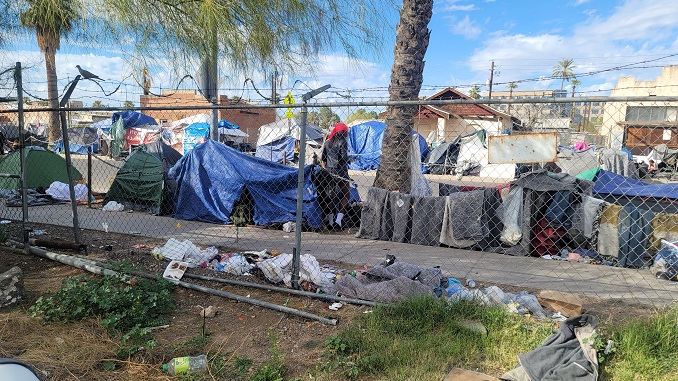
Phoenix also holds the vast majority of the homeless population in the county. The Maricopa Association of Governments reported a 36% increase in homeless individuals in the county from 2019 to last year. That increase was most greatly felt at the very heart of downtown Phoenix, evident in the mass homeless encampment called “The Zone.”
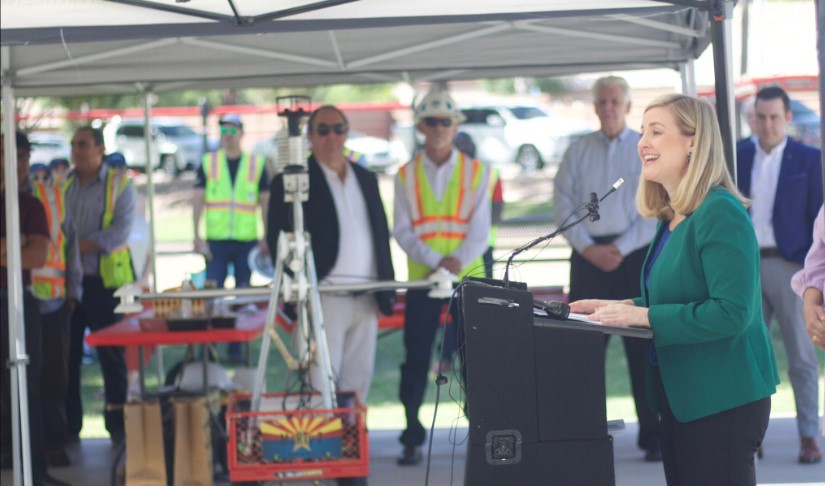
Phoenix Mayor Kate Gallego has used heat deaths to bolster her campaign to declare The Valley’s regular summer heat as a federal emergency. Such a declaration would result in the awarding of federal relief funds.
Heat relief teams like @HeatReadyPHX are working tirelessly to support residents during this heat wave, and additional federal resources could multiply our impact.
During her annual state of the city address in April, Mayor Gallego petitioned the Federal Emergency Management Agency (FEMA) to qualify extreme heat as a disaster by adding the regular seasonal occurrence to its national emergency declarations categorization.
A FEMA recognition would bring in more federal funding. The city has a number of heat mitigation projects that would likely benefit from such funding, like the manufactured shade and drinking water access areas known as “cool corridors,” which are determined on an equity basis, and the special sunlight absorption streets known as “cool pavement.” Those initiatives were unique creations under Mayor Gallego’s administration.
Mayor Gallego was also responsible for the creation of one of the first heat mitigation offices within city government: the Office of Heat Response and Mitigation (OHRM). The city established the office with $2.8 million in 2021, with the explicit attempt to combat “urban heat”: the theory that urbanization causes higher temperatures.
Presently, the OHRM doles out COVID-19 relief federal funding provided by the American Rescue Plan Act (ARPA) for annual heat relief grants. These grants are earmarked for nonprofit, charitable, small business, and faith-based organizations existing within the city-recognized Maricopa Association of Governments Heat Relief Network that claim negative impacts from the COVID-19 pandemic. OHRM will give out a maximum of $450,000 total, with each recipient receiving anywhere from $10,000 to $25,000.
A major focus of the OHRM is providing heat respite for the homeless. The latest update from OHRM, issued last summer, announced initiatives costing millions to increase the comfort of the homeless residing within the The Zone: the creation of seven new shade structures; distribution of insulated and reusable water bottles, hats, sunscreen, personal misters, towels, ice chests with water; and hundreds of shelter beds for 24/7 heat respite.
The first and current OHRM director is Arizona State University (ASU) professor David Hondula, who teaches within the Global Institute of Sustainability. Hondula was named director of the office overseeing the pavement initiative within weeks of publication of a joint study on the city’s “cool pavement” infrastructure, which the city knew ahead of expansion would make people hotter.
Although FEMA hasn’t heeded Gallego’s call, her Congressman ex-husband did. Rep. Ruben Gallego (D-AZ-03) introduced the Extreme Heat Emergency Act last month.
When it gets dangerously hot in Arizona, our leaders should have the ability to call on FEMA to deploy the necessary resources to save lives.
Per the latest county heat deaths report, fatalities decreased from 2012 to 2014. 2012 totaled about one-fourth of last year’s deaths and 2014 reached a low of 61 deaths. Deaths then increased from 84 in 2015 to 199 in 2019, spiking to 323 in 2020 and steadily increasing since then.
The county report also revealed that African American and Native American individuals made up the most heat deaths: 13 per 100,000 and 9 per 100,000, respectively. White individuals followed closely behind at nearly 8 per 100,000 deaths.
Corinne Murdock is a reporter for AZ Free News. Follow her latest on Twitter, or email tips to corinne@azfreenews.com.
The city of Phoenix’s “cool” pavement is making people hotter, something the city learned from their pilot program study with Arizona State University (ASU) — but chose to prioritize its sustainability goals to combat climate change instead.
The 2021 joint study discovered that the “cool” pavement makes people feel up to six degrees hotter: the material deflects sunlight, causing people to absorb it. The study declared the increased human discomfort a “necessary tradeoff” for reducing the temperature of city infrastructure.
The study not only reported negative physical impacts resulting from the pavement; survey respondents also relayed negative feelings about the aesthetics, safety, and durability of the pavement. Residents reported that the pavement was “blinding” due to its light color, and that the tire and oil marks stained the pavement in ugly ways. They also reported the pavement being slick, and even wearing off at a fast rate.
It appears that ASU researchers and Phoenix leaders were aware even prior to the study that the cool pavement would make people hotter. At the start of the pilot program, ASU professor David Sailor revealed that the same material was planned for use in the 2020 Summer Olympics marathon route in Japan, but that the material would likely make the runners hotter due to the solar reflection.
Despite the report indicating overall negative impacts to the human body and resident sentiments, the city decided to make the pavement program permanent. Since 2019, the city has spent over $12 million perArizona’s Family.
The city announced last month that it installed over 100 miles of the cool pavement.
🆒 NEWS: Three years after launching our Cool Pavement program, we've installed over 100 miles of cool coating across Phoenix!
This innovative coating is produced locally and is proven to reduce street surface temperatures by up to 12 degrees! 😎 pic.twitter.com/XLqoX3AkjM
While the city increases the coverage of pavement making people hotter, public health officials have been warning residents of the consequences of long-term exposure to record summer heat.
Temperatures are likely to reach record territory this weekend. Be careful out there and please practice good heat safety. #azwx#cawxpic.twitter.com/AlI3j0cfTh
In marketing their initiative, city leaders have pointed out that the pavement makes the ground 10-12 degrees cooler. While that may be true, the 2021 Phoenix-ASU report revealed that the surfaces cool by deflecting half of that heat to people.
Despite the 2021 report, city leaders claim that the material makes people feel cooler. Phoenix Mayor Kate Gallego claimed the pavement makes the city more “comfortable.”
Cool pavement has also presented an opportunity for city leaders to market Phoenix as innovative in terms of sustainability efforts, namely with energy usage. Gallego has cited the city’s membership with C40 Cities, a progressive climate change organization on whose steering committee Gallego sits as vice chair, as the driving force behind cool pavement.
Over the past 4 years, the most meaningful movement on climate has come from cities and states. #PHX has one of the largest cool pavement projects in the country, we lead the nation for solar installed on municipal property & we’re ensuring #RenewableEnergy is accessible for all. https://t.co/Z1tlCXcWLg
Sailor, one of the ASU researchers, projected in a 2020 interview during the ASU-Phoenix pilot program that the technology would save ratepayers up to $75 million per degree in energy costs.
Another researcher on the study, ASU professor David Hondula, was named director of the office overseeing the pavement initiative within weeks of the study’s publication.
The California-based manufacturer for the pavement material, GuardTop, opened its downtown Phoenix facility to create the product in 2017. Since 2022, after Phoenix made its pavement initiative permanent, the company has exclusively produced the material at its Phoenix facility, naming it “Phoenix Gray.” Australia, Canada, Singapore, and the United Arab Emirates have purchased the cool pavement material from the company.
GuardTop’s founder and CEO, Bob Koleas, is an alumnus of the University of Arizona.
Corinne Murdock is a reporter for AZ Free News. Follow her latest on Twitter, or email tips to corinne@azfreenews.com.
Phoenix Mayor Kate Gallego heeded the call of Amtrak CEO Stephen Gardner, urging for the addition of a public railroad to the city.
Gallego said that the railroad, or passenger railway, would make long-distance travel easier for both locals and visitors.
“An @Amtrak connection in Phoenix would make long-distance travel easier for Phoenicians and bring more visitors. Let’s get it done!” said Gallego.
An @Amtrak connection in Phoenix would make long-distance travel easier for Phoenicians and bring more visitors. Let’s get it done! https://t.co/2NYqU7AuTN
The renewed calls for a public railway came after Gardner singled out Phoenix in recent public comments on his company’s intent to expand nationally. Gardner said it was an “embarrassment” that Phoenix doesn’t have his passenger railway company.
“(It is) frankly an embarrassment that we don’t serve such a major, prominent city,” said Gardner.
Amtrak applied for $716 million in federal funding from the Bipartisan Infrastructure Law to launch 16 projects nationwide, including Phoenix. The Arizona Department of Transportation (ADOT) submitted a proposal to the federal Corridor Identification and Development Program (Corridor ID Program) to assist in the expansion. Additionally, ADOT provided $3.5 million.
Another proponent of the Amtrak expansion into Arizona, Rep. Greg Stanton (D-AZ-04), claimed that passenger railway would reduce the number of cars and therefore result in significant emissions reductions.
In a press release, Stanton also claimed that a public railway would provide an economic boost for the state.
“[It’s an] opportunity to connect our communities, make them more accessible and productive, and more internationally competitive,” said Stanton. “Opportunity to boost our regional economies with better access to jobs and more private investment along the route. Opportunity to ease congestion along Interstate 10 and help reduce air pollution.”
Likewise, Sen. Mark Kelly (D-AZ) said Phoenix needed to join the other major cities in the country served by Amtrak.
“Phoenix is the largest city in the country not served by Amtrak, but thanks to our Bipartisan Infrastructure Law, we’re working to fix that,” said Kelly. “This support for the Return to Phoenix Project will finally bring together Arizona communities, the railroads, and Amtrak to develop a comprehensive plan to connect Phoenix and Tucson with passenger rail and connect Phoenix to Amtrak’s nationwide network.”
Public railway, like other forms of public transit, suffers from high crime rates. According to Amtrak police, there were around 6,000 incidents and over 456,400 calls for police assistance in 2021. That’s based on the latest National Incident-Based Reporting System (NIBRS) data from the FBI.
That’s compared to about 5,000 incidents and 412,000 calls in 2020; around 6,700 incidents and 419,700 calls in 2019; around 6,100 incidents and 254,700 calls in 2018.
Amtrak has 30 routes consisting of 500 stops along 46 states. Based on their latest crime data report (2021), that’s about 12 incidents and 912 calls to Amtrak police at each stop annually.
In a press release on Monday, Amtrak explained that their applications were submitted through the Federal Railroad Administration (FRA) programs funded by the Infrastructure Investment and Jobs Act (IIJA): the Corridor ID Program and the Federal-State Partnership for Intercity Passenger Rail Program. The essential goal of the programs is to establish a comprehensive national passenger rail network.