“The debate debacle continues this morning,” the TV anchor said, laughing. “The never-ending story of Democratic candidate Katie Hobbs choosing not to debate her opponent, Kari Lake.”
That’s what Arizona voters heard last week as they woke up and turned on one of Phoenix’s most popular morning news programs. They’ve been hearing it for months.
Hobbs’ refusal to debate Lake, the Republican nominee, has become the defining story of the gubernatorial race, one that started out as a 20-year precedent-breaking decision and has morphed a larger-than-life narrative about the Democrat’s political judgment and skittishness, with multiple left-leaning media outlets, from MSNBC and The View to the Arizona Republic and the New York Times, all asking the same question: What in the world is she thinking?
Hobbs claims it’s because her opponent is too far to the right. In reality, her national headline-making stage fright has been going on for much longer than the general election.
It began in April when Hobbs declined to participate in a June 30th debate with her Democratic primary opponent Marco López, the former mayor of Nogales and chief of staff at U.S. Customs and Border Protection under President Barack Obama. With one exception, Hobbs was the only statewide candidate in Arizona who declined. López used light political pressure hoping to change her mind — he’d often ask the crowd: “¿Dónde está Katie?” — but, when approached by the local press in May, Hobbs’ campaign claimed that she had (conveniently) scheduled “multiple events in Tucson” on June 30th and couldn’t make the two-hour drive back to Phoenix.
López understood. So, he wrote a letter to the Citizens Clean Elections Commission, the government body that organized the debate, granting it permission to “reschedule the debate to a time and date that fits into the Secretary’s busy schedule” over the next 40-plus days. Hobbs declined to reschedule.
When June 30th arrived, a local reporter reached out to Hobbs for comment on her absence. She must have been pretty busy that day, what with “multiple events in Tucson.” But why were no photographs posted online? Oh, about those events, her campaign responded … um, they were canceled. The candidate had come down with a (convenient) case of COVID.
Three days later, Hobbs was spotted, mask-less, waving a flag at a crowded parade in Flagstaff. A superb immune system, indeed.
It wasn’t long after the general election began that Hobbs announced she would not be debating Lake, either. Instead, the Democrat demanded separate one-on-one TV interviews — but that’s not how the Clean Elections process works. Candidates who bow out are not rewarded for doing so. Hobbs insisted that Lake would create a spectacle if the debate format were not right, so the Commission held a formal meeting to appease her, during which its chairman asked her campaign manager point-blank: “Is there any scenario where Ms. Hobbs will share the stage with Ms. Lake in a debate?”
She dismissed his “hypothetical” question and refused to offer an alternate format, and the Commission ruled that the October 12th debate would go on with or without the Democrat in attendance. (Lake said that her opponent was free to change her mind at any time.)
The morning of October 12th, Hobbs joined MSNBC for a softball segment … a little too soft. Because Hobbs got a little too comfortable and accidentally blabbed to the host, as if in the middle of a private conversation, that “PBS is also giving me the same format that Kari Lake has.”
Oops. That secret arrangement wasn’t supposed to come out until after Lake’s interview that evening.
You see, Arizona PBS is the Commission’s official broadcast partner, a relationship that provides the station with unique access to high-profile debates in exchange for complying with the Commission’s rulings when candidates disagree. It turned out that Arizona PBS had struck a side-deal with the Hobbs campaign to shoot and air the one-on-one interview she’d been begging for, right as voters received their early ballots.
The Commission had no clue that the station violated its agreement — and wouldn’t have until it was too late, had Hobbs not accidentally revealed it on live TV. The Commission was forced to cancel the long-planned debate with hours to spare in order to find a new broadcast partner it could trust. In response, Lake held a press conference condemning Arizona PBS’ “backroom deal” with Hobbs, which a source informed her was made at the behest of Michael Crow, the politically connected and contentious president of Arizona State University. (ASU owns and operates Arizona PBS.)
Approached for comment the next morning, Crow denied directing the backroom deal with Hobbs but acknowledged that “he let his preference be known” to the station (which I am certain Arizona PBS interpreted in the exact way that Crow meant it). The Commission’s executive director described himself as “bewildered” by Crow’s political meddling — casting him as “the most powerful man in Arizona” other than the governor — and decried the appearance that “ASU was playing favorites with the candidates.”
Much like Crow, Mi-Ai Parrish, a managing director at ASU who helps oversee Arizona PBS, also “wouldn’t say who made the call to invite” the Democrat. Hobbs herself is similarly claiming now that “I wasn’t involved in those conversations” with ASU — which, again, is a strange series of denials coming from several people who insist they did the right thing.
A Republican state legislator has already announced plans to file a bill that will strip the state’s ties to Arizona PBS as a result of it circumventing the Clean Elections ruling. And, unfortunately for ASU, it doesn’t appear that Hobbs will be in a position to veto it.
Outside of vomiting on herself on-stage, I cannot fathom a single humiliation Hobbs could have endured in a 30-minute debate that would have been worse than the six-month headache of negative headlines her refusal has caused. Two separate polls released this month reflect that reality, finding that the Republican nominee enjoys a 3-point lead heading into Election Day, with even CNN’s Dana Bash acknowledging Monday that “the fact that [Hobbs] won’t debate has given Kari Lake a very wide opening.”
At the end of the day, Arizonans vote for who shows up — and, so far, Katie Hobbs hasn’t.
Brian Anderson is founder of the Saguaro Group, an Arizona-based political research firm.
The Arizona Citizens Clean Elections Commission (AZCCEC) accused Arizona State University (ASU) President Michael Crow of playing favorites by giving Democratic gubernatorial candidate Katie Hobbs the interview she wanted. Normally, AZCCEC and ASU’s Arizona PBS station coordinate debates between candidates.
Last month, AZCCEC rejected Hobbs’ proposed alternative to a debate with Republican opponent Kari Lake: two back-to-back, individual interviews of each candidate. Since only Lake agreed to the debate terms set forth by AZCCEC, she was scheduled to have an interview in lieu of a debate on Tuesday. However, hours before Lake’s interview was to take place, AZCCEC learned that Arizona PBS (AZPBS) went behind their back to schedule a special interview with Hobbs next Tuesday — moving them to postpone Lake’s interview.
In a statement shared with multiple news outlets, Crow claimed that he wasn’t involved in a policy-level decision concerning the debate. However, he disclosed that he advised AZPBS that giving Hobbs airtime was necessary. ASU owns AZPBS.
“But I did indicate that we need to continue to fulfill our mission of unbiased and nonpartisan coverage of public figures and talk to important people in the public realm like Lake and Hobbs to have the public learn of their views, even if there is no debate,” stated Crow.
In response to Crow’s remarks, AZCCEC Executive Director Tom Collins asserted to reportersthat Crow influenced AZPBS editorial decisions.
Collins also said that it wasn’t acceptable for the AZCCEC to be involved in the kind of behavior exhibited by AZPBS.
“The issue here is the way AZPBS went about soliciting this particular interview and then having one candidate announce [it] on the day that another candidate — who had followed a specific set of rules that ASU had agreed to as well — [had their interview, which] made it look like ASU was playing favorites with candidates,” said Collins.
"The issue here is the way that @ArizonaPBS went about soliciting this particular interview … made it look like @ASU is playing favorites with the candidates. Well, that's not acceptable …"
AZPBS’ special exception for Hobbs prompted the Arizona House Republicans to take action. State Representative John Kavanagh (R-Fountain Hills) pledged in a press release to introduce legislation to sever all state ties and support of AZPBS if the station didn’t cancel Hobbs’ interview.
“It would be inappropriate for the state to continue its relationship with AZPBS, given its sabotaging of the clean elections debates that were approved by the voters,” stated Kavanagh. “The clean elections rules are clear. If a candidate refused to debate, their opponent (who is willing to debate) is eligible to have a 30-minute question and answer session.”
Kavanagh added that AZPBS was wrong for essentially lifting AZCCEC’s penalization for Hobbs. He predicted that AZPBS was setting a precedent to encourage future candidates to avoid debates.
“I believe the station’s decision to reward a candidate’s refusal to debate, by giving them free television time, is tantamount to making a partisan political contribution to their campaign,” wrote Kavanagh. “AZPBS needs to keep its thumb off the election scale and not shortchange the voters.”
Rep. @JohnKavanagh_AZ announces intent to sponsor legislation to sever state support of @AZPBS if it fails to correct troubling 11th hour decision to circumvent AZ Clean Elections Commission debate rules.
AZPBS offered Lake an interview as well, one also not arranged or approved by AZCCEC. However, Lake formally rejected that offer in a letter sent to AZPBS, Crow, and AZCCEC on Thursday. The letter, written by attorney Timothy La Sota, said that Lake would only come to the interview if it was reformatted as a debate between her and Hobbs.
“PBS & ASU have betrayed not only the Clean Elections Commission, but every voter in Arizona by going behind the backs of citizens to allow Hobbs to continue dodging a debate,” read the letter. “Any other format [than a debate] will result in the complete destruction of a 20-year tradition.”
Hobbs claimed that Lake’s refusal to the alternative interview was her opponent’s way of making a “spectacle.”
And there you have it. If Kari Lake can’t create a spectacle and has to take tough questions about her dangerous record, she won’t participate. https://t.co/A6EasmsZCF
For the first time in history, it appears that Arizona PBS has cast a vote for governor — and not for the candidate they owed a platform to on Wednesday. As it stands, Democratic gubernatorial candidate Katie Hobbs got what she wanted while Republican opponent Kari Lake was left empty-handed.
Just for Hobbs, Arizona PBS ignored Arizona Clean Elections Commission’s (AZCCEC) decision and scheduled a one-on-one interview with Hobbs. The move by Arizona PBS forced a cancellation of Lake’s interview, which in itself was a consolation for voters that Lake secured with her unwavering willingness to debate. Lake had even advocated for Hobbs to have an open invitation to the debate; in this case, it seems no good deed goes unpunished.
In response to the last-minute cancellation, Lake held a press conference outside the Arizona PBS building. Lake’s remarks triggered protestors nearby, who attempted to drown out Lake by shouting.
“Unfortunately, PBS and ASU have done a backroom deal with that coward [Katie Hobbs] to give her airtime which she does not deserve,” said Lake.
Starting at 4:00 PM AZ time…
LIVE – PBS Betrays Kari Lake, Clean Elections Commission & Arizona Voters — BIG MISTAKE!https://t.co/H9PnwCAITD
Arizona PBS and its owner, Arizona State University (ASU),are taxpayer-funded. Lake asked voters to call the ASU School of Journalism, KAET-PBS, and ASU President Michael Crow to complain about the capitulation to Hobbs.
“This is not an arm of the Democratic National Committee, and unfortunately it appears that’s what it has become. Walter Cronkite would be rolling over in his grave right now at what’s happening here,” said Lake.
AZCCEC decided to postpone Lake’s interview because Arizona PBS scheduled an independent interview with Hobbs without their knowledge. AZCCEC shared in a public statement that they were surprised by Arizona PBS.
“This decision is disappointing, especially following the multiple attempts on behalf of all the partners involved in producing this year’s General Election debates, to organize a traditional gubernatorial debate between the two candidates,” stated AZCCEC.
Hobbs will be interviewed by Arizona PBS next Tuesday. Lake said that she would accept a similar invitation, but only if it was restructured to be a debate with Hobbs. Lake promised that she wouldn’t yell, wouldn’t interrupt, and would allow Hobbs to write the debate questions and bring an emotional support animal if necessary.
“If she doesn’t appear with me, they should kick her out and say she should not be on the airwaves at PBS,” said Lake. “Show up like a grown-up and debate.”
Corinne Murdock is a reporter for AZ Free News. Follow her latest on Twitter, or email tips to corinne@azfreenews.com.
In a Sunday interview, Democratic gubernatorial candidate Katie Hobbs said she wouldn’t put any limits on abortion. Hobbs also evaded questions about her strength to handle a debate with Lake, as well as who caused the present border crisis.
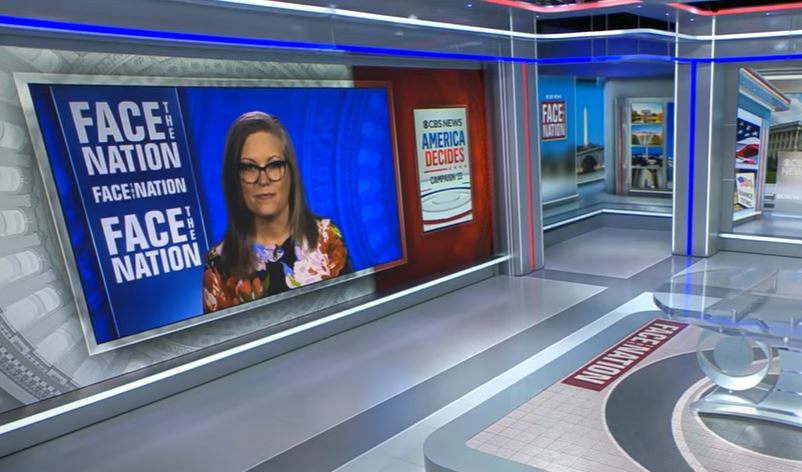
Hobbs’ remarks occurred during her 8-minute one-on-one interview with CBS host Major Garrett, as part of a “Face the Nation” segment that also featured a separate one-on-one with Lake. Concerning abortion limits, Hobbs stated repeatedly that no laws should exist limiting abortion.
“I support leaving the decision between a woman and her doctor, and leaving politicians entirely out of it,” said Hobbs.
Hobbs said she didn’t agree with the state’s 15-week limit on abortions. She didn’t denounce late-term abortions but claimed that they’re never elective.
When pressed about her refusal to debate Lake, Hobbs claimed that her opponent would create a “circus” of no benefit to voters. Hobbs refused to answer Garrett when he asked if she were strong enough to handle the “circus” Lake might concoct. Rather, Hobbs said voters had plenty of other opportunities to see her performance under crisis, referencing controversy over the 2020 election.
Hobbs said there were no circumstances under which she would debate Lake.
Hobbs again refused to answer Garrett when he asked who she considers responsible for the present border crisis, and whether the Biden or Trump administration policies were safer for immigrants. Rather, Hobbs said that decades of bad policies from both parties were to blame.
Garrett pressed Hobbs, reminding her that she’d criticized “current immigration policy” — which would be that of President Joe Biden’s administration. Hobbs admitted that Biden should do more to mitigate the border crisis, but didn’t say he was to blame. She noted that former President Donald Trump failed to fulfill his promise of a complete border wall.
“Biden does need to step up immigration and border security,” said Hobbs.
Hobbs also claimed that her economic plan, which includes upending Arizona’s universal school choice, would reduce inflation.
During her one-on-one interview, Lake took the opposite stance on all issues. Lake answered nearly all of Garrett’s questions directly, except for his question about whether she believed that President Joe Biden was the legitimate president. Rather, Lake said that distrust in elections has been a pervasive issue since the early 2000s. She said that the ability for people to question elections ceased with the 2020 election, though doubts over the 2016 election continue to be permitted.
“All of a sudden in 2020, we don’t have free speech anymore,” said Lake. “All I’m asking for is the ability to speak out: when our government does something wrong, we should be able to speak against it.”
Concerning her plan to form an interstate compact to secure the border, Lake explained that the Constitution granted her plan the legal authority to act. She disclosed that other governors agreed to join the compact.
“We meet all three criteria [of Article I Section X of the Constitution]: we have an invasion, our people are in danger, and time is of the essence,” said Lake. “I hope that Joe Biden doesn’t fight us, because then it will really look like he’s on the side of the cartels.”
Lake said that the “lust” for cheap illegal immigrant labor exists not only in Arizona, but nationwide. She pointed to House Speaker Nancy Pelosi’s (D-CA-12) press conference remarks that Republican-led states should welcome illegal immigrants because they can “pick the crops” there. Lake expressed concern not only for the quality of life for illegal immigrants,
On abortion, Lake said that she would uphold the law as governor. She said that she was for “true choices” which would entail more than just abortion. Lake asserted that abortion was the only choice offered at abortion clinics, not other choices like adoption.
Lake agreed with last week’s arrest of an Iowa man who threatened a Maricopa County supervisor over the 2020 election. She opined that the root cause of these threats were frustrations from restrictions on free speech and expression that occurred during the pandemic.
The latest polling shows Hobbs and Lake tied among likely voters.
Read the full transcript of the Hobbs and Lake interviews here.
Corinne Murdock is a reporter for AZ Free News. Follow her latest on Twitter, or email tips to corinne@azfreenews.com.
Katie Hobbs has her reasons for refusing to debate Kari Lake face-to-face in the race for Arizona Governor. But by doing so Hobbs is limiting the opportunities for Arizonans to hear her explain her history of supporting higher taxes while a member of the state legislature.
Hobbs, a Democrat currently serving as Arizona Secretary of State, has spent the last few weeks touting her promise to not raise taxes if elected. In fact, she is even promising to reduce taxes for many Arizonans even though it is doubtful that Democrats will control the legislature.
So with Hobbs making herself scarce for public questioning, voters are left to scrutinize her legislative history. And what can be found there casts doubt on her tax cut mantra.
Hobbs served in the Arizona State Senate from 2013 to 2019 and was Senate Minority Leader during much of that time. She also served one term as a member of the Arizona House of Representatives prior to the Senate.
In January 2018, Hobbs co-sponsored Senate Bill 1316 along with progressive Democratic Senators Juan Mendez, Jamescita Peshlakai, and Martin Quezada to eliminate the light class motor vehicle classification from Arizona’s fuel tax statutes.
But more importantly, SB1316 proposed to double the state’s per gallon motor fuel tax from 18 cents to 36 cents. The bill, which would have been one of Arizona’s largest tax hikes in state history, was so unpopular it was never heard by a Senate committee.
SB1316 is not the only time in Hobbs’ legislative history that she supported tax increases. In 2017, she was a fervent proponent of a sales tax increase that would have cost taxpayers between $500 and $600 million a year.
And back in 2015, Hobbs opposed critical legislation which was introduced to protect Arizonans from the effect of inflation on personal income tax brackets. The bill was eventually signed into law by Gov. Doug Ducey.
Hobbs’ legislative history on the subject of taxes is one reason organizations such as the Arizona Free Enterprise Club are encouraging voters to look at facts, not campaign speeches when it comes to Hobbs’ promise of tax cuts.
“Anyone who has followed Hobbs’ political career knows that this is just another outrageous lie,” AFEC posted Wednesday. “During her time in the state legislature, Katie Hobbs regularly opposed tax cuts for families while making it a habit to support multiple tax hikes….Hobbs has spent her political career trying to squeeze every possible dollar from your bank account.”