On Wednesday, the Arizona Supreme Court granted a review to gubernatorial candidate Kari Lake in her challenge of the 2022 election’s validity.
The court dismissed six of the seven issues presented by Lake. The one granted review concerned Maricopa County’s signature verification policies. Chief Justice Robert Brutinel determined that the trial court had wrongly dismissed this issue by interpreting it as a challenge to the policies themselves rather than the application of the policies.
The issue asks:
“Did the panel err in dismissing the signature-verification claim on laches, mischaracterizing Lake’s claim as a challenge to existing signature verification policies, when Lake in fact alleged that Maricopa failed to follow these policies during the 2022 general election?”
Lake alleged that Maricopa County violated A.R.S. § 16-550(A), claiming that a material number of early ballots cast in the election were transmitted in envelopes containing an affidavit signature that election officials accepted despite determining that it didn’t match the signature on that voter’s registration record.
In a press release, Lake characterized the ruling as a win. She called Maricopa County’s signature verification system “completely broken,” and claimed the county was “absolutely terrified” of transparency.
Court watchers say the court has remanded the signature verification issue to the trial court to reconsider the motion to dismiss on grounds other than laches. If the court determines there are no legally sufficient grounds to dismiss, then the court must hold a trial to review the relevant evidence to determine if an outcome determinative number of early ballots were accepted without appropriate signature verification.
While this ruling offers Lake the opportunity to review the signature process, it likely won’t change the outcome of the trial based on the lead in votes by Gov. Katie Hobbs: over 17,100. On the other hand, the court’s signal that it would allow a trial may be favorable for attorney general candidate Abe Hamdeh.
Hamadeh is recorded as losing the election to Democratic opponent, Attorney General Kris Mayes, by just under 300 votes.
"Not only is this the closest race in Arizona history, but it is also the race with the biggest recount discrepancy in statewide history. Making sure the legitimate candidate who received the most votes won is paramount for the success of democracy." https://t.co/Yy0ftm0ybu
Hamadeh appealed the election after the recount discovered that Pinal County undercounted hundreds of ballots, halving Mayes’ original lead from over 511 to under 300.
Mass failures of election machines on Election Day, specifically stemming from the printers, caused long waiting times at vote centers and, in some instances, caused voters to either be discouraged from voting or unable to vote due to time constraints. Those who did stay and were unable to cast a regular ballot due to tabulator issues were forced to cast provisional ballots. Over 17,000 voters filed provisional ballots.
Corinne Murdock is a reporter for AZ Free News. Follow her latest on Twitter, or email tips to corinne@azfreenews.com.
Kari Lake has announced she will once again seek review from the Arizona Supreme Court of her claims that she, and not Katie Hobbs, is the state’s legitimate governor.
It will be Lake’s third such effort since the Nov. 8, 2022 General Election, and comes after the Arizona Court of Appeals issued a Feb. 16 opinion upholding a Maricopa County judge’s dismissal back in December of Lake’s election challenge.
Lake has claimed in various legal pleadings that Hobbs’ victory by more than 17,000 votes was improperly influenced by myriad Election Day problems in Maricopa County. As a result, Lake has been seeking to have the county’s election certification voided in the governor’s race.
Her legal filings have argued that a judge should declare Lake as the rightful winner based on various evidence presented to the court. Or in the alternative, she wants an order for a new election in Maricopa County in the governor race.
Last week’s unanimous appellate opinion noted Lakes’ request for relief “fails because the evidence presented to the superior court ultimately supports the court’s conclusion that voters were able to cast their ballots, that votes were counted correctly, and that no other basis justifies setting aside the election results.”
The opinion authored by Chief Judge Kent E. Cattani and joined by Presiding Judge Maria Elena Cruz and Judge Pro Tempore Peter B. Swann came on the heels of two failed earlier attempts by Lake’s legal team to bypass the appellate court and have the Arizona Supreme Court hear the case.
Lake now has until March 20 to file a Petition for Review with the state’s high court. There is no guarantee, however, that the Justices will accept the case.
BREAKING: I told you we would take this case all the way to the Arizona Supreme Court, and that's exactly what we are going to do. Buckle up, America! 🇺🇸https://t.co/DXTi4WoEQ3pic.twitter.com/ik5sSqMz5P
Benjamin Franklin once famously said, “[I]n this world, nothing is certain except death and taxes” — true, unless you’re a leftist political nonprofit. For many of them, taxation isn’t certain, even if they run afoul of tax-exempt status requirements.
Funding sources, expenditure recipients, and even those operating these nonprofits may remain secretive under the current state of lax federal enforcement. These tax-free and opacity perks are possible through two interrelated federal tax classifications: 501(c)(3), or “C3,” and 501(c)(4), or “C4.” There are over 27,000 C3s and just over 1,200C4s registered in Arizona. The big difference between the two classifications is that donations to IRS-recognized C3 organizations are deductible under our income tax code. And the Left has learned how to exploit this tax status for their political benefit.
In Arizona, many liberal C3 and C4 nonprofits work in tandem, each executing symbiotic duties while coordinating their activities and sharing data and resources. Sometimes, these C3 and C4 duos are “sister” organizations — meaning, they’re affiliated rather than independent entities allied over common goals.
These arrangements are legal so long as clear distinctions are made between charitable and non-charitable activities. Over the last several months, AZ Free News has conducted an extensive review of over a dozen different liberal nonprofits in the state, examining their websites, tax documents, and social media accounts. Our research has found that many of these organizations have blurred the lines on their political activities via various C3 and C4 groups. In some cases, there appeared to be no distinction at all, with some C3 organizations providing completely different accounts of their tax-deductible program activities to the IRS compared to what they shared publicly.
How the IRS Intended for C3 and C4 Organizations to Operate
C3s have two major qualifiers: they’re supposed to be nonpartisan and apolitical—meaning, they can’t expend funds or use resources to coordinate with political activity being conducted by C4s.
C3s must organize and operate exclusively for purposes that are one or more of the following: charitable, religious, educational, scientific, literary, testing for public safety, fostering national or international amateur sports competition, and preventing cruelty to children or animals.
The IRS defines “charitable” as relief of the poor, the distressed, or the underprivileged; advancement of religion; advancement of education or science; erecting or maintaining public buildings, monuments, or works; lessening the burdens of government; lessening neighborhood tensions; eliminating prejudice and discrimination; defending human and civil rights; and combating community deterioration and juvenile delinquency.
The IRS expressly prohibits C3s from being an “action organization”: those engaging in political or legislative activities. Political activities include the direct or indirect participation or intervention in any political campaign on behalf of or in opposition to any political candidate. The IRS also prohibits political campaign fund contributions or public statements of positions, either verbal or written, on behalf of the organization in favor of or opposing any candidate.
The IRS does condone voter education activities, such as get-out-the-vote (GOTV) efforts like voter registration. However, any evidence of political bias is forbidden: favoritism of a candidate, opposing a candidate in any way, or “hav[ing] the effect of favoring a candidate or group of candidates.” Lobbying is also largely forbidden.
Comparatively, the IRS classifies C4 organizations into one of two categories: social welfare organizations or local association of employees. The former concerns civic leagues or organizations organized exclusively for social welfare promotion, not profit. The IRS clarifies that social welfare promotion doesn’t include direct or indirect participation or intervention in political campaigns on behalf of or in opposition to any candidate. Those that do must not render that activity as their primary activity, and risk being subjected to taxation. The latter concerns membership-based organizations with net earnings devoted exclusively to charitable, educational, or recreational purposes.
How Leftist C3 and C4s Operate in Arizona
Our review of leftist C3s in Arizona appears to indicate that their activities are overtly partisan and political. They coordinate with politically active C4s to achieve shared, partisan goals, and receive political action committee (PAC) funding while doing so. Often, these leftist C4s have either direct or indirect participation or intervention in political campaigns on behalf of or in opposition to one or more candidates.
Progressive activists leading these C3s have effectively mastered the art of exploiting the IRS code for partisan advantage, helping to maximize liberal donor partisan impact with their dollars while still hiding their identity. The C3s will claim that their allowable vote (GOTV) efforts, such as voter registration, are nonpartisan. They will claim they’re reaching out to certain, “marginalized” demographic groups; however, these groups turn out to be known Democratic voter bases.
One example of this is Mi Familia Vota Education Fund, the C3 sister organization of Mi Familia Vota, the C4. The former admitted on their 2020 tax filing to coordinating political activity with the latter. The executive director of Mi Familia Vota Education Fund, Hector Sanchez Barba, has publicly advocated for the losses of Republican candidates.
“We will keep working to keep extremism, Trump and MAGA out of our democracy,” wrote Sanchez Barba. “@MiFamiliaVota.”
In response to a Politico article documenting the GOP’s underperformance in last year’s midterm elections, Sanchez Barba thanked Latino voters for having Democrats win.
Meanwhile, their partner C4s pay for media and partisan activities like ad campaigns for candidates. It’s uncertain whether the funding for these activities comes from their C3 partners since those grant or cost-sharing agreements aren’t public. The IRS requires that C3 funds given to C4s be restricted to charitable uses — not electioneering activity.
The C3-C4 duo targets certain voter demographics to achieve a partisan outcome. They contact Democrat-leaning voters to get their vote cast, convince newly registered voters to vote Democratic through mailers and ads supportive of Democratic candidates and causes, and publicly support certain partisan ballot initiatives.
The C3-C4 sister organizations thinly veil their efforts that a division exists between them. For example, Mi Familia Vota spent tens of thousands on TV advertising that advocated for the election of Reginald Bolding ahead of last year’s primary. However, they listed a staffer for their C3 sister organization, Mi Familia Vota Education, as the point-of-contact on that campaign filing.
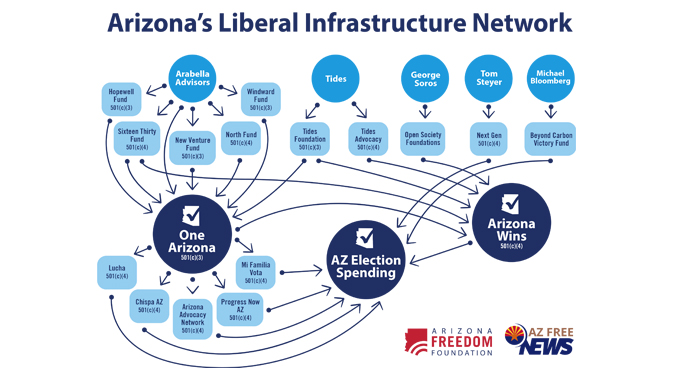
As AZ Free News reported in Part One of this series, Mi Familia Vota receives funding from One Arizona, a C3, which in turn receives its funding from the Tides Foundation, George Soros’ Open Societies Foundation, and several different organizations under Arabella Advisors.
.@RealMarkFinchem, a MAGAmigo, lies, & says that the 2020 election was fraudulent. If elected, he would use his position to help Trump. We are fighting for free and clear elections this cycle. Our democracy is at stake in Arizona, we must fight back. We say #BastaFinchempic.twitter.com/WPVSjflt2L
Ahead of the midterm election last June, One Arizona advertised a job opening for an independent expenditure (IE) campaign manager. The position appears to be one for a political staffer, which would constitute prohibited electioneering.
While not a complete pitcure, the above graphic illustrates some of the connections in the left’s secretive infrastructure and how they relate to Arizona elections.
Leftist C3s also hire for both the C3 and C4, resulting in shared jobs and salaries. One Arizona (C3) and Arizona Wins (C4) co-hired staff including a field director, field program coordinator, and finance and compliance director. That shared salary should not be used for political work. One recent example of this was a job listing by Arizona Coalition for Change (C3) and Our Voice Our Vote (C4) for a data manager that would work within the duo’s political and grassroots lobbying arms.
These blurred lines surrounding co-hires don’t just apply to staff. Arizona Center for Empowerment (ACE, a C3) and LUCHA (C4) share an executive director, Alejandra (Alex) Gomez, as well as staffers. This relationship is further complicated by the fact that ACE listed LUCHA as its “Employer of Record” on their latest tax return. Under Gomez, both organizations have expressed their partisanship.
Last year, LUCHA launched an initiative to get Democratic candidates elected: “LUCHA Blue.” The nonprofit pledged to prioritize certain races and voter bases in its GOTV efforts. On its hiring page for the initiative, LUCHA disclosed that it would staff between 70 and 105 people.
“We believe that not all candidates align with the mission of LUCHA, and this is why we created a campaign not only to flip Arizona Blue — but LUCHA Blue!” stated LUCHA. “Overall, the goal of the campaign is to win these targeted races, increase Latin/Hispanic voter turnout, and educate voters on the voting process.” (emphasis added)
In one post following Sen. Mark Kelly (D-AZ) winning re-election last November, LUCHA appeared to affirm that both it and ACE assisted in organizational efforts to assure Kelly’s victory.
Wealthy dark money donors have a greater financial incentive to back C3s. 75 percent of their donations can go to politics and qualify as tax deductible — effectively maximizing their gift-giving while affording them a tax break. C4 donations aren’t tax deductible.
The IRS has long been aware of the disparity between the lawful intent for C3 and C4 entities, and the current reality of C3-C4 relationships. As ProPublica revealed in 2019, the IRS essentially gave up on holding nonprofits accountable.
The following are some of Arizona’s liberal C3-C4 nonprofit duos: One Arizona and Arizona Wins, Arizona Center for Empowerment and Living United for Change in Arizona, Mi Familia Vota Education Fund and Mi Familia Vota Victory, Chispa AZ/League of Conservation Voters Education Fund and League of Conservation Voters, Arizona Coalition for Change and Our Voice Our Vote, Instituto Lab and Instituto Power, Rural Arizona Engagement and Rural Arizona Action, and Voto Latino Foundation and Voto Latino.
The relationships between these nonprofits and the awareness of their straining tax law will be further explained in the next installment of this series.
This is Part Two in a series on the Left’s secret infrastructure to turn Arizona blue. Be sure to sign up for our newsletter to be notified of Part Three in the series.
Corinne Murdock is a reporter for AZ Free News. Follow her latest on Twitter, or email tips to corinne@azfreenews.com.
Attorneys siding with embattled GOP gubernatorial candidate Kari Lake are insisting that Maricopa County’s mass Election Day failures were purposeful.
Mark Sonnenklar, a roving attorney with the Republican National Committee (RNC), told AZ Free News that the county experienced few of the issues during the primary election that suddenly metastasized on Election Day: faulty printer settings and incorrect ballot paper size.
Sonnenklar said that out of the 11 vote centers he visited on the primary election day, only one had major problems with tabulation: the North Phoenix Baptist Church location.
“My theory is that the county was on a trial run for the general. I believe in my heart, my gut tells me, that they planned to create this chaos on general Election Day,” said Sonnenklar. “They were testing methods to create that kind of chaos during the primary. That’s when they were figuring out how to do that.”
None have produced evidence that the Election Day failures were intentional.
Although tabulators were the initial suspect for the mass Election Day failures across the county, it turned out to be administrative errors prior to tabulation. Sonnenklar pointed out that it wouldn’t make sense for these issues to multiply due to the sheer amount of in-person voters, since printer settings and paper size wouldn’t be affected.
On Election Day, Sonnenklar said he witnessed mass tabulator issues at six of the 10 vote centers. The widespread failures were so pervasive that Sonnenklar, alarmed, reached out to other roving attorneys across the county to gather their experiences while fresh. Many reported witnessing the same failures, which lasted around eight hours and forced thousands of affected voters to cast ballots into a “door 3” slot to be manually tabulated later.
Maricopa County largely dismissed voter concerns, assuring that door 3 ballots would be tabulated properly and opting to push off a review of the chaos for a post-certification investigation. An estimated 71 sites (44 percent) out of the 211 vote centers were impacted (Lake’s attorneys claim that 132 sites were impacted, or 59 percent).
“I was receiving calls from everyone I knew in the Valley,” said Sonnenklar. “I knew there was a massive problem.”
Poll worker testimonies of election machine issues leading up to Election Day, given during the election certification in late November, aligned with Sonnenklar’s evidence gathered. Similar testimonies were also given during the Maricopa County Superior Court hearing in Lake’s lawsuit challenging the 2022 election results.
Sonnenklar stated that there were at least three primary causes of the tabulator malfunctions: timing marks and small white specks, which were uncovered before Lake’s trial, and incorrect ballot paper size, which was revealed during the trial.
Sonnenklar claimed that he spoke with election officials at various vote centers about the tabulator issue. He cited one example from a Mountain View vote center inspector who reportedly showed him that the timing marks weren’t printing correctly. The inspector backed up her claim with nearly 200 ballots fed into box 3 with faulty timing marks.
“She was definitive. She said that the problem was the timing marks on the ballot not printing dark enough,” said Sonnenklar. “She had 175 ballots that she had taken out of box 3. She showed me every one of those ballots and they were gray, they weren’t black. They hadn’t printed dark enough. All 175 of the ballots rejected by the tabulators had gray timing marks instead of black timing marks.”
As for the white specks: Sonnenklar said that another poll worker noticed that the bubbles indicating the chosen candidates weren’t filled in completely. They appeared to have little white specks where the printer failed to fill them in.
“He asked the voter if they would be willing to color in the white spec with the felt-tipped Pentel pens,” said Sonnenklar. “Every single time that the voter did that, it went through the tabulator just fine.”
The third issue, the ballot paper size, was discussed by Lake’s witness Clay Parikh, an information security officer, during the trial. Parikh testified that ballots from six of the six vote centers he inspected the day before Election Day printed 20-inch ballots on 19-inch paper. Sonnenklar noted that these six vote centers were selected randomly, and expressed concern that this represented a rate of 100 percent of vote centers being problematic.
Maricopa County didn’t dispute the erroneous ballot paper size, noting that it was a recurring issue over the last few years. However, they did dispute the number of affected vote centers (three versus Parikh’s sworn six) and pressed Parikh to admit that these ballots could be duplicated and counted. Parikh noted that those reprinted ballots could be counted, if done correctly. Sonnenklar questioned why the county didn’t solve the problem completely.
“The county maintained that the 19-inch paper on 20-inch ballots only occurred at three vote centers and that they knew about that problem from three prior elections,” said Sonnenklar. “Bottom line is, we think there were multiple reasons why the tabulators failed. In one case it was printers not printed properly. And in another case it was 19-inch paper printing 20-inch ballots.”
Sonnenklar insisted that the court wrongly dismissed Lake’s case because the judge, Peter Thompson, failed to consider whether the affected voters could’ve changed the outcome of the election. He said the judge only considered one legal standard, whether fraud occurred, but didn’t address if there was enough misconduct to render the election outcome “uncertain.” Sonnenklar contended that the judge created a high legal standard inconsistent with legal precedent.
Lake lost by over 17,100 votes, around the same number of voters affected by mass Election Day failures. Though this margin may seem slim, another race was even closer. Hamadeh, also contesting his election, lost by just over 500 votes.
“We just had to prove that the number of votes in the election could have changed the outcome of the election. I don’t think the defendants ever countered that,” said Sonnenklar. “On the legal front, I think we have a very strong grounds for appeal here. I think we made a pretty good case for overturning the decision of the trial court.”
Sonnenklar will be filing a reply brief to the county and Hobbs’ responsive briefs.
Corinne Murdock is a reporter for AZ Free News. Follow her latest on Twitter, or email tips to corinne@azfreenews.com.
From their pulpit at press conferences, they shrugged off questions and concerns about the potential for long lines on election day and whether they would have their voting centers properly equipped. For weeks, the mainstream media blasted out to Arizonans that they are competent election officials, about to implement the “safest, most secure” election in history.
Then it all came crumbling down in what was one of the worst election days in recent history. Long lines, yes. But more importantly, critical equipment failures resulted in the complete inability to tabulate ballots at dozens of voting locations for several hours. It didn’t stop there. The issues persisted in the coming weeks for Maricopa County, who responded to requests for information with hostility. And then, we found out Pinal County (following major problems in their primary election) had miscounted hundreds of ballots, shrinking the already miniscule gap between the candidates for attorney general.
Two months later, these issues are still being litigated. But regardless of how the election contests being pursued by Kari Lake and Abe Hamadeh turn out, nothing changes the fact that Maricopa and Pinal Counties bungled the election.
Going forward, Arizona must learn from what happened, craft meaningful solutions, and focus efforts on productive goals ahead of 2024…