The Trump administration has finally come to an agreement with Arizona and the other Lower Basin states on Colorado River water usage.
The news was met with a mixed reaction.
Gov. Katie Hobbs described the agreed-upon deal in an announcement on Friday as adequately protecting the state from the “disastrous and unacceptable forced federal water cuts” that were floated by the federal government earlier this month.
I'm glad the federal government has chosen to implement the Lower Basin's water allocation plan. We've protected Arizona from disastrous and unacceptable forced federal water cuts.
Together, we’ve proven that the Lower Basin will work in meaningful ways to protect the Colorado…
Under the federal government’s proposal, Arizona would have seen cuts up to 77%.
Under this deal, Arizona will lose about 61%: the most out of the Lower Basin states.
While Arizona will give up 760,000 acre-feet between 2027 and 2028, California and Nevada will collectively lose 490,000 acre-feet. Overall, the cuts represent a reduction of approximately 25%.
The Upper Basin states will not see cuts under this plan.
Brenda Burman, Central Arizona Project (CAP) general manager, said the Upper Basin states needed to pull their weight.
“Lake Mead should not be sacrificed to protect Lake Powell or other Upper Basin reservoirs, and every state that relies on the river should be part of the solution,” CAP General Manager Brenda Burman said in a statement. “The Colorado River needs to be treated as the system it is.”
Some of Arizona’s elected leaders issued stand-in statements in which they disclosed that they were still reviewing the plan.
Rep. Juan Ciscomani (R-AZ-06), co-chair of the congressional Colorado River Caucus, said that upon initial review the current plan avoids the “most drastic options” previously announced by the Trump administration. However, Ciscomani intimated that long-term solutions were still lacking in this latest plan.
“The goal is clear: long-term water certainty and security for Arizona,” said Ciscomani. “I will continue working with the Administration and bipartisan leaders at every level of government to protect this critical resource for our farmers, ranchers, businesses, tribes, and every Arizona family that relies on the Colorado River.”
Rep. Greg Stanton (D-AZ-04) said that the deal provided two years of “welcome” stability, but that it was only “another short-term fix” and not a lasting solution.
“[A] two-year reprieve is not a solution. The agreements holding this decision together must be durable, and a record-breaking drought won’t suddenly resolve itself,” said Stanton. “Every two years, this same threat of ‘CAP to zero’ will hang over Arizona’s head. That’s no way to run a system millions of people depend on for water, power and food.”
Rep. Yassamin Ansari (D-AZ-03) didn’t issue a statement on the plan, but did post on social media calling water “the lifeblood of Arizona,” promising “bold action to confront the climate crisis,” and including a link to the city of Phoenix’s water quality page.
Rep. Adelita Grijalva (D-AZ-07) issued a statement blending elements from colleagues Stanton and Ansari, calling for a more permanent solution among both the Upper and Lower Basin states while also urging action on climate change as the purported root causes of the prolonged drought.
Democrat Senators Mark Kelly and Ruben Gallego issued a joint statement simply expressing gratitude for the two years the plan afforded Arizona, and presented a lighter look forward at the road ahead for a more “lasting” plan of action. The senators also indirectly called on the Upper Basin states to take on some of the water-cuts burden as well.
“This decision provides much-needed certainty for Arizona and the Colorado River over the next two years,” Kelly and Gallego said. “The 2027 and 2028 guidelines protect Arizona from even deeper near-term cuts while giving the seven Basin states more time to reach a long-term agreement.”
Danny Seiden, Arizona Chamber President and CEO, said that the deal was “workable,” not perfect. Seiden credited state leaders for working in a bipartisan manner to accomplish the deal, specifically Hobbs, Senate President Warren Petersen (R-LD14), and House Speaker Steve Montenegro (R-LD29).
“We are still working through the details, but today’s decision appears to provide a workable path forward over the next two years and avoids some of the most damaging scenarios our state was facing,” said Seiden. “Arizona has already put real conservation and real cuts on the table, and the work now continues toward a long-term agreement that requires every Basin state to share in the responsibility. Arizona’s business community will continue to support our leaders as they fight for a fair, durable solution that protects our water and our economic future.”
Others weren’t so optimistic.
Scot Mussi, president of the Arizona Free Enterprise Club, called the deal “a total failure of leadership.” Mussi criticized the deal, saying it imposes water cuts on single family homes but not data centers and apartments.
This deal is a total failure of leadership. On top of that, this deal will place most of the cuts on new single family homes while data centers and apartments get unlimited water. Conveniently, those big water users happen to be some of your biggest campaign contributors. https://t.co/pLaenPuDCc
Democratic congressional candidate JoAnna Mendoza said immigrants are “the only folks” who will perform some jobs in Arizona’s agricultural industry in a resurfaced video highlighted this week by the Republican National Committee (RNC). She also cited construction, service-sector work, and caregiving as industries dependent on immigrant labor.
In the video, Mendoza discussed immigration’s effect on the labor force.
“Immigration. It’s also impacting our economy, labor. Here we have a huge Ag industry. So, you know, the only folks that will really do that are immigrants,” Mendoza said. “Cows that need to be milked twice a day, 365 days a year. You know, they don’t have the labor for it. Construction, service, service industries. We’re talking about caregivers in hospitals or, you know, that go to the home.”
Democrat Congressional candidate JoAnna Mendoza thinks that illegal immigrants are the only people who do manual labor:
“It’s also impacting our economy, labor. Here we have a huge ag industry so the only folks that will really do that are immigrants.” pic.twitter.com/geOdliJvSi
The RNC characterized the remarks as an endorsement of illegal-immigrant labor, but Mendoza did not use the term “illegal immigrants” in the excerpt provided to AZ Free News.
Mendoza, a retired Marine running against Republican Rep. Juan Ciscomani in Arizona’s Sixth Congressional District, has also questioned whether the Trump administration deserves credit for reducing illegal immigration.
In another video cited by Republicans, Mendoza was asked whether the Trump administration deserved any credit for slowing illegal immigration.
After 14 months of zero illegal aliens being released — JoAnna Mendoza lies that illegal immigration hasn’t slowed.
Q: Do you think the Trump admin deserves credit for slowing the flow of illegal aliens coming across the border?
“Unfortunately, we have not seen that play out,” Mendoza responded.
Federal border data show a sharp decline in Border Patrol apprehensions during President Donald Trump’s second administration. U.S. Customs and Border Protection reported that Southwest Border Patrol apprehensions during fiscal year 2025 fell to their lowest level since 1970.
The issue has particular significance in southern Arizona. The Tucson Sector, which covers much of the border area within and near the Sixth Congressional District, experienced a dramatic increase in encounters during the previous border surge. Federal data show encounters rose from approximately 66,000 in 2020 to more than 250,000 in 2022, according to the Department of Homeland Security’s Office of Homeland Security Statistics.
Mendoza’s criticism of federal border enforcement predates her current congressional campaign.
In a 2019 letter to the Casa Grande Dispatch, published by PinalCentral, Mendoza described then-President Trump’s proposed border wall as racist.
“Families across the nation are suffering and racism has found a new shape — the wall,” Mendoza wrote.
“The wall will not only be a waste of taxpayer dollars, but what will the presence of a wall do to future generations?” she continued. “It will be a symbol of racism and hatred. It will ignite anger and violence. As it stands, it’s already tearing our country apart.”
Mendoza wrote the letter shortly before Martin Luther King Jr. Day and connected her criticism of the wall to an encounter in which she said someone made racist remarks toward her.
More recently, Mendoza has sharply criticized Immigration and Customs Enforcement (ICE).
In one video excerpt from Meidas Touch, Mendoza said, “These ICE agents are not living up to their oath.”
Another video shows Mendoza calling for ICE operations to stop. “First and foremost, what we need to address is… we need to stand down for ICE and all ICE operations right now, because an external, independent investigation needs to happen,” Mendoza said.
Arizona Democrat JoAnna Mendoza wants to put innocent Americans at risk to stop ICE from arresting violent criminal illegal aliens.
In a separate clip from Meidas Touch, Mendoza compared conditions under current federal immigration enforcement to those of a developing country. “Like we’re living in a third world country,” Mendoza said. “I never thought I would see the government and its federal law enforcement agency turn against the American people.”
In more recent appearances, however, Mendoza has argued that ICE should continue receiving federal funding while operating under greater oversight. In a March 2026 op-ed highlighted by her campaign, she wrote, “The answer is not to defund law enforcement – it’s to fund law enforcement with intention. That includes ICE.”
The RNC seized on Mendoza’s earlier remarks as the Sixth District race heads toward November.
“JoAnna Mendoza wants Arizona to be full of criminal illegal immigrants and let the inmates run the asylum,” RNC spokesman Nick Poché said. “That is not serious border security – It’s a recipe for more of the chaos southern Arizona already endured.”
Ciscomani has made border security a central issue during his tenure in Congress. His congressional office lists multiple border-focused bills introduced during the 118th and 119th Congresses.
Among them is the Agent Raul Gonzalez Officer Safety Act, H.R. 35, which establishes federal penalties for individuals who intentionally flee Border Patrol agents, or law enforcement officers assisting Border Patrol, in a motor vehicle within 100 miles of the border.
Congressman Juan Ciscomani (R-AZ-06) has once again been ranked as Arizona’s most bipartisan member of Congress, earning an “A” grade and a 97.5 Bridge Score in the latest Bridge Grades report evaluating members of Congress.
The score, based on data through June 30 2026, places Ciscomani among the top 20 most bipartisan members of the entire House. His 97.5 score is more than double the House average of 44.9.
Bridge Grades, a nonpartisan project of the Mediators Foundation, evaluates members of Congress based on how collaboratively or divisively they govern.
The organization uses third-party data examining legislative records, bipartisan bill sponsorship and co-sponsorship, public statements, rhetoric, and other measures of congressional collaboration.
According to the organization, “bridgers” are lawmakers who build bipartisan consensus and coalitions, while “dividers” pursue more partisan approaches to governing.
For Ciscomani, the latest recognition marks the second consecutive time he has received an “A” grade from the Bridge Grades.
“Getting results for Arizona families means working with anyone willing to find solutions, regardless of party,” stated Ciscomani. “I was sent to Congress to deliver common-sense, lasting results for Arizonans, and I will keep fighting to deliver real, tangible outcomes for our local communities. This recognition again reflects the hard work of my team and our commitment to ensuring Southern Arizona has a seat at the table in Washington.”
Ciscomani’s bipartisan ranking comes alongside his record of legislative activity during the 119th Congress.
According to data cited by the congressman, he has introduced 32 bills, with 10 passing the House of Representatives, as well as bringing tens of millions of dollars in federal investment back into Arizona.
The congressman has also been recognized for his legislative effectiveness. The nonpartisan Center for Effective Lawmaking previously ranked Ciscomani as the most effective member of Arizona’s congressional delegation during the 118th Congress.
As a member of the House Appropriations and Veterans’ Affairs Committees, Ciscomani has focused on issues including national security, veterans’ services, border security, Arizona’s water resources, and federal investments in local communities.
The latest Bridge Grades recognition adds another national bipartisan distinction to Ciscomani’s record as he prepares for another general election campaign in Arizona’s Sixth Congressional District, where he faces Democratic nominee JoAnna Mendoza.
“Voters who want lower costs, safer communities and funding for local priorities trust Representative Juan Ciscomani to break through the D.C. noise and get results,” stated NRCC Spokesperson Ben Petersen. “But far-left lobbyist Joanna Mendoza would jeopardize Arizonans’ priorities for her extreme agenda, raising taxes and risking their safety.”
“Working down the aisle” has remained a central theme of Ciscomani’s congressional record with his office pointing to bipartisan legislation, federal funding for Arizona communities, and legislation addressing issues ranging from veterans and critical mineral to economic development.
Ethan Faverino is a reporter for AZ Free News. You can send him news tips using this link.
By U.S. Secretary of Agriculture Brooke L. Rollins |
Recently, I visited the port of entry in Douglas, Arizona, which has been traversed by cattle nearly 150 years. Last year alone, over 57,000 live cattle were imported into the United States from Mexico through the port—that is, until we closed it in May 2025 to protect American livestock from the New World screwworm (NWS). Thanks to our round-the-clock efforts, in partnership with state and local animal health officials, it is now safe to begin a coordinated, phased reopening of southern cattle ports.
Every model showed NWS entering our country by late summer of 2025, but by increasing oversight of containment efforts in Mexico and strengthening border protections, we bought critical time to prepare. Since January 20, 2025, the Trump administration has invested a record $1.3 billion in emergency funding to combat the pest—one of the largest animal health responses in U.S. history.
Our defensive plan is robust. We have expanded the number of staff working on NWS by 1,000 percent, and over the past two months, we have conducted more than 1,000 drone flights observing over 21,000 wildlife in Texas. To prevent NWS from reproducing, we are also dropping 100 million sterile flies per week over Texas and Mexico. This spring at Moore Air Base in Texas, we opened a new sterile fly dispersal facility and broke ground on a sterile fly production facility. Last month, a production facility we helped upgrade in Metapa, Mexico, officially opened, and another facility we support in Panama is currently producing sterile flies at maximum capacity.
But we’re not stopping there. In Arizona, I announced a $25 million U.S. Department of Agriculture (USDA) investment to construct a brand-new sterile fly dispersal facility in the Grand Canyon state, which is coming into being thanks to the visionary leadership of Arizona’s own U.S. Representative Juan Ciscomani. Ranchers can rest assured that we are working with state officials to advance this project as soon as possible. Sterile flies were key to eliminating NWS from the U.S. in the 1960s, and they remain so today.
Just as important are surveillance and preparedness on the ground, which are led in Arizona by the Arizona Department of Agriculture, and in Texas by Governor Abbott, the Texas Animal Health Commission, and the Texas Parks and Wildlife Department. The Trump administration is reinforcing their efforts at every turn, including by ramping up outreach to producers and veterinarians and monitoring over 120 dedicated NWS traps and over 8,000 fruit fly traps along the border.
The results have been remarkable. Since the first confirmed case of NWS in the U.S. on June 3, the same month only saw 31 total cases within our borders, all of which are now inactive. Even better, July saw just 12 cases, and only 3 cases overall are active today. To put that in perspective, Mexico had over 30,000 cases last year alone. Clearly, our efforts are bearing fruit.
The fight is not over, but as the presence of NWS declines, so does the threat to our ranchers. That’s why it is now safe to reopen U.S. livestock ports of entry on our southern border, which have historically played a critical role in the American cattle trade—especially in recent years, as the U.S. cattle herd has reached a 75-year low. Live imports from Mexico make their way to U.S. feedlots and eventually end up on dinner tables across America.
The port in Douglas will be the first to reopen on August 24 due its low-risk profile and because the bordering Mexican state of Sonora remains the lowest-risk Mexican state for NWS and maintains some of the strongest livestock inspection and movement controls anywhere in Mexico. After evaluating the success of the initial reopening, we will then consider reopening the ports in Santa Teresa, New Mexico, and Columbus, New Mexico, to live cattle, bison, and horses.
Make no mistake, these reopenings are contingent on Mexico making continued forward progress and meeting all enhanced USDA requirements. Every animal entering the U.S. will fully comply with our comprehensive import protocol, which requires preventive treatment for NWS, multiple inspections before an animal approaches our border for import, and inspection by USDA for any trace of NWS.
If at any point we determine there is an imminent threat to our domestic herd, we will not hesitate to immediately pause the reopenings. Protecting American livestock will always come first, and we will continue using every tool at our disposal to support the ranchers who raise them and to eliminate NWS once and for all. Our nation’s food security—and, therefore, our freedom—depend on it.
Brooke Rollins serves as the U.S. Secretary of Agriculture
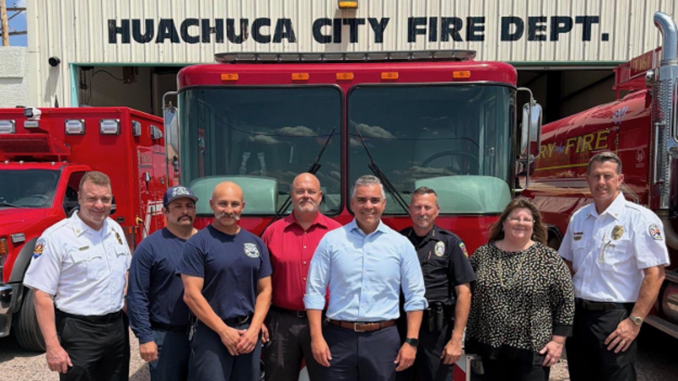
Congressman Juan Ciscomani (R-AZ-06) met with Huachuca City officials Tuesday to discuss a $1.3 million federal funding provision intended to replace the town fire department’s aging ladder-equipped fire engine.
The congressman visited Huachuca City this week and met with local leaders and fire personnel about the proposed purchase. The funding remains preliminary and has not been distributed to the town.
The provision appears in H.R. 8646, the Agriculture, Rural Development, Food and Drug Administration, and Related Agency Appropriations Act for fiscal year 2027. The House passed the bill 213-210 on June 4, and it was received by the Senate on June 8. Senate approval and enactment of the appropriations legislation are still required before the funding becomes available.
Grateful to see firsthand how the $1.3 million in federal funding I preliminarily secured will strengthen fire response in Huachuca City and across the region.
Proud to fight for this meaningful investment, which will bring a much-needed quint ladder truck and help keep #AZ06… pic.twitter.com/p5j5qGuHhg
— Congressman Juan Ciscomani (@RepCiscomani) August 12, 2026
Ciscomani’s Community Project Funding disclosure identifies Huachuca City as the intended recipient of $1.3 million for the “Community Fire Protection and Regional Mutual Aid Ladder Truck Acquisition Project.”
The money would replace an aging fire engine with a quint ladder truck equipped with a 78-foot Viper aerial. According to the disclosure, the apparatus would be used for fire suppression, rescue operations, and emergency response.
Huachuca City’s existing ladder-equipped engine dates to 2008 and is approaching the end of its service life. It is currently the department’s only apparatus equipped with a ladder. The town relies on grants and federal funding to finance large equipment purchases.
The proposed truck would be stationed in Huachuca City and made available for regional mutual-aid responses. Ciscomani’s disclosure states that the apparatus would also support emergency operations in Sierra Vista, Fort Huachuca, Whetstone, and unincorporated areas of Cochise County.
“This has different layers of purpose,” Ciscomani told KGUN while discussing the project’s regional role.
Huachuca City Mayor Johann Wallace said the purchase would give the department approximately 20 additional years of apparatus service and allow it to continue assisting other communities throughout Cochise County.
The Huachuca City proposal is among 20 fiscal year 2027 Community Project Funding requests supported by Ciscomani. His office announced in June that the fire-truck provision and two other projects in Arizona’s Sixth Congressional District had been included in the House-passed agriculture appropriations bill.
According to a press release from Ciscomani’s office, the proposed funding for Huachuca City is included among a total of $7.3 million in FY2027 funding for Cochise County.
“As Arizona’s sole appropriator in either the House or Senate, I have made it my mission to be a relentless advocate for Southern Arizona by listening to the needs of our communities and fighting to bring those priorities to Washington,” Ciscomani said.
“Every Community Project Funding request I champion is driven by local leaders and the people they serve, ensuring taxpayer dollars are invested where they will have the greatest impact. These meaningful investments in Cochise County will improve and strengthen public safety by equipping our first responders with the tools necessary to do their job effectively, such as replacing an aging fire engine with a new quint ladder truck, to ensure that across Cochise County they are prepared to meet the moment when it matters most.”
H.R. 8646 remains pending in the Senate. The Huachuca City allocation will depend on the project remaining in the final appropriations legislation approved by Congress and signed into law.