by Diana Furchtgott-Roth | Apr 7, 2024 | Opinion
By Diana Furchtgott-Roth |
Originally published by The Daily Signal.
One week the Environmental Protection Agency comes for our gasoline-powered cars, the next for our diesel-powered trucks.
EPA chose Good Friday, when many Americans were preparing to celebrate Easter Sunday (if not Transgender Day of Visibility), to release a new rule requiring that 25% of truck sales be electric by 2032.
Practically everything Americans use comes by truck, either all the way from the producer or from ports or railroad terminals. That’s why, if electric truck and charging technology existed, EPA’s new rule would raise costs of everything Americans buy, resulting in higher prices for goods and services and inflationary pressures throughout the economy.
All this at a time when the Federal Reserve is trying to get inflation down to 2%.
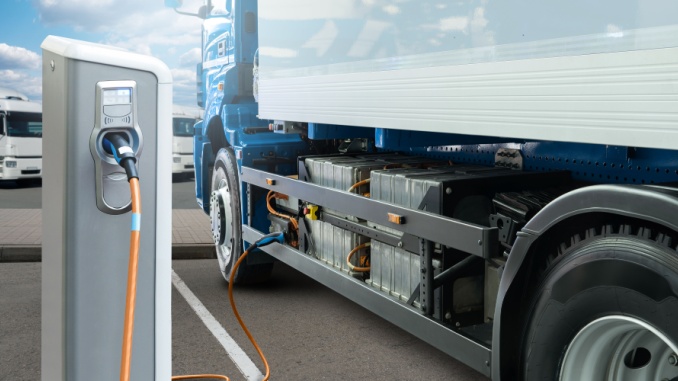
But America doesn’t have the electrical grid capacity, the charging stations, or the technology to operate long-haul electric trucks, and the nation won’t have them by 2032.
Trucking and utility companies would have to invest almost $1 trillion in charging infrastructure before electric trucks could be operational. EPA’s goals either will have to be discarded or moved steadily into the future.
The electric truck rule follows regulations released last month that would require 70% of cars and light trucks, such as pickup trucks, to be electric by 2032. Both these rules will face court challenges on the grounds that EPA exceeded its authority.
EPA’s stated rationale is to reduce emissions, but electrifying trucks would have minimal effect on global temperatures while raising transportation costs and therefore inflation.
The differences in the costs of diesel and electric trucks are monumental, and only a government official with no trucking experience could consider one a substitute for another.
A diesel truck costs about $120,000; an electric truck costs in the range of $450,000 to $500,000. Trucking companies would have to raise prices to cover these costs, and small trucking companies simply couldn’t afford the higher costs and would go out of business.
Not only that, but a proposed power plant rule from the EPA, soon to be released in final form, would make electricity more expensive. This rule, not mentioned in EPA’s vehicle tailpipe regulations, would require power plants to sequester 90% of their carbon emissions by 2039 or close in 2040.
Although smaller commercial trucks, including school buses and utility trucks, often travel locally and can be charged at depots overnight, heavy-duty trucks transport goods for long distances. These larger electric trucks can’t carry loads as heavy as diesel trucks do, because they lose range. So businesses need more trucks to carry a given volume of product, which raises transportation costs.
Electric trucks now have a range of 230 to 310 miles, and generally must stop and recharge when battery strength falls below 20%. Truckers would have to recharge every 180 to 250 miles, which can take one to two hours.
Long-haul electric trucks also can’t travel as many miles in a day, because truckers are limited to 11 hours on the road, and recharging time comes out of that.
Truckers are already in high demand, with 80,000 estimated job vacancies. Because of growing e-commerce, more trucks are needed, rather than fewer.
Requiring truckers to stop for two hours to recharge would reduce earnings and make these jobs less desirable. Some drivers would quit, and others would have to be paid more to remain on the job.
EPA calls the costs of truck electrification “billions of dollars’ worth of investments from trucking fleets, vehicle manufacturers, and U.S. states,” as though these investments would have a positive rate of return. But the costs would be borne by all Americans in the form of higher prices.
EPA’s massive project to reshape America’s transportation system would lower economic growth and increase the budget deficit as manufacturers attempt to comply with regulations and use green tax credits in the Inflation Reduction Act to waste resources investing in products that are unsuited to companies’ needs.
EPA justifies its regulation on the grounds that America would have cleaner air as a result. But electric trucks are not emissions-free and impose costs on the environment that gasoline-powered cars don’t.
Electricity for battery-powered vehicles comes from coal and natural gas, not renewable energy sources. Solar, wind, and nuclear power are generally fully used for other purposes; additional sources of energy to meet demand for electricity come from fossil fuels and hydropower.
Batteries for electric heavy trucks are produced in China using energy from coal-fired power plants. Producing batteries for electric vehicles uses carbon; the longer the range of the battery, the more carbon is used.
Large electric trucks need two 8,000-pound batteries. Miners have to move 500,000 pounds of earth to get enough critical minerals for one 1,000-pound passenger car battery, according to physicist Mark Mills, and multiple quantities of these minerals would be required for electric trucks.
Mining for critical minerals is environmentally disruptive. America outsources the work to Asia, Latin America, and Africa.
In 2022, the Supreme Court concluded in West Virginia v. EPA that EPA had overstepped its authority in its 2015 Clean Power Plan by forcing states to shut down power plants. Chief Justice John Roberts described the plan as “a regulatory program that Congress had conspicuously declined to enact itself.”
Now, in a similar sleight of hand, the Environmental Protection Agency is trying to determine what vehicles are allowed on the road, adopting a program that Congress has not voted into law.
EPA wants to require the purchase of electric trucks because companies wouldn’t use them otherwise—just as the agency is requiring more passenger vehicles to be electric than Americans want to buy.
It is pure illusion to think that America’s commerce could run on electric trucks. The size and composition of the batteries, the network of charging stations, and the electricity to run those stations make this whole enterprise fantastical.
Far more people believe in the Easter Bunny than believe that EPA will succeed in this particular mission.
Diana Furchtgott-Roth is director of the Center for Energy, Climate and Environment and the Herbert and Joyce Morgan Fellow.
by Staff Reporter | Mar 30, 2024 | Economy, News
By Staff Reporter |
Inflation hasn’t discouraged Americans from spending to celebrate the upcoming Easter holiday. Analysts project a spending total surpassing $22 billion, with consumers explaining to them that Easter is an important tradition.
Despite record inflation and consumer goods increasing in price by more than double over the past several years, it appears that Americans still feel the holiday of hope and new life is worth the expense.
The projections come from the annual survey by the National Retail Federation (NFR) and Prosper Insights & Analytics (PIA). In a press release, NRF President and CEO Matthew Shay explained that Easter maintained its positive meaning for Americans.
“Each year, Americans look forward to the celebration of Easter and the renewal of time and traditions with loved ones,” said Shay.
NRF surveys date back to 2003. This year’s survey spanned about 8,400 adult consumers from March 1 to 6 with a margin of error plus one or minus 1.1 percent. A majority of Americans (81 percent) said they would celebrate Easter.
64 percent of consumers told survey analysts that they remain inspired to shop for Easter-related items because it’s tradition for them. The next-highest popular reason concerned spending time with family or friends (32 percent), while a close third (29 percent) shopped to capitalize on sales and promotions.
These projections account for food, clothing, and gifts in general. Respondents said they would spend an average of $177 per person. Unsurprisingly, the top-reported expenditures were equally candy and food, followed by general gifts, then clothing, then decorations.
Last year’s Easter shoppers set the record high at $24 billion, with about $190 spent per person.
Back in 2007, shoppers spent $14.5 billion. The 2008 recession did cause a decline in Easter shopping for several years; it wouldn’t be until 2011 that Americans would surpass 2007 Easter spending.
The annual survey also gauged how consumers planned to spend their Easter weekend. 57 percent mentioned cooking a holiday meal, 53 percent mentioned visiting friends and family, and 43 percent mentioned going to church. Only half of households with children planned to conduct an Easter egg hunt at home.
Discount stores were top of the list for Easter shopping destinations (53 percent), followed by department stores (40 percent), online retail (33 percent), local/small businesses (22 percent), and specialty stores (20 percent).
There were those surveyed who shared that they would not be celebrating Easter. 55 percent of that demographic said they would still take advantage of Easter sales, but would spend much less per person, around $20. The capture of their market has to do with how stores advertise and curate a shopping experience, explained PIA Vice President of Strategy Phil Rist in the NRF press release.
“The overall shopping experience itself also plays a role in purchasing behavior,” said Rist. “This year almost one-quarter of consumers said they were inspired to shop for Easter items from store displays and decorations as well as exclusive or seasonal products.”
AZ Free News is your #1 source for Arizona news and politics. You can send us news tips using this link.
by Elizabeth Troutman | Mar 25, 2024 | Economy, News
By Elizabeth Troutman |
Inflation persists due to record levels of spending over the past three years, according to Rep. David Schweikert, R-Ariz., in a speech on the House floor Thursday night.
Schweikert said the total deficit spending for FY24 will be dramatically higher than both the Congressional Budget Office (CBO) and the Office of Management and Budget (OMB) initially projected if the national debt continues to increase at the current pace of over $99,000 per second.
Last May, Congressional fights over the next speaker overshadowed the greater concern, the national debt, Schweikert said.
“And think of this — in that time, we were fighting over like $16 billion,” he said. “We’re borrowing about $9 billion a day. So we’ve gone how many months, and we’ve never gotten around to actually working on the real problems because of the theatrics around here.”
As a result, the Scottsdale-Phoenix area resident said the Congressional Budget Office missed its FY24 deficit spending projection by $1 trillion.
Interest spending alone is projected to top $1 trillion this fiscal year, he said.
“When I came here a couple of months ago and said we could be heading for $1 trillion [in interest spending], I got mocked. I even saw my colleagues go, ‘Schweikert, you’ve got to stop making things up!’ Well, turns out I’m right,” he said.
“We will spend all day fighting over a few million here, which is important, and I am willing to cut these things, but we’re picking up pennies off the ground as the avalanche is crushing us,” he continued. “Because that same day we fought over those millions, we borrowed $9 billion a day when we are fighting over millions. Understand, $1 trillion has 12 zeros. Start to work your zeros and understand the scale.”
Addressing inflation, Schweikert said America is paying the price for spending money in ways that did not actually spike productivity. He said subsidizing things does not yield the most efficient and cheap way to produce them.
Schweikert advocated for a level of competition so the best, fastest product is rewarded.
“The last two months, [inflation] hasn’t been going down the way it’s supposed to,” he said. “So expect these interest rates I just showed you to continue. And if you live in my neighborhood, if you live in the Scottsdale-Phoenix area — wonderful area, absolutely incredibly beautiful this time of year. From January 2021 to two months ago, if you’re not making 23.6% more, you are poorer today than you were in January 2021.”
Making Americans less sick with new healthcare technology is one of the most powerful things we could do to lower the national debt, he said. Six weeks ago, the FDA approved the first cure to sickle cell anemia.
“Artificial intelligence is about to have a revolution in bringing cures to market dramatically faster,” Schweikert stated. “We’ve actually now had the first couple of AI drugs designed to make it through the FDA.”
Schweikert said policies can make it possible to bring new drugs to the market without costing $100 million.
“Do we think about things we could do in farm policy and nutrition policy in helping our brothers and sisters live better, healthier, more prosperous, [improve their] ability to join the labor force, maybe family formation, crushing income inequality,” he asked his fellow congress members.
Elizabeth Troutman is a reporter for AZ Free News. You can send her news tips using this link.
by Corinne Murdock | Dec 17, 2023 | Economy, News
By Corinne Murdock |
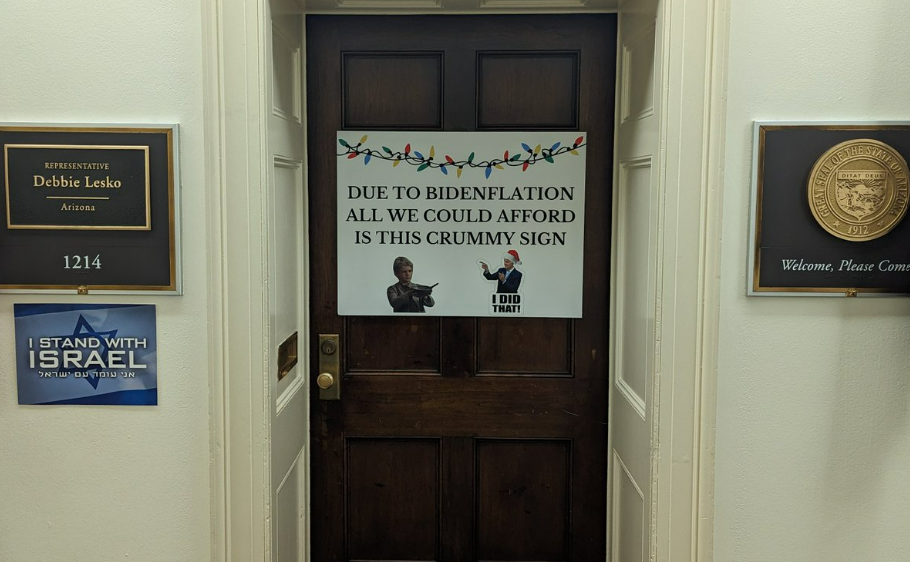
Rep. Debbie Lesko’s office showed off this year’s Christmas decorations available to them due to “Bidenflation”: a single, plain sign poking fun at historic inflation rates.
“Due to Bidenflation all we could afford was this crummy sign,” read the sign, with a classic depiction of Charles Dickens’ Oliver Twist begging for more food with an empty bowl of porridge, next to a picture of a Christmas hat-wearing Biden pointing at Twist with the caption “I did that!”
Lesko explained in a post that “Bidenflation” had a detrimental impact on her office’s tradition of decorating for Christmas.
“It’s a long-standing tradition that the second floor of Longworth is decorated for Christmas,” said Lesko. “My staff and I wanted to participate, but with Bidenflation who can afford it?”
The Bureau of Labor Statistics (BLS) reported last month that the Consumer Price Index (CPI) of all items increased by 3.2 percent compared to last year, with food at about three percent higher, all other items at four percent higher, and energy down over five percent.
On Tuesday, the BLS confirmed a .1 percent increase in the CPI last month, noting that overall cost of living reflected in the shelter index offset the decline in the energy index.
The greatest increases occurred in the cost of meals eating out, medical care commodities (drugs, medical equipment, and supplies), and services less energy services including shelter and transportation.
Meals at home increased by 1.7 percent: cereals and bakery products increased by 3.4 percent; meats, poultry, fish, and eggs increased by .1 percent; dairy and related products decreased by 1.4 percent, fruits and vegetables increased by .4 percent, nonalcoholic beverages and beverage materials increased by 2.9 percent, and all other foods increased by 3.3 percent.
Eating out increased by 5.3 percent: full service meals and snacks increased by 4.3 percent, and limited services and meals increased by six percent.
Energy commodities decreased by 9.8 percent: gas decreased by 8.9 percent and fuel oil decreased by 24.8 percent. Energy services decreased by .1 percent: electricity increased by 3.4 percent, while utility gas decreased by 10.4 percent.
Commodities less food and energy commodities sustained their price levels: new vehicles increased by 1.3 percent, while used cars and trucks decreased by 3.8 percent; apparel increased by 1.1 percent; medical care commodities increased by five percent; alcoholic beverages increased by 2.9 percent; and tobacco and smoking products increased by 7.7 percent.
Services less energy services increased by 5.5 percent. Shelter increased by 6.5 percent, with rent of primary residence increased by 6.9 percent and owners’ equivalent rent of residences increased by 6.7 percent.
Transportation services increased by 10.1 percent: motor vehicle maintenance and repair increased by 8.5 percent, motor vehicle insurance increased by 19.2 percent, and airline fare decreased by 12.1 percent.
Medical care services decreased by .9 percent, with physicians’ services decreased by .7 percent and hospital services increased by 6.3 percent.
Under President Joe Biden, the CPI hit a four-decade high last June: a 9.1 percent increase.
Annual inflation rates under former President Donald Trump averaged out to 1.9 percent: 2.1 percent in 2017, 1.9 percent in 2018, 2.3 percent in 2019, and 1.4 percent in 2020. The average annual inflation rates under Biden — factoring in 2021, 2022, and the latest inflation rate from this year — sits at over 5.5 percent.
These increases translate to Arizonans having to spend tens of thousands of dollars more for everyday necessities on average.
A study released earlier this year found that the average Arizona household must spend over $13,300 more to maintain the same standard of living they had in January 2021 — the state with the third-highest averages, just after Utah and Colorado.
The Thanksgiving dinner table may have also looked different this year. This year’s annual American Farm Bureau reported an average cost of $61 for a basic 10-person Thanksgiving dinner, down three dollars from last year but still eight dollars higher than 2021.
The average gas price in Arizona is currently at about $3.30.
Biden administration officials indicated to reporters this week that they anticipate 2024 will bring a continued decline in inflation. The Federal Reserve didn’t modify interest rates on Wednesday; Chairman Jerome Powell indicated that they would cut them next year.
Corinne Murdock is a reporter for AZ Free News. Follow her latest on Twitter, or email tips to corinne@azfreenews.com.
by Daniel Stefanski | Dec 4, 2023 | Economy, News
By Daniel Stefanski |
Americans are paying the price for an economy seemingly in decline.
A recent study, released by CBS News, showed that “the typical American household must spend an additional $11,434 annually just to maintain the same standard of living they enjoyed in January of 2021, right before inflation soared to 40-year highs.”
These numbers showed that Arizona has experienced the high-end of inflation and added cost-of-living expenses for residents. On average, Arizona households must spend $13,329 more than they did in January 2021. Only two states, Utah and Colorado, are ahead of Arizona.
One of the contributing factors to the higher costs of living in the Grand Canyon State might be the prices at gas pumps, which have consistently been more than many other states in America. Throughout 2023, Republicans at the Arizona Legislature have attempted to get to the bottom of the reasons for the above-average prices for gas. Earlier this fall, the Joint Legislative Ad Hoc Study Committee on Air Quality and Energy convened to hear from Michelle Wilson, the Regulatory Compliance Administrator for the Arizona Department of Weights and Measures.
After the hearing, the Committee issued a press release to publicize that Wilson “admitted the Hobbs Administration was passive when oil companies in March warned of refinery shutdowns,” adding “that according to Wilson, for the first time in five years, the Governor’s office received a request from refineries to ask the EPA for a waiver, allowing for an alternative fuel type to provide an adequate supply for drivers and preventing a hike in gas prices.” Yet after the Governor’s Office “had conversations with the EPA about submitting a request for a waiver, … the EPA convinced Hobbs to not submit one.”
“Rather than making a case on behalf of Arizonans struggling to fill their tanks with prices hitting $5 per gallon, Governor Hobbs chose to not push back against the EPA and was complicit with the Biden Administration’s pro-inflation, radical environmentalist agenda,” said Senator Sine Kerr, the Committee’s co-chair. “As a result of Hobbs’ inaction, Maricopa County drivers were forced to shell out an extra several hundred million dollars just to get to their destinations during this supply disruption.”
The national average for gas prices, as of November 29, is $3.246 for a regular gallon of gas, which is down from last year’s average of $3.521 at the same time. Arizona clocks in at above average at $3.490, down from $4.055 at this time in 2022.
The state’s cost of living is regarded as one of the country’s highest, regardless of the study used to compute the ranking. The MERIC 2022 Cost of Living Index shows Arizona as 37th (out of 50) while RentCafe has the state’s costs at six percent higher than the national average.
Arizona’s housing market is also a contributing factor to the state’s high cost of living. According to Redfin, the median sale price in Arizona is $438,000, compared to $414,633 for the entire U.S. market (as of October 2023).
Daniel Stefanski is a reporter for AZ Free News. You can send him news tips using this link.