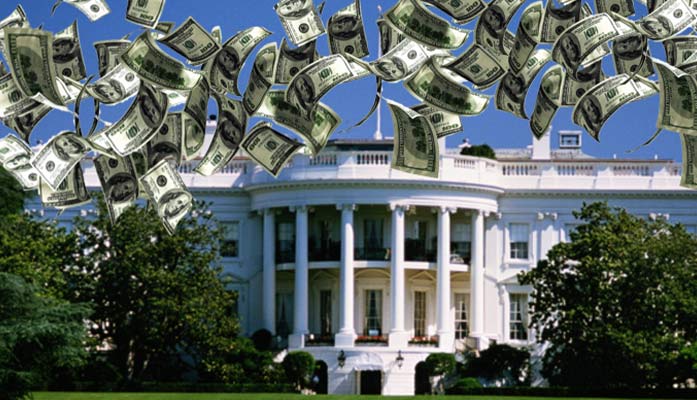
President Joe Biden’s skyrocketing, 40-year-high inflation levels have resonated with a historic worst for Arizona. Arizona households are spending an average of nearly $6,000 more on household necessities since the 2020 election.
According to the most recent report from the Common Sense Institute, a Phoenix-based research nonprofit, Phoenix inflation prices rose over eight percent in one year. The metropolitan area reached 11 percent price inflation, nearly three points higher than the nation’s average.
The institute noted that the current rate of increasing inflation would cause the cost of living in Phoenix to be higher than San Francisco’s cost of living by 2034.
Additionally, the cost of rent and housing grew by nearly 15 percent over the last year. The pandemic marked a record-high for the number of those moving to Arizona.
Yet, Biden declared that the last year marked positive changes lending to a “historically strong” economic foundation that would result in a decline in inflation.
We’ve laid an economic foundation that is historically strong.
Now we are moving forward to a new moment where we can build a future of stable, steady growth. So we can bring down inflation without sacrificing all of the historic gains we’ve made.
Governor Doug Ducey blasted Biden’s handling of inflation as a “disaster,” noting that Arizona families were paying an average of over $500 a month more in household costs.
President Biden’s inflation disaster is costing AZ families $500+ more per month in added household costs. Curbing the damage of Biden’s policies is a top priority. Cutting taxes is an answer. We’ve done so by adopting the lowest flat tax in the nation. https://t.co/Pq3AQfkahw
In a Wall Street Journal opinion piece succeeding Memorial Day, Biden blamed inflation on Russia President Vladimir Putin. Biden said that Putin’s warring impacted the energy market and supply chain. The president alluded to heavier intervention in the Russia-Ukraine war, with more aggression toward Russia, to uplift the flagging economy.
“We can’t let up on our global effort to punish Mr. Putin for what he’s done, and we must mitigate these effects for American consumers,” said Biden.
The president explained that the federal government would build a million more affordable housing units, and proposed using Medicare to negotiate with pharmaceutical companies. He also proposed recouping lost tax revenue from companies established overseas who benefit from international tax policies, and claimed that billionaires pay lower tax rates than working-class individuals like teachers or firefighters.
Biden also claimed that the job market was the strongest since World War II, though he didn’t distinguish between new jobs and those restored after the pandemic layoffs.
The most important thing we can do now to transition from rapid recovery to stable, steady growth is to bring inflation down. That is why I have made tackling inflation my top economic priority. My plan has three parts — read more about them here: https://t.co/5IUu0qbCaa
The president relied on the “kitchen table” illustration again to empathize with Americans’ struggles. (For context: there are over 40 speeches from Biden on the White House’s website in which he’s used the “kitchen table” illustration; it is unclear whether his speech writer has a penchant for kitchen tables or whether the term is meant to serve as a touchstone concept, but former first lady Hillary Clinton is credited for popularizing the term within the Democratic Party in the 1990s).
Secretary of State and gubernatorial candidate Katie Hobbs has picked up on the “kitchen table” illustration, though she hasn’t denounced the Biden administration’s handling of inflation.
From groceries to gas prices to child care to inflation, these are just a few of the kitchen table issues I hear about from Arizonans.
As Governor, I will tackle these—and more—to ensure our state is the best place to live, work, and raise a family.
Instead, Hobbs blamed Ducey and the Republican-controlled state legislature for not doing more to curb inflation. She insisted that her plan — Affordable Arizona — would mitigate inflation.
Once again, I’m calling on Gov. Ducey & our Legislature to put partisan politics aside, alleviate the burden of inflation & put money back in pockets by passing my Affordable Arizona plan.
Biden has denounced one specific plan from across the aisle by Senator Rick Scott (R-FL): a “12 Point Plan to Rescue America.”
Earlier this month, the president reiterated that the plan to bring down inflation consisted of taking a hands-off approach with the Federal Reserve. He then listed two end goals — lowering the cost of living and reducing the deficit — as part of the plan, without elaborating further.
My plan to tackle inflation is simple:
– Let the Fed do its job – Lower everyday costs for Americans – Keep reducing the deficit
By taking these steps — and with Congress taking action — we can build a sustained recovery that benefits all Americans.
The latest Internal Revenue Service (IRS) migration report revealed that Arizona gained about $4.8 billion aggregate adjusted gross income.
Over 247,600 were reported migrating into Arizona from all 50 states. Nearly 63,100 from California, over 15,700 from Texas, over 15,000 from Washington, nearly 12,800 from Colorado, and over 12,500 from Illinois.
During the same period, the state lost over 169,400 individuals: over 25,300 to California, over 16,500 to Texas, nearly 9,000 to Colorado, over 8,800 to Washington, and over 7,600 to Florida.
Based on the latest IRS data, the Wall Street Journal editorial board discovered a pattern: high-tax states lost the most aggregate adjusted gross income. The majority of those states were blue, with Ohio being the exception.
New York lost $19.5 billion, California lost $17.8 billion, Illinois lost $8.5 billion, Massachusetts lost $2.6 billion, New Jersey lost $2.3 billion, Maryland lost $1.9 billion, Ohio lost $1.4 billion, Minnesota lost $1.2 billion, Pennsylvania lost $1.2 billion, and Virginia lost $1.1 billion.
California has the highest individual income tax rate in the nation at over 13 percent, followed by New York at nearly 11 percent, and New Jersey and Washington, D.C. at 10.75 percent.
They noted that Florida gained $23.7 billion, Texas gained $6.3 billion, North Carolina gained $3.6 billion, Tennessee and Nevada gained $2.6 billion, Colorado gained $2.3 billion, Idaho gained $2.1 billion, and Utah gained $1.3 billion.
Florida, Texas, Tennessee, and Nevada don’t have an income tax. North Carolina, Colorado, and Utah have flat income tax. Idaho has a graduated-rate income tax.
Arizona’s graduated income tax rate ranges from those individuals making up to about $27,800 at 2.59 percent to those making between $166,800 to $250,000 at 4.5 percent. Those making over $250,000 pay one percent of their taxable income, plus just over $10,000 and a 3.5 percent surcharge.
Corinne Murdock is a reporter for AZ Free News. Follow her latest on Twitter, or email tips to corinne@azfreenews.com.
If Tax Day were held in early November instead of April 15th, I doubt Republicans would lose a close election again.
The financial squeeze of the Internal Revenue Service’s (IRS) filing deadline always feels personal. But it especially hurts this year. On top of President Joe Biden’s proposal to hike taxes on everything from capital gains to married couples, families across the country are suffering from another hidden tax: historic inflation.
The nationwide Consumer Price Index (CPI) increased by 7.9 percent as of last month. In Arizona, where the average price of gas now exceeds $4.60 per gallon, the Phoenix area is suffering from a CPI increase closer to 11 percent. Wherever you look, workers’ paychecks just aren’t going as far as they used to.
It’s wrong.
Florida and Texas have it right. People deserve to keep the money they earn. That’s why, if I’m elected as Arizona’s next governor, I plan to eliminate our state’s income tax once and for all.
Republicans need to stay on offense. Democrats in the Grand Canyon State dream of turning us into California. They have been aggressive in their efforts to do so, from pushing a 78 percent hike on small businesses at the state level to ramping up tax and fee increases at the local level.
Conservatives cannot allow ourselves to be pacified by simply stopping these bad ideas. We should feel equally comfortable moving in the opposite direction. And so far, thanks to smart policymaking by Governor Doug Ducey and our state legislators, we have been successful in doing so.
Over the past few years, Arizona has indexed the state income tax rates to inflation; conformed the state income tax to the Internal Revenue Code after passage of the Tax Cuts and Jobs Act; exempted military retirement from the state income tax; and passed into law a 2.5 percent flat tax representing the single largest tax cut in our state’s 110-year history.
Along the way, Democrats repeatedly warned that further reductions in the income tax would plunge us into turmoil and bankrupt government services. In reality, our state budget is in better shape than ever, with $5.27 billion in projected surplus revenue this year and plenty of room to return money to taxpayers.
Our economy is booming, too. We experienced the third-fastest economic recovery in the United States coming out of the pandemic, and we are expected to add more than 720,000 jobs over the next ten years.
These are the fruits of freedom. It is well past time to go further.
By eliminating the state income tax, we will create a business environment so welcoming to new investment that we’ll be beating businesses and entrepreneurs off with a stick. These job creators won’t pay any income tax. But they will pay property taxes, sales taxes, and more—and our tax revenues, along with our economy, will continue to grow hand-in-hand.
The bottom line is that hardworking families deserve to keep the money they earn, especially in inflationary times like these when the American Dream feels so far out of reach.
Zeroing out this tax—and ringing in Arizona’s final Tax Day—is not just the smart thing to do. It’s the right thing to do. I am the only candidate for governor who has endorsed it. And, as our next governor, it’s exactly what we will do.
Matt Salmon, a former U.S. representative and co-founder of the Freedom Caucus, is a Republican candidate for governor of Arizona.
Let’s face it. America botched its response to the COVID pandemic.
Traditionally, as in the Spanish flu and polio pandemics, authorities have recommended common sense public health measures and protected the vulnerable. This time, they ordered sweeping lockdowns of the economy and closed schools, churches, and businesses.
The results were economic devastation, educational stagnation, greater income inequality, and loss of civic life.
Sweden, even though it has a reputation for a more collectivist mindset than our “land of the free” got it right. Their health officials adopted a live-and-let-live strategy, mostly rejecting lockdowns and letting normal life go on.
Initially, health outcomes suffered some, partly because Swedes neglected to adequately protect their nursing homes. But today, probably because of herd immunity, Sweden’s death rate is just over 1614 per million, compared to 2335 in Britain and 2836 in the US.
Even better, Sweden avoided the multiple consequences Americans now face. GDP growth is projected to be 5% larger than pre-pandemic, and they don’t face a mountain of future debt. Since schools stayed open without face masks, there were no lost years of education and test scores are up.
Unfortunately, America’s response to the self-inflicted wounds caused by our COVID panic caused yet more harm. When confronted with the results of their mismanagement, America’s governing leftists reverted to their universal solution for all ills: spend more money.
So last March, President Biden triumphantly announced “help is here” as he signed the $1.9 trillion American Rescue Plan. We were assured that the truly massive spending would help defeat the pandemic, reopen schools, and revitalize the economy, creating at least 4 million additional jobs.
We now know the bill was a colossal failure. We didn’t get more jobs, but we did get ominous inflation even though Biden had insisted that “no serious economist” predicted inflation as a result of the spending surge.
The inflation was totally predictable. At least 1.8 million people declined to reenter the workforce when the $300 per week unemployment benefit supplement was extended. That’s understandable since one study indicated that in 19 states, a family of four with two “unemployed” adults could receive $100,000 in total government benefits.
Meanwhile, trillions more were pumped into the economy. This excess demand, combined with fewer goods and services being produced, was the perfect recipe for inflation, which “serious economists” now acknowledge is probably here to stay.
Why did the plan have no effect on COVID? Answer: it didn’t really try. PolitiFact concluded only 10% of the bill addressed COVID health impacts and 1% went to advancing vaccines, the most effective way to impact serious disease.
Instead, the ever-vigilant spenders saw their chance to enact a wish list and took it. Their dreams that came true included $20 million for “preservation of Native American languages,” raising Obamacare subsidies, and a massive expansion of the child tax credit.
Since the feds are sitting on so much surplus funding (sarcasm alert), $350 billion went to state and local governments to help them weather the pandemic. But even when the bill was being considered, it was already clear that state-local tax revenues were growing, and their budget crisis never materialized. It was simply an excuse for feds to shovel out money, mostly to their friends in Democrat states.
Public schools were also showered with $120 billion to help them reopen safely. But the funds came with no requirements attached. By the end of FYI 2022, only $40 billion will have been spent, leaving education administrators with an $80 billion slush fund. Thanks, COVID.
So, another $1.9 trillion accumulates onto our debt load, and we have precious little to show for it. We have fewer jobs than were predicted in the “baseline” without the bill, and there was minimal or no effect on the course of the pandemic.
Lesson learned? Nah. Biden preposterously proposes spending yet more on Build Back Better, an even larger collection of handouts, as an inflation cure. Yet our debt is not only higher than ever ($30 trillion) but rising interest rates now will make our debt service more expensive and hasten the Day of Reckoning.
The Biden/Harris administration is ignoring established budget tradition in their determination to spend yet more money.
Since the Reagan era, each federal budget has included a list of achievable spending cuts. The final Obama/Biden budget boasted of their averaging 140 cuts, saving $22 billion, yearly. Then-VP Biden headed up these cost cutting efforts as he did the spending reductions in the 2011 Budget Control Act.
Obama praised Biden‘s leadership in the Campaign to Cut Waste, calling him “the right man to lead it because nobody messes with Sheriff Joe.”
So Biden was justified in campaigning on his record of cost-cutting, which he did (although overall spending never fell during his tenure). But, as we have seen on almost every front, the rhetoric of candidate Biden meant nothing.
His initial budget was the first in 40 years to not include a section on savings. Instead, he withdrew President Trump’s final 73 rescissions, which would have saved taxpayers $24.4 billion, including several, such as the Commission on Fine Arts and the Presidio Trust, that had been included in earlier Obama/Biden reductions. His address to Congress in April in lieu of the SOTU contained no mention of waste reduction, nor has any other communication so far.
The contrast is striking. In 2011, President Obama proposed a $4 trillion deficit reduction over 12 years. We now know he fell far short of the mark, yet 10 years later, President Biden proposed a $14.5 trillion increase in deficits over 10 years. Success seems quite probable this time.
What’s going on here? Biden’s inference that there is no waste available in federal spending is laughable. State and local governments are awash in newfound largess. Unemployed beneficiaries have received so much compensation that millions have understandably quit their jobs.
Americans in no financial stress, nursing home residents and dead people by the millions have received COVID stimulus checks. Meanwhile, the Department of Education, an inconsequential agency that has overseen the decline of American education at all levels despite a massive funding surge, was given a $67 billion boost.
The tsunami of spending is relentless. Our national debt has now reached $28 trillion, including a 30 percent increase from spending on the Covid shutdowns alone. Federal spending this fiscal year is about $8 trillion, fully half of which will be put on the tab.
Biden’s next budget is $6 trillion, plus $6 trillion or so of additional spending on anticipated campaign promises. If Biden’s budget plan is adopted, the projected national debt would be $44,800,000,000 by 2031. Moreover, the current value of obligations to finance legal entitlement programs is $132 trillion more.
We are clearly on an unsustainable course. Easy money and goosing the economy with government spending can only take us so far. Eventually, our luck will run out when interest rates return to normal, creditors run out of confidence, inflation and lack of productivity gains take their toll or all of the above.
Technology may help some to delay the deterioration of our standard of living. But our descendants will be far worse off and America will be permanently damaged from our foolish selfishness.
Yet there is a preternatural calmness in Washington circles over the consequences of pushing massive debt out to future generations. When the ruling Left discusses their multi-trillion dollar spending proposals, they typically don’t bother to address the revenue problem. The fact that they are politically popular (and Biden’s “free” spending proposals are) is rationale enough in Dem World.
The spenders act as if spending itself is a social good. Deeply in debt, they spend for unnecessary frills like taxpayer-supplied benefits for illegal immigrants and middle class social programs.
They profess to believe that money will always be available so long as government can figuratively print more, but that is patently ludicrous. More likely, they just don’t care.
These are people who fervently believe in the power of Big Government to make life better, the overwhelming evidence to the contrary notwithstanding. The more money that is spent on anything, the larger their constituent base grows. As in the border crisis, the chance to maintain power drives policy.
Literally nothing else matters.
Dr. Thomas Patterson, former Chairman of the Goldwater Institute, is a retired emergency physician. He served as an Arizona State senator for 10 years in the 1990s, and as Majority Leader from 93-96. He is the author of Arizona’s original charter schools bill.