by Tiffany Benson | Aug 1, 2025 | Opinion
By Tiffany Benson |
K-12 superintendents are the CEOs of public schools, spearheading a cabinet of professionals who manage district resources and implement safety and academic programs. Superintendent qualifications may include a doctorate of philosophy (Ph.D.) or education (Ed.D.) and some experience in finance, communications, and organizational leadership.
Superintendents are paid exorbitant salaries topping close to $1 million, depending on the district size. This amount does not include performance bonuses, work vehicles, mobile devices, or lavish vacation packages—er, I mean, “out-of-state professional development conferences.” Whether superintendents do good or evil, employment agreements stipulate that they receive full compensation and benefits, largely at the taxpayers’ expense.
Arizona public schools are home to some of the most ethically challenged and morally questionable high-level administrators. K-12 superintendents across the Valley primarily care about aesthetics and the “business of the district.” Below is an incomplete list of superintendents with controversial reputations, alongside the elected officials who bow to their almighty paper-pushing agenda.
Newly hired Higley USD Superintendent David Loutzenheiser now sits on the dais with governing board members, leaving his cabinet on the floor. This arrangement was approved by the purple-haired board president, Amanda Wade, who once advocated for striking the word “immoral” from teacher-student communication policies. Radical board member Tiffany Schultz—who once declared that professional dress codes “sexualize children’s bodies”—backed Wade’s decision to disrupt the chain of command. No one but Loutzenheiser benefited from this stunt. He set a bad precedent for what’s to come. Read more in AZ Free News.
Earlier this year, a resident in the Cartwright Elementary School District sued two board members for nepotism, citing A.R.S. 15-421. Cassandra Hernandez (elected at age 19) is the daughter of board president and state representative Lydia Hernandez (D). Despite using different addresses on their campaign applications, constituents cried foul and called for their resignations. The Hernandezes led a charge to install the disgraced former Maricopa County Superintendent Steve Watson as district superintendent. Watson is accused of fraud and leaving behind an infestation of financial deficits, lawsuits, and dysfunction in the county office. Cartwright residents have no reason to expect Watson will leave their district any better than he found it.
Deer Valley USD residents constantly complain across social media about Superintendent Curtis Finch’s dismissive “leadership” style. Residents are also suspicious of Finch’s camaraderie with board president Paul Carver, who once told a room full of conservatives that Finch is the best superintendent in the state. Both men support a twice-failed ballot measure that would allow the district to exceed its budget. Finch defended the 15% override, stating: “The anti-public school movement is growing here in Arizona, which is a crime against humanity.” Whether or not good things are happening in DVUSD is up for interpretation, but declining enrollment numbers are the telltale sign of a district in freefall. Go Parents!
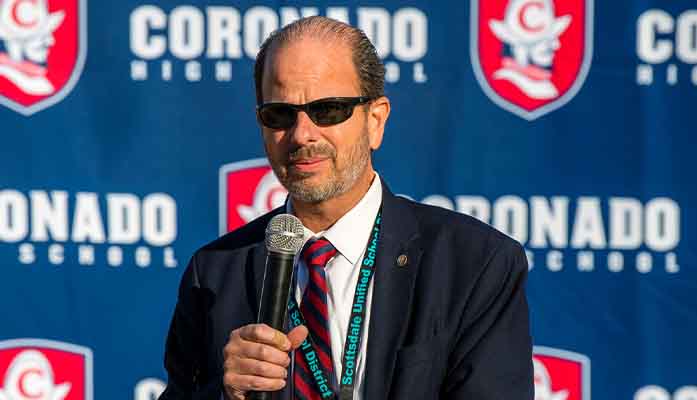
No list of sketchy superintendents is complete without Scottsdale USD’s Scott Menzel. He is a freak show in his own right, accounting for the majority of the district’s media exposure. Menzel is widely known for shaming white people who don’t feel guilty about their skin color. Before vacating their seats, debased board members Zach Lindsay, Libby Hart-Wells, and Julie Cienawski extended Menzel’s contract through 2025. Under his “leadership,” SUSD chartered more student-led sexuality clubs, adopted an anti-police curriculum, and circulated hundreds of pornographic books in school libraries. As a result, in 2024, the Arizona School Administrators organization proudly named Menzel the National Superintendent of the Year (this title must be reserved for clowns).
Peoria USD has a slightly better handle on its administration problem since board president Heather Rooks removed Superintendent K.C. Somers from the dais. This establishes a clear separation of employer and employee while respecting the expertise each brings to the district. Unfortunately, though, Somers is developing a reputation for operating in subtle forms of manipulation and subversion, as if he’s trying to sabotage the board members he can’t control. I once attended a meeting where Somers yowled at board members when they ripped off the COVID-19 funding band-aid. Interestingly, before coming to Arizona, Somers was the superintendent of a Colorado school district steeped in scandal and cover-up. He would do well to note that PUSD residents won’t sit for that.
(Dis)honorable Mentions: Tolleson Union HS Superintendent Jeremy Calles morally and financially bankrupted his district. Former Mesa Public Schools Supt. Andi Fourlis oversaw an untold number of social gender transitions without parental knowledge. Tucson USD Supt. Gabriel Trujillo encouraged and attended a student-led drag show on campus, even after one teen was sexually abused by a high school counselor who organized the opening event. Chandler USD Supt. Frank Narducci declared a “week of kindness” and distributed 9-1-1 stickers after unchecked bullying led to one student’s murder and another student’s suicide. There’s more, but we’re out of time.
Those who can’t get elected apply for high-power jobs. Most K-12 superintendents have no campaign grit and no winning personality. Thus, they depend on compromised board members to execute their agenda. Superintendents don’t represent the whole community—they represent the educated community. They may be intellectual experts, but they don’t swear an oath to the U.S. Constitution, and they are not the final governing authority.
The board of education—elected officials who report to taxpayers (that’s you!)—hires the superintendent, and they ultimately decide what to approve or reject. No one is demanding perfection. Arizona families simply want integrity, transparency, and common sense. K-12 community members who experience dissatisfaction with bloated, overcompensated administrative teams should call, email, request meetings, alert the media, and speak at school board meetings. When superintendents refuse to operate within the scope and ability of their job description, expose them.
Tiffany Benson is the Founder of Restore Parental Rights in Education. Her commentaries on education, politics, and Christian faith can be viewed at Parentspayattention.com and Bigviewsmallwindow.com. Follow on Facebook @TiffanyBenson and Instagram.
by Peggy McClain | Jul 17, 2025 | Opinion
By Peggy McClain |
Recently, the Peoria Unified Governing Board made a necessary correction: They removed the superintendent from the dais, restoring a clear boundary between the elected and the employed. While some saw this as dramatic, the only real surprise was that the line had been blurred for so long.
Unfortunately, the Higley Unified School District went the opposite direction, and they did it quietly.
At what should have been a routine meeting last week, Superintendent David Loutzenheiser, attending his very first meeting as head of Higley Schools, took a seat on the dais without any board vote or public discussion. And unfortunately, his first moves were not in line with what he promised when interviewed.
Immediately after the meeting began, Board Member Anna Van Hoek read a detailed statement opposing the new seating arrangement. Her opposition was not just personal, it was procedural. According to Van Hoek, she learned about the change via email, without any discussion or vote among the five board members. She stated: “The dais represents the authority entrusted to us directly by the voters.”
Van Hoek is absolutely correct.
Per Arizona Statute §15-503, governing boards in Arizona are responsible for hiring and evaluating the superintendent. When an employee sits on the dais as if equal to the officials tasked with his oversight, it blurs the lines of authority. That distinction may be lost on those with long careers in education, but in the private sector, these boundaries are well understood. There is a reason the CEO does not share the boardroom table with the board of directors. It is not about ego, it is about structure, accountability, and ensuring each role is properly respected.
Employees, even highly paid ones, are assigned responsibilities, expectations, and standards of behavior. If a superintendent is perceived as a peer rather than an employee, will board members evaluate him objectively when the time comes? That is not a rhetorical question as it became reality just minutes into the meeting when Board Member Scott Glover asked the superintendent if it was “okay” to table the vote on his dais placement. That single moment flipped the chain of command upside down.
Superintendent Loutzenheiser oversees a district with a budget exceeding $100 million and is responsible for hundreds of employees. He will hold meetings with principals, department heads, and administrators to carry out the board’s direction. Will any of them be invited to sit beside him at his desk? Of course not. And yet, some expect him to sit shoulder to shoulder with his bosses. It is not just improper, it is dysfunctional.
According to Van Hoek’s statement, the superintendent requested to move to the dais, and Board President Amanda Wade approved the request entirely on her own. When Van Hoek received the email, she immediately requested the seating change be added as an action item for the July 8 board meeting. Had she not spoken up, the change would have gone forward without any transparency, just Wade’s quiet approval. That would have set a dangerous precedent.
While Loutzenheiser initiated the request, the greater failure lies with President Wade, who acted without board consensus. Tiffany Shultz, another board member, responded to Van Hoek’s concerns by claiming the new arrangement promotes collaboration and a “united front.” Yet collaboration was not on display in that email from the superintendent to board members. And the role of an elected official is not to present uniformity, but to represent the full range of community concerns, especially when those views differ.
There is no legal or ethical requirement for a school board to look united. In fact, the opposite is true. Voters should expect to see board members raise concerns, challenge decisions, and vote independently. When votes are unanimous and debate is absent, the public should worry, not applaud. Disagreement is not dysfunction. It is how oversight works.
Sadly, the obsession with unity and harmony is a symptom of a broader trend in public education, one fueled by Social Emotional Learning (SEL). SEL prioritizes emotional well-being and interpersonal bonding over academic rigor and role clarity. This focus has blurred the lines between teachers and parents, students and staff, and now board members and the superintendent. Meanwhile, test scores fall and academic achievement stalls.
The confusion SEL has introduced into the system is precisely why the Arizona Legislature passed laws like the Parents Bill of Rights, to restore proper authority to parents. In the same way, this dais debacle exposes a need to restore proper authority and boundaries at the board level.
President Wade claims she values her fellow board members. If that is true, why didn’t she involve them in the decision? Her words and actions while sitting on the dais say otherwise.
It is important that the public can identify district staff in their designated spaces. I have attended many board meetings and am shocked at the whispers and private conversations happening on the dais between board members. Now, the same thing can happen between the superintendent and whichever board member is seated beside him. That is a problem.
Superintendent Loutzenheiser is under a three-year contract with a base salary of $210,000, not including perks and bonuses. With that kind of compensation comes an obligation to honor the governance structure. If he wants to begin his tenure with integrity, he should respectfully return to his proper seat off the dais at the next board meeting.
It may seem like a small gesture. But it would speak volumes.
Because the dais is for the elected, and it must stay that way.
Peggy McClain is a concerned citizen who advocates for accountability in Arizona’s schools. You can follower her on Twitter here.
by Staff Reporter | May 22, 2025 | Education, News
By Staff Reporter |
Editor’s Note: A Higley Unified School District spokesperson has denied that the Quran was taught to Pre-K students. The spokesperson has claimed that that social media post (see below) was due to an autocorrect error that changed Qatar to Quran. AZ Free News attempted to recreate the autocorrect error with no success. A search of Google AI indicates that “Qatar” is not likely to autocorrect to “Quran.”
An East Valley school is coming under fire from parents for teaching the Quran to pre-kindergarten students.
Children involved in the PreK THINK! Highly Gifted Academy at the Sossaman Early Childhood Development Center within the Higley Unified School District (HUSD) got an impromptu lesson on the Islamic religion this week.
A teacher for gifted students, Janet Williams, allowed the father of one student to teach the class about the Quran. In a picture posted by Williams to a forum frequented by parents, a father wearing Islamic garb offers the children to inspect his clothing.
“We celebrated [a student’s] birthday and his dad told us all about Quran,” said Williams.
Peggy McClain, who runs the Not in Our Schools website, questioned the legality and fairness of the school allowing a lesson on the Islamic religion.
“Where is the separation of church and state we are always lectured about?” asked McClain. “Look what happened in a Pre-K in a Higley District school, they discussed the Quran.”
A parent asked whether HUSD would allow their daughter to teach the Mormon religion to students next.
“Since you’re allowing members of the community to come in and share their religion, my daughter is a missionary for the LDS church and would love to stop by with treats and a quick message about Jesus Christ,” said the parent. “My Catholic and Jewish friends want their turn, too.”
Schools may not compel religious action, such as prayer. Coercion violates the separation of church and state, according to the advocacy group Secular Arizona. Schools may also not distribute religious materials, or present religious content as true or false, or present religious doctrines or beliefs as factual.
“It is easy for a teacher to give students the impression that submitting to an unwanted religious exercise is required, expected, or preferred, even if you don’t mean to do that,” stated Secular Arizona. “Students have an absolute right to be free from that pressure.”
Arizona’s chief executive and legal officer are vocally opposed to religious influence in public education. Both women have consistently maintained that religion in the classroom violates the “separation of church and state” — not an exact phrase enumerated in the U.S. Constitution but a concept derived from the First Amendment’s Establishment and Free Exercise clauses.
The Establishment Clause prohibits Congress from making laws establishing religion, while the Free Exercise Clause stops Congress from making laws prohibiting the free exercise of religion.
Last year, Governor Katie Hobbs vetoed a bill approved by the legislature to allow schools to post the Ten Commandments in classrooms.
Hobbs asserted in her veto letter that the display of the Christian religious text was not only not essential for education but likely unconstitutional.
“Not only do I have serious concerns about the constitutionality of this legislation, it is also unnecessary,” said Hobbs.
Last month, Attorney General Kris Mayes joined 17 attorneys general in a legal fight before the U.S. Supreme Court against the creation of the nation’s first publicly funded religious charter school.
“Charter schools are not private schools – they are public schools,” said Attorney General Mayes. “Allowing religious charter schools would force states to choose between violating the Constitution or dismantling their public charter systems.”
In 2023, HUSD again irked parents when it relaxed its dress code policy to allow for clothing which expose the chest, abdomen, and midriff.
AZ Free News is your #1 source for Arizona news and politics. You can send us news tips using this link.
by Staff Reporter | Apr 25, 2025 | Education, News
By Staff Reporter |
Scottsdale Unified School District (SUSD) parents are attempting to reverse the relaxation of the district’s dress code.
SUSD surveyed Scottsdale Parent Council (SPC) members about the district’s dress code, which parents criticized for failure to indicate a requirement for students to cover their midriffs.
The survey, shared by Scottsdale Unites For Educational Integrity (SUFEI), only included “genitals, buttocks, chest, and nipples” in its description of “private body parts” in a question to parents about appropriate student clothing.
SUFEI urged parents to respond to the survey in opposition to the question of appropriate student clothing and to leave a comment explaining their support for qualifying the midriff as a private body part.
Current SUSD dress code does not require students to cover their midriffs. However, the dress code does prohibit students from wearing anything deemed “hate speech,” along with any clothing depicting profanity, nudity, or pornography.
In 2022 emails reported by the Arizona Daily Independent last fall, the governing board’s then-vice president Libby Hart-Wells reportedly pressured SUSD administration to override the district’s Code of Conduct to allow girls to wear clothing that exposed the midriff.
Hart-Wells, who presided over the board last year, no longer serves on the board.
Most other districts around the Valley do not allow midriffs and have maintained the traditional set of dress codes, but several have begun to loosen their dress codes as well.
In 2023, Higley Unified School District (HUSD) removed policy language prohibiting clothes which “immodestly exposes the chest, abdomen, midriff, genital area, or buttocks,” instead reducing the prohibition to clothing exposing “undergarments [or] undergarment areas.”
Last year, Tucson Unified School District revised its policy citing concerns of sexism and equity, effectively allowing students to expose most of their breasts along with their entire torsos and buttocks.
Scottsdale parents concerned with the relaxed dress code are also coming off of other, more significant concerns with the district. Last year, the governing board approved a bonus to Superintendent Scott Menzel despite lower test scores. Menzel earned the bonus based on meeting several nonacademic achievement goals over the course of a year, not any of the academic ones: increased attendance rate, increased student extracurricular and cocurricular activity participation, increased certified staff retention, an established baseline for work-based learning opportunities and hours, and the production of a decision making matrix and proposal.
Under Menzel’s leadership for the past four years, SUSD enrollment dropped by over 1,500 students and science scores dropped 24 percent. Less than 50 percent of 8th grade SUSD students were proficient in math, despite 94 percent of students graduating.
Menzel has been a proponent of more progressive ideologies, such as those behind critical race theory and LGBTQ+ lifestyles. Menzel has defended the inclusion of sexualized discourses and subject matter on campuses as protected under Civil Rights law.
Menzel came to SUSD in July 2020 amid the racial reckoning sweeping the nation following George Floyd’s death in police custody. The year before, while still a superintendent in Michigan, Menzel gave an interview calling the white race “problematic” and meritocracy “a lie.”
“[White people] should feel really, really uncomfortable, because we perpetuate a system by ignoring the realities in front of us, and living in a mythological reality,” said Menzel. “In this country it’s about meritocracy. ‘Pull up yourself by your bootstraps, everybody has the same opportunity.’ And it’s a lie.”
The discovery of these past remarks prompted Scottsdale lawmakers to advocate for Menzel’s removal.
Arizona Superintendent of Public Instruction Tom Horne also advocated against Menzel’s contract renewal last fall.
AZ Free News is your #1 source for Arizona news and politics. You can send us news tips using this link.
by AZ Free Enterprise Club | Jan 17, 2025 | Opinion
By the Arizona Free Enterprise Club |
With the new year here and the 2025 legislative session officially underway, Democrats are already proving they can’t learn a lesson. Led by Governor Katie Hobbs, one of their primary targets is once again…you guessed it…Arizona’s Empowerment Scholarship Account (ESA) program. Stop us if you’ve heard this before.
You would think that Democrats would find a different target after getting trounced in an election where teachers’ unions and other anti-school choice groups made it a referendum on school choice. But no. After 2 ½ years and multiple failures trying to overturn school choice, they’d rather double down on their same tired and out-of-touch policies.
This time, Hobbs and the Dems say they want to roll back ESAs because of all the supposed “fraud” in the program. Never mind the fact that the rate of waste, fraud, and abuse in the ESA program is extremely low. Never mind the fact that ESAs have proven to be far more financially accountable than other government programs. Democrats don’t care about facts. Instead, they want to regulate this popular program while Arizona’s Democrat Attorney General Kris Mayes asks for more funding to investigate ESA fraud.
But here’s a message for Hobbs, Mayes, and the rest of the Democrats:
If you care so much about fraud, why not investigate Arizona’s public school districts?
They could start with Isaac Elementary School District (IESD)…
>>> CONTINUE READING >>>