The town of Gilbert has named a new Chief Digital Officer to oversee the Office of Digital Government (ODG), mired in controversy earlier this year over its speech-monitoring practices.
According to public records shared with AZ Free News, the town selected Kandice Kwan to take over for Dana Berchman, who resigned in February in relation to ODG’s monitoring and occasional punishment of employees’ online speech.
Under Berchman, ODG would contact various departmental leadership about employees’ online speech if it ran counter to progressive ideals (namely support for Black Lives Matter or LGBTQ ideology) or was critical of their department. Internal messaging from Berchman alluded that she maintained a dossier of town employees’ social media activity.
As reported, Berchman would post publicly and often her support of Democratic candidates and progressive issues such as abortion, gun control, and same-sex marriage.
In response to the reporting on ODG’s practice, the town issued a statement (likely from ODG) defending the speech monitoring and restrictions.
“The town has been clear that we will not tolerate divisive, offensive, or culturally insensitive posts from employees purporting to represent the town,” said the public statement. “There is not further need to address the false claims from anyone, including disgruntled former employees.”
For nearly a decade, Kwan has worked for R&R Partners, an advertising, marketing, and public affairs firm. Among their clients are Avnet, Anheuser-Busch, Boeing, Ford, Facebook, Honeywell, Los Vegas Convention and Visitors Association, and Signature Aviation. Prior to that, Kwan worked as the digital marketing director for the Valley’s popular Fox Restaurant Concepts.
Based on her limited online footprint, it appears that Kwan’s political ideologies, like her predecessor, are left-leaning.
In the wake of the racial upheaval prompted by George Floyd’s death in 2020 and both physical and social attacks on Asians early on in the pandemic, Kwan implied in a 2021 article that white individuals needed to become better allies to minorities, such as acknowledging and becoming educated on biases.
“We’re asking to stand together to #stopasianhate. We’re asking you to stand #insolidarity with the AAPI community, the Black community and all other marginalized communities,” said Kwan.
Kwan supported prolonged shutdowns of businesses during the COVID-19 pandemic, according to her social media activity.
“[Governor Doug Ducey] is part of the reason of [sic] why we are having the ‘second wave’ due to opening businesses too early,” commented Kwan on a June 2020 news article. “Now, businesses are having to close proactively due to the spike in cases. Shame on you Governor Doug Ducey.”
Kwan will take over ODG on September 16, according to a letter from the town sent earlier this month.
Per that letter, Kwan’s starting salary will be $170,000, a decrease from Berchman’s $200,800. Under Berchman, ODG staff salaries amounted to over $1.15 million a year.
After resigning from ODG, Berchman launched her own marketing firm, Oh, hi! Communications. Berchman’s firm received endorsements from Arizona League of City and Towns deputy director Rene Guillen and former Gilbert Mayor Jenn Daniels.
AZ Free News is your #1 source for Arizona news and politics. You can send us news tips using this link.
A small business champion could be on his way back to the Arizona Legislature for the upcoming session.
Former State Representative Jeff Weninger is running for the same position in the November General Election for Arizona Legislative District 13. He previously served in the Arizona House of Representatives from 2015 to 2023.
Legislative District 13 covers parts of Chandler, Gilbert, and Sun Lakes.
After a brief hiatus from public service, Weninger decided that it was time for him to return to the legislature. He announced his candidacy for state House on July 27, 2023, in an email to supporters. In that email, Weninger wrote, “Over the last year I moved my son to college, helped my daughter start high school, dedicated more time to my small business, and continued to invest in our community. Personally, things are going really well. Unfortunately not every Arizonan feels the same way. Inflation and prices are climbing, energy costs are higher than ever, and parents are struggling with decisions on the best educational environment for their kids.”
Weninger added, “When I served in the Legislature, I fought to lower your taxes, keep our cost of living affordable, support our first responders, and make Arizona one of the most business-friendly states in the country. I’m excited to announce that I’m running for State Representative in the new Legislative District 13 to bring those same values and principles to the Capitol.”
Business organizations around the state know Weninger and trust his expertise and record in office as evidenced by the support he’s received for his campaign during this go-around. Earlier this summer, the Arizona PAC for the National Federation of Independent Businesses endorsed Weninger’s bid for election.
Back in 2022, Weninger was awarded with the organization’s Guardian of Small Business recognition. Chad Heinrich, the Arizona state director for NFIB AZ, said, “Representative Weninger is one of few small-business owners who dedicate the time needed away from his business to also serve effectively in the State Legislature. In 2022, he sponsored a key reform to the business personal property tax that will unleash untold amounts of business investment in Arizona through the simplification and reduction of this burdensome tax. He’s built a solid reputation in the State Legislature as being on the cutting edge of technology and has worked effectively to keep Arizona’s policies attractive to industry and innovators.”
The Greater Phoenix Chamber PAC also endorsed Weninger. Chamber PAC Chair John Moody stated, “It is absolutely critical we support and help elect lawmakers who understand the issues impacting the success of businesses and who will work collaboratively to advance and protect policies supporting our Arizona businesses. This will allow for a prosperous economy in the Greater Phoenix region and throughout the state of Arizona.”
In June, the Arizona Chamber of Commerce & Industry endorsed Weninger as well. President and CEO Danny Seiden said, “The Chamber is proud to endorse a bipartisan slate of candidates who will be strong champions for job-creating policies that will drive economic growth and further advance Arizona’s competitive position on the global stage.”
It’s not just business organizations that have lined up behind Weninger. The Arizona Troopers Association endorsed him back in June. According to the group, Weninger (and other officials and candidates) were selected “based on their support of Arizona law enforcement and the men and women of the Department of Public Safety.”
On the flip side, Secular AZ, a left-wing organization, gave Weninger a zero percent legislative score for the 2022 session – his last in the Arizona House of Representatives. Out of 22 votes scored by the group, Weninger voted the “wrong” way all 22 times. This organization, per its website, “represent[s] the Arizona nontheistic community – a vibrant and growing community of Arizonans who self-identify as atheists, agnostics, humanists, freethinkers, ‘nones,’ and other labels of personal choosing.”
Arizona Legislative District 13 is one of the most competitive in the state, so Weninger will have his work cut out for him in the General Election. According to the Arizona Independent Redistricting Commission, the district has a 1.6% vote spread over the past nine statewide elections. Out of those races, Republicans have won five times, compared to four for Democrats in the district.
Weninger is running alongside fellow Republican Julie Willoughby for the two House seats up for grabs in Legislative District 13. Both candidates were unchallenged in the primary. In unofficial results reported as of Wednesday morning, Weninger had received 16,631 votes, and Willoughby had garnered 15,931 votes.
The two Republicans will face off against Democrats Nicholas Gonzales and Brandy Reese, who were also unchallenged in their primary. Reese had received 11,901 votes, and Gonzales had obtained 11,576 votes. Shante Saulsberry previously withdrew from the race. Additionally, Cody Hannah is a Green Party candidate for State Representative.
Currently, the district is represented by Willoughby and Democrat Jennifer Pawlik in the state House. J.D. Mesnard, a Republican, represents the district in the state Senate.
AZ Free News is your #1 source for Arizona news and politics. You can send us news tips using this link.
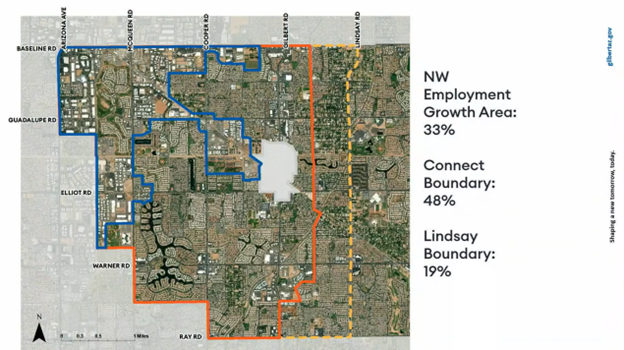
On Tuesday, June 18, 2024, the Gilbert Town Council will hold a meeting to adopt the boundaries of a redevelopment plan which could encompass up to 18% of the town’s landmass extending from its western boundary eastward to Lindsay Road and then south to Ray Road, an area of almost 9 ½ square miles. The Town is seeking to take this action under Arizona Revised Statue § 36-1471-1491 using laws intended to curb “slum or blighted areas,” terms that could hardly be used to describe the 22nd Best Place to Live in the U.S. by Money Magazine and the 2nd Safest City in America by Law Street Media according to Gilbert’s website.
The controversial move, which seems to carry the broad support of the Town Council, would allow Gilbert to bypass property taxes over the vast swath of real estate, opening a path for the town to engage in a property acquisition and lease scheme known as a Government Property Lease Excise Tax (GPLET) according to Arizona Tax Research Association President Kevin McCarthy.
Ironically, McCarthy, who has opposed this method of redevelopment for years, told AZ Free News that he penned an op-ed for the Arizona Republic crediting Gilbert with not employing this strategy.
“Most of your suburban cities have done very little of this,” McCarthy explained. “Gilbert to date has done none of it. Ironically, I wrote an op-ed for the paper, I don’t know, six, seven years ago that was in the Arizona Republic, crediting the city of Gilbert for doing development the right way and not doing it by harvesting the property taxes that are otherwise owed, making everybody else’s property taxes higher as a result of some development, not being on the rolls and shorting the schools, their monies, that kind of thing.”
Adding another wrinkle to the matter though, is a potential legal vulnerability to the strategy which could land the town in court. McCarthy continued, “And so now we’ve got them wanting to break through and begin using this tool. But what’s different about this now than even five years ago, the last time we made a legislative effort to narrow the use of it, is that there have been court decisions in this space that we’ve been involved in with the Goldwater Institute that have found that this mechanism violates the constitution’s gift clause.”
As reported by the Arizona Republic, a 2020 ruling found that a similar GPLET scheme between the city of Phoenix and developers of The Derby Roosevelt Row, involving a promised tax break, was illegal. In 2016 the Phoenix City Council okayed a plan that would have had developer Amstar/McKinley successfully avoid paying the appropriate property taxes for 25 years. For eight years under the law, the tax would be completely waived, and it would’ve been further reduced for an additional 17 years.
McCarthy explained how the process works: “I assume what happened in Gilbert: Gilbert’s probably got a new economic development director, or maybe it’s the city manager goes to some meetings, and here’s what fund the city of Phoenix is having harvesting the property taxes that otherwise would be owed on a development. To make development easier, the way these deals are usually done is a developer goes to City Hall, and if a city has a central business district that they’ve declared as slum and blight, they know that if they want to propose an $80 million multi-use building that is 30 stories high and have some residential apartment building and then commercial on the first floor, that kind of thing they can negotiate to have it qualify as a GPLET.”
During a Town Council meeting on April 16th, Gilbert Redevelopment Program Manager Amanda Elliott explained that under the law, a municipality must have a combination of nine findings for redevelopment “to eliminate or prevent your [town’s] signs of decline”
Under the applicable law (ARS § 36-1471), the statute states that a “’Blighted area’ means an area, other than a slum area, where sound municipal growth and the provision of housing accommodations is substantially retarded or arrested in a predominance of the properties by any of the following:
(a) A dominance of defective or inadequate street layout.
(b) Faulty lot layout in relation to size, adequacy, accessibility or usefulness.
(c) Unsanitary or unsafe conditions.
(d) Deterioration of site or other improvements.
(e) Diversity of ownership.
(f) Tax or special assessment delinquency exceeding the fair value of the land.
(g) Defective or unusual conditions of title.
(h) Improper or obsolete subdivision platting.
(i) The existence of conditions that endanger life or property by fire and other causes.”
This language is explicitly presented by the Town as the basis for the redevelopment plan. Further, under the finding for the necessity of the law, the legislature explained clearly, “That the existence of these areas contributes substantially and increasingly to the spread of disease and crime, necessitating excessive and disproportionate expenditures of public funds for the preservation of the public health and safety, for crime prevention, correction, prosecution, punishment and the treatment of juvenile delinquency and for the maintenance of adequate police, fire and accident protection and other public services and facilities, constitutes an economic and social liability, substantially impairs or arrests the sound growth of municipalities and retards the provision of housing accommodations.”
The law adds, “the acquisition of property for the purpose of eliminating the conditions or preventing recurrence of these conditions in the area, the removal of structures and improvement of sites, the disposition of the property for redevelopment and any assistance which may be given by any public body in connection with these activities are public uses and purposes for which public money may be expended and the power of eminent domain exercised.”
According to the Town Council, the moves toward this step have been gradual and ongoing for more than a decade.
Two Words Not Spoken: Property Taxes
During the presentation given by Elliot, the Town explicitly made the claims that the redevelopment plan “will not,” “Specify individual properties, specify commercial centers industrial complexes or neighborhoods, show up on a title report, displace residents or businesses, institute zoning changes, decrease property values or change the voter approved general plan.” However, conspicuously absent from that list is: property taxes.
McCarthy told AZ Free News that when a municipality negotiates to have a redevelopment qualify as a GPLET, “they are exempted from paying any property taxes on the improvement of the property for the first eight years, which is usually when the maximum amount of tax exposure is going to be on a property. That results in the schools not getting all the property tax money that they should get. The counties get zeroed out. The community colleges get zeroed out. The city themselves, it doesn’t get the property. If they do use property taxes, they don’t get any property taxes out of it. And the way that they execute this is that upon completion of the building, they literally deed the property back to the city.”
He added that a developer then wouldn’t have the property added to the tax rolls, “but it’s put on the tax rolls as an exempt property as any government property is, and [wont’] get a property tax bill for eight years.” In prior years, the period was as high as 25 years, but organizations like ATRA, working with the legislature, succeeded in getting that narrowed to eight. A bill was passed to lower it again to four years, but was vetoed by Governor Katie Hobbs. McCarthy noted, “Our argument to lawmakers was that at four years, it’s a lot closer to being able to pass the mathematical calculation of whether or not it’s a gift of public funds and therefore in violation of the constitutional gift clause.” The same gift clause that Phoenix ran afoul of in the Derby ruling.
McCarthy concluded, “Last thing I’ll say is that these property taxes are harvested because in many instances, these deals are agreed to by the cities because there’s a mutual benefit between the developer and the city to exempt the property from paying property taxes and enter one of these GPLET deals, and that is they can enter into any number of agreements that allow them both to benefit financially and maybe not. So not just the developer benefits the city.
So in the example I gave you that the deal might include me as the developer paying for infrastructure that otherwise may not be owed by the developer, but would be a city obligation. Whether the utilities that would be going in the city would bring up to the boundary of the property, any number of improvements in city of Phoenix, it could include, if it’s going to have multifamily, which is a lot of our stuff that we’re seeing in Tempe and Phoenix, a lot of apartment buildings where I as a developer grant concessions to the city council that a certain percentage of the apartments are going to be saved for low-income housing.”
The implications for property taxes also could impact the Gilbert Unified School District considerably as McCarthy observed with properties that “normally would be paying a million dollars a year in property taxes to Gilbert Unified,” not doing so. State funds would be used to subsidize the difference. However, that isn’t so for school bond measures, which are voter approved as are school overrides. “In those instances, the tax rates are going to be higher than they otherwise would’ve been if that property would’ve been on the tax rolls. But even there, the schools really don’t lose money.”
“It’s the other taxpayers that are on the tax rolls that get screwed because the property isn’t paying taxes.”
Gilbert Mayor Brigette Peterson made particular mention during the April meeting that the council is “not trying to turn the town of Gilbert into a city because that’s always a bone of contention with our residents. But it is focused on making sure that this town doesn’t become a city that we’ve seen in the past go downhill. We’re trying to make sure that we’ve learned from other cities’ mistakes in the past and do what’s best for our community to move us into the future and forward.”
Peterson added, “The other thing that we heard at that last meeting that was so well attended was um they they felt like the decisions had already been made. We have not made any decisions, and tonight even we’re just offering more feedback. We’re not voting on anything at a study session, so this still has a lot of time to go through more of a process and to hear from the public too.”
A mailer sent to Gilbert residents in the proposed ‘Blighted area’ indicated that the next meeting is scheduled for June 18, 2024 at 6:30 PM.
Four Arizona cities made it onto a list of America’s least financially distressed cities.
Last month, WalletHub released the results of their comparison of the 100 largest cities without data limitations across nine key metrics. The personal-finance website determined cities are the most and least financially distressed in light of inflation making it more difficult for Americans to keep up with payments on their loans and lines of credit.
Glendale was 92nd on the list, followed by Chandler at 97, Gilbert at 98, and Scottsdale at 99.
“Getting out of the downward spiral of financial distress is no easy feat,” WalletHub Analyst Cassandra Happe said in a news release. “You may get temporary relief from your lenders by not having to make payments, but all the while interest will keep building up, making the debt even harder to pay off.”
“People who find themselves in financial distress should budget carefully, cut non-essential expenses, and pursue strategies like debt consolidation or debt management to get their situation under control,” she continued.
Chicago, Illinois was the city with the most financial stress.
“It seems that in the Windy City, people’s financial security is also blowing away,” Happe said. “The share of Chicago residents who are allowed to skip debt payments due to financial difficulties went up by nearly 30% between Q4 2022 and Q4 2023.”
Additionally, Chicago residents had the third-most accounts in distress per person, according to Happe.
“Financial distress may increase further, too, as Chicago has some of the highest Google search interest in the country for terms like ‘debt’ and ‘loans,’ which indicates that people need to borrow even more,” she said.
After Chicago, Houston, Texas had the second most financial stress, followed by New York City, Los Angeles, Dallas, Las Vegas, San Antonio, Atlanta, Riverside, and Jacksonville.
Elizabeth Troutman is a reporter for AZ Free News. You can send her news tips using this link.
Government leaders must be held accountable. That’s supposed to be the job of the mainstream media. But somewhere along the line, this changed. Many journalists employed by traditional corporate media started to twist facts to drive home a particular narrative. Others began disguising their own opinions as news. And some just stopped doing any real investigations altogether—choosing to protect our elected officials and government bureaucrats from any sort of real accountability.
Now, with fewer people trusting in the mainstream media, our nation has seen a rise in independent news media. We have a great one right here in Arizona called AZ Free News that has shown it is willing to do real research and investigation into what is happening in our state. And their latest investigative report shows exactly why independent journalism is critical for the future of our state and nation…