Two Arizona cities are among the top ten in America for military veterans to live, according to a recently released survey.
WalletHub issued its findings for its latest installment of the Best and Worst Places for Veterans to Live, showing Scottsdale and Gilbert among the highest-ranked municipalities in the nation. Scottsdale clocked in at the sixth-ranked city, and Gilbert as the eighth highest.
Chandler (#11), Mesa (#29), Glendale (#37), Tucson (#46), and Phoenix (#58) also appeared on the list of 100 cities.
WalletHub used four dimensions as determining factors for its report: Employment, Economy, Quality of Life, and Health.
Scottsdale received two top-ten marks in the “Economy” and “Quality of Life” dimensions. Gilbert received one top-ten distinction in the “Employment” dimension and an eleventh-ranked notation for “Economy.”
The Veterans Association estimates that there are more than 18 million veterans in the United States. WalletHub releases this annual study “to help military veterans find the best places in which to settle down.”
The City of Scottsdale has an online page dedicated to military events, giving these American heroes easy access to resources and organizations they might need. The foreword for the page states, “No matter when you served or where you served, we honor your service, your sacrifice and your dedication to the United States of America. The people of Scottsdale have a great admiration and the utmost gratitude for the men and women who selflessly served – and serve – this country.”
The Town of Gilbert also has a webpage for military veterans, which is “intended to boost engagement with veterans and their families in our community, provide for recognition, and connect them with needed resources.” Gilbert’s Veterans Advisory Board seeks to “create a supportive Town atmosphere and examine issues affecting the health and well-being of service members, veterans, and their families.”
Daniel Stefanski is a reporter for AZ Free News. You can send him news tips using this link.
The town of Gilbert is offering up to $800 to residents and up to $3,000 to non-residential customers who swap their lawns for desert landscaping that uses less water.
The financial incentive in the Grass Removal Rebate programs isn’t cash: it’s applied as credit on the recipient’s water bills, and may take up to two bill cycles to appear. A Gilbert spokesperson told AZ Free News that they have a total of $120,000 per year to issue on their rebate programs, and that the allocated funding within that budget may change from year to year based on the popularity of each program.
Those who don’t qualify include those who have removed or are currently removing their lawns, those living in non-single family residential properties, and those with grass areas watered by flood or well water.
The grass must also be healthy and growing at 50 percent density, as well as routinely and permanently irrigated by a landscape irrigation system.
Gilbert residents may now be eligible to receive up to $800 for replacing their lawns with low-water-use landscaping.
The rebate requires an inspection of the resident’s grass landscape. The amount received by residents for the lawn removal also depends on the lawn’s size. On the low end, properties with 200 to 399 square feet of grass are worth $100; on the high end, those with over 1,000 square feet of grass are worth $500.
The additional $300 from the town comes as a reward for planting new shade trees or low water-use plants. Residents with a rebate area with at least 50 percent low-water-use or drought-tolerate plant coverage may receive an additional $200. Residents may also receive up to a $100 rebate for planting two trees from the Arizona Department of Water Resources’ Low-Water-Use/Drought-Tolerant Plant List.
As for non-residential customers, like HOAs and businesses, grass removal comes at $1 per square footage of grass, with a $3,000 cap.
Anyone who receives $600 or more in water bill credits must complete a W9 for the Gilbert Water Conservation, as per the Biden administration IRS reporting requirement enacted last year.
Those aren’t the only water conservation financial incentives that Gilbert has offered. The town introduced rebates up to $250 for residential, $400 for non-residential properties to install smart irrigation controllers.
Another municipality, Tucson, opted for involuntary compliance with water conservation. Last month, the city of Tucson prohibited new builds from installing lawns and reduced their water flow; in May, they increased water rates by reclassifying several winter months — billed at a lower rate — into summer months. The city of Phoenix cut water allowance, as well as raised its water usage fees.
Corinne Murdock is a reporter for AZ Free News. Follow her latest on Twitter, or email tips to corinne@azfreenews.com.
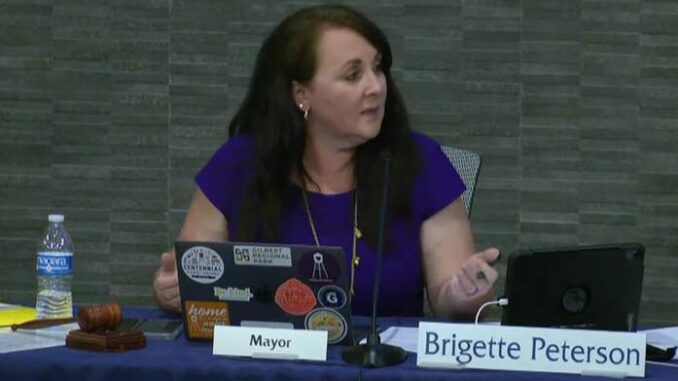
Gilbert Mayor Brigette Peterson faces two federal lawsuits for alleged free speech violations.
Peterson was served the lawsuits earlier this month, both of which were filed in the Arizona District Court.
One of the lawsuits, Handelsman v. Town of Gilbert, names Ryan Handelsman, Brandon Ryff, and Joanne Terry as the citizens whose First Amendment rights were allegedly violated. The other lawsuit names one of the plaintiffs only, Ryff v. Town of Gilbert.
In the initial complaint filed in Handelsman v. Town of Gilbert, the citizens allege that Peterson and town officials retaliated against them for their criticism. The citizens handed out and held up approximately 100 signs at the town’s Sept. 20 council meeting last year. Peterson ordered police to remove a sign held by one of the plaintiffs, Terry. Following that interaction, another plaintiff, Handelsman, advised the mayor during public comments that no statute, code, or law prohibited silent display of a sign. Fellow plaintiff Ryff then issued critical comments of the mayor during the public comments.
Following those events, the three plaintiffs decided to hold their signs up again. Peterson had police remove the three plaintiffs from the meeting room.
“There was no disruption caused by Plaintiffs by silently hold[ing] their signs,” read the lawsuit. “It was the Mayor who created an actual disruption along with a constitutional violation, overreacting to something she could have simply ignored and was prohibited from squelching by the United States Constitution.”
After that incident, a citizen filed an ethics complaint against the mayor. The complaint alleged that Peterson violated policy provisions ensuring the impartial, fair, and respectful treatment of all citizens, as well as ensuring the loyalty to Gilbert citizens over personal considerations.
The final ethics report defended the mayor’s actions. It determined that Peterson was right in her actions in order to uphold decorum.
In response, the three plaintiffs alleged that the ethics investigation wrongly neglected to interview them; they alleged that the total defense provided by the final ethics report amounted to retaliation. In remarks to the media, Peterson accused the three plaintiffs of harassment and bullying. At least one of the plaintiffs, Ryff, alleged that these false public accusations by the mayor caused his business to suffer.
The three plaintiffs compared the mayor’s response to their sign-holding with her response during a November town council meeting last year, in which a disgruntled citizen forced the council into emergency recess and continued to disrupt even after the recess with her continued shouting.
There have been at least nine ethics complaints against Peterson since she became mayor in 2021. Eight of the nine were cleared; Peterson was found to have violated open records law as a result of one of the complaints. Concerning five of those complaints, outside investigation concluded that Peterson hadn’t violated the ethics code but did “exercise poor judgment” in some instances.
Ryff and Handelsman were behind several of the other past complaints. The pair filed complaints about the mayor’s communication and conduct concerning an apartment project in Morrison Ranch.
Corinne Murdock is a reporter for AZ Free News. Follow her latest on Twitter, or email tips to corinne@azfreenews.com.
Last Wednesday, the town of Gilbert apologized for creating a document ranking residents based on their support or opposition of a road widening project.
Maricopa County island resident Rich Robertson presented the document to the Gilbert Town Council during last week’s meeting item discussing the project. The document listed the affected homeowners, their parcel, their address, the landowners’ stance on the project, and a “vocal level” of 1-4. A rating of “1” indicated the resident was among the most vocal in opposition, while a rating of “4” indicated that the resident was reasonable.
“The town of Gilbert has created, effectively, an enemies list,” said Robertson. “Why are we as residents — who are trying to exercise our rights — being ranked by your staff on how compliant we are with you? This is, I suspect, not how the council really wants its residents to be treated. I think it’s outrageous.”
The city issued an apology statement last Wednesday from Public Works Director Jessica Marlow.
Marlow apologized for using the “vocal level” category, and said that the intent wasn’t to label anyone. She explained that the intent was to prepare city leaders for meetings with affected homeowners last October. Marlow admitted that the document should’ve been named differently, in hindsight.
“It was meant to help staff better understand how to address concerns ahead of the meetings,” wrote Marlow.
Awareness of the issue was made possible due to three freshman council members who placed the item on last week’s agenda: Jim Torgeson, Chuck Bongiovanni, and Bobbi Buchli. The trio and Mayor Brigette Peterson vocalized their dismay over the document. The mayor noted that she wasn’t aware of the document before the meeting, and apologized.
“I don’t know anything about it, and I am just appalled that something like that might be going around,” stated Peterson. “I do believe that you don’t deserve any of that. I apologize for that.”
Robertson, who was rated a “2,” rejected the city’s claim that the classification wasn’t intended as a list of enemies.
“I think that’s what leads to those kinds of characterizations,” said Robertson. “It certainly wasn’t inadvertent. It was clear that it (the document) was intended to identify the people who were problems and to steel themselves against those people.”
Robertson speculated that he received the “2” ranking due to writing letters frequently to the council.
The project that inspired so much controversy about residents intended to widen Ocotillo Road into a 110-foot right-of-way. The expansion would require several new bridges to span a section of missing roadway. It was included in the FY2023-2032 Capital Improvement Plan, with funds from 2022 General Obligation (Transportation) Bonds.
Watch the discussion of the “vocal level” controversy below:
Corinne Murdock is a reporter for AZ Free News. Follow her latest on Twitter, or email tips to corinne@azfreenews.com.
An order last month by Gilbert Mayor Brigette Peterson for town police officers to remove three people from a council meeting has resulted in a notice of claim being served against town officials for First Amendment violations.
A notice of claim is required under Arizona law before a party can initiate a lawsuit against a public entity. On Thursday, such a notice was served on the Gilbert mayor and council members on behalf of Ryan Handelsman, Dr. Brandon Ryff, and Joanne Terry, who contend they were forced out of Sept. 20 town council meeting for engaging in constitutionally protected speech.
According to attorney Tim La Sota, his three clients attended the meeting during which dozens of protest signs were taken into the council chambers. Some of the signs were printed with the phrase “Stop Lying” while others read “Don’t Mesa My Gilbert.”
Peterson interrupted the meeting at one point and ordered a Gilbert police officer to remove a 6-inch by 24-inch “Stop Lying” sign Terry was holding in the back of the room. Terry set the sign down and the officer did not confiscate it.
A short time later, Handelsman addressed the mayor and council during the call to the public to challenge town officials to cite a statute or code being violated by those holding signs. Then Handelsman, Ryff, and Terry each decided to silently hold their signs.
“The Mayor halted the meeting and ordered the police to remove Dr. Ryff, Mr. Handelsman and Ms. Terry from the room. The police escorted them out of the meeting without incident,” according to the notice of claim, which notes the town code does not prohibit signs in the council chambers.
A First Amendment obstruction or retaliation violation could cost the town tens of thousands of dollars in legal fees plus potential damages to each of the three claimants. However, La Sota says his clients will settle for $1, but it will also cost something other than money.
In exchange for a complete release of their claims, the claimants will accept $1 as damages if Peterson and the town of Gilbert issue an official apology, La Sota wrote. In addition, Peterson would have to attend a First Amendment training class.
According to the notice of claim, Handelsman, Ryff, and Terry acknowledge that the government “need not tolerate actual disruptions of government business” and that courts have held that municipalities may enforce “certain free-speech restrictions.”
But those restrictions apply to time, place, and manner of public comment, La Sota noted, and even then courts have ruled such restrictions “must be reasonable, consistently enforced, and fall within constitutional parameters.”
Free speech restrictions by the government are also reviewed to ensure they “are both viewpoint neutral, equally and consistently enforced, as well as narrowly-tailored to meet the needs of the governing body to conduct its business, free of actual disruptions,” La Sota noted.
It is also not allowable to engage in retaliation against someone for asserting their First Amendment rights, which is what the notice of claim alleges Peterson did when she ordered Ryff removed. La Sota points to Ryff’s critical comments about the mayor during his call to the public comments at the prior council meeting.
“Then, at the very next meeting, 50 ‘Stop Lying’ signs show up with essentially the same message,” the notice of claim states, adding that Ryff contends Peterson believed Ryff was responsible for the signs.
“Dr. Ryff’s rights were violated by a vindictive Mayor who seized the opportunity to retaliate against him for years of political opposition and for having filed ethics complaints against her in the past,” the notice of claim states.
The notice of claim further alleges Handelsman, Ryff, and Terry were not being disruptive in how they displayed their signs at the Sept. 20 meeting. It also contends Peterson did not treat all sign-holders the same during that meeting, including an attendee with a visible “Don’t Mesa My Gilbert” sign who was not forced to leave the meeting.
“Certain persons silently holding signs in the back of the room may have been a distraction to the Mayor, but not every distraction is necessarily a disruption and not every disruption is an actual disruption which impedes the ability of the Council to do its business,” La Sota notes, citing a major First Amendment ruling from the Ninth Circuit of the U.S. Court of Appeals (Norse v. City of Santa Cruz, 2010).
Peterson later commented on her actions, arguing she could not read what was written on the signs. Yet that does not explain why his clients were ordered out of the council chambers while others with signs were allowed to remain, La Sota wrote in the notice of claim.
Town officials have 60 days to reject or accept the settlement demand included in the notice of claim.