Surprise Police Chief Benny Piña has found himself once again taking wide criticism stemming from the arrest of a mother who defied the city council while exercising her First Amendment rights. Along with the initial arrest, the Chief is now at the center of a firestorm after an internal department video from a week after the incident was obtained by KFYI’s James T. Harris. The video features Piña giving officers “a few things to avoid when confronted by a 1st Amendment auditor,” and defending the woman’s arrest.
Rebekah Massie, a mother from Surprise, was arrested in front of her 10-year-old daughter after criticizing the Surprise City Attorney Robert Wingo in August in a now-viral video. Massie and the Foundation for Individual Rights and Expression (FIRE) subsequently sued the city, and the council eventually reversed the policy that led to her arrest.
In the Surprise Police Department video created a week later, Piña is seen telling officers, “What happened last week in a council meeting resulted in what I think everybody in the world is calling an illegal arrest and a violation of someone’s First Amendment rights. That’s clearly not what we’re about, and that’s not what happened.”
Curiously, the Chief advised officers not to be completely open or truthful to what he called “First Amendment Auditors.” “[There are a] few things to avoid when confronted by a First Amendment auditor,” Piña said.
Piña introduced Sgt. Jamie Rothschild and suggested that the criticisms against him and the department are the work of “trolls and bots.” He responded to calls to fire Steve Shernicoff, the arresting officer.
The Chief told officers, “We took action that night to complete what we normally would do which is a use of force report. We took real quick action to make certain that we were in line with what our policy is and what our philosophy is, which is to take next steps to make certain that we were in a position of power to show that we, specifically Officer Shernicoff, acted with absolute speed to carry out the mission as directed that evening.”
He added, “When something doesn’t look right, or something doesn’t look popular, that doesn’t mean it’s wrong.”
Footage of the meeting and of Massie being led out as her child cried quickly went viral within days of the arrest. Bodycam footage was later released by Surprise PD.
The footage shows that Piña was present during the arrest and did not intervene. Massie was charged with trespassing, resisting arrest, and obstructing government operations. Following the uproar in response to the incident, State Senator John Kavanaugh publicly called for Attorney General Kris Mayes to investigate the arrest.
“In Arizona statutes, we have a provision that specifically says, ‘[a] public body may make an open call to the public during a public meeting, subject to reasonable time, place and manner restrictions, to allow individuals to address the public body on any issue within the jurisdiction of the public body,’” said Kavanagh.
“Protecting freedom of speech, especially in public government settings, is incredibly important to our democracy. Regardless of where they stand, members of the public deserve the opportunity to voice their opinions and concerns to city leaders.”
AZ Free News has reached out to Massie via her representation from FIRE for comment. As of this report no response has been received.
The McCain Institute played host to several “disinformation experts” in Phoenix last week, where they discussed how best to control free speech online.
These experts, Bret Schafer and Rachael Dean Wilson, hail from Alliance for Securing Democracy at the German Marshall Fund.
Schafer created and manages Hamilton 2.0, an online open-source dashboard tracking the outputs of Russia, Chinese, and Iranian state media outlets, diplomats, and government officials. Wilson was the communications director and advisor to the late John McCain.
Schafer’s Hamilton 2.0 is a continuation of his original project within Alliance For Securing Democracy, Hamilton 68, which culled data from major social media companies to identify content similarities between foreign adversaries and Americans — X when it was “Twitter” prior to Elon Musk’s buyout, Facebook, and Instagram — shortly after Donald Trump assumed the presidency in 2017. Musk paywalled X’s application programming interface, stymieing Schafer’s data stream.
Schafer was part of investigations into practices by social media companies that were weaponizing the government against right-wing citizens.
During last Thursday’s panel, Schafer said that an individual from Meta (Facebook) told him that they began to implement more “guardrails” following the Christchurch shooting, since the shooter used the company’s live-stream function, “Facebook Live,” to film and publish the attack. Schafer said that artificial intelligence (AI) was the “reverse” of efforts to implement guardrails, and expressed concern that there should be greater limitations on “problematic” online speech.
“I think the concern is this pollution in the information space, so if somebody has a narrative that’s particularly problematic it now seems as if it’s coming from 50, 100, 200,000 different sources and it can kind of drown out competing voices who are not using manipulated information to get their message out,” said Schafer.
Schafer advocated for social media companies to reduce the spread of content not originating from certain officials or media outlets. He recalled how those technology companies did some of this during the 2020 election. Schafer lamented that public perception of social media companies controlling content reach and visibility became “politicized” and controversial.
“The only way to make sure the people who genuinely want to actually access accurate information […] is for [social media companies] to make some decisions about what is and is not quality information,” said Schafer. “That has become politicized in ways that I think are really problematic so I think we do need to pressure the companies to the various mechanisms we can: advertisers, everything else to ensure at least around elections that they are taking an active role in making decisions about what should be prioritized because if it’s just left up to the algorithms we’re not going to see the good information surface at the top.”
Wilson agreed. She added that officials could rely on online influencers to spread their information. Combined with Schafer’s proposal of increasing and prioritizing reach for certain information from certain officials and experts, that may mean influencers would be incentivized to spread certain information in order to increase their visibility, engagement, and monetization.
“I think getting the influencers to encourage referencing experts is really important,” said Wilson.
Secretary of State Adrian Fontes also participated in the panel discussions.
Like the Hamilton initiative, the Alliance for Securing Democracy was founded after Trump took the White House. The organization is led by Laura Thornton, whom the McCain Institute hired in August to serve as senior director of global democracy programs.
Among its team members are David Salvo, former Obama administration foreign service officer within the State Department, and Shanthi Kalathil, former deputy assistant to the president and coordinator for democracy and human rights at the National Security Council under President Joe Biden.
Alliance for Securing Democracy used to publicize its list of advisory members until some time late last year or earlier this year.
Mike Cherthoff, formerly the W. Bush administration Homeland Security Secretary;
Toomas Ilves, formerly the Estonia president and a World Economic Forum co-chair;
David Kramer, formerly a McCain Institute senior director and W. Bush administration State Department official;
Bill Kristol, editor of The Weekly Standard and former staffer for the Reagan and H.W. Bush administrations;
Rick Ledgett, formerly the Obama administration NSA deputy director;
Mike McFaul, formerly the Obama administration ambassador to Russia;
Michael Morelll, formerly the Obama administration CIA acting director;
Ana Palacio, lawyer and formerly European Parliament member;
John Podesta, formerly Hillary Clinton’s campaign chair and an official for both the Clinton and Obama administrations.
Mike Rogers, CNN commentator and formerly a GOP congressman, army officer, FBI special agent;
Marietje Schaake, formerly a European Parliament member;
Kori Schake, American Enterprise Institute director and formerly employed by the State Department, Defense Department, and White House National Security Council; and,
Nicole Wong, formerly the Obama administration deputy chief technology officer, Google vice president and deputy general counsel, and Twitter legal director for products.
This week, the McCain Institute announced it had been accepted to be featured in the competitive annual event, South by Southwest.
Last week’s full panel is available here:
AZ Free News is your #1 source for Arizona news and politics. You can send us news tips using this link.
Free speech is dying in schools. Ian Prior with America First posted on X that the Loudoun County School Board Chair recently shut down public comment to “combat misinformation.” The Chair claimed that misinformation is rising, and the board must be vigilant in actively combating it. Since COVID, parents have taken to the microphone at Loudon County Public Schools (LCPS) board meetings nationwide to make public comments. Some respectfully, and some in outrage, have sought to hold the governing board accountable for unthinkable, immoral school incidents and an apparent reckless disregard for core academics.
Take, for example, another LCPS board meeting. A female student’s father became agitated about her daughter’s alleged recent assault in the girls’ bathroom by a boy wearing a skirt. When the LCPS Superintendent Scott Ziegler spoke up in response, he asserted that “the predator transgender student or person simply does not exist” and that “we don’t have any record of assaults occurring in our restrooms.” According to Fox News, a judge found the boy guilty, and the father filed a lawsuit against the school.
Suppression of free speech seems to be “in the air,” and it’s frightening to discover that some conservatives, once the bastion of free speech defenders, are taking on an authoritarian posture. School board members have been known to tell community members not to make public comments at their board meetings. Everyone has the right to sign up to make public comments under open meetings law while respecting board protocols and decorum when making comments.
Recently, in North Carolina, after making public comments at a board meeting, Pastor John Amanchukwu was put in handcuffs and escorted out. Amanchukwu travels the country speaking at school board meetings to defend public school kids from dangerous woke culture in the classroom. Maybe in a different style, he did what hundreds or thousands of us nationwide did when making public comments at school board meetings. He asserted that the Board allowing pornographic content and discussions on gender identity in schools was a violation of parental rights.
Free speech may not always be welcomed by the hearer, but we are entitled to our opinions. The freedom to speak up about issues of concern is a hallowed right unique in human history, as expressed in the First Amendment to the United States Constitution. It safeguards speech in the press, at an assembly, and the right to petition the government from governmental interference. Its protections include what we say and wear on a hat, a T-shirt, a sign, and other symbols. Yes, even at school board meetings.
However, freedom of speech appears to be eroding across the board, including on social media platforms. And this affects all issues of concern, including education. The recent SCOTUS case (Manhattan Community Access Corporation v. Halleck) determined that while freedom of speech applies to federal, state, and local governments, the First Amendment does not govern private entities. That makes sense. What doesn’t make sense is that this ruling is being applied to social media platforms. They are exempt from the responsibilities of a publisher. Yet, Facebook and other social media can regulate or restrict speech hosted on their platforms by manipulating algorithms to favor their friends and harm their enemies.
In addition to honestly examining whether our right to free speech is being infringed, we should also determine whether we are operating out of mutual respect when it comes to the free speech of others despite everyday differences of opinion. For example, what is the real reason that the Loudon County Public School Board decided to shut down certain kinds of speech at board meetings? Well, for one thing, in doing so, they are shutting down dissent. Government entity or not, this differs from where we should go as a society.
Tamra Farah has twenty years of experience in public policy and politics, focusing on protecting individual liberty and promoting limited government.
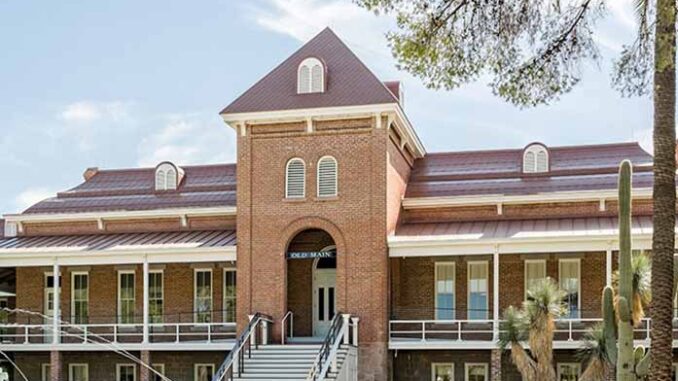
Universities are free to adopt ethics contrary to constitutional values, but they aren’t free from the consequences. This is especially true when the University of Arizona hired me, a Christian apologist to teach government ethics, and then fired me on ethical grounds.
For the last four years, I taught college students the skills of effective moral decision making in a required course titled “Ethics for the Public Administrator.” The students come from majors like law, criminal justice, and political science—many becoming cops, lawyers, and bureaucrats. I have countless emails and evaluations praising me for offering something they never had before: deep thinking on moral issues.
Selecting course content wasn’t easy. At first, I was tempted to model my predecessors by surveying the most popular moral theories like utilitarianism, deontological ethics, virtue ethics, relativism, natural law, and divine command theory so students could select their preferred choice.
However, ethics isn’t something public administrators can choose. They are bound by an oath to protect and defend constitutional values which are based on biblical ethics. So, that’s what I taught.
While constitutional values are based on biblical values, they aren’t the same thing. There are some obligatory commands (loving God and making disciples) and prohibitions (idolatry, blasphemy) that apply only to those who accept biblical theology. However, all values in the Constitution can be traced back to some biblical principle. No other moral theory (or combination of theories) captures the totality of constitutional values like the Bible. This is probably why the Bible was far and away the most cited text by the Founding Fathers when the Constitution was written.
While I always avoided teaching theology in my classroom, part of me worried that administrators may confuse my teaching of biblical ethics with the teaching of biblical theology. Whether this ever was their concern remains a mystery since it wasn’t why I was fired.
To my own surprise, the department director didn’t mention anything about my beliefs or my class content but pointed instead to a financial reason for firing me. After thanking me for my good service to the students, she announced I was being terminated because an unexpected budget surplus allowed them to hire full time tenure track faculty to teach my course instead.
This would be a legitimate reason, if true, but it’s not. Around the same time, the U of A made headlines for just the opposite reason. Just two weeks earlier, the AP reported U of A disclosing a nearly quarter-billion-dollar funding crisis. Needless to say, this historic calamity didn’t cohere with the director’s claim of excess funding. So, I became suspicious and asked if there was anything else that weighed into her decision to fire me. She replied simply, “No, nothing more.”
Unconvinced, I filed a freedom of information request the next day. After a seven-month wait, I enlisted an attorney to compel the university to disclose the truth of what led to their decision. The disclosure showed administrators panicked by two anonymous letters from community members complaining about statements I made at a public school board meeting. The letters alleged that I criticized the LGBTQIA+ community and asked the university to punish me for violating the university’s “values.”
The first anonymous email was sent on October 12, 2023. That same day, a Facebook thread shows three people—a teacher, parent, and school board candidate—plotting to submit their complaint. This was followed two weeks later by a second anonymous email containing similar defamatory claims. This is the true reason I was fired.
No one ever cited evidence of these alleged statements, and the university never asked me about them. They simply ended my employment for constitutionally protected speech I’m accused of making outside of the workplace, and then they lied about the reason.
This problem is much bigger than me or any other persecuted U of A employee. The problem is that there is no longer any ethical standard employed by the university that’s consistent with constitutional values. As I said at the beginning, they are free to embrace another morality, but not free from the consequences.
The university suppresses speech outside the workplace and lies about it. If this behavior accurately reflects the university’s values, we may wonder what kind of ethics they base all other decisions. If not constitutional ethics, what model will they use to operate their institution? Furthermore, what kind of moral system will they teach to future public administrators now that professors teaching constitutional ethics are not allowed? It’s a scary thought.
Dan Grossenbach is a 20-year federal criminal investigator, state-certified educator, husband, dad, patriot, and Jesus-follower in Tucson, AZ. You can follow him on X here.
Attorney General Kris Mayes has been asked to investigate the city of Surprise over its alleged violation of one citizen’s free speech rights.
Republican State Senator John Kavanagh sent a letter to Mayes on Tuesday requesting an investigation into the arrest of a Surprise citizen after criticizing the city attorney during a city council meeting last month. The arrested citizen, Rebekah Massie, sued the city of Surprise last week with the aid of Foundation for Individual Rights and Expression (FIRE).
Mayor Skip Hall, who ordered Massie’s removal, cited city policy prohibiting public comment from lodging any “charges or complaints” against city employees or elected officials.
State law requires the attorney general to investigate local governmental ordinances, regulations, orders, or other official actions alleged to be in violation of the state law or Arizona Constitution. Under this law, Mayes’ office would have to issue a written report of their findings within 30 days of receiving the investigation request.
🚨FOR IMMEDIATE RELEASE: Senator Kavanagh Calls on Attorney General to Investigate Potential Free Speech Violations in Public Comment Policy for City of Surprise
In a press release, Kavanagh claimed that the city of Surprise had violated both state law and the Constitution with Massie’s arrest.
“In Arizona statutes, we have a provision that specifically says, ‘[a] public body may make an open call to the public during a public meeting, subject to reasonable time, place and manner restrictions, to allow individuals to address the public body on any issue within the jurisdiction of the public body,’” said Kavanagh. “Protecting freedom of speech, especially in public government settings, is incredibly important to our democracy. Regardless of where they stand, members of the public deserve the opportunity to voice their opinions and concerns to city leaders.”
Kavanagh’s letter to Mayes asked the attorney general’s office to investigate whether the city of Surprise’s policy restricting public speech by prohibiting complaints against city employees and elected officials violates the Arizona Constitution and state law governing public comment within public meetings.
Were Mayes to determine that the city of Surprise’s public comment policy violates state law or the Arizona Constitution, her office would provide notice to the city by mail of its violation and give the city a 30-day deadline to resolve the violation. Should the city fail to resolve the violation, Mayes would notify the state treasurer to withhold and redistribute state shared funds.
Or, were Mayes to determine that the city’s public comment policy may violate certain state law or the Arizona Constitution, the attorney general would file a special action in the state Supreme Court to seek a resolution. The court would then require the city to post a bond equal to the amount of state shared revenues paid to the city in the last six months.
AZ Free News is your #1 source for Arizona news and politics. You can send us news tips using this link.