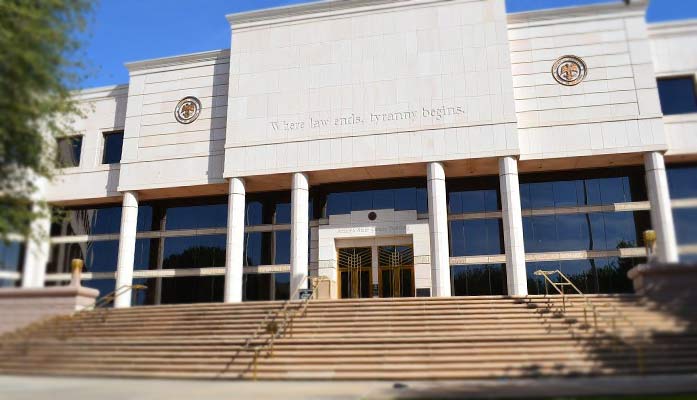
The Arizona Supreme Court agreed Thursday to review whether the Citizens Clean Elections Commission can determine that the secretary of state incorrectly certified candidates’ qualifying contributions and order repayment of public campaign funds on that basis.
In the order, the justices granted review of two questions in Lombardo v. Arizona Citizens Clean Elections Commission. The court ordered the parties to submit simultaneous briefs by Monday, Oct. 19, at 4 p.m., and will consider the case on an expedited basis without oral argument.
Risa Lombardo and Duwayne Collier, the Green Party nominees for governor and secretary of state, are challenging the commission’s authority to demand repayment amid an investigation into whether they properly qualified for public campaign financing.
In September, Lombardo and Collier alleged that the threat of repayment obligations had effectively halted their campaigns and burdened their free speech rights. Their lawsuit also challenged the commission’s authority to revisit their qualification for public funding after certification by the secretary of state. At that point, the commission had directed Executive Director Thomas Collins to investigate further without issuing a repayment order.
The Supreme Court’s first question asks: “Does the Citizens Clean Elections Commission possess legal authority to determine that the Secretary of State’s certification of qualifying contributions was incorrect?”
The second asks: “If yes, does the Commission have the authority to order repayment of funds on that basis?”
Chief Justice Ann Scott Timmer signed the two-page order. It limits review to those questions and contains no ruling on the underlying allegations or express directive halting the commission’s investigation.
The candidates contend that the secretary of state and county recorders have authority to determine whether they collected sufficient qualifying $5 contributions. Their attorney, Timothy La Sota, has argued that the threat of repayment interfered with their campaigns and that relief after the election would come too late.
The litigation reached the state Supreme Court after Maricopa County Superior Court Judge Melissa Iyer Julian dismissed the candidates’ lawsuit. Julian concluded in her ruling that the challenge was premature because the commission had not completed its investigation or issued a repayment order.
“Plaintiffs’ challenge is to the basis for a repayment order that has not and may never be issued,” Julian wrote. “That claim is not ripe for this Court’s review.”
The judge said the administrative process could establish the facts and allow the commission to determine whether enforcement was warranted before judicial review.
The Court of Appeals declined special action jurisdiction on Oct. 6. Lombardo and Collier then sought Supreme Court review through a special action petition that the clerk docketed as a petition for review.
The Supreme Court considered the petition and responses from the commission and its executive director, Thomas Collins, before granting limited review.
The underlying investigation includes allegations that qualifying-contribution records were falsified. La Sota has disputed the accusations, characterizing them as conspiracy theories.
Stand for Health Freedom has endorsed U.S. Rep. Andy Biggs in Arizona’s governor race, adding another national organization to the growing list of groups and elected officials backing his campaign. The endorsement was announced Wednesday by the organization and the Biggs campaign.
Stand for Health Freedom, which describes itself as a grassroots organization representing nearly one million Americans, advocates for policies centered on medical freedom, informed consent, parental rights, religious liberty, privacy, and free speech. According to the organization, it endorsed Biggs based on his record supporting those issues.
@andybiggs4az has a proven track record of taking a stand for health freedom, we are proud to endorse his race for Governor! https://t.co/CqSumVeHSu
— Stand for Health Freedom (@standforhealth1) July 2, 2026
“We must protect the medical freedoms of Arizonans and ensure everyone can make the right health decisions for their families,” Biggs said in a statement.
“From my bipartisan work in passing Right to Try legislation in Congress to pushing back against outrageous and nonsensical COVID mandates, I’ve fought for the MAHA agenda throughout my time as a legislator. As Governor, I’ll make sure Arizona is the healthiest and freest state in the country so our citizens can thrive and prosper without government overreach into health decisions. I thank the Stand for Health Freedom coalition for their support and I look forward to getting their many Arizona members out to vote in 2026.”
The campaign said Biggs has made outreach to supporters of the Make America Healthy Again (MAHA) movement a key component of his gubernatorial campaign, including discussing MAHA priorities during the June Republican gubernatorial debate, television interviews, and meetings with health freedom advocates.
The endorsement comes as health freedom legislation and medical autonomy continue to be active issues in Arizona politics. Lawmakers introduced numerous bills addressing vaccines, medical interventions, parental rights, and informed consent during this year’s legislative session, reflecting the continued prominence of health policy debates that emerged during the COVID-19 pandemic.
Biggs has built much of his congressional record around limiting federal involvement in health care decisions. In December 2025, he introduced the Putting Patients First Healthcare Freedom Act, a legislative package consolidating conservative health care proposals focused on expanding health savings accounts, increasing price transparency, strengthening health care sharing ministries, and other market-based reforms. Biggs also co-sponsored the Right to Try for Individualized Treatments Act alongside Rep. Diana Harshbarger (R-TN), the companion of a Senate measure from Sen. Ron Johnson (R-WI).
According to the campaign, the endorsement adds to support Biggs has already received from President Donald Trump, the late Charlie Kirk, Erika Kirk, U.S. Reps. Eli Crane, Paul Gosar, and Abe Hamadeh, Texas Gov. Greg Abbott, Maricopa County Supervisors Debbie Lesko and Mark Stewart, Maricopa County Attorney Rachel Mitchell, Pinal County Attorney Brad Miller, along with several conservative organizations and more than 40 current and former Arizona legislators.
The Arizona Supreme Court has kept a constitutional challenge to Arizona’s donor disclosure law alive, ruling that conservative organizations and anonymous donors may try to prove Proposition 211 violates the state constitution’s free speech protections as applied to them.
In its June 29 decision in Center for Arizona Policy Inc. v. Arizona Secretary of State, the court did not strike down Proposition 211, also known as the Voters’ Right to Know Act. The justices rejected the plaintiffs’ broad facial challenge to the law, along with their claims under the Arizona Constitution’s Private Affairs Clause. But the court ruled that the Center for Arizona Policy, the Arizona Free Enterprise Club, and two anonymous donors sufficiently alleged that the law’s disclosure requirements could unconstitutionally burden protected political speech and association.
The case now returns to the Maricopa County Superior Court, where the plaintiffs will have the opportunity to develop their as-applied challenge and attempt to show that compelled disclosure of donors could expose supporters to harassment, retaliation, reprisals, or other harms tied to their advocacy.
Scott Freeman, senior attorney at the Goldwater Institute, which represented the plaintiffs, called the ruling “an important victory for every Arizonan who believes people should be free to support the causes they care about without fear of government-compelled disclosure.” He added that the court recognized that citizens are entitled to try to prove compelled donor disclosure violates Arizona’s free speech protections.
“From the very start, this case has been about protecting the freedom of everyday Arizonans,” said Peter Gentala, President of Center for Arizona Policy (CAP). “No one should have to choose between supporting a cause they believe in and fearing harassment, retaliation, cancellation, or personal safety. Today’s decision affirms what we’ve always known to be true: our constitutional freedoms belong to every one of us, not just to those whose views happen to be popular at the moment.”
The Voters’ Right to Know Act requires nonprofit groups that weigh in on ballot measures or reference incumbents near an election to publicly disclose their donors—not just names and amounts, but also home addresses and employers—in a searchable database.
The court’s majority opinion was authored by Chief Justice Ann Timmer and joined by Justices James Beene and William Montgomery, along with retired Justice Rebecca Berch. Justice Kathryn Hackett King concurred in part and dissented in part, joined by Vice Chief Justice John Lopez and Justice Clint Bolick. Justice Maria Elena Cruz was recused.
The majority held that Arizona courts must interpret the state constitution’s Speak Freely Clause independently from the First Amendment. The court said federal free speech cases may be consulted when helpful, but the Arizona Constitution remains its own source of free speech protection. “The Speak Freely Clause tolerates no censorship or restraint…for speech that falls within the Clause’s protective scope,” Timmer wrote.
The court also concluded that donations made to an organization for the purpose of funding campaign media or knowingly allowing donations to be used for that purpose can constitute expressive conduct protected by the Arizona Constitution’s Speak Freely Clause.
For compelled election disclosure laws, the court adopted an Arizona-specific standard requiring the state or another defender of the law to show that the disclosure requirement meaningfully furthers election integrity or transparency and does not unreasonably burden or hinder protected expression.
Applying that framework, the court found that Proposition 211 meaningfully furthers election integrity and transparency. The court also found, however, that the plaintiffs had sufficiently alleged that the disclosure requirements may impose a concrete burden on their speech because public disclosure could expose donors or organizations to harassment, retaliation, reprisals, or other harms tied to their advocacy.
The court cited allegations that CAP and the Arizona Free Enterprise Club (AZFEC) had faced threats and harassment connected to their issue advocacy. The opinion noted that CAP alleged it received a message stating, “Sooner or later, you will die, and some of us pray it is sooner,” and “You are a cancer that will soon be sliced out of our nation’s sick body. I will make it my personal mission to bury every single one of you.” AZFEC reported that staff had received threats of violence and that one staff member’s car had been vandalized in retaliation for communicating AZFEC’s message.
The two anonymous donors alleged that they had previously donated more than $5,000 to nonprofit organizations involved in campaign media and would limit future donations to avoid disclosure. The court found those allegations sufficient at this stage to allow the as-applied free speech claim to proceed.
“Free societies depend on people being willing to speak, advocate, and support important causes without fear of retaliation,” said Scot Mussi, President of the Arizona Free Enterprise Club. “Today’s decision ensures that Arizonans will have the opportunity to demonstrate that the Arizona Constitution protects those freedoms.”
Andrew Gould of Holtzman Vogel, who argued the case for the plaintiffs, said the decision establishes that the Arizona Constitution is an “independent source of liberty” and confirms that Arizona courts are not required simply to follow federal free speech doctrine, adding it “recognized that plaintiffs may challenge compelled donor disclosure when it chills protected expression.”
The Goldwater Institute’s case page states that the organization represents the Center for Arizona Policy, the Arizona Free Enterprise Club, and two private donors in the lawsuit against the Arizona Secretary of State, the Arizona Citizens Clean Elections Commission, and public officials charged with implementing and enforcing Proposition 211.
Campaign Legal Center, which represents Voters’ Right to Know, framed the ruling as a victory for disclosure. In a statement, the organization said the court affirmed Proposition 211’s constitutionality by rejecting the broad challenge to the law while allowing the plaintiffs to attempt to prove serious harm from the disclosure requirements as applied to them.
Campaign Legal Center President Trevor Potter said the ruling affirmed “Arizonans’ right to know” who is spending major money to influence elections. The organization said Proposition 211 was supported by 72% of Arizona voters in 2022 and was designed to trace original sources of money spent in elections.
Justice King’s partial dissent, joined by Lopez and Bolick, would have gone further than the majority. The dissent argued that political advocacy before an election is core political speech and that anonymous speech contributes to liberty.
The case now returns to the Maricopa County Superior Court for further proceedings on the plaintiffs’ as-applied Speak Freely Clause claim. The court did not strike down Proposition 211, and the plaintiffs still must prove that the law unconstitutionally burdens their speech as applied to them.
The principal who went viral in the Valley for barring parents from attending eighth grade graduation due to Immigration and Customs Enforcement (ICE) activity played a key role in banning a parent from another school campus in violation of the First Amendment.
This week wasn’t the first time that Bronwyn Sternberg, principal at the Cecil Shamley School in the Tempe Elementary School District (TESD), has kept parents off campus for reportedly political reasons.
In February 2020, Sternberg participated in the ban of a parent, Rebecca Hartzell, from the premises of Marana Unified School District’s Dove Mountain School. Sternberg was an associate principal at the time, and identified in a Supreme Court filing as an official who coordinated Hartzell’s removal. The Arizona District Court ruled in March that district officials had unconstitutionally retaliated against Hartzell for her speech, consistent with a prior finding in the Ninth Circuit Court of Appeals. A jury awarded Hartzell $200,000.
Now, a little over six years later, Sternberg has taken another action to keep parents off campus in relation to a highly politicized issue.
On Wednesday, Sternberg informed parents that they wouldn’t be permitted to attend their child’s eighth grade graduation to prevent any additional ICE detainments.
Immigration authorities detained a Cecil Shamley School mother and her son off school property on Tuesday. This prompted Sternberg to call off all outside attendance to the promotion ceremony, which occurred on Thursday.
ICE issued a statement explaining that it arrested the mother, 47-year-old Margoth Del Pilar Paredes-Ortiz of Ecuador, on referral by Border Patrol for suspicion of illegal alien smuggling. Paredes-Ortiz was subject to a removal order from an immigration judge issued last March.
Per ICE, Paredes-Ortiz voluntarily requested that her son, also an illegal alien from Ecuador with a final order of removal, be returned with her to Ecuador.
Federal law requires equal public school access to all children regardless of immigration status.
Paredes-Ortiz and her son were taken to a Texas facility for deportation proceedings.
Sternberg said that closing the graduation ceremony off to parents and other guests was a matter of safety. Sternberg said students from the sixth and seventh grades would be allowed to attend instead, and that parents would receive a recorded video of the promotion ceremony.
“This change may be disappointing for some families; however, we feel it is truly in the best interest of our students and staff. I appreciate the partnership, kind words, and questions that I have received from our parents. Thank you for your cooperation as we prioritize our students,” said Sternberg.
Libs of TikTok shared a copy of the letter to parents in a viral post.
BREAKING: @TempeElementary Principal Bronwyn Sternberg sent a letter to families informing them that parents and guests will NOT be allowed to attend students' graduation after a reported illegal alien parent and her child were arrested by ICE near the school. pic.twitter.com/TGRxTFsqcT
Democratic Rep. Greg Stanton (AZ-04) visited the detained family and indicated he was working to secure their release. Stanton and Arizona’s other elected Democrats have given illegal aliens constituent privileges and prioritized them in their constituent work.
I’m sickened that a Tempe student and their parent were violently detained by ICE and taken to a detention center in Texas just before his 8th grade promotion.
Terrorizing a child, ripping them from their community, and forcing them into detention is beyond cruel. It is inhumane… https://t.co/n7i1jv9J1W
— Congresswoman Yassamin Ansari (@RepYassAnsari) May 28, 2026
Shamley School students conducted a walkout from school in protest of the Paredes-Ortiz family’s deportation.
Sternberg became principal of Cecil Shamley School in 2023.
AZ Free News is your #1 source for Arizona news and politics. You can send us news tips using this link.
For years, Americans were told our schools existed to expand minds, encourage debate, and prepare young people to think independently. Today, too many do the opposite.
Conservative voices are being shouted down, disinvited, or silenced by radical activists and administrators more interested in appeasing the far left than defending free speech. What happened recently in South Carolina is just the latest of numerous incidents across the country.
Lt. Governor Pamela Evette, a successful businesswoman, unapologetic conservative, and strong supporter of President Trump, was pushed out of delivering the commencement address at South Carolina State University after activists objected to her political beliefs. University officials cited “security concerns,” but the real issue was ideological intolerance.
From Ivy League institutions to taxpayer-funded public universities to our K-12 schools, activists increasingly dictate who may speak, which ideas are acceptable, and what students are allowed to hear.
Administrators routinely surrender to pressure from the left while treating conservatives as threats rather than participants in open debate. That should concern every American.
Our education system has drifted far from its mission. Instead of teaching students how to think critically, schools now teach them what to think. Activism has replaced scholarship, and ideological conformity has replaced intellectual diversity. And taxpayers are funding it.
The time for cosmetic reform is over. America needs structural change.
First, tenure at publicly funded colleges and universities must end.
Tenure was intended to protect academic inquiry. Too often now, it protects ideological activists from accountability while classrooms become platforms for political agendas unrelated to education.
After the assassination of conservative activist Charlie Kirk last year, several professors openly celebrated or excused political violence against someone they opposed politically. That moment exposed how radical parts of academia have become.
Lt. Governor Evette rightfully called for the end of tenure because employment should be based on performance and professionalism, not guaranteed lifetime protection.
Second, our schools must return to education instead of indoctrination.
Parents expect schools to teach reading, writing, math, science, history, and critical thinking. They do not send their children to be immersed in divisive identity politics, anti-American rhetoric, or gender ideology.
Students should graduate understanding the principles that built this country, capable of thinking independently, and able to engage with opposing viewpoints.
Finally, parents must have real authority over their children’s education.
For too long, bureaucracies and special interests trapped families in failing schools. Every parent deserves the freedom to choose the educational setting that best serves their child, whether public, charter, private, technical, or homeschool.
Choice creates accountability. Competition drives improvement. Parents, not government officials, should make these decisions.
This is not just a South Carolina problem. It is happening nationwide.
We need conservative leaders like Lt. Governor Pamela Evette, who are willing to confront these problems directly. She understands what is at stake and has consistently fought for parental rights, accountability, school choice, and classrooms focused on education instead of activism.
If we fail to reclaim our schools and universities now, the consequences will reach far beyond the classroom.
Mick Zais is a contributor to The Daily Caller News Foundation and has been a dedicated conservative voice in the fight for education reform. Zais served as Acting Secretary of Education and as Deputy Secretary under the first Trump Administration. He also served as Superintendent of Education in South Carolina from 2011 to 2015 and President of Newberry College from 2000 to 2010. Zais retired from the Army as a brigadier general.