The 2024 report from the Joint Legislative Budget Committee could potentially silence opponents of Arizona’s Empowerment Scholarship Account (ESA) Program once and for all. This week, Superintendent of Public Instruction Tom Horne called the myth that the ESA program was ever a threat to the budget: “utterly demolished.”
In a press release from the Arizona Department of Education, Horne explained that for Fiscal Year 2024, which concluded on June 30th, the Basic State Aid payments for education programs at district and charter schools and the controversial ESA program all finished well under budget with a net savings to the state of $4.3 million. The news comes just days after the Goldwater Institute debunked the narrative that the ESA program harmed students and blew up the state budget as previously reported by AZ Free News.
Horne said in the press release, “Having a surplus of more than $4 million is proof positive that the critics who have claimed the ESA program will bust the not only the state’s education budget but the entire budget itself were always wrong. It was always a myth, and that myth is utterly demolished.”
The report revealed that out of $6,309,352,100 appropriated toward education funding, even with the ESA, the state only spent $6,305,050,851.55 leaving behind a $4,301,248.45 surplus.
Horne, who was previously State Superintendent of Schools from 2003 to 2011 before being elected State Attorney General, continued:
“Budget figures are stubborn facts and they do not stand up to the political posturing that ESA critics have consistently and wrongly thrown at the program. The universal ESA scholarships are a vital part of making sure that parents are able to choose the schools that best fit the needs of their children. For example, we have families with three children. Two are doing fine in the neighborhood public school, but the needs of the third are not being met. ESAs enable the parents to find a school that meets the needs of the third child. How can anyone be so immersed in ideology that they would deny the parents that ability?”
He concluded, “Having choices such as charter schools, open enrollment for district schools and ESAs are a valuable tool for Arizona parents. As today’s announcement shows, these choices do not result in any part of the budget deficit. It resulted from overly optimistic projections of state revenues. ESAs are enabling parents to find the best schools to meet their children’s needs. No rational person should oppose that.”
The revelation from the JLBC report could severely undermine the political arguments of Democrats running against the state’s ESA program in November such as Democrat John McLean who is seeking to gain a State Senate seat in Arizona Legislative District 17. McLean is challenging Republican Vince Leach.
In a statement to AZ Free News in early August, Leach warned, “John McLean is going to have to defend the actions of the Democrat party both at the state level and the national level. He owns the damage to the state of Arizona by Governor Katie Hobbs, and also the radical policies that President Joe Biden and Vice President Kamala Harris are inflicting on our country. If voters elect McLean to office, that will help the Democrats take over the state legislature, which means that taxes will increase, school choice will disappear, and commonsense election laws will be reversed.”
Citing a report from the Arizona Legislative Budget Committee, the Goldwater Institute debunked the narrative that Arizona’s universal education savings account (ESA) program has harmed students and blown up the states’ budget.
In a lengthy and detailed report from Director of Education Policy at the Goldwater Institute Matt Beienburg, it is made plain that the universal ESA program has been a net-positive development for Arizona’s students, families, and taxpayers.
In a post to X, Beienburg summarized the report writing, “Since universal expansion, AZ enjoyed a $2B budget surplus one year, & an overall K-12 formula savings compared to its enacted budget the second, all as 75,000 ESA students are now being served at lower taxpayer cost $ than their peers in the state’s public school system.”
NEW: Arizona ESAs Defy National Media Propaganda Campaign.
Since universal expansion, AZ enjoyed a $2B budget surplus one year, & an overall K-12 formula savings compared to its enacted budget the second, all as 75,000 ESA students are now being served at lower taxpayer cost $… pic.twitter.com/D1Kc2m3bQ3
In a subsequent comment, he added, “Arizonans deserve better than willful or sloppy misrepresentations by @propublica, @joedanareports, @laurieroberts & @arizona_sos attacking the ESA program while ignoring record public school costs (including recently uncovered misspending on wine tastings & political candidate bootcamps)[.]”
The depth of Beienburg’s breakdown of the committee’s analysis can be summarized into a few key points.
He writes, “While union-aligned journalists and advocacy organizations have painted Arizona’s ESA program as excessively costly to taxpayers and responsible for triggering a budgetary shortfall, the two years of the universal ESA program’s history—and a new report from Arizona’s nonpartisan state budget analysts—suggest otherwise.”
The committee analysts explained, “With the above forecast adjustments, we estimate the total combined district/charter/ESA enrollment will generate savings of $(352,200) in FY 2024 relative to the enacted budget.”
Beienburg points out that the budget deficit of 23’-24’ only arose after Democrat Governor Katie Hobbs vetoed the original budget passed by Republican majorities in the House and Senate. That budget would have left the state with over a billion dollars in reserve funds even after fully funding the ESA program.
“Hobbs instead signed a budget that increased state spending by an additional $2 billion to the highest level of all time and exhausted the state’s surplus financial cushion, leaving it unable to absorb lower than projected revenue collections.”
Beienburg also mentions that the bevy of claims from critics of the ESA program “have relied on ideologically motivated, often factually dishonest misrepresentations of the program and its finances,” and “are simply false and represent either basic numerical illiteracy or willful misrepresentation of fact.”
Finally, the report from Goldwater assesses the fifth claim that critics of the ESA make which is that the program “siphons too much money to ‘wealthy’ or ‘high-income’ families,” by supporting families who are either pursuing home schooling or private education. And it is in this last segment of the report, the ultimate, purely ideological and class-warfare driven motivation for all of the “misrepresentations of the program and its finances” emerges.
The glaring inconsistency in the view of ESA critics that the “Empowerment Scholarship Accounts” benefit the wealthy is utterly undone by even a cursory examination of the families utilizing the program. As the Goldwater Institute, the nonpartisan Common Sense Institute, and multiple conservative outlets have repeatedly verified, families of ESA children cover the full breadth of the socio-economic strata from crushingly impoverished to blindingly wealthy, from the broken down trailer parks of South Phoenix to the most lavish homes of Paradise Valley.
Beienburg notes, “By simply proclaiming a national ‘consensus’ in support of their own views—and ignoring an entire half of the nation seeking something better—advocacy organizations like Brookings suggest the education status quo should be preserved because…that’s how it’s always been.”
He concludes, “Yet this same status quo failed families during COVID-19, locked children out of classrooms, has doubled inflation-adjusted K-12 costs over recent decades, and has failed to meaningfully improve student outcomes for generations. The proliferation of education savings accounts—like other school choice innovations such as charter schools—on the other hand, offers families and lawmakers the opportunity to expand the range of educational choices available to students and ensure that each child can pursue an education of excellence, not simply political convenience.”
A powerful Arizona organization is attempting to coax the state’s once-invincible champion for school choice into fighting back against one of its most fierce opponents.
Last week, John Thorpe, a Staff Attorney with the Goldwater Institute, sent a letter to Arizona Superintendent of Public Instruction Tom Horne, over his office’s continued capitulation to Attorney General Kris Mayes over the interpretation of certain laws pertaining to the Empowerment Scholarship Account (ESA) program.
The letter from the Goldwater Institute sought “to bring some clarity to the issues of (1) whether the use of ESA funds for ‘supplementary expenses’ requires an explicitly documented ‘nexus’ to a curriculum approved by the Department of Education, and (2) whether ESA funds are subject to the AG’s authority under [state statutes].”
This communication addressed an earlier email from Arizona Department of Education ESA Executive Director, John Ward, to parents within the program, informing them about a letter he had received from Mayes’ Solicitor General. According to Ward, that letter “stated that some ESA program practices are inconsistent with State law and result in payment of ESA funds without authorization of law, [and that] the Solicitor General’s Office has directed the ESA program to address the issues it identified.”
The Attorney General’s Office cited two Arizona statutes to bolster its argument that “the Arizona Department of Education has approved certain supplemental items and textbooks without requiring curricula, which may result in ‘illegal payment of public monies.’” Ward told parents that “ADE has no choice but to comply with the Solicitor General’s determination,” forcing families to “submit a curriculum with all supplemental materials requested or purchased” – something that he even noted was a practice “in place since before the current ADE administration.”
Horne’s acceptance of Mayes’ interpretation of the law was surprising to many members of the public, being that his office has been at odds with the Attorney General’s Office on almost every issue related to this program. Previously, Horne issued several statements expressing his unabashed opposition to the Democrat Attorney General’s persistent attacks on the ESA program and vowing to match her office step for step in defense of parents.
In Thorpe’s letter, he argues that “the law does not condition families’ rights to buy supplemental materials on an explicitly documented ‘curriculum nexus,’” and that “Arizona families’ ESA dollars are not ‘public monies.’”
Thorpe concluded his letter to the state’s schools chief, writing, “The AG’s power to investigate misuse of public monies does not give her the authority to prevent your office from allowing Arizona families to use their ESA funds for statutorily permitted uses. Nor does the law require you, or those families, to justify every textbook or ‘supplementary expenditure’ with a Department-approved curriculum nexus or documentation from a private school.”
On the same day of the Goldwater letter, Ward sent another email to ESA families in response to questions of his department “to provide additional guidance on what is required to use Empowerment Scholarships to purchase supplemental materials” – perhaps signaling that Horne and the Arizona Department of Education would not be backing down from its surrender to Mayes. Ward stated that “ADE would like to provide you with an updated template of Parent-Prepared Curriculum that you can use to submit with your requests for supplemental materials.”
One of the state’s most ardent and effective advocates of the ESA program, Christine Accurso, linked to the Goldwater letter on her social media platform, adding her own commentary about how parents should react to the decision from the Arizona Department of Education on these supplemental materials for their ESA accounts. She said, “ESA parents should have absolutely no fear with submitting orders (for direct purchase or for reimbursement) that includes items that are obvious supplemental educational materials. If an order gets rejected, then email asking them to approve it. If you get an email or communication about your order that says it is the ‘department’s final administrative decision’ then you can go to the State Board of Education and file an appeal. However, you must have proof that the department has given its ‘final administrative decision’ before submitting an appeal to the SBE.”
The Goldwater Institute’s public foray into this controversial action from the Republican Superintendent’s Office follows a letter that was previously sent to Horne from Arizona House Speaker Ben Toma, a fellow Republican. In his letter, Toma wrote, “I understand that you may have no choice but to cooperate with the Attorney General’s politically-motivated investigation. However, ADE is best situated to determine how to implement its policies in a way that fulfills legislative intent but does not burden parents with unnecessary bureaucratic requirements.”
Toma added, “As you implement your Department’s policies, I urge you to scrutinize Attorney General Mayes’ unsolicited legal advice expressed in her July 1, 2024, letter, consider how her interpretation of Arizona statutes would impact parents throughout the state, and reject her interpretation of the law that would lead to absurd results.”
In a blog post for the Goldwater Institute, Matt Beienburg referenced Toma’s letter, stating, “As noted by Arizona Speaker of the House Ben Toma, the unprecedented intrusion and second-guessing by the AG’s office into ADE’s administration of the ESA program is just the office’s latest attempt to advance a novel legal theory in order to hijack the legislative deliberations and decisions of state lawmakers. Indeed, just days before firing off its attack against ADE for its application of state statute, the AG’s office was forced to concede and drop its efforts to override the provisions of the recent bipartisan state budget agreement. The AG’s demands against the ESA program should similarly be rejected by the state department of education, the state board of education, and the judicial system of Arizona.”
A few days removed from the Goldwater Institute letter, the Arizona Department of Education sent another email to ESA parents, informing them of a virtual meeting with Horne, Ward, and others from the department to “provide account holders with an opportunity to have their questions answered regarding the new curricula requirements for supplemental materials.” However, families will not be able to ask their questions live and unfiltered. Instead, as per the electronic notice, “the format for the virtual meeting will be the Department of Education reading and answering questions that have been submitted to it by ESA Holders.”
Daniel Stefanski is a reporter for AZ Free News. You can send him news tips using this link.
Another one of Arizona’s middle-of-the-road legislative districts may be represented by a liberal after November’s General Election if enough Democrats and left-leaning independents have their say.
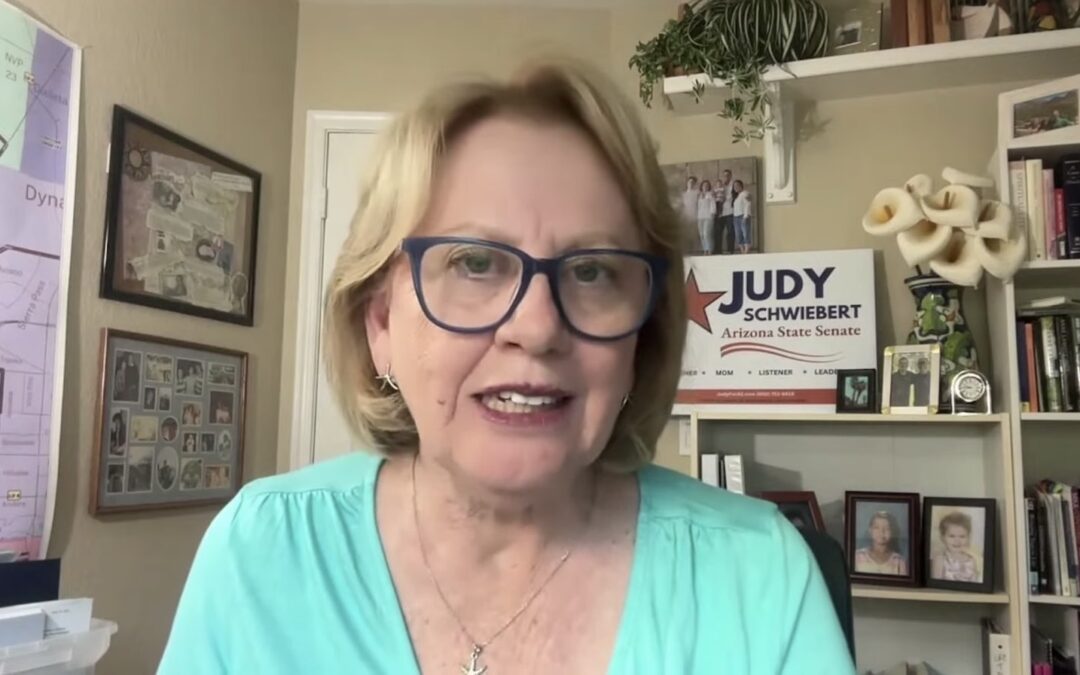
Judy Schwiebert, a Democrat, is running for the Arizona State Senate in Legislative District 2. Schwiebert currently serves as a State Representative for the district. She announced for the seat in June 2023, saying that “we need people who will work together to focus on the toughest challenges facing Arizonans including our teacher, affordable housing, and water shortage crises.”
Today, I am announcing my candidacy for the AZ State Senate in Legislative District 2. Now is the time to make real progress for Arizona families, so everyone gets their chance to thrive. Join our team and chip in now —> https://t.co/eqlsLuWVeRpic.twitter.com/TKI1imW0I7
— Representative Judy Schwiebert, LD2 (@JudyForAZ) June 16, 2023
Schwiebert posted more than 1,600 signatures at the Arizona Secretary of State’s Office earlier this spring to qualify for the ballot.
Thanks to so many amazing and dedicated volunteers, our campaign turned in over 1600 signatures this morning to qualify for the ballot! That’s three times more than the minimum required! I’m deeply honored to have the support of our community. pic.twitter.com/29djq2Tbou
— Representative Judy Schwiebert, LD2 (@JudyForAZ) March 27, 2024
The Democrat legislator has been endorsed by several left-leaning organizations, including National Organization for Women Arizona PAC, Arizona Education Association, Moms Demand Action, Save Our Schools Arizona, Arizona List, Jane Fonda Climate PAC, the Grand Canyon Chapter of the Sierra Club, Emily’s List, Moms Fed Up, and Human Rights Campaign PAC.
If voters were to select Schwiebert over the Republican favorite in the district’s primary, Shawnna Bolick, they would be sacrificing one of the state’s strongest school choice proponents for one of the top opponents of educational opportunities and freedom for students and families. In a recent interview with a local outlet, Schwiebert set her sights on the Empowerment Scholarship Account (ESA) program, which has given tens of thousands of Arizona families the opportunity to choose the education that best suits their children, saying, “What we cannot afford is to create an entirely separate private school system – funded by taxpayer money – that siphons almost a billion dollars a year out of the state budget. That’s what the universal ESA voucher program is doing. It is creating huge deficits. It is preventing us from investing in all kinds of things that Arizonans urgently need.”
In June 2022, Representative Schwiebert voted against the bill that expanded the ESA program in the state (HB 2853), which was the first of its kind in the country.
Schwiebert’s endorsements from Arizona Education Association and Save Our Schools Arizona also speak volumes about what she would continue to do in the state senate to undermine school choice opportunities for her constituents. In its 2023 Legislative Policy Priorities, Save Our Schools Arizona wrote that “Diverting public funds away from public schools toward private schools through ESAs and STOs only exacerbates the crisis – especially with universal ESA vouchers directing state tax dollars overwhelmingly to families who never sent their children to public schools in the first place. This negatively affects Arizona students and families, leaving the next generation unprepared for success and risking our state’s future.”
On her “X” account, Schwiebert has posted her participation with Save Our Schools Arizona at different events.
It was great to join Save Our Schools Arizona for today’s education town hall! pic.twitter.com/fqi10pwOBB
— Representative Judy Schwiebert, LD2 (@JudyForAZ) April 13, 2024
The Arizona Education Association is also an ardent opponent of the state’s many educational freedom opportunities. After Democrat Governor Katie Hobbs signed the state’s budget in 2023, which she negotiated with Republican legislative leadership, the Association wrote, “It’s extremely frustrating that this budget does not address the growth of the state’s out-of-control voucher program. The extremist majority in our state legislature has ignored the will of Arizona voters and pushed through policies that bankroll private schools for the wealthy at the cost of the public schools attended by 90% of Arizona kids…This unchecked spending is completely irresponsible and is on track to bankrupt our state. The fight to repeal vouchers during next year’s legislative session starts today.”
Earlier this year, Schwiebert bemoaned the resistance of Arizona Republican legislators in the House majority “to even consider sensible legislation to raise educator pay…”
4 years later, the only change has been universal vouchers. The majority refuses to even consider sensible legislation to raise educator pay and improve retention.
— Representative Judy Schwiebert, LD2 (@JudyForAZ) April 15, 2024
However, during the 2023 Arizona Legislative Session, Schwiebert voted against HB 2800 in committee, which would have “mandate[d] each school district and charter school increase the base salary of all eligible teachers” – according to the overview provided by the state House of Representatives. That bill, which was sponsored by Republican State Representative Matt Gress, received a green light from the House Appropriations Committee, but failed to make it out of the full chamber for the Senate’s consideration.
Schwiebert explained her vote at the time, saying, “The bottom line for me is well, this bill is really, I think, well-intentioned, and it’s good that, I’m glad to hear that Mr. Gress is acknowledging that teachers deserve higher pay, they absolutely do. But unfortunately, there are some serious flaws in this bill that I’m concerned could leave public schools in a worse financial position than they are in now.”
Representatives from both the Arizona Education Association and Save Our Schools Arizona registered opposition to the legislation on the Arizona Legislature’s Request to Speak system.
Arizona Legislative District 2 is one of the most competitive in the state, with a 3.8% vote spread in the past nine statewide elections. It is very winnable for Republicans, however, as the party has emerged victorious in six out of those nine elections. The district covers a large portion of northcentral Phoenix.
Schwiebert is running unopposed in the July primary election for Democrats. She will face off against the winner of the district’s Republican primary contest for state senator, which features incumbent, Shawnna Bolick, and Josh Barnett.
Bolick told AZ Free News that her “general election opponent was voted in shortly after she helped collect signatures for a ballot initiative that would have levied a billion dollar tax on small businesses not only hurting these business owners, but our state’s economy.” She added, “[Schwiebert] cares more about protecting special interests than voting for common sense education policies that gives every kid a chance to thrive in the school of their choice.”
AZ Free News is your #1 source for Arizona news and politics. You can send us news tips using this link.
Another political battle may be brewing over Arizona’s historic school choice program.
Earlier this week, Arizona House Speaker Ben Toma sent a letter to Tom Horne, the state’s Superintendent of Public Instruction (ADE), over his department’s controversial decision to acquiesce to Attorney General Kris Mayes’ demands to increase regulation of the Empowerment Scholarship Account (ESA) program.
Parents are understandably concerned about Attorney General Mayes’ politically-motivated investigation of the ESA program. I trust ADE will interpret the law and administer the ESA program as the legislature intended. pic.twitter.com/8GSjdT6KSo
In his letter, Toma wrote, “I understand that you may have no choice but to cooperate with the Attorney General’s politically-motivated investigation. However, ADE is best situated to determine how to implement its policies in a way that fulfills legislative intent but does not burden parents with unnecessary bureaucratic requirements.”
Toma added, “As you implement your Department’s policies, I urge you to scrutinize Attorney General Mayes’ unsolicited legal advice expressed in her July 1, 2024, letter, consider how her interpretation of Arizona statutes would impact parents throughout the state, and reject her interpretation of the law that would lead to absurd results.”
The Republican Speaker’s communication addressed an email from ADE ESA Executive Director, John Ward, to parents within the program, informing them about a letter he had received from Mayes’ Solicitor General. According to Ward, that letter “stated that some ESA program practices are inconsistent with State law and result in payment of ESA funds without authorization of law, [and that] the Solicitor General’s Office has directed the ESA program to address the issues it identified.”
The Attorney General’s Office cited two Arizona statutes to bolster its argument that “the Arizona Department of Education has approved certain supplemental items and textbooks without requiring curricula, which may result in ‘illegal payment of public monies.’” Ward told parents that “ADE has no choice but to comply with the Solicitor General’s determination,” forcing families to “submit a curriculum with all supplemental materials requested or purchased” – something that he even noted was a practice “in place since before the current ADE administration.”
Horne’s acceptance of Mayes’ interpretation of the law was surprising to many onlookers, being that his office has been at odds with the Attorney General’s Office on almost every issue related to this program. Previously, Horne issued a number of statements that expressed his ardent opposition to the Democrat Attorney General’s persistent attacks on the ESA program and vowing to match her office step for step in defense of parents.
One of the foremost experts and defenders of the ESA program, Christine Accurso, addressed this action by Horne’s office, writing, “I joined the ESA program as a parent in 2014 and in all of the years we participated, I never had to submit curriculum that listed pencils and paper (for example) as something I can use ESA funds for. This new regulation is not what the legislature intended. If you go back and listen to the many years of committee hearings you will clearly hear the lawmakers desired to give parents access to tax dollars to provide an excellent education for their child, putting them on equal footing financially (while providing a 10% savings) to what the state funds in the public schools. I don’t know of a school district in Arizona, let alone America, who has curriculum for such obvious supplemental educational materials, as noted above.”
Accurso’s sentiments were reciprocated by Speaker Toma, who in his letter to Horne, stated, “it appears that the Attorney General’s Office is advancing an argument that documentation is required for most ESA-related expenses. The legislative record does not support such an overtly restrictive view or burdensome administration of the ESA program.”
Speaker Toma concluded his letter by expressing his appreciation for Horne’s “willingness to discuss these implementation issues with legislators who – like parents – are understandably concerned about the Attorney General’s letter.”
Daniel Stefanski is a reporter for AZ Free News. You can send him news tips using this link.