by Staff Reporter | May 20, 2026 | News
By Staff Reporter |
The Republican candidate for the Arizona secretary of state race stands in support of precinct-based voting.
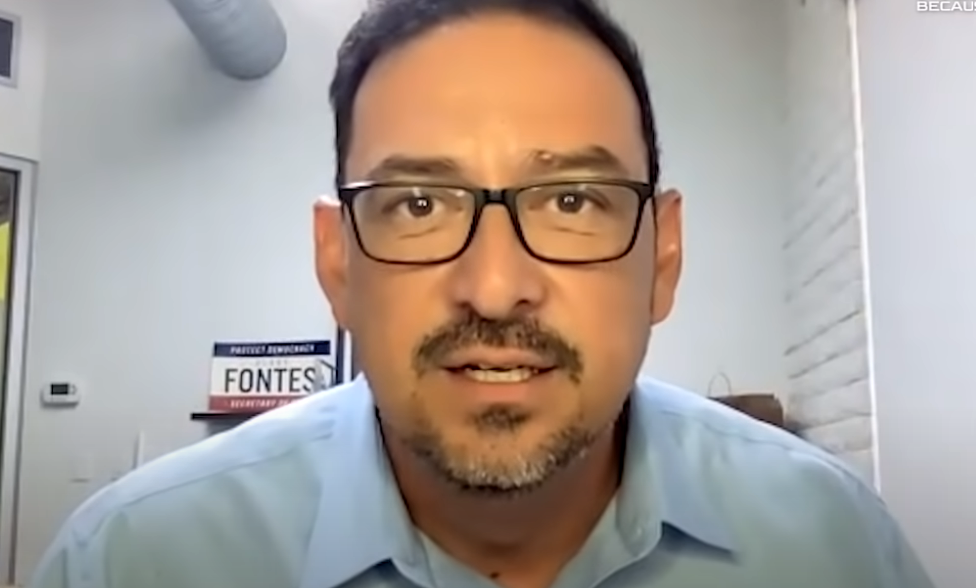
Alexander Kolodin, a Republican lawmaker representing LD3, told Pinal County Attorney Brad Miller in a sit-down interview that precinct-based voting had “the opposite” effect of disenfranchising disabled voters.
Rather, Kolodin said that the vote center model preferred by his opponent — incumbent Secretary of State Adrian Fontes, a Democrat — presents a greater risk for disenfranchisement because of the distance between vote centers.
“Precinct-based voting — I want to make this very clear — is the opposite of disenfranchising disabled voters. It is the vote center model that disenfranchises the most disabled voters because, again, it’s that travel time, it’s that distance,” said Kolodin.
Kolodin added that the distances between vote centers compared to precinct polling were more costly, gas- and time-wise. Kolodin likened the cost to taxation, with the greater burden on disabled voters.
“It’s almost a poll tax. Imagine how much gasoline it costs these days to drive 30 miles. You drive 30 miles there and back, I tell you in my car that’s going to cost me $10, $15 bucks. So, I’d have to pay that money in order to vote,” said Kolodin. “It’s hard for me to get a caregiver who can have that much time to take me if I’m a disabled person that far to vote, whereas if I have a polling place in my precinct, that becomes a much easier lift for me.”
Earlier this month, Secretary of State Fontes lost a court fight with Pinal County over its precinct-based voting model. Fontes sued in 2024 to force the county to adopt vote centers under the guise of retaining precinct-based voting.
In the 2025 Election Procedures Manual (EPM), Fontes mandated that all counties with precinct-based voting repurpose the Accessible Voting Devices (AVDs) to contain provisional ballots for the entire county. AVDs were intended and used exclusively in the past for voters with disabilities. Under Fontes’ design, precinct-based polling places would deprioritize voters with disabilities by requiring them to share this specialized voting equipment with out-of-precinct voters.
The court ruled that Fontes’ mandate would likely disenfranchise disabled voters.
Fontes dismissed the judge’s ruling as “sid[ing] with conspiracy theorists” in a social media post. He claimed his 2025 EPM policy wasn’t rooted in a desire to force “de facto” vote center models, as the court ruling stated, but instead an intent to allow voters with disabilities to vote wherever they wanted in the county.
“We were trying to help voters with disabilities just go to whatever polling place they can get to the easiest and cast a ballot from anywhere in their county,” said Fontes. “Unfortunately, for now, the politics have won in the court.”
However, that EPM policy didn’t explicitly limit AVDs usage to out-of-precinct voters with disabilities. The policy opened up the AVDs to all out-of-precinct voters.
“If the voter declines or is unable to travel to the voter’s assigned polling place, permit the voter to vote a provisional ballot in the correct ballot style for the voter’s assigned precinct using an accessible voting device that is programmed to contain all ballot styles,” stated the 2025 EPM. “The election official should inform the voter that their provisional ballot will be counted only if it is confirmed the voter is otherwise eligible to vote and did not vote early or at another voting location and had that other ballot counted as determined by the County Recorder.”
AZ Free News is your #1 source for Arizona news and politics. You can send us news tips using this link.
by Ethan Faverino | Sep 24, 2025 | News
By Ethan Faverino |
Arizona House Speaker Steve Montenegro, alongside Senate President Warren Petersen and House Republicans, announced the filing of an amicus brief with the Arizona Supreme Court in the case Republican National Committee v. Fontes.
The brief urges the Court to require Arizona Secretary of State Adrian Fontes to adhere to Arizona’s Administrative Procedures Act (APA) when drafting the Elections Procedures Manual (EPM), a critical set of rules governing the state’s election process.
The APA mandates a transparent public notice and comment period before new rules take effect, ensuring accountability and alignment with Arizona’s election statutes.
The brief, filed in support of the Republican National Committee, the Republican Party of Arizona, LLC, and the Yavapai County Republican Party, argues that the EPM must comply with the APA’s procedural requirements, as neither the APA nor the authorizing statute (A.R.S. § 16-452) explicitly exempts it.
“The integrity of Arizona’s elections is absolutely vital. House Republicans are committed to the rule of law and to ensuring that Secretary Fontes stays within the limits of his authority,” said Speaker Montenegro. “We already convinced a judge to strike down unlawful provisions in the 2023 EPM in our own lawsuit. We fully support this case, which asks only that Secretary Fontes follow long-standing notice and comment requirements when drafting the manual. Arizonans deserve accountability and transparency from every public officer, especially when it comes to election rules.”
The brief emphasizes that Arizona’s comprehensive election laws, which cover voter registration, early ballots, polling places, and vote tabulation, limit the Secretary of State’s authority to draft an EPM.
The APA’s notice and comment process serves as a check, promoting transparency and preventing deviations from legislative intent.
The brief cites the Court of Appeals’ ruling in Republican National Committee v. Fontes, which affirmed that the EPM is subject to the APA’s requirements due to clear statutory language.
The filing highlights two key benefits of APA compliance. First, it reinforces constitutional and statutory limits on the Secretary’s authority, preventing overreach. Second, the public comment process allows for early identification of legal or practical flaws in the EPM drafts, potentially reducing litigation and supporting public confidence in Arizona’s elections.
The brief also notes issues with the 2023 EPM, where provisions added without public input led to legal challenges.
The ongoing litigation, Petersen v. Fontes, further highlights the importance of APA compliance, as it challenges the 2023 EPM’s deviation from state law. The amicus brief, submitted by Montenegro and Petersen in their official capacities, reflects the Arizona Legislature’s commitment to upholding the rule of law and protecting the integrity of the state’s electoral process.
Ethan Faverino is a reporter for AZ Free News. You can send him news tips using this link.
by Jonathan Eberle | Aug 7, 2025 | News
By Jonathan Eberle |
The Arizona Court of Appeals is set to hear oral arguments on August 19 in a closely watched lawsuit challenging the state’s early ballot signature verification process—one that could reshape how election officials authenticate mail-in ballots. The case, Arizona Free Enterprise Club v. Fontes, will be heard by Division Two of the Court of Appeals, which lifted a prior stay in the case following a joint request by all parties to move forward on the merits.
At the heart of the dispute is whether the Secretary of State’s Elections Procedures Manual (EPM) has unlawfully expanded the scope of documents used to verify a voter’s signature on early ballot envelopes. The plaintiffs—Arizona Free Enterprise Club, Restoring Integrity and Trust in Elections, and Yavapai County voter Dwight Kadar—argue that Secretary of State Adrian Fontes and his predecessor, now-Governor Katie Hobbs, enforced EPM guidance that violates state law.
Under Arizona statute A.R.S. § 16-550(A), election officials are required to compare a voter’s early ballot envelope signature to the one in their “registration record.” However, the current EPM—originally authored by Hobbs in 2019 and maintained under Fontes—permits election officials to validate signatures by comparing them to any election-related document on file, such as early ballot requests, provisional ballot envelopes, or Active Early Voting List notices.
“The current election procedures manual adopted by the Secretary of State has rewritten state law regarding signature verification for mail-in ballots,” said Arizona Free Enterprise Club President Scot Mussi. “The result is a process that invites questionable methods and opportunities for abuse during the signature review process. It’s time for the courts to bring this illegal EPM practice to a halt.”
The case has had a turbulent procedural history. In 2023, Yavapai County Superior Court Judge John Napper initially ruled that the EPM violated state law, stating that the definition of “registration record” is neither vague nor ambiguous. Napper rejected the Secretary of State’s argument that the term could include any number of election-related documents. However, in a surprising reversal later in the proceedings, Napper ruled in favor of the state—prompting the plaintiffs to appeal.
The outcome of this case could have major consequences for how Arizona handles the verification of early ballots in future elections. Arizona is a state with widespread early and mail-in voting, and signature matching is often the sole method for confirming voter identity on ballots returned by mail. Early ballot voters are not required to provide other identifying information, such as a driver’s license number, date of birth, or the last four digits of a Social Security number.
After months of delays—including a stay prompted by a separate ruling that invalidated the 2023 EPM for procedural reasons—the Court of Appeals has agreed to resume the case. All parties have urged the court to issue a ruling on the merits, regardless of the Arizona Supreme Court’s handling of a related challenge filed by the Republican National Committee.
The court’s decision will help clarify the balance of power between Arizona’s elected officials and its election laws, especially in the increasingly scrutinized area of early voting.
Jonathan Eberle is a reporter for AZ Free News. You can send him news tips using this link.
by AZ Free Enterprise Club | Apr 9, 2025 | Opinion
By the Arizona Free Enterprise Club |
Adrian Fontes has proven himself to be good at two things during his tenure as Arizona’s Secretary of State: losing in court and throwing tantrums. It’s really unfortunate. The state’s top election official is not supposed to be taken to court on a regular basis—especially for, you know, his repeated attempts to undermine election integrity. And of course, throwing tantrums should be more characteristic of toddlers, not a government official. But Fontes can’t help himself.
In his latest tirade, Fontes joined Hillary Clinton’s old consigliere Marc Elias on Democracy Docket to whine about President Trump’s recent executive order to preserve and protect the integrity of American elections. Toward the end of the discussion, Elias asked Fontes about the multiple lawsuits against his Elections Procedures Manual (EPM), which he lost to us and Arizona Republican lawmakers. As has become all too common with our Secretary of State, he responded how you would expect someone to respond when he knows he can’t win. He attacked our organization and degraded our 15,000 activists and donors.
Yes. That’s right. The top election official in our state, who is supposed to remain unbiased and simply do his job to protect election integrity, lashed out against us and told people not to donate to us because we won our lawsuit against him and his illegal EPM.
Ummm…news flash, Mr. Fontes. One of the reasons our donors support our cause is to stop government officials like you from circumventing the law. So, when we win, they feel good because their money was put to effective use.
But we shouldn’t expect someone with such low character as Adrian Fontes to understand that. After all, this isn’t the first time he’s tried to use the power of his office to attack and intimidate organizations like ours that participate in the election process…
>>> CONTINUE READING >>>
by Staff Reporter | Mar 9, 2025 | News
By Staff Reporter |
The Arizona Court of Appeals ruled against the Elections Procedures Manual (EPM) produced by Secretary of State Adrian Fontes.
Judge Lacey Gard reversed and remanded a lower court decision dismissing the case, Republican National Committee, et al. vs. Adrian Fontes, et al., last summer. Gard ruled the EPM fell under the Arizona Administrative Procedure Act (APA), a “plain reading” of the statute contrary to what the lower court ruled. Gard also dismissed Fontes’ arguments for his right to not comply with the APA because the APA and EPM statutes conflict.
“[The APA] unambiguously states that all agencies are subject to the APA’s rulemaking procedures unless ‘expressly exempted,’” stated Gard. “The APA and EPM statutes impose duties on the Secretary that may require him to begin promulgating the EPM earlier, but they are not inconsistent, do not directly conflict, and do not create impossible barriers to complying with both.”
Gard further ruled Fontes violated the APA by not allowing public comment on the proposed EPM for the full 30 days, instead only opening up review for 15 days.
Gard noted at the end of her ruling that she wouldn’t address other claims by the Republican National Committee challenging eight specific provisions of the EPM, since she arrived at the conclusion that Fontes’ promulgation of the 2023 EPM failed to “substantially comply” with requirements set forth by the APA for the rulemaking process.
The Republican Party of Arizona (AZGOP) sued Fontes over the EPM last February, along with the Arizona legislature leadership at the time (Senate President Warren Petersen and then-House Speaker Ben Toma) and the Arizona Free Enterprise Club. In a statement on Thursday’s ruling, the AZGOP claimed the appeals court found the EPM to be unconstitutional.
AZGOP Chair Gina Swoboda said the ruling confirmed the extent of the unlawfulness of Fontes’ EPM in the Thursday statement. Swoboda characterized Fontes and his EPM as an attempt “from the radical left to illegally assume control” of Arizona elections.
“This opinion from the court shows just how much Secretary Fontes and his allies in the Governor’s and Attorney General’s offices overreached in their partisan efforts to hijack our elections through this blatantly political manual,” said Swoboda. “As we have highlighted to the court, the most-recent elections manual contained many provisions that ran utterly contrary to Arizona law, giving the Democrat machine a clear advantage at the ballot box for years to come.”
Beyond the lack of compliance with APA, GOP leaders’ objections to the Fontes EPM concerned conflicts with state election law: accepting voters who declared themselves noncitizens on juror questionnaires; allowing voters who failed to submit or couldn’t achieve verification of their Documentary Proof of Citizenship (DPOC); allowing first-time, federal-only voters to provide only an ID and not DPOC for mail-in voting; not requiring county recorders to check federal databases for citizenship reviews; restricting public review of voter signatures on mail ballots; allowing Active Early Voting List voters to receive ballots outside the state for certain elections; requiring denial of early ballot challenges received prior to the return of an early ballot; and allowing out-of-precinct voters to cast provisional ballots.
AZ Free News is your #1 source for Arizona news and politics. You can send us news tips using this link.