Maricopa County Recorder Justin Heap has announced that his office set a new speed record for processing Election Day ballot drop-offs, completing signature verification and curing ballots within 48 hours of the Nov. 4th elections. The matter was complicated when officials scrambled to process thousands of ballot envelopes discovered days later in a misplaced transport box.
In a Nov. 6 update on X, Heap wrote, “All calls to voters with signature inconsistencies have been completed.” He added that finishing both signature verification and voter calls “within just 48 hours of Election Day shatters all previous timeframes for elections with more than 100,000 Election Day drop-offs.”
RECORDER’S ELECTION UPDATE:
✅ All calls to voters with signature inconsistencies have been completed.
Finishing both signature verification and voter calls within 48 hours of Election Day shatters all previous timeframes for elections with more than 100,000 Election Day…
— Maricopa County Recorder Justin Heap (@azjustinheap) November 7, 2025
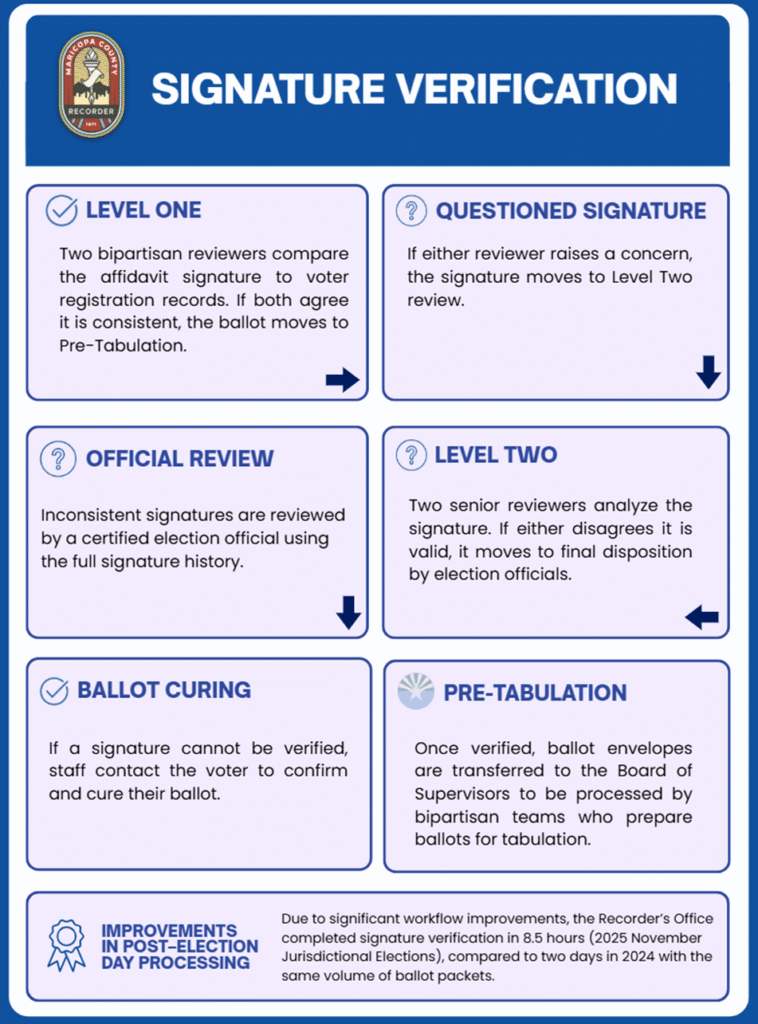
According to detailed metrics provided to AZ Free News by the Maricopa County Recorder’s Office, the November election included 117,664 ballot packets returned via mail or drop box on Election Day. Signature verification on those packets began at 6:00 a.m. on Wednesday, Nov. 5, and the office says the final file review was completed by 2:33 p.m., for an 8.5-hour turnaround on the Election Day returns.
For comparison, the Recorder’s Office pointed to the July 30, 2024, primary, when roughly 114,681 similar packets took about two days to clear signature review under then-Recorder Stephen Richer. In an emailed statement to AZ Free News, Maricopa County Director of Communications Judy Keane wrote:
“This represents a dramatic acceleration in post–Election Day processing: completing in 8.5 hours what previously required two days in the 2024 Primary, despite similar packet volumes. This outcome demonstrates the effectiveness of process improvements and the exceptional performance of the team.”
Two-Reviewer System and Quad-Screen Interface
Heap campaigned on tightening signature verification and has spent much of his first year in office overhauling the workflow while feuding with the Maricopa County Board of Supervisors over funding, control of election IT systems, and a controversial Shared Services Agreement now mired in litigation.
In response to written questions from AZ Free News, the county Public Information Office said that every early-ballot signature in the Nov. 4 election was reviewed by at least two human reviewers of different parties.
The office described the workflow this way:
Level One review uses a “quad-screen” interface on a single monitor:
Bottom left: the affidavit signature being reviewed
Above it: the voter’s latest signature on file
Upper right: second-latest signature
Middle right: third-latest signature
Bottom right: the voter’s registration signature
All signature exemplars can be rotated to the primary comparison position above the affidavit signature so reviewers can align shapes and slants.
According to the county, Level Two reviewers see the same layout. Still, they can also scroll through the voter’s full signature history when Level One reviewers either disagree or cannot comfortably verify a match.
County officials say that the combination of two reviewers of opposing parties and deeper access to a voter’s signature history at the second level was designed to increase both scrutiny and perceived neutrality, after years of partisan conflict over how Maricopa handles early ballots.
For voters whose signatures still couldn’t be confirmed, the office used multiple curing channels tied to identity verification: calls from election staff, text messages (for those who opted in), emails, and a secure online dashboard at BeBallotReady.vote, consistent with state guidance on signature curing windows.
Record Processing Claims Tested by Ballot Mishap
Heap’s announcement of “shattering” past performance landed just as Maricopa County was forced to acknowledge another election-administration black eye: the discovery of two sealed transport boxes with 2,288 returned ballot affidavit envelopes that had not been included in the initial post-Election Day processing.
On Nov. 7, county elections officials disclosed that poll workers had mistakenly placed the sealed transport boxes inside a blue drop box instead of returning them to the county’s election center on Election Night. Local outlets reported that the boxes bore intact tamper-evident seals and matched election-night serial numbers, but the ballots inside had not been counted, according to AZ Family.
Heap’s office responded with its own update, saying signature verification on all 2,288 ballot packets had been completed and that every voter whose signature needed curing had been contacted before the statutory deadline.
RECORDER'S ELECTION UPDATE:
The County Recorder’s Office has completed signature verification on all 2,288 of the missing ballot packets we received from the Board this morning. In the last hours, we have contacted all remaining voters with signatures requiring additional… pic.twitter.com/M1PGHj6Tkw
— Maricopa County Recorder's Office (@RecordersOffice) November 7, 2025
Jennifer Liewer, Deputy Elections Director, issued a statement following the report saying:
“Friday, Nov. 7, 2025: This morning, as part of standard post-election protocols, elections workers inspected equipment that had been returned from voting locations. This process includes unpacking and logging equipment.
“During this inspection, two sealed transport boxes of returned ballot affidavit envelopes were found inside a blue drop box. While the transport boxes did have tamper evident seals, ensuring the security of ballots, poll workers had mistakenly placed the sealed boxes inside a blue drop box rather than returning them on Election Night. Immediately after the discovery, a bi-partisan team of election staff took custody of the sealed bins and worked quickly to ensure chain of custody was followed. The green affidavit envelopes will now be signature verified and processed for tabulation.
“Per statute, green affidavit envelopes are to be counted at the close of voting on Election Night. Counted envelopes are then placed in a large bin, sealed, and returned to the Maricopa County Tabulation and Election Center.”
As previously reported by AZ Free News, Recorder Heap has been embroiled in a lengthy legal battle with the Maricopa County Board of Supervisors over funding to modernize and provide technical support for the county’s election equipment, and centered on the division of responsibilities created in a Shared Services Agreement (SSA) agreed to by Heap’s predecessor, Stephen Richer.
Heap sought a Temporary Restraining Order against the Board’s planned assessment of election systems and databases in early October, per KJZZ. However, on November 6th, Maricopa County Superior Court Judge Scott Blaney denied the motion, writing “The Recorder’s concerns regarding the assessment’s potential interference with the 2026 Primary Election are speculative at this point in the litigation,” according to the court order.
A series of posts to X on Tuesday sparked a firestorm of controversy when Merissa Hamilton of Strong Communities Action-EZAZ.org made a bombshell allegation that Maricopa County Election officials were made well aware of the potential for printing and supply issues during the 2022 statewide elections. Hamilton alleged that county officials moved forward without addressing the issues, citing a series of emails detailing the Maricopa County GOP raising concerns to then-Recorder Stephen Richer and Maricopa County Board of Supervisors’ Election Manager Scott Jarrett.
🚨 MARICOPA COUNTY ELECTION FAIL BOMBSHELL
Remember in 2022 when the nearly 70% of voting centers in Maricopa County failed on Election Day causing massive long lines and voter disenfranchisement resulting in @KariLake and @AbrahamHamadeh barely losing?
In the initial post Hamilton wrote, “Remember in 2022 when the nearly 70% of voting centers in Maricopa County failed on Election Day causing massive, long lines and voter disenfranchisement resulting in @KariLake and @AbrahamHamadeh barely losing? Maricopa County knew in advance their Election Day plan was set up for failure, and THEY LET IT FAIL!”
Hamilton noted that the emails were obtained for Strong Communities Action by The Gavel Project and civil rights activist and Arizona election attorney Ryan Heath saying, “Without his legal muscle we wouldn’t have secured it!”
In the thread that followed, Hamilton released several emails from then-Chairwoman of the Maricopa County Republican Committee Mickie Niland to Richer and Jarrett saying, “I remember hearing from Scott (Jarrett) at some point after the primary that there was a problem during the primary with some tabulators not reading correctly due to low ink. How long does it take you to get paper or ink to them if they run out? Is there a process for the voting locations to report when they are half out of paper? How far are the restocking trucks from the voting centers? Are you using the length of the lines to help you determine when more supplies are brought to the centers?“ She also asked if there was any way she could help.
Jarrett responded, “We’ve been monitoring turnout and are prepared,” adding that there was plenty of ballot paper and normal paper to print control slips as well as “sufficient toner and printer drums.”
Hamilton explained, “Several days ahead of Election Day, the Maricopa County GOP leadership warned Maricopa County that their Election Day plan would fail and disenfranchise voters. The Maricopa County BOS Election Director Scott Jarrett insisted everything would be fine saying he was ‘confident.’”
Niland, representing the Maricopa County GOP, even followed up with an email warning, “Trust is low and voting in person is the topic everyone wants to discuss with us. To us if you are basing your decisions off of history, we think things are different now.” Niland added, “Please consider this email the official raising of that flag.”
According to an investigation of the 2022 Maricopa County Election, former Arizona Supreme Court Chief Justice Ruth McGregor found that “many of the Oki B432 printers were not capable of reliably printing 20-inch ballots on 100-pound paper under election-day conditions.”
McGregor added, “The combined effect of the heavy paper, longer ballot, and intermittent burst of print demand pushed the printers to perform at the very edge of or past their capability, so that any decrease in fuser performance in an individual printer could result in problems.”
Replying to the post by Musk, Hamilton thanked the X owner for “bringing attention to this vital matter!” She also raised allegations that Maricopa County Board of Supervisors Chairman Thomas Galvin has blocked newly elected County Recorder Justin Heap from accessing “the IT staff and responsibilities assigned to him in AZ law to secure and run our elections!”
Later in the afternoon, Maricopa County published a post to X that outlined the October 2024 agreement, which demarcated the election responsibilities of the Board of Supervisors and the Recorder’s Office. Galvin shared the post as well.
On Tuesday, during the early hours of Election Day, American Majority Action (AMA) announced that with record numbers of early voters in the state of Arizona, it had exceeded 3.25 million voter contacts in its targeted voter group and conducted over 600,000 live conversations with them. In so doing, the group stated that it led the effort to encourage conservative voters to vote early.
Arizona Executive Director of American Majority Action Tracy DuCharme said in the statement:
“We focused our Arizona efforts on generating more absentee ballots and changing the voting behavior of low propensity conservative voters. We have been working with our partners to get more conservatives to vote absentee, whether through the mail or in person. We are having face-to-face conversations with voters at the doors, and through their phones with live calls and personal text messages.
Our absentee ballot generation plan was extremely successful and now 68.98% of conservatives who requested a ballot have returned them. We have engaged in nearly 3 million live contacts over phone calls, door knocks, and text messages with targeted voters. While they are tired of being bombarded through the airwaves, we have found people still appreciate personal conversations about the issues that face us all each day. We’re making a lasting impact on our state, one conversation at a time. I’m proud of the work AMA has done here in Arizona, and I know we’ll continue this mission for years to come.”
AMA credited the employment of advanced canvassing technology in its statement adding, “Face-to-face conversations are the highest form of voter engagement, and are shown to greatly increase election turnout. AMA’s activist groundswell is powered by Voter Gravity’s groundbreaking technology that allows staff to quickly and accurately get out the vote through micro-targeting voters.”
According to the Arizona Mirror, as Election Day voting commenced, 785,231 Republicans had already voted early for a turnout of 52.71% as compared to 643,450 Democrats and 466,140 independents.
Final voting data for the 2024 election is not yet available, however, President Donald Trump has been declared the winner of Arizona’s eleven electoral votes. And as of this report, in the race for the U.S. Senate, Democrat Rep. Ruben Gallego currently leads Kari Lake 1,381,684 votes to 1,348,362 votes.
The last polls before Election Day showed Democratic candidate Ruben Gallego with a slim lead over Republican candidate Kari Lake.
Of the multiple polls conducted over this past weekend, only one showed Lake with a slim lead over Gallego.
Patriot Polling asked over 800 likely voters over the weekend who they would support. Over half — 51 percent — backed Gallego, while 48 percent said they were supporting Lake.
Victory Insights asked over 700 likely voters from last Friday through Sunday who they would support. 50 percent said they would support Gallego, and 47 percent said they would support Lake.
InsiderAdvantage asked 800 likely voters last Friday and Saturday who they would support. 49 percent said Gallego and 47 percent said Lake.
The only polling to show Lake ahead came from Atlas Intel. They asked over 900 likely voters, also on Friday and Saturday, who they would support. 49 percent said Lake while 47 percent said Gallego.
Of the 900 likely voters polled by Emerson College from last Wednesday, 50 percent said they would support Gallego and 45 percent said they would support Lake.
The New York Times and Siena College (polling from October 25 through last Saturday, or nine days total) received the same results as Emerson College when they polled just over 1,000 likely voters.
An average of all polling results from Project FiveThirtyEight show Gallego with a lead of over 49 percent to Lake’s 45 percent.
These latest polling results are consistent with past polling, which have reflected Gallego maintaining a slim lead over Lake.
It would appear that the release of Gallego’s divorce records had no impact on the race, though they were anticipated to measure up as an October surprise and described as “damning” by Lake’s senior advisor Caroline Wren. The records in question contained little beyond what had been covered previously by the media and disclosed voluntarily by Gallego himself. Yavapai Superior Court Judge John Napper described the records as “one of the most garden-variety divorce files” he’d ever come across.
Gallego has built up a consistent lead in the polling, despite recently tellingThe Bulwark that Arizona remains a “center-right state,” more so than a moderate one based on his experiences.
The Democratic candidate told MSNBC over the weekend that Lake would “contest” the election results if she lost.
“What matters though is most Arizonans want to move beyond election denialism,” said Gallego. “What Kari Lake has done is not just funny and weird — it’s actually very corrosive, and it’s dangerous.”
.@RubenGallego: “When we beat Kari Lake, we know she will contest it. What matters though is that most Arizonans… want to move beyond election denialism. They want someone that’s going to be fighting for them, not someone who’s going to just create more division.” pic.twitter.com/1I0t08aaDZ
On Monday, in a late bid to convince the remaining voters to vote for her, Lake’s team released a video taken during one of Gallego’s private fundraisers in which the Democratic candidate admitted that he wasn’t “allowed” to post on his own social media.
“I’m not allowed to tweet out anymore,” said Gallego.
Yikes. If his staff doesn’t trust him with his social media, how can Arizonans trust him with their future? https://t.co/qT7PaI0KBF
Gallego’s team took a different approach on Monday. They posted videos depicting Gallego as a family man capable of having non-political conversations.
On Tuesday, the Arizona Senate passed a bill requiring voting locations to tabulate early ballots on site.
The bill, SB1105, passed 16-14 along party lines. The bill initially failed in the Senate, but received a second chance on reconsideration. However, the legislation wouldn’t apply to counties that tabulate Election Day ballots at a central location, and those that don’t otherwise tabulate Election Day ballots on-site at a polling location or voting center.
SB1105 from State Sen. Frank Carroll (R-LD28) modifies law to require rather than merely allow county officers in charge of elections to tabulate a voter’s early ballot on site on election day.
Officials who voiced opposition for the bill included Pima County Recorder Gabriella Cazares-Kelly, Mohave County Supervisor Jean Bishop, Mohave County Assessor Jeanne Kentch, and County Supervisors Association of Arizona Legislative Director Robin Hillyard.
During the Senate Elections Committee hearing on the bill in January, Senate Majority Leader Sonny Borrelli (R-LD30) called the legislation a “great, great bill” that “helps with accuracy.” Senate Assistant Minority Leader Juan Mendez (D-LD08) questioned what was more important: accuracy or speed. Borrelli responded that voting was a privilege worth waiting in line for, comparing voting lines to those lines people endure for things like movies and Disneyland.
“You can wait to stand in line, but you can’t wait for the election results to come out when they’re just going to come out?” asked Mendez.
“I’ve always advocated for accuracy, not speed,” said Borrelli.
Jen Marson, Arizona Association of Counties, said that her organization opposes the bill, calling it “unimplementable.” Marson relayed that only half of the counties in the state tabulate ballots on site. She questioned whether the bill would require all counties to tabulate on site.
The committee hearing preceded the amended version of the bill that passed the Senate on Tuesday, which included the exemption for counties that tabulate Election Day ballots at a central location.
Marson further warned that two separate polling places would have to be run within each location: one side for early ballot turn-ins, and one for on-site tabulation. She projected that not all locations would have enough space to run this size of operations. With that, Marson noted that counties would be required to have two separate boards, staff, and equipment to oversee these separate polling place operations.
In addition, Marson noted that it was difficult to find voting locations that are big enough and are ADA compliant. State Sen. John Kavanagh (R-LD03) pointed out that schools and churches are big enough and are ADA compliant, but Marson disclosed that counties are often told “no” by schools.
Marson questioned whether everyone would be required to stand in line rather than drop off an early ballot, and noted that there would need to be different tabulators for early ballots versus in-person, day-of ballots.
Democrats in the committee called the bill “problematic” and a “logistical mess.”
State Sen. Anna Hernandez (D-LD24) claimed that the bill would disenfranchise voters by requiring them to take the time to have their early ballot tabulated on site. Mendez concurred with Hernandez’s remarks, adding that it would make it harder for certain, undisclosed populations to vote.
State Sen. Ken Bennett (R-LD01) admitted that the bill was flawed but ultimately had good intentions. He voted for it in the hopes that the language would be cleaned up to address Marson’s warnings.
“If people are going to bring their early ballots to the polls, then show ID and let’s get those counted. But, half of the counties literally do not do tabulation at these voting centers. This bill is attempting to do something by striking the very language that gives the counties the flexibility, who don’t do on-site tabulation, to send it in and count it,” said Bennett.
These issues were addressed in an amendment on the bill, which provided the exemption for counties that tabulate Election Day ballots at a central location, and those counties that don’t otherwise tabulate Election Day ballots on site at a polling location or voting center.
Corinne Murdock is a reporter for AZ Free News. Follow her latest on Twitter, or email tips to corinne@azfreenews.com.