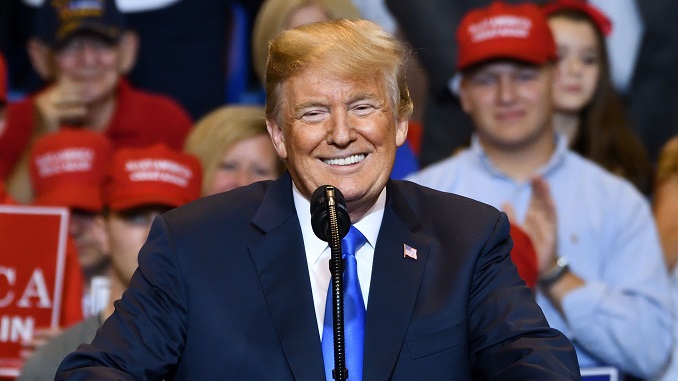
Noble Predictive Insights (NPI) released its Arizona Public Opinion Pulse (AZPOP) results on Thursday, offering the closest to a full exit-poll that has been generated in the state so far after the election. Conducted in the last pre-Thanksgiving week of November, the survey spoke to 988 registered voters in Arizona and among other things asked voters specifically, “WHY they voted the way they did.”
The pollsters asked voters to express their reasoning for voting for President-elect Donald Trump versus Vice President Kamala Harris and for Congressman and Senator-elect Ruben Gallego instead of Kari Lake in particular.
The latest AZPOP tells us why voters made their choices. Trump captured a majority of Independents, while the economy topped voter concerns (27%).
Of all concerns that dominated the presidential election, the outlet found, as many polls prior to the election did, that the economy predominated being the most important issue in voters’ decision with 27% of respondents. This was followed by immigration, “Threats to Democracy”, and the “candidate’s background or policy record.”
The economy (27%) was most impactful on voice choice, followed by immigration & threats to democracy. Trump’s GOP made immigration a signature issue. DEMs own the positive & negative aspects of the economy. Translation: The top issues were great for REPs.https://t.co/ztoJQLTfmtpic.twitter.com/idIuThEz4W
“Trump’s GOP has made immigration a signature issue for the party, and Democrats – the party in power – own both the positive and negative aspects of the economy. Translation: The two top issues were great for Republicans.“
Republicans and Independents both were motivated first by the economy and then by immigration, while Democrats were motivated by the perceived “threats to Democracy,” followed by the economy and abortion.
David Byler, NPI Chief of Research explained, “Republican and Democratic candidates ran like they were living in different universes. Democrats cared about abortion and threats to democracy much more than immigration. Republicans saw immigration and the economy as crises caused by the Biden Administration.”
“We saw this same pattern in the pre-election polling. But the election proved that the GOP argument – about the economy, immigration, and dissatisfaction with how Biden governed – won the day.”
The exact same share of Republicans and Independents (31%) said the economy was most important, and immigration came in second place – though immigration was important to more Republicans (24%) than Independents (17%).
The pollster also observed that a potentially fatal flaw in Harris’ campaign was her deep integration within the deliberately named Biden-Harris Administration, which precluded her making a clean-break from an extremely unpopular presidency among Arizona voters.
“As Biden’s VP, most voters (56%) view Harris as an extension of the Biden administration rather than a new politician forging a different path (33%). Arizonans disapproved of Biden’s job performance for most of his tenure as President – which suggests he may have been a liability for the Harris campaign.”
Most voters (56%) view Harris as an extension of the Biden administration. Arizonans disapproved of Biden’s job performance for most of his tenure as President – which suggests he may have been a liability for the Harris campaign.
Mike Noble, NPI Founder & CEO noted, “Hindsight is 20/20, but this might be one of the biggest mistakes of the 2024 Democratic process for replacing Biden. They chose someone who was part of the Biden Administration, knowing that he had a poor approval rating. Harris could be tied to Biden in a way that almost nobody could.”
Turning to the Senate race, the results took on a different character entirely. Rather than addressing particular issues or positions as they did in the presidential race, the pollsters’ questioning yielded more emotionally driven responses related to Kari Lake’s favorability, thus not offering a similar distinction in the Senate race. The outlet wrote, “This AZPOP asked voters who had an unfavorable view of Lake (53%) WHY they disliked her, and allowed them to select multiple reasons.”
Based on the narrow breadth of the question and its scope being limited to those who voted against Lake, Noble Predictive Insights found a majority of Gallego supporters either did so because she “denied her 2022 loss in the governor race,” because the respondent “did not like her personally,” or because she “imitated Trump without offering new ideas.”
The National Retail Federation (NRF) and Prosper Insights & Analytics have released a new survey indicating the hottest selling toys and gifts for the holiday season.
In a press release, NRF Vice President of Industry and Consumer Insights Katherine Cullen introduced the survey saying, “The holiday season is in full swing and while many consumers have made progress on their shopping lists, most shoppers will make the majority of their purchases over the coming weeks. Whether shoppers are looking to spread out their purchases or seeking the best deals, retailers are ready to help consumers with all their shopping needs this holiday.”
According to the survey, the NRF forecasts that 2024 holiday spending will increase by approximately 2.5-3.5% and total between $979.5 billion and $989 billion.
In the category of toys, the survey found real-world toys like Legos, Hot Wheels, and other toy cars reigning supreme over video games and video game consoles for boys. For girls, it found Barbie and other dolls standing tall with Legos, followed by cosmetics and beauty products.
For adults, the survey found that the top five gift-giving categories will be clothing (54%), gift cards (44%), toys (36%), books, video games, movies, series and other media (31%), as well as food and candy (30%).
For gift cards, the most popular are those for restaurants at 30%, department stores at 25%, bank-issued gift cards at 25%, and coffee shop gift cards at 22%.
Prosper Insights & Analytics Executive Vice President of Strategy Phil Rist explained that most shoppers will find their gift inspirations online. He said, “Younger shoppers continue to embrace social media for gift ideas, with those between the ages of 18-24 more likely to find inspiration through platforms such as TikTok (28%) and Instagram (27%). These shoppers are also more likely than any other age group to purchase jewelry, with 30% planning to gift these items.”
Against all odds, former President Donald Trump appears to have won a decisive victory and will become the 47th president of the United States. He will be only the second American in history reelected to a non-consecutive presidential term. Trump prevailed despite the opposition of every institution in America, including the corrupt media and government.
Far from merely a defeat for his notional opponent, Vice President Kamala Harris, a stand-in for the status quo, or the failed presidency of dotard Joe Biden, Trump’s victory marks a consolidation of the New Right. What lies ahead will be such a radical break that it will make Trump’s first term look like a warmup.
Many pundits across the political spectrum will hope that the election result is an aberration: that Trump is a populist who bewitched the Republican Party and then duped the electorate. Perhaps he won because of Biden’s decay, the late switch to Harris, or an electorate that the elite deems too stupid to understand how good it has it.
Unfortunately for the doubters, the reality is far more stark than merely a transient setback or misunderstanding. Trump is the vehicle. The force behind his victory marks a fundamental turning point in U.S. history and the politics of the right around the world. This is not the high-water mark of the fight against the system. Rather this marks a critical mass in the effort to replace that system.
Trump’s first victory in 2016 was a willingness by a public angered by a lost decade of economic stagnation and lost wars to give an unknown outsider a chance to mix things up. His second victory is a decision by that electorate, which now has his measure precisely, to supplant a corrupt system that runs through American and western society — a feckless compilation of self-appointed referees known also as the “elite” or the “establishment.”
What was whimsy then is now determination and it is much bigger than just Trump. The system put everything it had into this election and it lost.
Those at home and abroad who have estranged themselves from the MAGA movement will take false solace from Trump’s previous term. This time will be different. The degree to which Trump changes America will depend on the effectiveness of his administration and an always-disappointing Congress. But it will be different.
In broad terms, one should assume that Trump will reduce regulations and taxes to spur the productive part of the economy. Conceptually, his polices will supplant globalism with nationalism, including higher tariffs.
He will dispense with the progressive religions of climate change alarmism and racism under the banner of diversity. Despite being a late addition to his campaign, he will seek reductions in government spending except Social Security and Medicare.
Internationally, he will devote fewer resources and less time to irrelevant or exotic alliances and partnerships, focusing instead on ones that matter most. He will order the largest deportation program since the Eisenhower administration. However, he will otherwise seek the reduction of the national security state, especially the intelligence bureaucracy, the Justice Department and the secret police, all of which sought to undermine his presidency and reelection campaigns.
The big question is how far Trump wants to go and how far he will be able to go. In a nation of 335 million, it theoretically should not be hard to find effective and loyal people to fill the roughly 4,000 politically appointed positions in the executive branch. Yet subject-matter expertise in government and a willingness to confront the swamp while living in it are evidently rare qualities.
Trump One had more than its fair share of appointees who were indifferent or opposed to the president’s wishes, joined by two million federal civilian employees, most of whom hated his guts. Trump’s own aides recognized the failure with personnel and were planning big changes in a second term. Trump himself acknowledged the problem in his recent podcast with Joe Rogan.
If Trump and his top lieutenants manage personnel better — acknowledging that some duds and flops among appointees are impossible to avoid entirely — his impact will be magnified greatly. His term could see big tech broken up, the military transformed radically and reoriented to the Pacific, the seeds planted for the type of news media that America deserves, the border secured and all illegals deported, mass reductions in government employment and handouts in order to balance the budget, and universities regulated to teach real things instead of disdain for America.
However, no matter how well Trump does, one thing is already clear. The New Right he has helped to create is now not only dominant but insurmountable on its side of the political spectrum. The “NeverTrump” Republicans may still land some media money, but they no longer exist as a political force.
They have gone the way that Rockefeller Republicans did during the Reagan administration. The fact that anyone under fifty will have to look up what a “Rockefeller Republican” was is a testament to their extinction — and that of today’s opponents of Trump and the New Right among Republicans.
A final point is that this election’s rebuke of the system is not just political but cultural as well. Trump and the rise of the New Right are not just about the economy, inflation, tax rates and America losing. It is also a cultural shift. The system told Americans that voting for Trump would lead not just to bad policy but was morally wrong. He is a (fake) felon. He is a (fake) fascist. He is a lout and a liar — or so came the word from the system’s hypocrites projecting their own traits on Trump.
Electing Trump was a rejection of this schoolmarmery. It is a rejection of they/them pronouns, tampons in boys’ rooms, school shutdowns, neurotic Karens who politicize everything, celebrities who deign to preach, attempts to emasculate the military and everything else in America, and all of the other progressive passions. Trump’s election marks a return to normalcy in which merit and achievement are celebrated instead of politics and preening.
Like President Calvin Coolidge observing that “the chief business of the American people is business,” it is a deliberate turn inward, a focus on real life, and a decision to keep politics in its place.
Presumably there will be much emoting ahead. Who can forget the screaming woman at Trump’s first inauguration or the boo-hoo look on the faces of reporters for most of the following four years? (I was reminded of my own return to State Department headquarters after President George W. Bush’s 2004 reelection — I had Darth Vader’s “Imperial March” tune in my head as I enjoyed all of the sadder-than-usual faces.) Less amusing were the Russia hoax, the phony Ukraine impeachment, and the “Summer of Love” riots orchestrated by Antifa and BLM.
Who knows what lies ahead this time. But it is important to keep in mind that Trump and his policies have a clear mandate from the republic he will soon lead again. The country has spoken. And the country and the world will be changed.
Christian Whiton is a contributor to the Daily Caller News Foundation. He was a State Department senior advisor in the Trump and Bush administrations. He is a senior fellow at the Center for the National Interest and a principal at DC International Advisory. The author of “Smart Power: Between Diplomacy and War,” he co-hosts the “Domino Theory” podcast and edits “Capitalist Notes” on Substack. This article was first published on “Capitalist Notes.”
This analysis looks at President Trump’s first three years in office—2017, 2018 and 2019, the pre-COVID era—to get a more unbiased view of the policy impact of his approach.
In Trump’s first three years:
Trump extended economic growth to achieve the longest economic expansion in the history of the U.S.: 10.5 years.
To do this, Trump created 7.1 million full-time jobs in his first 3 years as president, the jobs that count: full-time jobs, in the pre-COVID era. This is more than an amazing feat because Trump only created 6.7 million total jobs. How did Trump increase full-time jobs by more than his total job increase? By making every job he created a full-time job, and, most importantly, converting 400,000 of Obama’s part-time jobs into full-time.
By comparison, Harris/Biden only created 1.0 million full-time jobs in the last two years, September 2022 to September 2024, the post-COVID era. Most of their job creation has been part-time jobs.
Trump created so many jobs that job openings exceeded the number of unemployed for the first time in history, not only exceeded but went on to double the number of unemployed.
The open job force was so strong under Trump’s first three years that he was stripping 160,000 people per month out of welfare for a total reduction of welfare recipients of 8.5 million, 19% of the total recipients.
The open job force was so strong that, for the first time ever, a million people left Social Security Disability and went from consuming Social Security tax dollars to paying into the system.
Trump pushed the bankruptcy date for the Social Security system back by years through welfare enrollment reduction and increased employment and wages.
Trump’s lowest unemployment rate of 3.5% was the lowest level since Eisenhower, just 0.1%, a tenth of a percent from its lowest level ever.
Trump set 12 all-time records for Black employment, pushing Black unemployment to its lowest level in recorded history, 5.3%, far below Obama’s lowest rate of 8.0%.
Trump reduced the personal income taxes for all families of four or more making $53,000 or less to zero. In the other 150+ countries of the world, such families are considered rich and pay tens of thousands in taxes. Economists have not begun to understand the full ramifications of this feat. In chess, it’s called checkmate. No other country can get the upper hand.
As a result, the wealth of the bottom 50% of the U.S. increased by $1.4 trillion under Trump. Under Obama’s last four years? 0.8 trillion
In a sane, rational world, Trump would have earned three economics Nobel prizes, setting records for trade, unemployment reduction, economic growth, and achieving economic equality. (That’s equality, not equity).
Trump’s strategy for his second term: the roaring 20s, where growth was 40% as compared to Obama’s 11%. The 1922 Fordney-McCumber tariffs of 40% were combined with a reduction of the personal income tax rate from 76% to 25% under Calvin Coolidge.
I am confident that Trump is eyeing a massive trade deal with China, just like Trump’s USMCA, which has shifted the trade balance of the world.
If Trump is successful at combining a modest and carefully designed broad tariff of 20% or less with equal or greater business tax rate reduction, we are likely to have the roaring 20s all over again. Hard to believe that the U.S. economy of $28 trillion could grow another 40% in the next four years but hold on to your hats.
John Huppenthal was the Arizona Superinterndent of Public Instruction from 2011-2015. Prior to this role, John served as a member of the Arizona State Senate and the Arizona House of Representatives. You can follow him on Twitter here.
Arizona home prices continue to be a major issue for people in the closing weeks of the 2024 General Election.
Last week, the Common Sense Institute Arizona unveiled its report for “Arizona Housing Affordability” for quarter 3 of 2024, sharing a “comprehensive analysis that details current challenges in Arizona’s housing market, including the ongoing housing shortage, escalating costs, and affordability issues that persist across the state.”
The report highlights that the state “is currently experiencing a housing shortfall of 65,721 units,” that “the average home price is nearly 23% higher than it would have been if prices had maintained the pre-pandemic trend,” and that “the number of building permits issued in Arizona has continued to drop, affecting the state’s ability to meet housing demand.”
“The high costs of housing in Arizona are creating significant barriers to homeownership, especially for lower-income families and first-time buyers,” said Zachary Milne, Senior Economist and Research Analyst. “While minor improvements in mortgage rates have provided some relief, the state’s overall housing deficit continues to widen, reflecting the need for housing policies that boost supply and affordability.”
CSI found that “it would take at least ten years for Arizona to resolve this [housing] deficit, that “it would still take 41 months for housing prices to fall back in line with the 2012-2019 trend if prices continued to decline at this pace [of July and August], that “new homebuyers today face nearly $500 more in monthly mortgage costs,” and that “it would take Maricopa County over 85 years to close their housing deficit.”
In a comment to AZ Free News about the report, Arizona Senate President Warren Petersen said, “It’s truly unfortunate the Governor vetoed the bipartisan Arizona Starter Homes Act and halted new home construction in two of the most booming areas in the Valley. Her actions have negatively impacted Arizona’s housing supply by contributing to the shortage, and as a result, hardworking Arizonans are having a difficult time achieving their American dream of homeownership because of skyrocketing prices. Republicans will continue to put bills on her desk to help alleviate the supply shortage next session, and we hope she will do the right thing by signing them.”
Recent polls have indicated that the issue of housing affordability is a top-three concern for many voters around the country, including in Arizona, affecting the upcoming election in November.
Daniel Stefanski is a reporter for AZ Free News. You can send him news tips using this link.