by Matthew Holloway | Feb 12, 2026 | News
By Matthew Holloway |
The Arizona House of Representatives passed a bill unanimously on Monday to intensify prison sentences for fentanyl traffickers. Supporters say it will strengthen law enforcement’s tools against the opioid crisis.
House Bill 2132, sponsored by Rep. Quang Nguyen (R-LD1), lowers the amount of fentanyl that triggers enhanced prison terms in state law. Under current law, mandatory enhanced sentences apply at the 200-gram threshold; the measure approved by the House would apply those penalties at 100 grams.
The bill passed the chamber with unanimous support and now advances to the Arizona Senate for further consideration.
“Fentanyl is killing Arizonans, destroying families, and driving crime across our state,” Nguyen said in a statement following the Monday vote. “HB 2132 targets the dealers who profit from death and puts serious prison time on the table. This bill backs law enforcement, protects our communities, and makes clear that Arizona will not tolerate fentanyl trafficking.”
According to the Arizona House GOP leadership, enhanced sentence ranges under existing law carry mandatory terms of five to 15 years, with longer terms for repeat offenders. Nguyen’s office says applying those penalties at a lower fentanyl threshold better reflects how the drug is moved and sold in real-world trafficking cases.
Critics of stricter sentencing, such as Rep. Alma Hernandez (D-LD20), have argued that enhanced penalties alone may not significantly deter addiction or drug distribution. She told the Judicial Committee in January, “I am just concerned that we continue to move the goal posts,” as reported by the AZ Mirror.
Yavapai County Sheriff’s Office Chief Deputy Jeff Newnum described fentanyl as “a drug of mass destruction,” speaking to the committee. He explained that 100 grams amounts to approximately 1,000 pills, adding that an average sale in his county involves about 30 grams.
“I would love an amendment that lowers it to 30 grams, but I’ll take 100 grams today,” Newnum said per the Mirror. “These are not people, in my opinion, that need to be placed on probation. They need to be put in prison.”
“Public safety is non-negotiable,” Nguyen said in his statement. “House Republicans are taking direct action against fentanyl dealers because Arizona families deserve safe streets, strong laws, and accountability for those who profit from destruction.”
The next stop for HB 2132 is the state Senate, where it will be assigned to a committee before a potential floor vote. A similar measure from Sen. Wendy Rogers (R-LD7), Senate Bill 1061, would lower the enhanced sentencing threshold to nine grams. The bill passed the Senate Judicial Committee in January and is pending a floor vote.
Matthew Holloway is a senior reporter for AZ Free News. Follow him on X for his latest stories, or email tips to Matthew@azfreenews.com.
by Ethan Faverino | Jan 5, 2026 | News
By Ethan Faverino |
The U.S. Department of Homeland Security (DHS) and U.S. Immigration and Customs Enforcement (ICE) remain steadfast in their core responsibility to defend American communities by apprehending and removing dangerous criminal offenders, even as political leaders intensify efforts to undermine these essential law enforcement operations.
In a recent action, DHS and ICE arrested Anel Billy Irigoyen Portillo, a criminal illegal alien from Mexico previously convicted in the United States District Court for the District of Arizona for importing fentanyl—a deadly narcotic that has ravaged families, fueled widespread addiction, and claimed countless lives across Arizona and the nation.
Portillo’s arrest is in line with the focus of DHS and ICE to target narcotics traffickers and other violent offenders who pose direct threats to public safety.
“While federal agents conduct lawful operations to protect public safety, newly elected Congresswoman Adelita Grijalva has chosen to publicly attack DHS and ICE, portraying enforcement actions as misconduct rather than acknowledging the clear and documented threat posed by violent criminal offenders,” said Representative John Gillette (R-LD30). “This rhetoric undermines law enforcement, encourages resistance to lawful authority, and erodes respect for the rule of law at a time when clarity and cooperation are essential.”
In a press release, Gillette called on officials in Pima County to prioritize full cooperation with DHS and ICE, rather than engaging in obstruction, delays, or politicalization of federal efforts. He urged the following actions to ensure the protection of Arizona communities:
- Complete cooperation between Pima County and federal law enforcement.
- Effective operational coordination with DHS and ICE.
- Termination of political attacks that disrupt lawful enforcement activities.
“DHS and ICE are doing the job the American people expect—removing violent criminals and drug traffickers from our communities,” Representative Gillette added. “Arizona does not need political grandstanding that shields offenders and targets law enforcement. The public wants dangerous individuals removed, and they want their elected officials supporting—not sabotaging—the mission. This issue is not ideological. It is about public safety, the rule of law, and standing with the men and women charged with protecting our communities and our country.”
Ethan Faverino is a reporter for AZ Free News. You can send him news tips using this link.
by Pat Nolan | Jan 27, 2023 | Opinion
By Pat Nolan |
The surge in deaths from Fentanyl overdoses is overwhelming communities across the country. Fentanyl is responsible for at least 70 percent of all drug deaths in the U.S. According to the Drug Enforcement Administration (DEA), the United States suffered more fentanyl-related deaths than gun- and auto-related deaths combined last year. And it is the number one cause of death among U.S. adults, aged 18-45.
Here in Arizona, the Fentanyl crisis is particularly acute. Fentanyl flows easily into our state across our southern border. Until Washington gets serious about controlling it, Arizona has to take decisive action now to disrupt the supply lines of the drug cartels.
In the rush to “do something” about this very real crisis, some well-intentioned legislators have proposed HB2167, which would spend precious law enforcement resources on seeking murder sentences for individual sellers rather than going after large traffickers. Certainly, we want to punish those who support their drug habit by selling small amounts of Fentanyl, and current Arizona law sends a person who provides illicit drugs to prison for up to 25 years. That is a substantial sentence.
HB2167 would go further so that if a person dies after receiving the drugs – even if it is not “the immediate cause of death” – the person who gave them the drug would be sentenced by the judge as a murderer.
This is problematic because the cartels often press Fentanyl into pills to make them like prescription pills. They do this because Fentanyl is cheaper than the ingredients of the real prescription drugs. And profit is what motivates the cartels. Keith Humphreys, a Stanford University professor who tracks the opioid crisis wrote, “You don’t need land, good weather, peasant labor, processing of crops, etc. Instead, you can whip it up in a small lab, and every gram is 50 times as strong as heroin.”
It is impossible for a buyer to know if the drugs they buy also contain Fentanyl. HB2167 calls for sentencing the person who gave or sold these ersatz drugs as a murderer even if they were unaware that Fentanyl had been added. That could result in real injustice.
Take for example, your daughter goes away to college and falls in with friends who enjoy getting high. If she gave a pill to a friend who later died, your daughter could be sentenced as a murderer without the state having to prove that the drug caused the death! Certainly, your child deserves to be punished, and she can be imprisoned for up to 25 years without HB2167. But it would be wrong to punish her as a murderer with a much longer sentence.
The DEA’s top priorities are interdicting the traffic in Fentanyl and prosecuting the large drug trafficking organizations. But by including “small fish” as I explained above, HB2167 in its current form puts Arizona out of step with the DEA’s priorities. The House Judiciary Committee should amend HB2167 so that it aligns with the DEA by targeting resources to taking down the leaders of the large distribution networks, and putting them out of business. That is the most effective way to make our communities safer.
Pat Nolan lives in Prescott and is the founder of the American Conservative Union Foundation’s Nolan Center for Justice. He is a respected national leader on crime issues.
by Corinne Murdock | Jan 20, 2023 | News
By Corinne Murdock |
Drug traffickers who commit homicide may be charged with a Class 1 felony in Arizona under a newly proposed bill.
Class 1 felonies carry a minimum sentence of 10 years, with a maximum sentence of 25 years. Repeat offenders face a minimum sentence of 15 years, with a maximum sentence of 29 years. If the victim is under 15 years old, then the perpetrator would be subject to life imprisonment.
The bill, HB2167, was named after a Yavapai County victim of fentanyl-tainted narcotics, Ashley Dunn, and comes from State Rep. Quang Nguyen. The bill defines “drug trafficking homicide” as occurring when individuals transfer a dangerous or narcotic drug and cause another’s death through the consumption or sale of the drug.
In a press release, Nguyen said that this legislation would help solve the immediate issue of Arizonans’ safety.
“Fentanyl is killing tens of thousands of Americans each year and destroying families,” said Nguyen. “It’s a public crisis that should unite political parties to act urgently. We are in a war to save lives.”
26 House Republicans signed onto the bill, and two senators: Ken Bennett (R-LD01) and Eva Diaz (D-LD22). The bill was assigned to the House Judiciary Committee.
Fentanyl’s deadliness not only impacts those who consume it, but those who so much as touch it, whether intentionally or unintentionally. The drug’s toxicity has state officials urging speedy implementation of new protocol to protect law enforcement that may handle the drug. Last June, Arizona Supreme Court Chief Justice Robert Brutinel established a task force to create guidelines for the safe handling of fentanyl. That task force must submit its report by March 31.
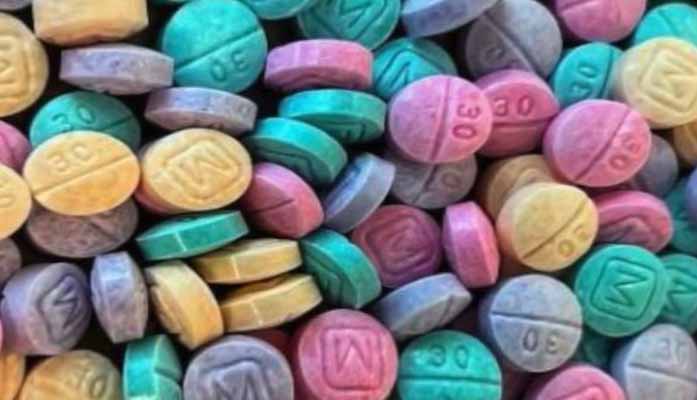
Quang’s bill includes stricter punishment for children’s deaths due to drug traffickers’ current operational patterns. With the rise of the border crisis, fentanyl traffickers expanded their targeted clientele to include minors. Over the last year especially, these traffickers have pushed “rainbow fentanyl” that look like candy to entice youth. Fentanyl pills are normally designed to look like oxycodone prescription pills: blue, and stamped with “M30.”
Like their traditional counterparts, these rainbow pills often carry fentanyl doses lethal enough to kill adults.
Almost one year ago to date, health experts and law enforcement warned that the state was facing a burgeoning pediatric fentanyl crisis. In 2022, there were 138 non-fatal opioid overdoses and 28 deaths in minors aged 0-17. That’s a decline of 70 non-fatal opioid overdoses and 19 deaths from 2021, and a decline of 198 non-fatal opioid overdoses and 31 deaths from 2020.
In fact, all non-fatal opioid overdoses and deaths have declined slightly since a peak in 2020.
Though these numbers have declined over the last few years, total drug seizures keep climbing. Law enforcement have seized millions in fentanyl pills amid the ongoing border crisis. According to Customs and Border Patrol (CBP) drug seizure statistics, there have been nearly 26,600 pounds of fentanyl seized along the southern border since President Joe Biden took office.
Seizures more than doubled from the 2020 to 2021 fiscal year. Last month was a historic high in fentanyl seizures for all time: nearly 3,000 pounds of fentanyl.
Corinne Murdock is a reporter for AZ Free News. Follow her latest on Twitter, or email tips to corinne@azfreenews.com.
by Corinne Murdock | Sep 7, 2022 | News
By Corinne Murdock |
On Monday, Customs and Border Patrol (CBP) busted a vehicle smuggling 233,000 fentanyl pills through a Nogales port of entry. 47,000 of those pills were “rainbow fentanyl,” a new marketing tactic by drug traffickers to entice children and young adults. The remainder were the traditional blue pills usually associated with fentanyl.
It is the latest of many similar busts in recent weeks. Last week, the Arizona Department of Public Safety (AZDPS) busted 46 pounds of fentanyl pills.
According to the DEA, even as little as two milligrams of fentanyl may be lethal — equivalent in size to 10-15 grains of table salt. It’s 50 times more potent than heroin and 100 times more potent than morphine. Approximately 42 percent of pills contained at least two milligrams. By those estimates, the 233,000 pills recovered on Monday could contain a minimum of 97,800 deadly doses. The troopers’ bust last week contained enough fentanyl to kill over 10.4 million people.
In a warning about rainbow fentanyl issued last week, the DEA noted that rainbow fentanyl was also being trafficked as powder and blocks resembling sidewalk chalk.
During the White House’s daily briefing last Wednesday, Press Secretary Karine Jean-Pierre evaded questions about President Joe Biden’s plans to address rainbow fentanyl and the larger fentanyl crisis. Instead, Jean-Pierre focused on the fact that it was Overdose Awareness Day and that the administration bolstered DHS with $80 million for general drug prevention. Jean-Pierre didn’t identify the root cause of the fentanyl crisis.
Instead, Jean-Pierre claimed that the increased number of drug seizures meant that their administration’s policies were working. She ignored Fox News reporter Peter Doocy’s counterpoint that fentanyl overdoses have increased as well, occurring by several hundred every day. Jean-Pierre also claimed that the Biden administration is successfully securing the border, despite overseeing a historic all-time high of illegal entries into the country.
“We see those same numbers as well. But the fact that we are securing the border, the fact that we are securing record levels of funding for DHS so they can stop illicit drugs from entering the country, the fact that it’s not just drug traffickers we’re dealing with as well, we’re stopping finance shares, this is happening under this administration,” said Jean-Pierre.
The primary suppliers of fentanyl in the U.S. are the Sinaloa and Jalisco New Generation Cartels. However, Mexico isn’t America’s sole or primary source of fentanyl; China is the primary source for all fentanyl-related substances trafficked into the country.
Health experts warned the Arizona legislature in January that fentanyl traffickers were targeting children. Prior to the rise of the rainbow fentanyl, drug traffickers made fentanyl that looked exactly like prescription oxycodone. These counterfeits are nicknamed “Mexican Blues,” “Blues,” or “M-Boxes.”
Traffickers also disguise other drugs as prescription drugs: methamphetamine as Adderall and fentanyl as Xanax. These counterfeits have disproportionately harmed youth, prompting the DEA to launch an awareness campaign, “One Pill Can Kill.”
Over 71,000 of over 107,600 fatal drug overdoses last year involved fentanyl.
The DEA advises those who encounter fentanyl to call 911 immediately.
Corinne Murdock is a reporter for AZ Free News. Follow her latest on Twitter, or email tips to corinne@azfreenews.com.
Page 1 of 11