by Corinne Murdock | Aug 27, 2021 | News
By Corinne Murdock |
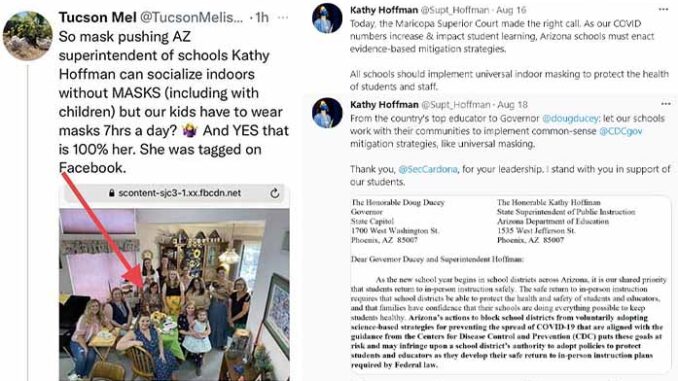
After months advocating for school mask mandates, Arizona Superintendent of Public Instruction Kathy Hoffman neglected to mask up for an indoors baby shower this past weekend. Hoffman has been a staunch advocate for universal masking.
Just one month ago, Hoffman issued a formal statement decrying Governor Doug Ducey’s ban on K-12 mask mandates. Hoffman sided with CDC guidance, which asks that all individuals wear masks – even those who’ve been fully vaccinated.
“We know masks work and, with rising cases, they’re a vital part of our effort to reduce everyone’s COVID-19 risks,” wrote Hoffman. “I encourage teachers, administrators, and families to listen to the CDC and take individual action to keep themselves and each other safe by wearing a mask during in-person school. Students, teachers, and parents are ready to get back to in-person learning, but it takes all of us.”
All of us, that is, except Hoffman. It appears that Hoffman’s personal life doesn’t align with the version she offers the public eye – even Hoffman’s Twitter and Facebook profiles have her wearing a mask.
The same weekend of Hoffman’s maskless party, another prominent politician and masking advocate, House Speaker Nancy Pelosi, was seen on video maskless at a fundraiser luncheon. Like Hoffman’s experience at the “Bee Tea” baby shower, neither Pelosi or any of the other guests caught on camera wore masks or were socially distant.
Corinne Murdock is a reporter for AZ Free News. Follow her latest on Twitter, or email tips to corinne@azfreenews.com.
by Terri Jo Neff | Aug 24, 2021 | Education, News
By Terri Jo Neff |
Although Arizona is not yet back to pre-pandemic workforce levels, a recent U.S. Bureau of Labor Statistics report shows the state is headed in the right direction, with more than 21,000 jobs added in July, boosting Arizona to fourth place in percentage of jobs recovered post-COVID19.
That means Arizona has restored all but around 20,000 of the 331,500 jobs lost in the pandemic’s aftermath, giving the state at a recovery rate of 93.7 percent. Only three states -Utah, Idaho, and Montana- have a better percentage of recovery than Arizona as of July.
Yet despite the state’s positive trajectory, many small business owners, economists, and job placement officials remain worried about whether Prop 208’s 3.5 percent income tax surcharge will go into effect or not, and whether legislation aimed at blunting any impact will withstand its own legal challenge.
The surcharge was narrowly approved by voters last November to hit Arizonans earning more than $250,000 (single filing) or $500,000 (joint filing) in an attempt to increase K-12 funding. The tax was designed to be on top of the then-existing income tax of 4.5 percent, but last week the Arizona Supreme Court ordered a Maricopa County judge to determine whether Prop 208 tax revenues will exceed the Education Expenditure Limit set in the Arizona Constitution.
If the answer is yes, then the judge must declare Prop. 208 unconstitutional and enjoin state officials from putting the tax surcharge into operation, the justices ordered.
Gov. Doug Ducey signed legislation in June to change Arizona’s individual income tax structure over the next three years and to blunt the surcharge effect. The legislation also provides small businessowners an alternative to the surcharge. But until the Prop 208 legal issue is resolved, there are worries that Arizona’s recovery will slow due to small business owners reducing spending -such as employee compensation and benefits- to cover any additional tax burden.
Others may choose to abstain from hiring or even decide to cut personnel. And that is a point of concern for those trying to get jobs for all Arizonans who want one.
The same Bureau of Labor Statistics report shows Arizona’s rate of unemployment was 6.6 percent in July, ranking 40th in the nation. That ties with Alaska, Louisiana, and Pennsylvania, while Utah, Idaho, and Montana had unemployment rates at 2.6, 3.0, and 3.6 respectively, among the Top 10 lowest percentages for July.
Arizona’s current unemployment rate, however, is a vast improvement from April 2020, when the state had 14.2 percent of work-eligible adults out of jobs, a historical high. In addition, next month’s end of two Arizona Department of Economic Security (DES) unemployment benefit programs is expected to spur many out-of-work Arizonans back into the workforce.
Those programs -Pandemic Unemployment Assistance (PUA) and Pandemic Emergency Unemployment Compensation- are scheduled to expire for the workweek ending Sept. 4. Ducey and DES have created a Back to Work program with several features to help Arizonans transition back to work, including childcare vouchers, educational incentives, and even hiring bonuses for eligible individuals.
by Terri Jo Neff | Aug 23, 2021 | News
By Terri Jo Neff |
A new state program announced last week by Gov. Doug Ducey will provide up to $10,000 to assist small businesses impacted by Mother Nature and her aftermath, as well as those still reeling from the COVID-19 pandemic.
Ducey’s Aug. 20 announcement of his Back to Work Small Business Rehiring and Retention Program came the same day he toured flood-ravaged Gila Bend. But while the program is being heavily touted in areas hard hit by flooding and wildfires, the funds are also available to thousands of other Arizona small businesses.
And by small, the governor means between 5 and 50 employees for businesses impacted by flooding or wildfires, and between 5 and 25 for all others. In addition, the business must be owned and operated in Arizona, have an incorporation date before Jan. 1, 2020, and rent or lease a physical location in Arizona.
“We want to make sure they have the resources needed to grow and serve their customers, and our new Small Business Rehiring and Retention Program will do just that,” Ducey said of the funding for employee hiring / signing bonuses, relocation bonuses for employees moving to take an open position, and employee retention bonuses.
One of those small business owners is Lilly Hritz, proprietor of Lilly’s Tombstone Memories located on historic Allen Street in Tombstone. Hritz’s business was hit hard by the pandemic, which essentially wiped out nine months of tourism in 2020 and continued to keep many customers away during the traditionally busy first quarter of this year.
That drop off in revenues and available work hours has made it difficult to find and keep quality workers, Hritz told AZ Free News.
“I am excited to about Governor Ducey’s new program. It will make it easier for me to retain the staff I have and help me attract new employees as we prepare for the upcoming tourist season,” said Hritz. “And that will give me the peace of mind to refocus on our expansion plans which had to be put on hold when COVID hit.”
Ducey’s new program has also received bipartisan support among lawmakers, including praise from Rep. Jeff Weninger (R-LD17) and Rep. Aaron Lieberman (D-LD28).
“Effectively hiring and maintaining employees is crucial for the success of any business, but especially the smaller businesses,” said Weninger, himself a small business owner in Maricopa County. “This new program will help them continue to bounce back from the pandemic and extreme weather, and they’ll have the opportunity to expand operations.”
Lieberman is also a business owner, and said he was happy to work with Ducey’s office on the development of the program.
“Small businesses create jobs, support communities and serve Arizonans’ needs,” said Lieberman. “I’m thrilled to see the launch of the Small Business Rehiring and Retention Program and look forward to all it will do to foster small business growth and help Arizona workers.”
The Small Business Rehiring and Retention Program is a new component of Governor Ducey’s Arizona “Back to Work” plan announced in May. Information about the program is available at https://www.azcommerce.com/covid-19/financial-resources/back-to-work-small-business-hiring-and-retention-program/
by Terri Jo Neff | Aug 22, 2021 | Education, News
By Terri Jo Neff |
Thursday’s announcement by Gov. Doug Ducey and House Speaker Rusty Bowers that Arizona “wholeheartedly welcomes our share of the refugees” fleeing the Taliban regime in Afghanistan is shining a light on a little known state program that provides financial, educational, and cultural support to refugees.
“As refugees come and find homes in states across the nation, we welcome them to our state full of opportunity and choice, and we’re working closely with federal and state officials to offer them safety in Arizona,” the joint Ducey-Bowers statement reads.
Those efforts will be made easier through the Refugee Resettlement Program (RRP) run by the Arizona Department of Economic Security (DES) which aids refugees as they adjust to life in the United States. The objective is to respect a refugee’s culture and language while helping them reach self-sufficiency as quickly as possible, according to the DES website.
Transition efforts are further assisted by local nonprofit Refugee Resettlement Agencies (RAs) which provide frontline essential services during a refugee’s first few months. RAs also link refugees to federally-funded programs such as Employment Services, English Language Training, Refugee Cash and Medical Assistance, and Case Management.
The U.S. Immigration and Nationality Act provides several criteria for who qualifies as a refugee. For most Afghanistan nationals, the applicable criteria will likely be the provision for any person outside the country of their nationality, who is unable to return to that country due to a “well-founded fear of persecution.”
Many of the Afghans coming to the United States are expected to receive a Special Immigrant Visa (SIV) connected to their past service to the U.S. government and military during the 20-year war which included Operations Enduring Freedom and Freedom’s Sentinel. SIV visas apply also to one’s spouse and children.
“They helped out military members in their country, and now we stand ready to help them in ours,” Ducey and Bowers noted in their statement.
The U.S. Department of State also recently announced another program, one which pertains to Afghans who worked for private American contractors, as well as in-country programs funded by the U.S. It would also apply to Afghani employees of media outlets and those who worked for nonprofit, non-governmental organizations which are headquartered in the U.S.
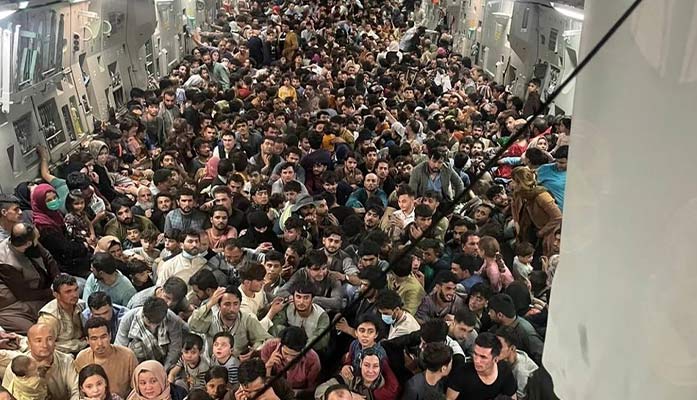
Before releasing his statement about refugees, Ducey expressed concern with the unfolding Taliban expansion in Afghanistan after the U.S. Air Force released a photograph showing 823 Afghans -men, women, and children- crammed in the cargo hold of a C17 flying out of Kabul. The governor pointed the finger of blame for the chaos directly at the top man in the White House.
“As we approach the 20th anniversary of 9/11, the events unfolding in Afghanistan represent complete negligence and an abdication of responsibility by President Biden,” Ducey tweeted on Aug. 16. “If the promise of President Biden was that he would restore America’s standing in the world, he’s just done the exact opposite.”
Government statistics show more than 120,000 people died during the U.S. war in Afghanistan, which included Operations Enduring Freedom and Freedom’s Sentinel. Among the dead are 2,443 U.S. military members, 66,000 Afghan military and police, roughly 47,000 local citizens, nearly 3,850 U.S. citizens working in the country, and more than 1,100 military members from other nations.
Meanwhile, many U.S. service members and defense contractors who deployed to Afghanistan between 2001 and 2021 are speaking out about the problems now facing that country. One such Veteran is Arizona lawmaker Rep. Steve Kaiser, who served with the U.S. Army in Afghanistan.
“America’s military have put their lives on the line to defend freedom at home and abroad. Our friends and allies in Afghanistan now face a terrifying future because we deserted them in the dead of night,” Kaiser wrote Aug. 17. “They are now alone, hiding behind barred doors with their families, and being targeted by Taliban members seeking revenge.”
DES reports show the most resettlements from one country to be served by Arizona’s RRP between October 1981 and August 2021 is more than 12,300 Iraqis. By comparison, less than 3,200 Afghanistan nationals came to Arizona during the same period.
The number of Afghans served by Arizona’s RRP started slow -only 240 Afghanis throughout all of the 1980s- but jumped to 254 in 1990 to 1994. Then over the next six years, only 142 Afghans came to Arizona, nearly one-half the number (271) who arrived the next year ending Sept. 30, 2001.
The data shows more than 1,000 Afghanistan nationals settled in Arizona in the decade after the Sept. 11, 2001 terrorist attacks before falling to a decade-and-a-half low of only 14 between Oct. 1, 2011 and Sept. 30, 2012. The annual number resettling to Arizona jumped to 237 for the year ending Sept. 30, 2014, then hit an all-time time high of 292 in 2016.
Since then, the RRP data shows a steady decline of Afghanistan nationals resettling in Arizona, with 95 reported for the year ending Sept. 30, 2020.
The U.S. Department of State shows roughly 4,200 Afghans have come to the United States since Oct. 1, 2020, with 31 reportedly making their new home in Arizona. However, DES records put that number at 53 as of Aug. 16.
Any Veterans in need of someone to talk to about their concerns related to Afghanistan can call the Veterans Crisis Line at 1-800-273-8255. Assistance is also available by text messages to 838255 or via online at chat at www.veteranscrisisline.net
by AZ Free Enterprise Club | Aug 22, 2021 | Opinion
By the Free Enterprise Club |
It needed to be done. At the end of June, Governor Ducey signed HB2898, which included a provision prohibiting a city, town, county, school board, or charter school governing body from requiring students or teachers to wear masks.
Bear in mind that this law doesn’t mean students and teachers can’t wear masks. They certainly can if they want to. But it keeps the heavy hand of government from enforcing unnecessary restrictions—especially on students who should be focused on learning.
Predictably, the liberal left has had a meltdown. The board president at Northland Preparatory Academy in Flagstaff went on a tirade in a now-removed Facebook post, referring to parents and students who disagree with mask mandates as “the worst of humanity.”
And some schools have decided that their first lesson for the year is to teach kids it’s ok to violate the law. A growing number of Arizona school districts are openly defying Governor Ducey by requiring students and staff to wear masks if they want to set foot on campus.
Our children have become pawns in a game of COVID chess—all at the mercy of the kings and queens on school boards throughout the state.
While parents are speaking up, they need help. Thankfully, Arizona’s House and Senate Republicans heard their cries. Last week, a group led by state representative Jake Hoffman called for Governor Ducey to do something…
>>> READ MORE >>>