The latest official employment report finds once again that the federal government and state-and-local government hiring spree is still in full gear. Over the past year health care and government hiring has outpaced every private sector industry.
So, even though there are a lot more government workers, good luck finding them or getting them on the phone.
This is because so few of them are actually physically on the job.
What is happening in the federal government (“Club Fed”) these days borders on the absurd — or should I say the obscene. A recent survey by Federal News Network of federal workers finds only 6% are working full time in the office. Thirty percent are full time remote. Office buildings in Washington have become city-block long zombies. Especially on Fridays.
While exact comparisons between public and private employees are tricky and inexact, best estimates are that in 2023 roughly 30% of private workers were working from home or remotely either some or all of the time. In the private sector, the percentage of employees working from home has actually declined from about 50% during Covid (2020).
This means that federal employees are three times more likely to be working remotely either some or all of the time.
I am all for employees working remotely a few days a week and this is likely to become more common in the information and digital age. I do that myself.
But one has to wonder how many of these workers are really necessary. And what are the chances that these remote government workers who can almost never get fired for bad performance are putting in an honest day’s work. My suspicion is very few.
The irony is that three years ago the federal government issued an order for federal employees to return to work post-Covid. Many thousands have blatantly ignored the order.
Remember, government workers have some of the cushiest and least stressful jobs on the planet. And they get paid roughly 30 to 40% more than comparably skilled private workers — when taking account exorbitant benefits.
Here is my solution. Uncle Sam is losing almost $2 trillion a year. Stop hiring new people. Every federal agency including the biggest bureaucracy in the world — the Pentagon — should impose a hiring freeze — except for extraordinary circumstances — until the budget is balanced. Then impose a 30% across the board reduction in force (RIF).
Finally, if the government needs more revenues, start by selling federal buildings that are less than one-half occupied. Many buildings are less than 20 percent occupied.
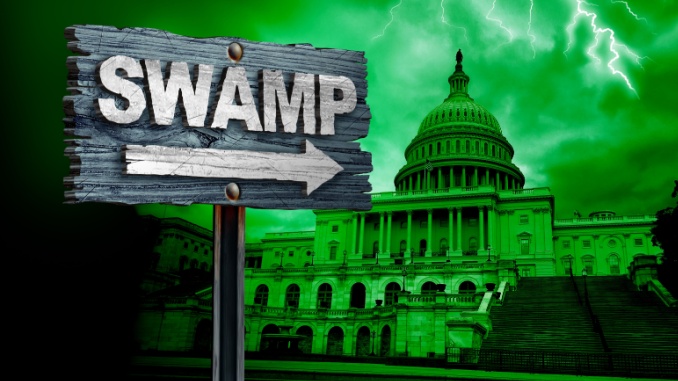
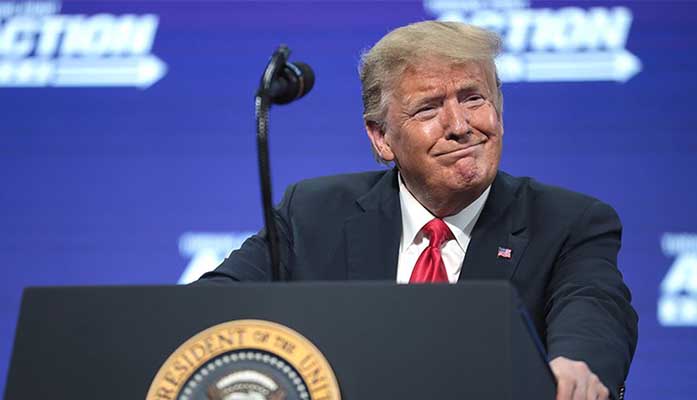
Former President Donald Trump’s most popular rallying cry in 2016 was to “drain the swamp.” But today the swamp is deeper than ever and the deep state swamp creatures are more numerous than ever after four years of the Biden-Kamala administration. If Trump wins, he and Republicans should get draining.
Stephen Moore is a contributor to The Daily Caller News Foundation, visiting fellow at the Heritage Foundation, and a co-founder of the Committee to Unleash Prosperity.
The warning signs can no longer be ignored. America’s future as a world power is fading. The emerging alliance of Russia, China, Iran, and North Korea, spanning the spectrum of autocratic, expansionist ideologies, is poised to seriously threaten Western values and our way of life.
America’s response to a notably more dangerous world has been passive and thoughtless. In three decades, America has gone from the preeminent world power, with the promise of spreading freedom and democracy throughout the world, to a nation of deteriorating moral and strategic standing. We’ve backed ourselves into a dangerous corner.
Our enemies relentlessly undermine our interests and propagandize against us. One even leads public chants of “Death to America.” Russia wages a war of territorial aggression. China menaces our ally in the South China Sea. Hamas’ October 7 massacre was just one of several recent attacks by Iran-associated Islamic terrorist groups.
Weapons programs, especially those involving advanced technology like space weapons and biotech, are being rapidly developed by our enemies. Meanwhile, America’s relative deterrence capability has declined. Defense spending, inflation adjusted, has been reduced while military inductees are versed in the finer points of DEI.
Our Cold War presidents, especially Truman, Eisenhower, Kennedy, and Reagan, faced similar dangers to those that challenge us today. The Soviet Union was a powerful force that brutally subjugated Eastern Europe, worked to destabilize regimes around the globe, and seriously intended to establish world hegemony.
Our leaders responded then with certitude and conviction. Ronald Reagan’s approach was not appeasement, but confrontation with superior force. He warned against “blindly hoping for the best while the enemies of freedom grow stronger by the day.” He recognized that “war comes not when the forces of freedom are strong but when they are weak…then tyrants are tempted.”
Reagan made defeat of the “Evil Empire” the central goal of his presidency. He rebuilt the military and doggedly pursued missile defense systems even when he was ridiculed for supporting “Star Wars.” In the end, it was this missile defense strategy that confounded and broke the Soviets, as Mikhail Gorbachev later confided to Margaret Thatcher.
In contrast, American policy today projects peace through weakness. We foolishly pretend tyrants will be mollified if we don’t provoke them. President Obama not only failed to support ballistic missile defenses, he backed out of commitments to install missile defense systems in Eastern Europe, despite mounting Russian aggression.
Biden fecklessly waived sanctions on Russia’s Nord Stream 2 pipeline, paused military aid to Ukraine, and intentionally slow-walked critical supplies to our Israeli allies. We carefully dole out only enough support to our friends to stave off defeat but not enough to win.
The Cold War presidents were resolute about “stopping partisan politics at the water’s edge,” meaning that domestic political considerations should never impact foreign policy. Today, Biden proves his leftist bona fides by shutting down domestic energy production while treating our enemies more indulgently. Worry over youth protests and Michigan’s electoral support inspired his support of the war aims of Hamas and other Muslim jihadis.
This summer’s presidential debate demonstrated all you need to know about why America is garnering so much disrespect. With pressing problems all about spinning out of control, two candidates with presidential experience vied to be the one to lead us into the future. The result was a farce, a “debate” that was essentially incoherent babbling between two intellectually flabby old men.
One showed the classic hallmarks of senility and should never again be allowed near the nuclear football. The other was unable to construct a coherent argument, instead lapsing into exaggerations and meaningless superlatives. There was nothing resembling serious policy analysis. The two argued over golf scores instead.
Former U.S. Secretary of Defense Robert Gates writes that “at the very moment that events demand a strong coherent response from the United States, the country cannot provide one.” Americans must take our elections more seriously. We need to stop fixating on policy dead ends like climate change and identity politics.
Our short-term problem now is vulnerability to attack as a result of exhibiting weakness. Our long-term goal must be to select leaders better able to keep us strong and free.
Dr. Thomas Patterson, former Chairman of the Goldwater Institute, is a retired emergency physician. He served as an Arizona State senator for 10 years in the 1990s, and as Majority Leader from 93-96. He is the author of Arizona’s original charter schools bill.
The poll was conducted June 1-4, 2024, with a sample of 1,095 Arizona registered voters.
President Trump improved his standing in this poll from an earlier survey in March, when he garnered 49 percent, compared to Biden’s 45 percent.
When other candidates are factored into the race, Trump maintains his five percent advantage over Biden, growing that number from March, when he led the Democrat by four percent (43-39%).
The forty-fifth President of the United States enjoys significant leads over Biden in a number of issues of trust for voters. From the poll, twenty percent more Arizona voters trust Trump than Biden when it comes to immigration and the border (58-38%), while fifteen percent more voters trust the presumed Republican nominee over the economy. Trump also enjoys a double-digit lead in trust when it comes to the Israel-Hamas War.
According to the poll, eleven percent more Arizona voters trust Biden than Trump over climate change (52-41%). The two candidates are closer together with the issues of abortion, health care, and election integrity.
President Trump traveled to the all-important swing state of Arizona on Thursday, where he participated in a packed townhall with supporters. The state’s eleven Electoral College votes will be vital to securing the General Election victory in November, and both Republicans and Democrats figure to spend massive amounts of resources to campaign for the votes of independent voters leading up to the political contest. Arizona also has several other races and initiatives that will be key to the state’s future, including the U.S. Senate, control of the Arizona Legislature, and a number of ballot initiatives.
Daniel Stefanski is a reporter for AZ Free News. You can send him news tips using this link.
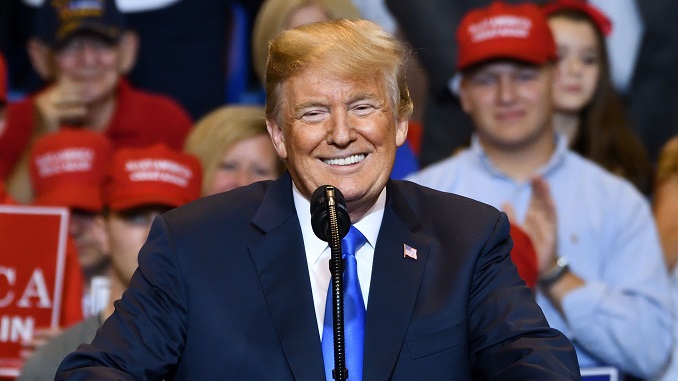
The temperature was a paltry 105 degrees as several thousand Trump supporters flooded the area surrounding the Dream Center Church on Cave Creek Road in Phoenix, AZ. Reports from the Phoenix Fire Department confirmed 11 people were transported to area hospitals to be treated for heat related issues. Nonetheless, the 3,600 house of worship was filled to capacity, with “thousands” turned away according to former President Donald Trump. The Turning Point USA event entitled, “Chase the Vote,” highlighted efforts of the Trump campaign to ensure a massive turnout in the 2024 election.
Beginning his remarks shortly after 2 PM, Trump expressed his thanks to members of Arizona’s GOP Congressional delegation including Congressmen Eli Crane, Andy Biggs, and Paul Gosar in addition to outgoing Congresswoman Debbie Lesko who is seeking a seat on the Maricopa County Board of Supervisors. Trump endorsed Lesko in her pursuit of what he called “an important job,” noting, “We’ve gotta get them on our side Debbie,” referring to the board led by Chairman Jack Sellers. He added, “You know they’re Republicans but they act like Democrats. We gotta get em’ on our side.”
Trump confidently told the audience that he is “working my *ss off for it to be too big to rig!”
I'M WORKING MY *SS OFF FOR IT TO BE TOO BIG TO RIG! – President Donald Trump@TPUSA
— Real America's Voice (RAV) (@RealAmVoice) June 6, 2024
Trump also voiced his support for U.S. Senate candidate Kari Lake as well saying, “She’s out there and she’s a warrior I’ll tell you. And she’s a very fine person and a great, great, she’s a great family person, and a great person who loves our country. You’re gonna be your next senator. She’s gotta be your next senator because she’s running against somebody, she’s running against somebody who’s for open borders. Do you like open borders? I don’t think so. You gotta elect Kari Lake. She’s gonna be fantastic. Thank you, Kari. She’s incredible. She’s gonna do a good job. The campaign is just beginning.”
JUST IN @PHXFire says it's transported a total of 11 people to hospital after reports of heat exhaustion outside Donald Trump rally at church. Temp 106 with 15 minutes to go before rally's 2 pm start. https://t.co/DsC2XzEDtd
Trump heavily criticized President Joe Biden for his recent executive order limiting asylum claims in the United States lampooning him for “importing more illegal aliens than the population of forty of our fifty states.” The former President soundly dismissed the executive order observing, “If Joe Biden truly wanted to sign an executive order to stop the invasion, he only needs the single, think of it, a single sentence,” he said.
That sentence: “I hereby immediately reinstate every single border policy of the gentleman named Donald J. Trump.”
Trump also announced to raucous applause that he is leading among Hispanic voters citing recent polls. He jokingly suggested that he too had a ‘catch and release policy’, but noted that “I released them in Mexico.”
“I ran because I saw such stupidity,” he said referring to Biden’s border policies, “He wants to turn every single illegal alien that he lets across the border into a voting citizen.”
“By contrast I want to send Joe Biden’s illegal aliens back home… Joe Biden wants an invasion, I want a deportation.”
"Joe Biden wants an invasion; I want a deportation!" – President Donald Trump@TPUSA
— Real America's Voice (RAV) (@RealAmVoice) June 6, 2024
Zeroing in on the Biden border policy’s implications for Arizona Trump explained, “Biden’s order is not a border security plan. It’s a concession to the fact that he has lost control over our border. He has totally lost control over the border into a really dangerous place. He is conceding death and he is conceding defeat at the border. On day one of my administration I will be rescinding crooked Joe’s outrageous executive order. And I will be slamming the door shut on the Biden migrant app, and I will terminate every single open borders policy of the Biden administration as soon as I take the oath of office.
“It will take place, it will take place on the exact same day. I don’t need to wait weeks. It’s going to be done on the same day that we together, we all take the oath of office. As the result of Biden’s action this week there will be more innocent Americans killed by illegal criminals or more children trafficked and sold into slavery and millions more illegal aliens pouring into our country and many will come through a very beautiful place known as Arizona. Right? Arizona. I tell you, it’s so sad to see what has happened here.”
Sheriff Joe took the stage and, in a heartfelt moment, told President Trump that he is the only Hero he's ever had in his life.@TPUSA
— Real America's Voice (RAV) (@RealAmVoice) June 6, 2024
During his remarks Trump brought former Maricopa County Sheriff Joe Arpaio, a candidate for Fountain Hills Mayor onto the stage. The fellow Republican recalled to the gathered audience how Trump took the time to call his late wife Ava, an avid Trump supporter, seven times before she passed away in 2021 after battling cancer.
Addressing his recent conviction on 34 counts of falsifying business records in New York, Trump was direct “Those appellate courts have to step up and straighten things out or we’re not going to have a country anymore.”
Former President Donald J. Trump continues to lead in the battleground state of Arizona, though his margin is not insurmountable over President Joe Biden for the November General Election.
Two polls were released last week, showing Trump over Biden in Arizona, whose eleven Electoral College votes will likely prove critical for the outcome of the 2024 Presidential Election.
The first poll was from CBS News / YouGov. This result had Trump beating Biden by five percent (52-47) in their second head-to-head match-up. This poll was conducted between May 10-16 with a sample of 1,214 registered voters across the state.
In this poll, Trump’s high-level support was stronger than Biden’s. Sixty-six percent of respondents indicated that their support for the former president was “very strong” compared to sixty-one percent for Biden. The economy (82%), inflation (78%), and the state of democracy (70%) were the top factors in the individuals’ selections for president, followed by the U.S. Mexico border (61%).
The second poll was from Noble Predictive Insights. This result had Trump beating Biden by three percent, with fifteen percent undecided. This poll was conducted between May 7-14 with a sample of 1,003 registered voters across the state.
The Noble poll also factored in other third-party candidates in the race, showing that Trump actually grew his lead over Biden in Arizona with individuals like Robert Kennedy, Jr. and Jill Stein competing for a share of the votes. With these other candidates in the race, the poll showed Trump beating Biden by seven percent (43-36). Kennedy, Jr. took eight percent, and Stein garnered two percent.
NPI Chief of Research David Byler said, “In 2020, Biden argued that he would be a ‘return to normalcy’ president – restoring competence and confidence to a nation in the throes of a pandemic and bitter partisan fighting. Biden’s problem: COVID-19 is gone, but normalcy isn’t back. Americans are worried about inflation and immigration – and, as a result, he’s lost ground in key swing states like Arizona.”
According to the Real Clear Polling Average, Trump enjoys a 4.6% lead over Biden with different pollsters showing his current margin of victory in Arizona between three and six percent over the past few months. On this day in history on Real Clear’s site, Biden was up four percent over Trump in Arizona in average polling in 2020, and Hillary Clinton enjoyed a one percent advantage in 2016. Trump ended up surpassing Clinton in 2016 to capture the state’s Electoral College votes, while he narrowly lost the state to Biden in 2020.
Daniel Stefanski is a reporter for AZ Free News. You can send him news tips using this link.