A Deer Valley USD (DVUSD) parent, referred to as “Amy,” contacted my organization to report that her children were questioned about their morning and bedtime routines. It turns out Stetson Hills School administrators had engaged students in an “Attendance Reflection Activity” during lunch on November 6, 2025. Parents weren’t notified about the event until the end of the school day.
“Our school utilizes a system called CUTS (Chronically Absent and Truant Students) to proactively identify students who are missing more than 10% of instructional days by the end of the quarter…During the session, students participated in fun discussions about:
Their current nighttime routines,
Their current morning routines [and]
Developing a goal or plan for one small, positive change they could make to improve their attendance moving forward.”
Walter ended the communication by thanking parents for their “partnership and support in encouraging consistent daily attendance.” In her zealousness to combat chronic absenteeism, I think Walter forgot that elementary students are not responsible for transporting themselves to school.
Stetson’s attendance survey can be viewed here. Note that in addition to answering questions about sleep schedules and household activities, students were required to sign the document as if it were a contract between them and the school district.
Amy said her kids were probed about their eating habits and family relationships, but those questions were not included on the survey. She also said her children described feeling anxious and “targeted” during the attendance reflection session.
According to Amy, her children haven’t missed more than a few days since the 2025 school year began, and every absence was excused due to illness or doctor’s appointments. Assistant Principal Walter confirmed that parents only need to notify the school, and doctors’ notes are not required in these instances.
Amy emailed her concerns about the district’s lack of transparency to DVUSD Superintendent Curtis Finch. Instead of responding to Amy, Finch forwarded her email to the School Operations and Safety Coordinator, Valerie Bullis. Bullis claimed the truancy probe was intended to be a “proactive approach in addressing student attendance patterns” and that school administrators were now “reviewing the process.” Meanwhile, Amy insisted that she and other parents she talked to were never informed about the student interrogation “process” to begin with. Amy also believes most parents are not aware of the CUTS program.
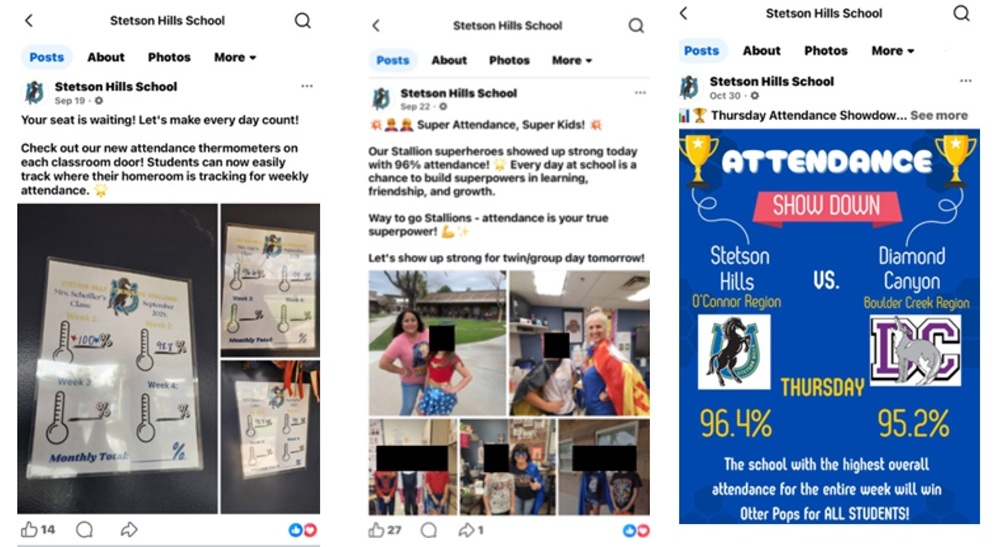
Screenshots from the Stetson Hills social media account show educators and other DVUSD schools engaging in attendance competitions. Amy said these activities promote unhealthy rivalry among students who are totally dependent on their parents for transportation and life decisions.
Deer Valley taxpayers are using their properties as collateral for failing schools. By passing the 15% override, constituents empowered government employees to keep pushing the boundaries of parental controls as they advance a State-sponsored agenda. “We got the override! We got your money!” was the overarching theme of the November 18 school board meeting.
The Glendale Star quoted Superintendent Finch, stating, “We’re pretty excited that we got the okay from the public to move forward.” When commenting on potential budget cuts, he said, “If it didn’t pass, I would be using a chainsaw, but now I can use the scalpel.” Finch also predicted “another explosion of enrollment in the next three to five years.” Wrapping up a discussion about DVUSD’s successful override campaign, he declared:
“The students are the winners when this happens. The community saw how far we’ve come and responded accordingly. It’s very gratifying for everyone involved.”
Cue the laugh track.
Finch’s million-dollar “scalpel” will never be used to dissect his compensation package, and most promises made during override campaigns are never kept. It’s no secret that Arizona public schools are losing students to the school choice movement. DVUSD’s decision to host intramural attendance games only proves that government education can’t compete with superior learning methods and institutions. Parents are waking up and moving on.
“The anti-public school movement is growing here in the state of Arizona, which is a crime against humanity. And it’s unfortunate that we’re caught in that web.”
— Superintendent Curtis Finch, ABC 15 News
For the record, there’s nothing inherently negative about finding creative and fun ways to encourage classroom attendance. The CUTS program mentioned in Assistant Principal Walter’s email may have attracted some families back to the district. Alas, the planning and execution were botched, and the interrogation activities left some parents feeling gaslighted.
I will never understand why school districts are so opposed to (or ignorant of) parental rights legislation. If you want students to enroll and attend, why wouldn’t you appeal to and listen to parents? If parents want a safe, academic-focused environment that’s free from politics, why not invest in that instead of engaging in a power struggle over their kids? In other industries, when a company loses business, board members and directors will research competitors and come up with ways to recapture the market by providing quality products and services.
This concept is simple when applied to education: If public schools don’t want parents to withdraw their children and go to private schools, then they should do what private schools do. Adopt their academic model and offer it at a lower cost. Stop waving rainbow flags and talking about gender and skin color. Stop asking intrusive questions and forming inappropriate bonds with other people’s kids. Give parents a reason to trust you. Or is that too much common sense for government folk?
School board elections are not magic. Ideally, we’d like to “get our guy in office,” trust that they have our best interests in mind, and carry on with our lives. This is not reality. More often than not, time reveals that “our guy” will say whatever needs to be said to gain our support and then turn on the dime of sleazy administrators, radical union leaders, and leftist community members. Unfortunately, this pattern emerges even in school districts that many consider as having a “conservative majority.”
Despite all the online drama that erupted over those attendance surveys, I was the only one who attended and spoke about it at the last Deer Valley school board meeting. Digital outrage accomplishes absolutely nothing in real time, and virtual group therapy has no power to shift this situation. DVUSD is corrupt. The school board is dysfunctional, the superintendent is shady, and educators are lacking real leadership. Now that they have your money, what’s their incentive to do right by your children? Who will hold them accountable, if not you?
Tiffany Benson is the Founder of Restore Parental Rights in Education. Her commentaries on education, politics, and Christian faith can be viewed at Parentspayattention.com and Bigviewsmallwindow.com. Follow her on socials @realtiffanyb.
School bureaucrats who have mismanaged their finances are hoping that voters will blame a convenient scapegoat: families using Empowerment Scholarship Accounts (ESAs) to educate their children. As usual, their allies in the legacy media are trying hard to help them shift the blame—but the numbers don’t lie.
Channel 12 recently ran a story titled “Deer Valley teachers self-fund or rely on classroom wish lists for basics, while ESA parents buy luxury items with state tax dollars.” Most of the article reads like a press release from Deer Valley Unified School District Superintendent Curtis Finch, who claims that the ESA program has “zero accountability,” “no oversight,” and is “out of control.” Meanwhile, the article quotes teachers in Deer Valley who are spending hundreds of dollars from their own pockets to cover school supplies for their students.
The implication is clear: district schools are financially starved while ESA families waste money on frivolous luxuries. But the reality is exactly the opposite.
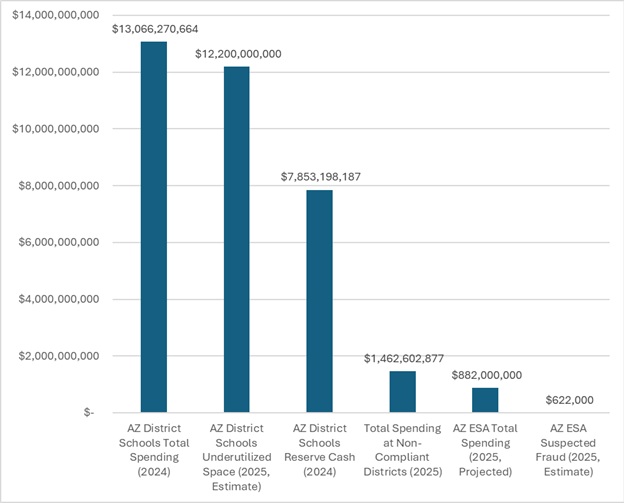
Misuse of the ESA program is vanishingly small. The Arizona Department of Education’s internal audit had turned up $622,000 in ESA funds that are “possible fraud or misuse.” That’s approximately 0.05% of total ESA spending over the past two years.
Misuse of funds in the ESA or any other public program must be detected, deterred, and punished. This is in fact happening in the ESA program, as the Arizona Department of Education had already found the misuse, suspended accounts of those responsible, and reports that it is “in the process of collecting more than $600,000” in improper spending. All of this makes the ESA program far more transparent and accountable than Arizona school districts, which do not post their purchases.
And while Deer Valley teachers may indeed purchase their own school supplies, it has nothing to do with the ESA program and everything to do with misplaced district priorities.
One of the oldest tricks in the school district advocate playbook involves pretending that teachers must buy their own classroom supplies because of a lack of funding. The Channel 12 story cites a Deer Valley biology teacher who said she “spends at least $500 of her own money every summer for her classroom.”
Days after the report aired, former Deer Valley school board candidate Tiffany Hawkins revealed that Deer Valley Unified had spent $560,407 to send students and staff on trips to Disneyland, Knott’s Berry Farm, Sea World, Universal Studios, and other destinations in Arizona, California, Hawaii, Indiana, and Texas. Apparently, the district leadership decided that these trips took precedence over classroom supplies for Deer Valley teachers.
Don’t hold your breath waiting for Channel 12 to cover that. Deer Valley Superintendent Finch—who recently faced charges of stonewalling public records requests and illegal electioneering on school grounds—attacked the ESA program for “out of control” spending with “zero accountability.” But his critiques of the ESA program much more accurately describe spending in his own district.
The Arizona Auditor General reports that Deer Valley spends $13,717 per pupil, meaning that a classroom of 25 students thus generates over $340,000 in total revenue. Where did this money go? Mainly not to teachers.
The Auditor General reports that Deer Valley average teacher pay is $2,163 below the state average. If Deer Valley is not prioritizing teachers, what is it prioritizing instead? The Auditor General report helpfully provides an answer: “high” and “very high” spending on administration and transportation, respectively, compared to a group of peer school districts.
The Goldwater Institute recently published a study of Arizona school superintendent compensation. Goldwater needed to use the open-records law to obtain this information, as districts compensate their superintendents in a variety of creative ways outside of their base salary, including providing either vehicles or “car allowances,” extra retirement benefits, and other perks.
The Goldwater Institute found that Deer Valley provides a total compensation package for their Superintendent of $290,505, including a car allowance of $10,000. This car allowance alone could have provided 20 teachers with $500 each for classroom supplies.
Even if one were to take the highly perverse view that students were the indentured servants of the school districts in which they reside, it would still be absurd for Deer Valley Unified officials to blame their problems on the ESA program. Arizona Department of Education reports show that 10,966 students lived within the boundaries of Deer Valley Unified but attended other public schools in 2024.
Deer Valley Unified meanwhile “drained” almost 3,000 students and their funding from other public schools. At the end of 2024, only 709 students had left a Deer Valley school to participate in the ESA program. Four different public schools outside Deer Valley Unified each have enrolled more students who reside in the district than the ESA program. Moreover 217 total public schools outside the district enroll Deer Valley Unified resident students.
Luckily, Arizona policymakers have decided that Arizona children are not merely funding units for their local school districts. Arizona families can use ESAs to choose the schools that are the best fit for the interests and aspirations of their children.
Arizona school districts have never had as much money as they have now, enough apparently to prioritize trips to California and perks for superintendents. If Deer Valley Unified officials hope to gain the enrollment of the thousands of resident students who have chosen to pursue their education elsewhere, a clear path forward would be to prioritize their funding.
Purchasing classroom supplies for teachers would be a great first step.
Matthew Ladner is a Senior Advisor for education policy implementation and Jason Bedrick is a Research Fellow at the Heritage Foundation’s Center for Education Policy.
Community members are questioning delays in Deer Valley Unified School District (DVUSD) releases of public records.
Tiffany Hawkins, a former board candidate and parent in the district, reported DVUSD “buried” about 3,000 emails in a public records request. Hawkins accused DVUSD officials of doing so to hide staff usage of school resources and time for electioneering.
DVUSD disgustingly buried 3k emails in a public records request to hide staff shamelessly hijacking school resources and time for election rigging, petition peddling, and political endorsements, flouting AZ law with reckless abandon! Taxpayers demand justice! @GoldwaterInstpic.twitter.com/Pvn6E2RSWB
DVUSD officials have previously faced accusations by parents of electioneering on school grounds. DVUSD Superintendent Curtis Finch was accused of doing so by placing political flyers on cars at school football games.
DVUSD is currently up for a budget override on the ballot this November. The 15 percent maintenance and operations (M&O) will cover approximately nine percent of all salaries, maintain maximum class sizes, pay for support services staff like counselors and nurses, and continue certain student programs such as free full-day kindergarten. This election is mail-in only.
Reporting from the Arizona Auditor General found that DVUSD spends more money on administrative costs in comparison to peer districts, ranking it as “high,” and noted that transportation spending per mile and per rider was “very high.” The report also noted that enrollments have declined steadily.
The auditor general also noted that the average teacher salary was over $2,000 less than the state average — even with the average teachers having over 12 years of experience. The district did apply its additional state monies intended to increase teacher salaries by 20 percent from the 2017 base fiscal year, which raised salaries by 35 percent.
Finch has blamed the state’s school choice program for their financial woes, manifesting as teachers struggling to come up with the funds for basic school supplies.
“Arizona has the most unusual (education) system in the nation. We have zero accountability,” said Finch in an interview with 12 News last week.
Hawkins also alleged that DVUSD denied 41 percent of her public records requests, along with withholding about 37,000 pages.
Arizona Women of Action (AZWOA), an affiliate of Hawkins, reported additional issues with public records requests being fulfilled in an untimely and incomplete manner.
AZWOA reported missing over 142,000 pages, collectively across multiple requests, and delays in responses taking anywhere from 100 to over 300 days.
A community member in Deer Valley Unified School District (@DVUSD) is exposing major delays and withholdings in public records requests, questioning compliance with Arizona’s public records law, which requires timely fulfillment.
DVUSD governing board member Kimberly Fisher said she has experienced “many games played” concerning public records retrieval. Fisher alleged “most” others wouldn’t speak up for “fear” of Superintendent Curtis Finch and his wife.
“Some excess redaction, some missing that suddenly show up, some taking over a year to receive, some they made me come in and scan myself if I wanted to see them only to find they already had them electronically,” said Fisher.
I, as an elected Governing Board member have had many games played with public records. Some excessive redaction, some missing that suddenly show up, some taking over a year to receive, some they made me come in and scan myself if I wanted to see them only to find they already…
Hawkins said she filed a complaint alleging “discrimination and retaliation.” The board dismissed the complaint.
Earlier this year, parents expressed concerns with DVUSD compliance with President Donald Trump’s orders to end Diversity, Equity, and Inclusion (DEI) teachings and programs.
AZ Free News is your #1 source for Arizona news and politics. You can send us news tips using this link.
K-12 superintendents are the CEOs of public schools, spearheading a cabinet of professionals who manage district resources and implement safety and academic programs. Superintendent qualifications may include a doctorate of philosophy (Ph.D.) or education (Ed.D.) and some experience in finance, communications, and organizational leadership.
Superintendents are paid exorbitant salaries topping close to $1 million, depending on the district size. This amount does not include performance bonuses, work vehicles, mobile devices, or lavish vacation packages—er, I mean, “out-of-state professional development conferences.” Whether superintendents do good or evil, employment agreements stipulate that they receive full compensation and benefits, largely at the taxpayers’ expense.
Arizona public schools are home to some of the most ethically challenged and morally questionable high-level administrators. K-12 superintendents across the Valley primarily care about aesthetics and the “business of the district.” Below is an incomplete list of superintendents with controversial reputations, alongside the elected officials who bow to their almighty paper-pushing agenda.
Newly hired Higley USD Superintendent David Loutzenheiser now sits on the dais with governing board members, leaving his cabinet on the floor. This arrangement was approved by the purple-haired board president, Amanda Wade, who once advocated for striking the word “immoral” from teacher-student communication policies. Radical board member Tiffany Schultz—who once declared that professional dress codes “sexualize children’s bodies”—backed Wade’s decision to disrupt the chain of command. No one but Loutzenheiser benefited from this stunt. He set a bad precedent for what’s to come. Read more in AZ Free News.
Earlier this year, a resident in the Cartwright Elementary School District sued two board members for nepotism, citing A.R.S. 15-421. Cassandra Hernandez (elected at age 19) is the daughter of board president and state representative Lydia Hernandez (D). Despite using different addresses on their campaign applications, constituents cried foul and called for their resignations. The Hernandezes led a charge to install the disgraced former Maricopa County Superintendent Steve Watson as district superintendent. Watson is accused of fraud and leaving behind an infestation of financial deficits, lawsuits, and dysfunction in the county office. Cartwright residents have no reason to expect Watson will leave their district any better than he found it.
Deer Valley USD residents constantly complain across social media about Superintendent Curtis Finch’s dismissive “leadership” style. Residents are also suspicious of Finch’s camaraderie with board president Paul Carver, who once told a room full of conservatives that Finch is the best superintendent in the state. Both men support a twice-failed ballot measure that would allow the district to exceed its budget. Finch defended the 15% override, stating: “The anti-public school movement is growing here in Arizona, which is a crime against humanity.” Whether or not good things are happening in DVUSD is up for interpretation, but declining enrollment numbers are the telltale sign of a district in freefall. Go Parents!
No list of sketchy superintendents is complete without Scottsdale USD’s Scott Menzel. He is a freak show in his own right, accounting for the majority of the district’s media exposure. Menzel is widely known for shaming white people who don’t feel guilty about their skin color. Before vacating their seats, debased board members Zach Lindsay, Libby Hart-Wells, and Julie Cienawski extended Menzel’s contract through 2025. Under his “leadership,” SUSD chartered more student-led sexuality clubs, adopted an anti-police curriculum, and circulated hundreds of pornographic books in school libraries. As a result, in 2024, the Arizona School Administrators organization proudly named Menzel the National Superintendent of the Year (this title must be reserved for clowns).
Peoria USD has a slightly better handle on its administration problem since board president Heather Rooks removed Superintendent K.C. Somers from the dais. This establishes a clear separation of employer and employee while respecting the expertise each brings to the district. Unfortunately, though, Somers is developing a reputation for operating in subtle forms of manipulation and subversion, as if he’s trying to sabotage the board members he can’t control. I once attended a meeting where Somers yowled at board members when they ripped off the COVID-19 funding band-aid. Interestingly, before coming to Arizona, Somers was the superintendent of a Colorado school district steeped in scandal and cover-up. He would do well to note that PUSD residents won’t sit for that.
(Dis)honorable Mentions: Tolleson Union HS Superintendent Jeremy Calles morally and financially bankrupted his district. Former Mesa Public Schools Supt. Andi Fourlis oversaw an untold number of social gender transitions without parental knowledge. Tucson USD Supt. Gabriel Trujillo encouraged and attended a student-led drag show on campus, even after one teen was sexually abused by a high school counselor who organized the opening event. Chandler USD Supt. Frank Narducci declared a “week of kindness” and distributed 9-1-1 stickers after unchecked bullying led to one student’s murder and another student’s suicide. There’s more, but we’re out of time.
Those who can’t get elected apply for high-power jobs. Most K-12 superintendents have no campaign grit and no winning personality. Thus, they depend on compromised board members to execute their agenda. Superintendents don’t represent the whole community—they represent the educated community. They may be intellectual experts, but they don’t swear an oath to the U.S. Constitution, and they are not the final governing authority.
The board of education—elected officials who report to taxpayers (that’s you!)—hires the superintendent, and they ultimately decide what to approve or reject. No one is demanding perfection. Arizona families simply want integrity, transparency, and common sense. K-12 community members who experience dissatisfaction with bloated, overcompensated administrative teams should call, email, request meetings, alert the media, and speak at school board meetings. When superintendents refuse to operate within the scope and ability of their job description, expose them.
Among many issues, the past two elections have been a referendum on the public school system throughout our country. And that’s especially true here in Arizona. The people have shown that they are tired of the leftist indoctrination, wasted taxpayer dollars on declining test scores, attacks on parental rights, and more.
Immediately after his inauguration, President Trump proved that cleaning up our schools wasn’t just a campaign talking point. He issued an executive order (EO) ending radical indoctrination in K-12 schooling, and the U.S. Department of Education took action to eliminate harmful Diversity, Equity, and Inclusion (DEI) initiatives. It’s been a breath of fresh air, frankly, but the woke crazies in our state are not going down without a fight.
Back in February, a teacher at Marana High School was suspended after he challenged President Trump’s denial of the existence of more than two genders during a classroom lecture. Then, in May, an advocacy group released audio from inside a Catalina Foothills School District (CFSD) ninth grade health classroom where an alleged teacher gave a “lesson” on LGBTQ issues and criticized religious texts. What any of this has to do with “health” is beyond us, but it certainly shows the lengths these crazies are willing to go in order to push their radical message.
Not wanting to be outdone, Scottsdale Unified School District (SUSD) also decided to get into the mix…