by Staff Reporter | Oct 6, 2024 | News
By Staff Reporter |
It seems that Arizonans are keenly aware of their position as a major swing state for the upcoming election just one month away.
Arizonans ranked the third-highest in Google searches for voter registration following the vice presidential debate on Tuesday between Democratic running mate Governor Tim Walz and Republican running mate Senator JD Vance.
The discovery of these search ratings was made by Final Round AI, which analyzed Google Trends data for the impact the Walz-Vance debate had throughout the country.
The company’s CEO, Michael Guan, said in a press release that the vice presidential debate was less impactful on search spikes than the presidential debate last month.
“With the vice-presidential debate between Governor Walz and Senator Vance on Tuesday, we wanted to see how this affects interest in voter registration topics. We found the debate had caused the third-highest spike in searches so far, behind the spike on September 10 after the presidential debate between Vice President Harris and former President Trump. The largest spike on September 17 came in the wake of the second assassination attempt on Donald Trump,” said Guan. “We also found that Georgia looked up voter registration the most, and Atlanta was the most interested metro area in the wake of the debate.”
The data from Final Round AI doesn’t traditionally align with the company’s purpose: their company provides an AI copilot for interviewees to land their desired jobs. Guan said that they applied their technology to bring awareness to misinformation spread by AI impacting politics.
“Voters must be wary of potential misinformation in this intense period, with the advent of AI making it much easier for people to make fake news,” said Guan. “AI has advanced to such a degree that convincing audio and video recordings can be easily made. We urge voters to take care and check that their information comes from trusted, unbiased sources. If news hasn’t come through official channels yet, it is better to wait rather than risk accidentally spreading misinformation.”
As for metro locations, Tucson ranked the fourth highest and Phoenix tied for ranking the eleventh highest.
The top ten metro areas for searches concerning voter registration were, in order: Atlanta, Georgia; Austin, Texas; Fairbanks, Alaska; Tucson; Columbus, Ohio; San Antonio, Texas; Waco/Temple/Bryan, Texas/Lafayette, Indiana; Wilmington, North Carolina; and Raleigh-Durham, North Carolina.
Georgia was ranked first, and Ohio was second. After Arizona, the top ten searches occurred in Washington, D.C., North Carolina, Texas, Arkansas, Indiana, and Nebraska/Pennsylvania tied for ninth.
However, Arizona didn’t rank as a state or by metro areas in terms of searches for “who won the debate.”
In order, those top ten states were Minnesota, New Hampshire, Maine, Vermont, Wisconsin, Pennsylvania, Ohio, Massachusetts, Rhode Island, and Iowa.
The top ten metro areas who topped search engines for asking who won the debate were, in order: Duluth, Minnesota/Superior, Wisconsin; Alpena Michigan; Minneapolis-St. Paul, Minnesota; Bend, Oregon; Wausau-Rhinelander, Wisconsin; Rochester, Minnesota/Mason City, Iowa/Austin, Minnesota; Juneau, Alaska; Mankato, Minnesota; La Crosse/Eau Claire Wisconsin; and Ottumwa, Iowa/Kirksville, Missouri.
AZ Free News is your #1 source for Arizona news and politics. You can send us news tips using this link.
by Daniel Stefanski | Sep 12, 2024 | News
By Daniel Stefanski |
Republicans in the Arizona Senate are looking for answers about a new rule from the Clean Elections Commission.
Last week, State Senator Jake Hoffman sent a letter to the Arizona Clean Elections Commission about the adoption of a “new rule blocking certain qualified Arizona candidates from participating in general election debates for statewide and federal offices.” In his letter, Hoffman writes that “this rule was not submitted for approval to the Governor’s Regulatory Review Council (GRRC) under the Arizona Administrative Procedures Act,” potentially violating Proposition 306, which was passed by state voters in November 2018.
The issue that prompted the inquiry by Hoffman was the confirmation from the Arizona Citizens Clean Elections Commission that Eduardo Quintana, the Green Party candidate for U.S. Senate, would not be allowed in the upcoming October debate with Republican Kari Lake and Democrat Ruben Gallego. The rule from the Commission stipulates that candidates for public office must obtain at least one percent of all ballots tabulated in primaries for their specific office in order to maintain eligibility for general election debates. Quintana received 282 votes in the primary – far less than the one percent threshold established by the Commission.
“At best, the Clean Elections Commission seems to be creatively, yet intentionally, blocking some candidates from participating in the debate, not to mention subverting the will of the voters to require proper transparency in agency actions through the Administrative Procedures Act,” said Chairman Hoffman. “At worst, the taxpayer-funded Commission has knowingly broken the law. Either action offends the non-partisan intent of the Clean Elections Act. Voters deserve an explanation from the Commission as to why the intent, or the actual text, of the voter-approved Prop 306 was ignored by the Commission.”
Senator Hoffman gave credit to KJZZ for its reporting that appeared to alert him to this issue.
According to the letter, “Under Prop 306 in 2018, Arizona voters required new rules of the Commission to be subject to the statutory rule-making requirements under the Administrative Procedures Act.”
The letter also explains that “had the Commission followed the Administrative Procedures Act as voters mandated under Prop 306, the Arizona Green Party would have had the opportunity to protest the unreasonableness of a rule that effectively precludes their participating based on party registration numbers.”
Quintana posted a note of gratitude to Hoffman on his X account, writing, “A big THANK YOU to Republican Senator Jake Hoffman for standing up for democracy by challenging Az Citizens Clean Elections Commission for refusing to invite the Green Party candidate (me) to the televised debate between candidates Kari Lake and Ruben Gallego October 9.”
The Green Party candidate also appealed to the Arizona Attorney General to intervene, adding, “Arizona Citizens Clean Elections Commission is discriminating against the Green Party in their televised debates. We think this is illegal. Let’s see what the attorney general has to say about this.”
Last month, Kari Lake contacted the Commission to ask for Quintana’s inclusion in the October Debate. She stated that “Clean Elections said they will approach Ruben Gallego & see if he agrees to have him on the debate stage.”
As of last week, however, it does not appear that Gallego had responded to Quintana’s and Lake’s appeals – or at least not in any positive manner.
Daniel Stefanski is a reporter for AZ Free News. You can send him news tips using this link.
by Staff Reporter | Sep 8, 2024 | News
By Staff Reporter |
It appears there won’t be a debate for the Phoenix mayoral race.
Matt Evans, the Republican challenger to incumbent Democratic Mayor Kate Gallego, announced on Tuesday that neither Gallego or her campaign had ever responded about scheduling a debate.
In addition to these reported private requests, Evans has repeatedly asked Gallego for a debate publicly.
The revelation whipped the Maricopa GOP base into a frenzy. The Maricopa County Republican Committee (MCRC) pointed out that Gallego had frequently engaged in debates for her successful 2018 run.
“[Gallego] participated in Debates to get where she is now. This time around, now that someone else is on the ballot, is she—representing 1 person—going to discriminate against the approx 770k registered to vote & 1.7M constituents of #PHX?” asked MCRC.
The party compared Gallego’s distancing from debates to a similar avoidance by Kamala Harris and, before her, Joe Biden. The comparison also expanded to both Harris’s and Gallego’s websites lacking any platforms or specific policy positions.
The most information that Gallego’s website offers in the way of policy consists of an “About” page, in which the mayor lists her accomplishments under her first term. These include bringing in the $65 billion semiconductor plant, establishing the Office of Heat Response and Mitigation, combating climate change, launching a cool pavement program, expanding electric vehicle charging infrastructure, and expanding clean drinking water access.
Gallego’s Republican challenger, Evans, includes several policy positions on his website, namely concerning homelessness. Evans, a Phoenix native and Arizona State University graduate, is an IT professional and married father of three.
Evans made an unsuccessful bid for the District 2 seat on the Phoenix City Council in 2022; he came in third out of the three candidates, gaining 17 percent of the vote compared to opponent Heli Nielson (30 percent) and the victor Jim Waring (53 percent).
According to the city of Phoenix’s latest reporting period, Gallego’s reelection campaign has raised over $1.3 million. Her highest donors this campaign in this year all gave $6,650 individually: EMILY’s List; International Association of Sheet Metal, Air, Rail, and Transportation Workers PAC; International Brotherhood of Electrical Workers PAC; Kathryn Lincoln; Jessica Raymond; Mark Breen; Walter Cichon; Sundae Breen; William Levine; James Pederson; Roberta Pederson; James Gordon; Norma Kafer; Georgia Michaelson; Mike Michelson; Jerry Simms; Jonn Graham; Jamie Hormel; and Susan Guzman.
Others also gave the same high amount — $6,650 — last year for her campaign: Simer Mayo; Ernie Adair; Gary Holloway; Jerry Reindsdorf; Mark Becker; Bob Ramsey; Jacob Zonn; Jaime Scanlin; Jenny Norton; Heidi Jannenga; Andrew Cohn; Jonathan Keyser; Mel Martin; Roberta Koleas; Patricia Christofolo; Jason Morris; Cheryl Najafi; Kurt Mangum; Michael Pollack; and Rosellen Papp.
City campaign finance records reflect that Evans has raised over $3,400. It is also noted that he has a negative balance of nearly $1,000 due to excess disbursements.
Evans’s top donor, Cassius Carter, has given $1,000.
AZ Free News is your #1 source for Arizona news and politics. You can send us news tips using this link.
by Corinne Murdock | Nov 3, 2022 | News
By Corinne Murdock |
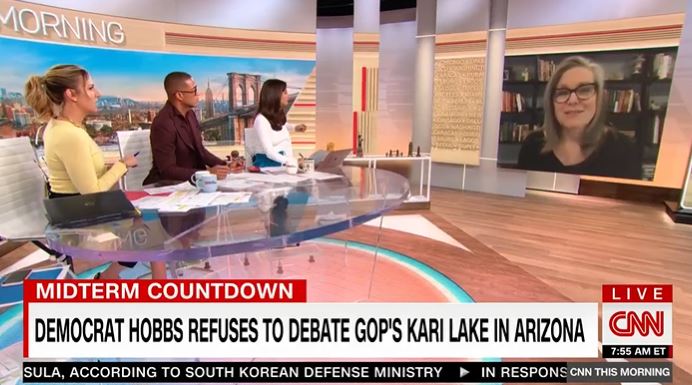
On Wednesday, Democratic gubernatorial candidate Katie Hobbs said debates don’t matter when explaining why she won’t debate Republican opponent Kari Lake.
Hobbs made the remarks during a CNN interview. Voters upset over Hobbs’ refusal to debate were told to accept it as part of her campaign strategy. Hobbs added that a debate at this point was too late anyway.
“Look, we’re six days out from the election and our campaign strategy is our campaign strategy,” said Hobbs. “We’re moving forward and I’m continuing to make my case to the voters of Arizona. Whether or not we debate in this race is not going to decide this election.”
Hobbs also claimed that Lake wasn’t interested in a debate, just in creating a spectacle. The CNN “This Morning” hosts — Don Lemon, Poppy Harlow, and Kaitlan Collins — insisted that Hobbs could challenge Lake’s narratives in real time.
Hobbs also neglected to debate her primary opponent, Marco Lopez. When asked the reason for avoiding that debate, Hobbs said she didn’t need to because of favorable polling. Effectively, Lopez wasn’t worth the time or effort required for a debate. Hobbs didn’t mention her initial excuse for skipping the debate with Lopez: a purported COVID-19 infection and a conflicting campaign event.
“I was miles ahead of him and won handily,” said Hobbs.
LISTEN: CNN INTERVIEWS HOBBS (timestamp: 1:26:40)
Hobbs initially told the public that she skipped the debate against Lopez because of a COVID-19 illness. Yet just several days later, Hobbs participated in an Independence Day parade in Flagstaff.
In September, Hobbs fled from in-person questions posed by media and supporters concerning her refusal to debate Lake.
Last month, Hobbs advised voters that they should forget about her refusal to debate and, instead, focus on her platform.
When Hobbs questioned Lake’s water crisis policies on social media last week, Lake pointed out that these sorts of questions were best answered in a debate. Lake has invited Hobbs repeatedly to debate her.
Corinne Murdock is a reporter for AZ Free News. Follow her latest on Twitter, or email tips to corinne@azfreenews.com.
by Corinne Murdock | Oct 23, 2022 | News
By Corinne Murdock |
Democratic gubernatorial candidate Katie Hobbs issued unproven claims on Tuesday that Arizona State University (ASU) was required to shutter its campus due to protests and threats of violence incited by her opponent, Kari Lake.
Hobbs accused Lake of inciting death threats and racial slurs against ASU staff, though it appears that the claims originated from one of her campaign staffers. However, no protest occurred and no threats were reported.
According to the Yellow Sheet Report, Walter Cronkite School of Journalism Dean Battinto Batts said that they haven’t received any threats. Batts clarified that his directive for online classes were due to students and staff concerned about a “potential” for protestors and fellow journalists outside campus buildings.
“[W]e haven’t received any formal threats at the Cronkite School/Arizona PBS,” stated Batts.
It appears that the claim of threats and protests originated with Hobbs’ campaign. Last Thursday, an unnamed Hobbs staffer told CNN reporter Kyung Lah that their campaign’s security team met with ASU for Tuesday’s Q&A. According to the staffer, an unnamed, female ASU operator reported intercepting death threats and racist slurs.
“A @katiehobbs staffer tells me Hobbs security met w/ ASU re: security for the town hall next week,” stated Lah. “A rash of death threats have come in since @KariLake’s presser last night and the ASU operator picking up those threatening calls has been called racist slurs (she is Black).”
State Representative John Kavanagh (R-Fountain Hills) told the “Conservative Circus” that the Cronkite School’s cowardice would cause their namesake, Walter Cronkite, to turn over in his grave. Kavanagh declared that the Cronkite School twice violated one of the cardinal rules of journalism: not becoming the story.
“I would not be surprised if his ghost rises up tonight with a can of spray paint and go to that school and spray paint out his name,” said Kavanagh. “First they became the story when they violated their agreement with Clean Elections and put their thumb on the elections scale in favor of Katie Hobbs, and now this absolutely ridiculous story that journalism students are threatened and afraid to go to demonstrations.”
After her specially awarded Q&A session with AZPBS, Hobbs went on a Twitter rant lasting nine posts describing her vision for Arizona: increased diversity hires in state government, no limits on abortion, tax cuts for 800,000 families, a teacher salary raise averaging $14,000, border security, and immediate action on the water crisis. Several of her tweets called out Lake, arguing that Lake’s insistence on having a debate was a distraction from her inability to defend her policies.
These other claims made by Hobbs also don’t appear to pan out. Lake has consistently agreed to a debate against Hobbs, and engaged in numerous interviews with a wide range of media outlets.
Lake even invited Hobbs to debate her on Tuesday rather than do back-to-back Q&A sessions. She encouraged AZPBS to restructure their Q&A into a debate for Arizonans’ benefit.
Lake also invited Hobbs to her Arizona Citizens Clean Elections Commission (AZCCEC) interview on Sunday.
Corinne Murdock is a reporter for AZ Free News. Follow her latest on Twitter, or email tips to corinne@azfreenews.com.