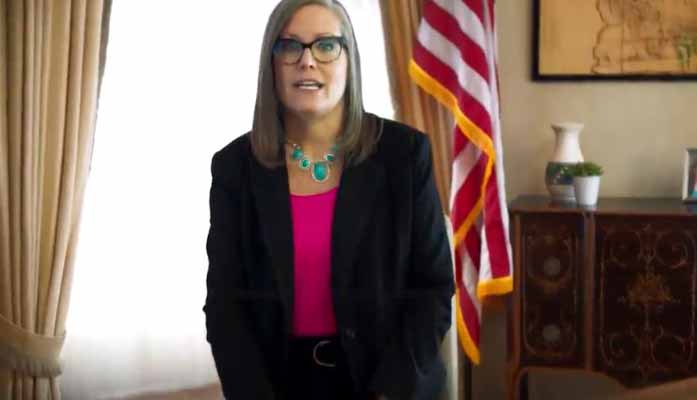
“The debate debacle continues this morning,” the TV anchor said, laughing. “The never-ending story of Democratic candidate Katie Hobbs choosing not to debate her opponent, Kari Lake.”
That’s what Arizona voters heard last week as they woke up and turned on one of Phoenix’s most popular morning news programs. They’ve been hearing it for months.
Hobbs’ refusal to debate Lake, the Republican nominee, has become the defining story of the gubernatorial race, one that started out as a 20-year precedent-breaking decision and has morphed a larger-than-life narrative about the Democrat’s political judgment and skittishness, with multiple left-leaning media outlets, from MSNBC and The View to the Arizona Republic and the New York Times, all asking the same question: What in the world is she thinking?
Hobbs claims it’s because her opponent is too far to the right. In reality, her national headline-making stage fright has been going on for much longer than the general election.
It began in April when Hobbs declined to participate in a June 30th debate with her Democratic primary opponent Marco López, the former mayor of Nogales and chief of staff at U.S. Customs and Border Protection under President Barack Obama. With one exception, Hobbs was the only statewide candidate in Arizona who declined. López used light political pressure hoping to change her mind — he’d often ask the crowd: “¿Dónde está Katie?” — but, when approached by the local press in May, Hobbs’ campaign claimed that she had (conveniently) scheduled “multiple events in Tucson” on June 30th and couldn’t make the two-hour drive back to Phoenix.
López understood. So, he wrote a letter to the Citizens Clean Elections Commission, the government body that organized the debate, granting it permission to “reschedule the debate to a time and date that fits into the Secretary’s busy schedule” over the next 40-plus days. Hobbs declined to reschedule.
When June 30th arrived, a local reporter reached out to Hobbs for comment on her absence. She must have been pretty busy that day, what with “multiple events in Tucson.” But why were no photographs posted online? Oh, about those events, her campaign responded … um, they were canceled. The candidate had come down with a (convenient) case of COVID.
Three days later, Hobbs was spotted, mask-less, waving a flag at a crowded parade in Flagstaff. A superb immune system, indeed.
It wasn’t long after the general election began that Hobbs announced she would not be debating Lake, either. Instead, the Democrat demanded separate one-on-one TV interviews — but that’s not how the Clean Elections process works. Candidates who bow out are not rewarded for doing so. Hobbs insisted that Lake would create a spectacle if the debate format were not right, so the Commission held a formal meeting to appease her, during which its chairman asked her campaign manager point-blank: “Is there any scenario where Ms. Hobbs will share the stage with Ms. Lake in a debate?”
She dismissed his “hypothetical” question and refused to offer an alternate format, and the Commission ruled that the October 12th debate would go on with or without the Democrat in attendance. (Lake said that her opponent was free to change her mind at any time.)
The morning of October 12th, Hobbs joined MSNBC for a softball segment … a little too soft. Because Hobbs got a little too comfortable and accidentally blabbed to the host, as if in the middle of a private conversation, that “PBS is also giving me the same format that Kari Lake has.”
Oops. That secret arrangement wasn’t supposed to come out until after Lake’s interview that evening.
You see, Arizona PBS is the Commission’s official broadcast partner, a relationship that provides the station with unique access to high-profile debates in exchange for complying with the Commission’s rulings when candidates disagree. It turned out that Arizona PBS had struck a side-deal with the Hobbs campaign to shoot and air the one-on-one interview she’d been begging for, right as voters received their early ballots.
The Commission had no clue that the station violated its agreement — and wouldn’t have until it was too late, had Hobbs not accidentally revealed it on live TV. The Commission was forced to cancel the long-planned debate with hours to spare in order to find a new broadcast partner it could trust. In response, Lake held a press conference condemning Arizona PBS’ “backroom deal” with Hobbs, which a source informed her was made at the behest of Michael Crow, the politically connected and contentious president of Arizona State University. (ASU owns and operates Arizona PBS.)
Approached for comment the next morning, Crow denied directing the backroom deal with Hobbs but acknowledged that “he let his preference be known” to the station (which I am certain Arizona PBS interpreted in the exact way that Crow meant it). The Commission’s executive director described himself as “bewildered” by Crow’s political meddling — casting him as “the most powerful man in Arizona” other than the governor — and decried the appearance that “ASU was playing favorites with the candidates.”
Much like Crow, Mi-Ai Parrish, a managing director at ASU who helps oversee Arizona PBS, also “wouldn’t say who made the call to invite” the Democrat. Hobbs herself is similarly claiming now that “I wasn’t involved in those conversations” with ASU — which, again, is a strange series of denials coming from several people who insist they did the right thing.
A Republican state legislator has already announced plans to file a bill that will strip the state’s ties to Arizona PBS as a result of it circumventing the Clean Elections ruling. And, unfortunately for ASU, it doesn’t appear that Hobbs will be in a position to veto it.
Outside of vomiting on herself on-stage, I cannot fathom a single humiliation Hobbs could have endured in a 30-minute debate that would have been worse than the six-month headache of negative headlines her refusal has caused. Two separate polls released this month reflect that reality, finding that the Republican nominee enjoys a 3-point lead heading into Election Day, with even CNN’s Dana Bash acknowledging Monday that “the fact that [Hobbs] won’t debate has given Kari Lake a very wide opening.”
At the end of the day, Arizonans vote for who shows up — and, so far, Katie Hobbs hasn’t.
Brian Anderson is founder of the Saguaro Group, an Arizona-based political research firm.
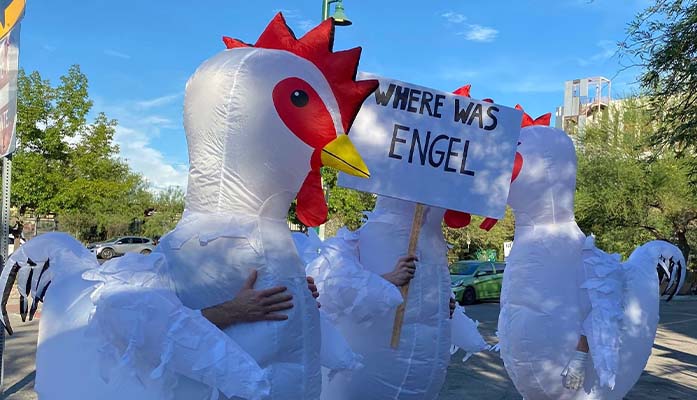
Several people in chicken costumes showed up Friday at a campaign event for former State Rep. Kirsten Engel (D), carrying signs asking where she was the night before.
Those signs refer to Engel’s absence on Sept. 22 from a well-publicized debate in Casa Grande with Republican nominee Juan Ciscomani. The livestreamed event was intended to give Pinal County voters a chance to compare the two candidates for Congressional District 6.
Engel’s campaign said after the no-show that the candidate was advised of the event nearly two months ago, but Engel’s calendar “was still up in the air” at the time. After that, Engel was “not provided with any further details” about the event before last Thursday, according to the statement.
That explanation did not set well with some people. The next night Engel had a campaign event at Club Congress inside Hotel Congress in downtown Tucson.
Hotel Congress is not within CD6.
Engel’s absence renewed attention to the fact other Democrats, including Katie Hobbs, have avoided face-to-face debates this election cycle.
Hobbs, the current Arizona Secretary of State and Democratic nominee for governor, has admitted she wants to avoid a face-to-face debate with her Republican rival Kari Lake. Her decision leaves voters across Arizona with no opportunity to hear her in direct comparison to an opponent.
In fact, Hobbs took the same “no debate” position in her primary contest against former Nogales mayor Marco Lopez.
For his part, Ciscomani appeared to benefit from Engel’s no-show last week by having an opportunity to speak about his policy positions without any distractions or interruptions.
When confronted by reporters and supporters in person on Wednesday, Democratic gubernatorial candidate Katie Hobbs wouldn’t elaborate on her refusal to debate her Republican opponent, Kari Lake.
Hobbs abandoned an interview when a Yellow Sheet Report reporter asked her why she won’t debate Lake, as well as dismissed a similar question from a female supporter.
Hobbs refused to provide the reporter with proof that she proposed a debate format to the Arizona Citizens Clean Elections Commission (AZCCEC). After the reporter challenged Hobbs’ assertion that she had offered debate format changes, Hobbs stated that their conversation wasn’t productive and left the interview after less than three minutes.
When one of Hobbs’ female supporters asked her why she wouldn’t debate Lake, Hobbs told the woman that they would talk about it later.
.@FOX10Phoenix: "@katiehobbs was asked first by a supporter on campus, "Why she didn't want to take the stage to debate with Republican nominee @KariLake. She told the woman, quote, "Let's talk about this later."
Hobbs never proposed changes to the debate format. Rather, Hobbs proposed something else entirely: two back-to-back town halls, effectively two interviews. The AZCCEC rejected Hobbs’ proposal earlier this month.
AZCCEC voted to reject the request to replace the standard debate format with separate 30-minute interviews and will give its staff & the campaigns of Katie Hobbs and Kari Lake 7 days to find an acceptable format to both parties. View the meeting here https://t.co/6rnR5TVjq4.
Hobbs effectively told Fox News that Lake wasn’t debatable. Hobbs’ campaign manager, Nicole DeMont, said during the AZCCEC meeting earlier this month that Lake wasn’t capable of a substantive debate because she was a conspiracy theorist.
TODAY: @katiehobbs campaign manager Nicole DeMont said @KariLake wanted to create a spectacle, not have a debate: "You can't debate a conspiracy theorist. … When she starts to come back to reality [then] we can have a debate." pic.twitter.com/6JVZHb3DwP
Last week, Lake requested the AZCCEC to extend an “open invitation” for Hobbs to debate her. At this point, Lake will have a Q&A session set up by AZCCEC on the scheduled debate day, October 12.
Corinne Murdock is a reporter for AZ Free News. Follow her latest on Twitter, or email tips to corinne@azfreenews.com.
On Thursday, the Arizona Citizens Clean Elections Commission (AZCCEC) voted to give gubernatorial opponents Katie Hobbs and Kari Lake another week to agree to a debate format. Even if the debate doesn’t take place, a Q&A session will occur on the scheduled day of the debate, October 12.
Democratic gubernatorial candidate Hobbs rejected the traditional debate setup at the end of last month, and last Friday issued a proposal to replace the debate with two separate, consecutive town halls.
AZCECC read aloud a letter from Republican gubernatorial candidate Lake refusing to accept Hobbs’ terms. Lake also requested that one of the commissioners, Amy Chan, recuse herself because she works as general counsel to Hobbs’ office. Chan did recuse herself from the discussion and vote.
New #AZGOV: @KariLake calls on @AZCCEC to reject Katie Hobbs’ counter proposal to debate:
“We are calling on the Commission to schedule the debate as planned with two podiums on stage. Kari Lake will be there to answer any & all questions from the moderator.” pic.twitter.com/iuthNUZIxc
AZCCEC rejected Hobbs’ proposal, 3-1. Only Commissioner Steve Titla voted in favor of Hobbs’ proposal.
Chairman Damien Meyer said he weighed the purpose of AZCCEC, and what is best for Arizona voters. Meyer said voter education was the most important function of AZCCEC. Meyer said it was most beneficial for voters to have a debate.
“I don’t believe the commission should accept Secretary Hobbs’ proposal of these back-to-back 30 minute town hall interviews,” said Meyer.
However, Meyer stressed that both campaigns needed to work with AZCCEC to agree on a fair debate structure. Meyer clarified that any future debate format modifications shouldn’t include content regulation. He implied that fact-checking wasn’t the role of debate moderators.
“If someone wants to make a claim, then they’re going to have to live with that claim,” said Meyer.
Commissioner Mark Kimble said he agreed with Meyer, but “only up to a point.” Kimble said there was an issue with timing, since AZCCEC usually sends a format in August. He took issue with Hobbs’ action to send a proposal last week. Kimble argued that it was unrealistic to believe that Hobbs and Lake could come to a mutual agreement.
“It’s incumbent on us to say enough. This is the format we set up,” said Kimble.
Commissioner Galen Paton concurred. He said voters needed to see a debate between the two candidates.
“If they want to do town halls they can do that somewhere else with someone else sponsoring it,” said Galen.
Titla disagreed. He said there was time for the two campaigns to work with AZCCEC to create a fair solution. Titla said he liked Hobbs’ proposal, implying that Lake didn’t meet the criteria of conducting a “fair and reasoned” debate. Titla said the “Apache way” was to give people time to speak, not to insult and speak over one another.
“There should be reasonable people talking, not speaking over each other, not insulting one another in front of people,” said Titla.
Present at the meeting were representatives of both campaigns: Nicole DeMont for Hobbs and Timothy La Sota for Lake.
DeMont said Hobbs was willing to participate in a “substantive” debate, which she said Lake wasn’t going to do. She accused Lake of wanting to create a spectacle.
“You can’t debate a conspiracy theorist,” said DeMont. “When she starts to come back to reality [then] we can have a debate.”
La Sota retorted that Hobbs’ avoidance of the debate is a “cop-out.” He said Hobbs’ proposal is merely an infomercial, not substantive. La Sota warned that AZCCEC capitulating on this debate would cause future candidates to avoid debates. La Sota added that a town hall wasn’t a debate, and therefore would undermine AZCCEC’s purpose.
Public comment heavily favored hosting a traditional debate: 13 voters desired a debate, while 3 voters said they would rather have Hobbs’ proposed town hall format or no debate at all.
Watch the entire AZCCEC meeting below:
Corinne Murdock is a reporter for AZ Free News. Follow her latest on Twitter, or email tips to corinne@azfreenews.com.