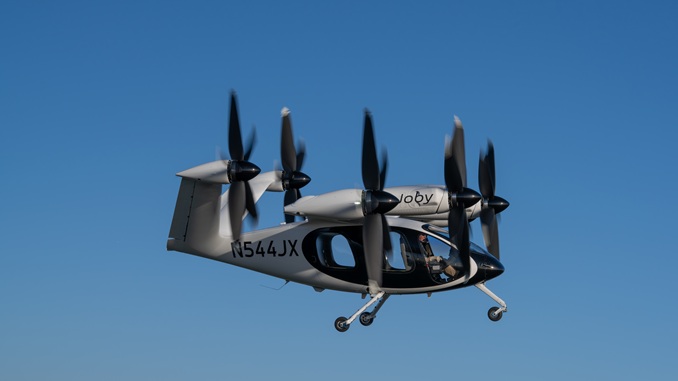
Arizona lawmakers are continuing efforts to prepare the state for advanced air mobility, hosting Joby Aviation at Phoenix Deer Valley Airport this week for a demonstration of the company’s autonomous flight technology.
Senate Majority Whip Frank Carroll (R-LD28) and Sen. David Farnsworth (R-LD10) attended the event, which featured Joby’s autonomous J208 aircraft and marked the beginning of the company’s nationwide Electric Skies tour.
🚨FOR IMMEDIATE RELEASE: Arizona Senate Republicans Help Prepare State for the Future of Advanced Air Mobility
The J208 is a Cessna 208 Caravan equipped with autonomous aviation technology developed by Xwing, an autonomy division acquired by Joby Aviation in 2024. The aircraft is separate from Joby’s electric vertical takeoff and landing air taxi, which the company is developing for commercial passenger service.
Joby said the J208 departed Concord, California, on September 8 for its 2026 Electric Skies tour, which is intended to demonstrate autonomous aviation technology during a cross-country flight.
Joby reported that the aircraft completed its eastbound cross-country journey under remote supervision, with an onboard safety pilot who made no control inputs.
September is shaping up to be a huge month for our J208 program and the future of autonomous flight.
Former fighter pilot @maxabusa spent his career flying with a stick and a rudder.
The pilot commanding the J208 uses a keyboard, a mouse, and a microphone.
The Phoenix event continued a series of demonstrations and legislative initiatives aimed at expanding Arizona’s advanced air mobility sector.
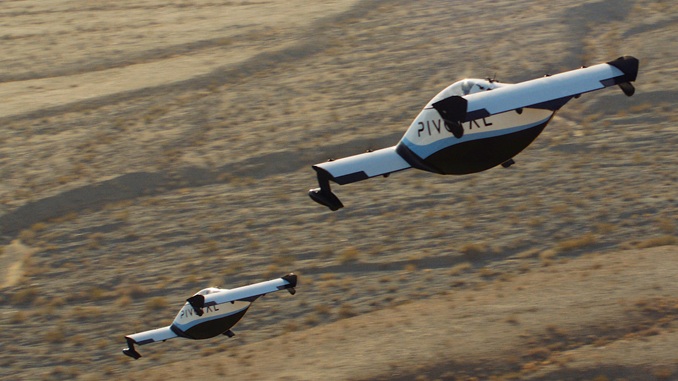
In March, Farnsworth hosted representatives from Pivotal Aviation at the Arizona Capitol for discussions about potential uses of electric vertical takeoff and landing aircraft in communities including Superior and Globe.
Those discussions focused on rural transportation, emergency response, public safety, and connections between communities that have limited access to traditional transportation infrastructure. Pivotal Aviation markets the Helix, a single-seat electric vertical takeoff and landing aircraft.
Later that month, legislation sponsored by Farnsworth had advanced through the House Technology and Infrastructure Committee.
One measure, SB 1826, would appropriate $2 million from the Advanced Air Mobility Fund to the Arizona Office of Defense Innovation and require a public-private partnership supporting autonomous systems, advanced aviation, and related defense and aerospace development.
A second measure, SB 1549, would add ultralight vehicles to Arizona’s statutory definition of advanced air mobility.
The legislative work builds upon SB 1307, sponsored by Carroll and signed into law in 2025. The law directs the Arizona Department of Transportation to incorporate advanced air mobility into state aviation planning and consider infrastructure including vertiports, charging facilities, emergency-response applications, and integration with existing transportation systems.
Arizona’s fiscal year 2025-2026 transportation budget also deposited $2 million into the Advanced Air Mobility Fund. State law allows the fund to support planning, infrastructure development, research, workforce development, public education, and local transportation projects connected with advanced air mobility.
Carroll said Arizona has an opportunity to lead the next major development in transportation by creating a regulatory and infrastructure environment that encourages aviation investment.
“We’ve been laying the groundwork at the legislature so companies developing the future of aviation know Arizona is open for innovation and ready for investment,” Carroll said. “Advanced Air Mobility can improve connectivity between our communities, strengthen emergency response and public safety, support our defense industry, connect communities, and create tremendous economic opportunities.”
“Arizona has the opportunity to lead the next revolution in transportation,” he continued.
Farnsworth said technological development in the sector is accelerating and that lawmakers must ensure state policy keeps pace.
“Our responsibility as lawmakers is to remove unnecessary barriers and ensure that the infrastructure and policies are in place to translate innovation into real-world transportation.” He added, “This is about more than new aircraft. It’s about jobs, economic growth, stronger communities, and giving Arizonans entirely new ways to move around our state.”
“The technology is here, the momentum is building, and Arizona has every ingredient necessary to become the national leader in Advanced Air Mobility,” Farnsworth continued.
Joby also demonstrated its autonomous technology during the U.S. military’s 2025 Resolute Force Pacific exercise, testing capabilities for cargo delivery and military logistics. According to Joby’s account, the campaign logged more than 7,000 autonomous miles, including round-trip ferry flights across the Pacific; six exercise sorties accounted for 2,416 miles. Ground stations supervised the flights, with a safety pilot aboard to monitor system performance.
Carroll and Farnsworth said they are continuing to consult aviation companies and other stakeholders as they prepare for the 2027 legislative session. The Senate Republican announcement did not identify specific legislation planned for the session.
Correction:An earlier version incorrectly described the 2025 military demonstration as transporting personnel and attributed its total flight mileage to operations between Hawaiian locations. The article has been corrected to describe the cargo-logistics demonstration, distinguish exercise mileage from ferry flights, and include the presence of an onboard safety pilot.
This November, voters will decide on a resolution amending the Arizona Constitution to further prevent noncitizen voting and foreign influence in elections.
House Concurrent Resolution 2001 passed the legislature along party lines last week. The Arizona Secure Elections Act, also known as the FAST Election Results Act, will appear on the general election ballot.
The resolution would amend the state constitution to repeat an existent declaration that only U.S. citizens may register and vote in Arizona elections. The resolution would also ban foreign nationals from contributing or expending money or anything of value to influence an Arizona election, and would require voters to show valid government-issued proof of identity for all voting methods prior to casting their ballot — including mail voting.
Republican State Sen. Alexander Kolodin (LD3), the resolution sponsor and secretary of state candidate, issued a press release describing the legislation as an opportunity for voters to establish better safeguards for elections by enshrining these proposed rules in the state constitution.
“For years, Arizonans have watched the same election problems repeat while trust in the system has eroded,” said Kolodin. “Election laws should be written by Arizonans, not dictated by bureaucrats, activists, or outside interests.”
Democrats and Republicans argued over the impact of the resolution during the Senate vote last Friday.
Senate Democrats criticized the legislation as redundant at best and a fatal threat to voting by mail at worst.
State Sen. Lauren Kuby (D-LD8) claimed the resolution was a “backdoor attempt” to end mail-in voting. Kuby accused Republicans of being stooges for President Donald Trump’s election policy preferences at the expense of Arizona voters.
“It’s disturbing to see the legislature put the desires of a sad, desperate man above their very own constituents,” said Kuby.
State Sen. Priya Sundareshan (D-LD18) called the bill “unnecessary” and filled with “vague” language, saying the state constitution’s present voter ID and citizenship proof requirements were enough.
State Sen. Analise Ortiz (D-LD24) said the bill was “voter suppression” and “a state-level SAVE Act.” Ortiz argued the resolution would enable lawmakers to repeal mail-in voting in the future. Ortiz claimed Trump was “plotting to meddle in the 2026 midterms.”
“The real goal of this is to make it harder for eligible voters to vote,” said Ortiz. “Our democracy is being systemically dismantled across the country.”
State Sen. Mitzi Epstein (D-LD12) said the legislation’s declaration that only citizens were eligible to vote was not only redundant and unnecessary, but that the other provisions would create an undue burden on mail-in voters.
“This bill opens the door to no more mail-in ballots,” said Epstein.
State Sen. Theresa Hatathlie (D-LD6) claimed the resolution was a template to “lay the groundwork for Project 2025.”
Republicans countered that existing voter registration requirements already require proof of citizenship, and that voters already anticipate security measures when casting ballots.
Majority Leader John Kavanagh (R-LD3) accused Democrats of “confusing the issue” and misleading voters.
“You’re only scaring people and creating a false argument,” said Kavanagh.
State Sen. David Farnsworth (R-LD10) said an increasing number of Arizonans have lost faith in their elections, and that this resolution was the means of remedying that sentiment.
“Our motive is not to make it more difficult to vote, but to make our elections more secure so that all of us can have confidence that those who vote their votes will be counted properly, and that those who win the most votes will be elected,” said Farnsworth.
State Sen. Jake Hoffman (R-LD15) argued that the “overwhelming majority” of Arizonans support these proposed provisions within the resolution.
AZ Free News is your #1 source for Arizona news and politics. You can send us news tips using this link.
Senator David Farnsworth (R-LD10) paid tribute to the life and courageous work of investigative reporter Don Bolles, earlier this week, marking the 50th year anniversary of his assassination and reaffirming the enduring importance of journalistic integrity and accountability.
On June 2, 1976, Bolles, a reporter for the Arizona Republic and one of the founding members of Investigative Reporters and Editors (IRE), was mortally wounded when a bomb detonated beneath his vehicle in a Phoenix parking lot. He succumbed to his injuries 11 days later on June 13, 1976 at age 47. Prior to the attack, Bolles had been lured to a downtown hotel by a source promising information on land fraud linked to organized crime, in which the source never appeared.
Bolles dedicated his career to exposing organized crime, political corruption, and influence peddling in Arizona. His murder sent shockwaves across the nation and galvanized the journalistic community.
In the wake of his assassination, IRE members launched a major collaborative investigation not only into Bolles’ killing but into deeper systemic corruption that enabled such violence against a reporter in broad daylight. Their efforts underscored a powerful message: assassinating a journalist would not silence the press but would instead amplify scrutiny of the powerful interest involved.
“Don Bolles paid the ultimate price in pursuit of the truth. Fifty years later, his sacrifice still serves as a reminder that corruption thrives when good people look the other way,” stated Senator Farnsworth. “Don Bolles may not have succeeded in rooting out every instance of crime and corruption he set out to expose, but he succeeded in something equally important: he opened the eyes of countless Arizonans to the fact that corruption existed and demanded attention.”
In March, Senate Republicans advanced legislation to honor Bolles’ legacy alongside that of Charlie Kirk. SB 1686, sponsored by Senator Jake Hoffman (R-LD15), would rename Wesley Bolin Plaza as the Wesley Bolin and Charlie Kirk Freedom Plaza. The bill would also authorize the placement of memorials commemorating both Kirk and Bolles within the plaza. It is currently pending in the Arizona House of Representatives.
“In many ways, I am serving in the legislature because of Don Bolles and the awareness his work created,” added Farnsworth. “His story instilled in me a belief that public service comes with a responsibility to challenge corruption wherever it exists and to demand accountability from those entrusted with power. Fifty years later, I still feel obligated to do my part.”
The legislation includes specific provisions for the memorials, emphasizing private funding:
No public monies are authorized for the costs of either memorial.
All fundraising and contracts for design and construction are the responsibility of private proponents.
The authorizations include delayed repeal provisions effective after September 30, 2029.
Fifty years after his death, Don Bolles is remembered not only as a victim of violence but as a martyr for truth whose work helped elevate public awareness of corruption and reinforced the vital role of a free and independent press in safeguarding democracy.
Ethan Faverino is a reporter for AZ Free News. You can send him news tips using this link.
Arizona State Senator David Farnsworth (R-LD10) is pushing back against Democratic criticism of the Republican-backed state budget vetoed this week by Gov. Katie Hobbs. Farnsworth argues that the plan maintains core government services while reducing spending and providing tax relief.
In a statement released Wednesday, Farnsworth said claims that the Republican proposal would harm public safety, wildfire suppression, child welfare, and water protection efforts were “completely false.”
The Republican budget proposal would spend approximately $800 million less than Hobbs’ proposed budget while maintaining funding for K-12 education and public safety. Senate Republicans also said the proposal includes approximately $1.45 billion in tax relief over four years without raising taxes or defaulting on state financial obligations.
🚨FOR IMMEDIATE RELEASE: Senator Farnsworth Responds to Misleading Claims About Republican Budget Proposal
Arizona Senate Republicans said the proposal preserves funding for wildfire mitigation efforts and Colorado River protection programs, exempts the Department of Child Safety from a proposed 5% operating reduction, and supports law enforcement while focusing on reducing unnecessary spending and prioritizing relief for working families, seniors, and small businesses.
“The Republican budget proposal, which Hobbs vetoed on Tuesday, reflects a balanced approach,” Farnsworth said. “It protects essential services, supports public safety, and shows respect for taxpayers by focusing on responsible spending.”
The statement follows Hobbs’ veto of the Republican-backed budget proposal. Hobbs criticized the proposal as “unbalanced and reckless,” arguing it would jeopardize healthcare access, public safety funding, and services for vulnerable residents while prioritizing tax cuts.
Republican lawmakers have defended the proposal as a fiscally conservative alternative to the governor’s spending plan. Legislative leaders previously said the budget would reduce overall spending compared to Hobbs’ January proposal while implementing tax conformity measures tied to recent federal tax changes.
Farnsworth also said he had invited lawmakers from both parties and both legislative chambers to participate in budget discussions throughout the session and said that invitation remains open.
“While there may be disagreements about priorities, it is crucial that our discussions are based on facts rather than fear,” Farnsworth said. “Although the governor walked away from budget discussions, we look forward to renewing good-faith negotiations to ensure that Arizona families, communities, and critical services are supported both now and in the future with a responsible state budget.”
Budget negotiations between the Republican-controlled Legislature and the governor’s office remain ongoing as lawmakers work toward passage of a final spending plan before the end of the legislative session.
Legislation to expand Arizona’s advanced air mobility framework advanced this week at the state Legislature, with key measures clearing a House committee and moving toward a full House vote.
The bills, sponsored by State Sen. David Farnsworth (R-LD10), were approved by the Arizona House Technology and Infrastructure Committee.
One of the measures, SB 1826, would appropriate $2 million from the state’s advanced air mobility fund to the Arizona Office of Defense Innovation to expand AAM initiatives. The legislation requires the office to enter into a public-private partnership with a qualified entity to support the state’s defense, aerospace, dual-use, and national security sectors.
A second proposal, SB 1549, would define “ultralight vehicle” in statute and incorporate it into Arizona’s broader definition of advanced air mobility, a change intended to ensure emerging aviation technologies are included in long-term planning and regulatory alignment.
🚨FOR IMMEDIATE RELEASE: Arizona Advanced Air Mobility Package Moves Closer to Finish Line
“I am optimistic about the outcome of these bills and pleased to see the strong momentum behind them as they move through the House,” Senator Farnsworth said in a statement.
“This has been a priority of mine, and it’s encouraging to see the level of support these measures have received from stakeholders across the state. We’ve had numerous productive meetings as the policy has taken shape, and that collaboration continues to strengthen these efforts as we push towards the finish line.”
The legislation builds on prior efforts by Arizona lawmakers to position the state as a hub for advanced aviation technologies. Farnsworth hosted a February aviation event at the Arizona Capitol, highlighting the development of electric vertical takeoff and landing aircraft and the state’s role in advancing AAM infrastructure.
That report noted that Arizona has already enacted legislation requiring the Arizona Department of Transportation to incorporate advanced air mobility infrastructure into its statewide aviation plan, including vertiports and charging systems, with a deadline of September 2026.
Advanced air mobility generally refers to next-generation aviation systems that utilize electric or hybrid aircraft, including vertical takeoff and landing vehicles, to transport passengers or cargo in urban and regional environments.
State and local planning efforts have also begun to align with those goals. The City of Phoenix Aviation Department has released a framework outlining how AAM technologies could be integrated into existing airport infrastructure, including operations at Phoenix Sky Harbor, Deer Valley, and Goodyear airports.
Additional legislation considered this session has explored expanding the use of AAM technologies beyond transportation, including potential applications tied to border security operations.
Arizona lawmakers have also appropriated funding in recent years to support AAM planning and development, including directing resources toward statewide aviation planning and infrastructure development tied to emerging aircraft technologies.