President Donald Trump signed a temporary federal funding measure Wednesday that finances government operations through Dec. 11 while Congress works on fiscal year 2027 appropriations.
The House approved the Senate-amended version of H.R. 6500 on Sept. 1 by a vote of 370-48, with 14 members absent. The supporting votes included 193 Republicans, 176 Democrats, and one independent.
Arizona’s House delegation divided 5-4 on the measure.
Republican Reps. Juan Ciscomani (R-AZ-06), Abe Hamadeh (R-AZ-08), and Paul Gosar (R-AZ-09) joined Democratic Reps. Greg Stanton (D-AZ-04) and Adelita Grijalva (D-AZ-07) in voting for the bill. Republican Reps. David Schweikert (R-AZ-01), Eli Crane (R-AZ-02), and Andy Biggs (R-AZ-05) joined Democratic Rep. Yassamin Ansari (D-AZ-03) in opposing it.
The Senate passed the measure Aug. 8 by a vote of 90-6. One senator voted present and three did not vote. Arizona Democratic Sens. Mark Kelly and Ruben Gallego both supported the bill.
The enrolled legislation generally continues programs covered by the 12 annual appropriations acts at rates derived from fiscal year 2026 funding. Those appropriations encompass defense, homeland security, veterans’ services, transportation, housing, health, education, federal land management, and other government operations.
The law directs agencies to take limited funding actions during the stopgap period and generally prevents projects that received no money or authority during fiscal year 2026 from being initiated. It also permits agencies to fund civilian compensation at rates needed to avoid furloughs after reducing or deferring eligible administrative expenses.
For Arizona, the measure maintains funding for federal personnel and operations along the international border, at military installations, in national forests and parks, and throughout the state’s federal health care and veterans’ systems.
Ciscomani said a shutdown would have disrupted military pay, required Customs and Border Protection personnel and other federal law enforcement officers to continue working without pay, and affected services for nearly 80,000 veterans in his southern Arizona district.
Today, I voted for a bipartisan, temporary Continuing Resolution (CR) to prevent another government shutdown. A government shutdown is not a political game; it has REAL consequences. It disrupts pay for our troops, leaves CBP agents and law enforcement working without pay, and…
“A government shutdown is not a political game; it has REAL consequences,” Ciscomani said. “It disrupts pay for our troops, leaves CBP agents and law enforcement working without pay, and disrupts services for the nearly 80,000 veterans I have the privilege of representing.”
The stopgap also keeps some new fiscal year 2027 spending from beginning until Congress enacts regular appropriations. Ciscomani said operating under a continuing resolution could postpone $42.7 million in proposed projects for Arizona’s Sixth Congressional District that had cleared initial appropriations hurdles.
He concluded, “I have NEVER supported a government shutdown—partial or full. Arizona families should not have to pay the price for Washington’s dysfunction. The House did the right thing today by coming together to keep the government open, keep essential services running, and continue delivering for Arizona.”
One provision with a direct Arizona connection authorizes the Interior Department to fund its assumption of the remaining responsibilities of the Office of Navajo and Hopi Indian Relocation.
The relocation office was created to administer benefits arising from the federal division of disputed Navajo and Hopi lands in northeastern Arizona. Its remaining work includes administrative appeals, fiduciary responsibilities, land management, and livestock obligations. Congress directed Interior Department to begin handling those outstanding responsibilities as part of the office’s closure, according to a Congressional Research Service report updated in February.
The law also provides additional funding authority for the Indian Health Service (IHS) at operating rates of $75.8 million for health services and $8.3 million for facilities. The money is intended to staff and operate facilities opened, expanded or renovated during fiscal years 2022, 2026 and 2027. The legislation states national account rates and leaves facility-level allocations to the agency.
The IHS maintains Phoenix, Navajo, and Tucson administrative areas with hospitals, clinics, and health centers located throughout Arizona. The Phoenix Area system provides health and community services to approximately 180,000 Native Americans in Arizona, Nevada, and Utah through service units and tribally operated facilities. The Phoenix Indian Medical Center alone provides direct services to more than 171,000 patients.
Wildfire and disaster operations also received special treatment in the stopgap.
The Interior Department and U.S. Forest Service may spend at rates needed for wildfire suppression during the approximately 10-week funding period. Arizona fire officials entered 2026 anticipating increased fire activity because of persistent dryness, fine fuels, drought-stressed vegetation, and tree mortality.
The law gives the Federal Emergency Management Agency (FEMA) similar flexibility to fund disaster response and recovery. It also extends the National Flood Insurance Program through Dec. 11.
Transportation programs that were scheduled to expire Sept. 30 will continue through Dec. 11 under a separate division of the legislation. The extension provides a proportional share of fiscal year 2026 highway and mass transit funding and extends the federal government’s authority to spend from the Highway Trust Fund.
Federal funding accounts for most of the money used in Arizona’s highway construction program. ADOT’s 2026-2030 program includes $2.77 billion for pavement and bridge preservation, $742.9 million for highway expansion, and $603.6 million for modernization.
The law also authorizes the Transportation Department to spend at the rate needed to maintain Essential Air Service. The program subsidizes commercial flights connecting Page and Show Low with Phoenix and Prescott with Denver and Los Angeles.
The Transportation Department’s May 2026 program report listed annual subsidies of approximately $4.4 million for Page, $5.9 million for Show Low, and $6.3 million for Prescott, totaling about $16.6 million.
Federal nutrition and housing programs serving Arizona residents will also continue.
The law maintains mandatory payments and activities under the Food and Nutrition Act, which covers the Supplemental Nutrition Assistance Program (SNAP). Arizona reported that 451,762 people received SNAP benefits in May 2026.
The measure allows the Department of Agriculture to spend at rates needed to maintain participation in the Special Supplemental Nutrition Program for Women, Infants and Children (WIC) and the existing caseload for the Commodity Supplemental Food Program (CSFP). Arizona administers the latter program as the Commodity Senior Food Program, providing monthly USDA food packages to qualifying residents who are at least 60 years old. The state projected an average monthly caseload of 29,931 people during fiscal year 2026 in its budget materials.
The Department of Housing and Urban Development may use prior-year balances to prevent families from losing tenant-based rental assistance because of insufficient funding during the 2026 calendar-year cycle. The City of Phoenix’s Housing Choice Voucher program alone assists more than 7,000 households.
H.R. 6500 also extends a series of veterans’ programs through Dec. 11. Those provisions cover rural mental-health services, suicide-prevention grants, assistance for family caregivers, ambulance reimbursement for qualifying rural veterans, housing support for homeless veterans, transportation to VA facilities, and adaptive sports programs for disabled veterans and service members.
The Department of Veterans Affairs estimated Arizona’s veteran population at 467,010 in fiscal year 2025. Nearly 160,000 Arizona veterans received disability compensation totaling an estimated $4.24 billion annually, while more than 53,000 participated in VA education programs.
The law also permits the Small Business Administration to adjust spending to meet demand for 7(a), 504 and Small Business Investment Company financing. The 7(a) program is the agency’s primary lending program and guarantees qualifying loans for real estate, equipment, working capital, business acquisitions, and other expenses.
H.R. 6500 keeps those operations and programs funded until Congress enacts the applicable fiscal year 2027 appropriations bill or the stopgap expires on Dec. 11.
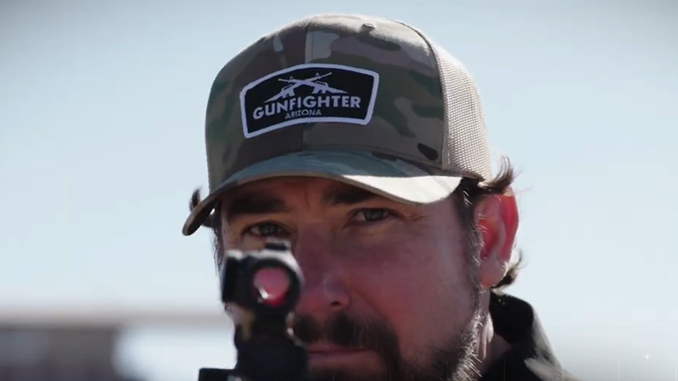
U.S Representative Eli Crane (R-AZ-02) has officially launched his general election campaign with the release of his first television and digital advertisement of the 2026 election cycle. The ad emphasizes Crane’s military background and positions him as a fighter for rural Arizona.
The advertisement titled “Fight,” debuted July 17, 2026. It centers on Crane’s service of five wartime deployments as a U.S. Navy SEAL sniper, focusing on his combat experience and leadership qualities that he says continue to guide his work in Congress.
According to the campaign, the ad will run across digital advertising platforms as Crane prepares to invest seven figures in paid media to defend Arizona’s 2nd Congressional District against Democratic challenger Jonathan Nez.
The campaign rollout follows Crane’s latest Federal Election Commission fundraising report, which shows the congressman has raised $9.4 million during the current election cycle.
The campaign says that total is more than two-and-a-half times the amount raised by Nez’s total receipts.
The filing also reports Crane entered the general election with approximately $2.8 million in cash on hand, compared to roughly $1.4 million at the same point during the 2024 election cycle.
In a statement accompanying the ad release, Crane contrasted his leadership style with what he described as Washington’s political establishment.
“The career politicians in Washington are really good at one thing – ducking a fight,” said Crane. “They retreat at the first hint of political blowback. They may talk tough on TV, but when the battle begins they are AWOL. Their battle cry is surrender. Real warriors know you are never out of the fight.”
Crane also argued that his willingness to challenge entrenched interests has made him a target of political opponents.
“The political establishment cannot control me and that is why they want me gone,” added Crane. “I do not back down. I take on the tough fights, and I deliver results. We don’t have to choose between principle and effectiveness. The real choice is between complacency and courage, between protecting the status quo and defeating it. I will fight for rural Arizona, and I will win. If the D.C. elites are firing back, that tells me I am directly over the target.”
The ad marks the beginning of what is expected to be a competitive general election campaign in Arizona’s 2nd Congressional District, with Crane seeking another term representing the largely rural district against former Navajo Nation President Jonathan Nez.
Ethan Faverino is a reporter for AZ Free News. You can send him news tips using this link.
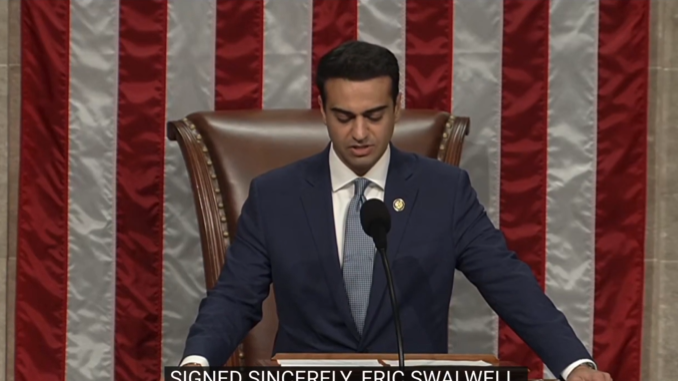
Rep. Abraham Hamadeh (R-AZ-08) formalized the resignation of now-former California congressman Eric Swalwell on Tuesday.
Hamadeh acted in accordance with a provision of the House Rules requiring the Speaker or his designee to announce the House membership adjustment on the floor.
Since the initial sexual assault allegations against Swalwell broke last week, at least five other women have come forward claiming wrongdoing by Swalwell ranging from sexual harassment to rape.
Arizona politico Brian Anderson remarked on the difference between Arizona members’ circumstance in relation to the Swalwell fallout: Hamadeh stepping in for the House Speaker to finalize Swalwell’s rushed exit, and Sen. Ruben Gallego defending himself against accusations of his knowledge or participation in Swalwell’s impropriety.
“Pretty shocking split-screen for Arizonans right now,” said Anderson. “On one side, Ruben Gallego shaking and stuttering, defending himself against credible allegations he knew about Swalwell. On the other, Abraham Hamadeh putting the final nail in Swalwell’s career.”
Pretty shocking split-screen for Arizonans right now –
On one side, @RubenGallego shaking and stuttering, defending himself against credible allegations he knew about Swalwell.
Gallego’s decade-long friendship with Swalwell has put him in the center of the former California gubernatorial candidate’s fallout.
Social media users and influencers have speculated that the mystery man in a now-viral video depicting Swalwell getting intimate with a young woman on a bed was Gallego.
During a Monday press gaggle, Gallego denied that he was the man in the video. He blamed “right-wing, political operatives” for the popularization of the narrative.
“This is an example of the lies. No, I was not sitting next to him, I was not in the room, I don’t even know where it happened,” said Gallego.
Gallego said he, too, was a victim of Swalwell. He claimed innocence of knowledge, saying Swalwell had led a “double life” and lied to him about the allegations.
“Look, I messed up. I’m human. I trusted this man, I trusted him to watch my children. I would watch his children,” said Gallego. “He knew that I had just gone through the most bruising campaign, where I was accused of being a mule for the cartel, where my kids were subjected to TV commercials about what an awful human being I was; he knew how to prey on that. I was a loyal friend to someone that was just not loyal to me.”
However, Gallego also indicated that he knew of rumors of his former friend’s flirtatiousness over the years, but had dismissed them based on his personal interactions with Swalwell and Swalwell’s wife.
“I heard rumors of him being flirty [for years],” said Gallego. “We all heard rumors in Washington, D.C.”
Gallego said he had never engaged in inappropriate behavior with any woman outside of his marriage. He claimed Swalwell lied to him and manipulated him.
Former New York congressman George Santos accused Gallego of being one of a number of U.S. House and Senate members to engage in sexual romps up the hill. Santos alleged Gallego’s behavior was “the worst-kept secret” at the Capitol.
“There is an AZ senator that needs to be looked into ASAP,” said Santos in another post. “The rumors about him have alway[s] been WILD.”
I will say this…
There is an AZ senator that needs to be looked into ASAP!
The rumors about him have alway been WILD… when I was in Congress it was the worst kept secret… he also happened to be my neighbor in the Longworth house office building, so my staff and I saw and…
Arizona Senate Majority Whip Frank Carroll (R-LD28) introduced a measure on Tuesday, urging the U.S. Congress to clearly define and limit the Environmental Protection Agency’s (EPA) regulatory authority. Carroll and his cosponsors argue that ambiguous federal power threatens jobs and economic growth in Arizona. The proposal, SCM 1004, was advanced by the Arizona Senate Republican Caucus earlier this week.
Carroll’s measure calls on Congress to affirm its role in setting national environmental policy and to draw explicit boundaries around the EPA’s authority under federal law. The memorial highlights that, under the Clean Air Act, the EPA is charged with setting and reviewing National Ambient Air Quality Standards (NAAQS) every five years to protect public health and welfare, but argues that compliance requirements have grown burdensome for businesses and workers.
“Americans deserve clean air, land, and water, but they also deserve an economy that can grow without unnecessary federal interference,” Carroll said in a statement distributed by the Arizona Senate Republican Caucus. He added that the measure urges Congress to ensure EPA regulations are “grounded in law and sound science” and do not impose undue economic restrictions.
In additional remarks included in the memorial, Carroll said he is seeking to define the limits of EPA authority to prevent what he described as regulatory overreach.
“I am working to clearly define the EPA’s powers to prevent regulatory overreach that negatively impacts Arizona’s economy,” Carroll said. “While the Clean Air Act allows for specific emissions regulations, the EPA must not exceed its authority or violate fundamental principles of separation of powers. By preventing bureaucratic overreach, we can protect both the environment and the economic opportunities Arizona families and businesses rely on.”
SCM 1004 directs the Arizona Secretary of State to transmit copies of the memorial to leadership in both chambers of Congress and all members of Arizona’s federal delegation. The measure notes that while the EPA’s mission is to enforce environmental laws as intended by Congress, concerns over overreach have prompted states to call for clearer statutory limits on the agency’s powers.
Carroll’s push reflects broader national debates over the scope of federal environmental regulation. Critics of recent EPA proposals have warned that aggressive regulatory action could affect industries including agriculture, energy production, and water resources. Such debates have included congressional hearings examining the consequences of EPA actions on sectors like American agriculture and rural economies.
The memorial challenges key assumptions underlying EPA policies formulated under Democratic administrations and proponents of policy such as the ‘Green New Deal’, stating:
“Greenhouse gases like CO2 and methane are not acutely toxic like other hazardous pollutants and have no direct impact on human health;”
“There is no consensus as to whether global warming is a problem or a benefit or how current temperatures fit into the broader climate context;”
“Global temperatures, droughts, floods and hurricanes have not increased with increasing global CO2 emissions;”
The memorial further refutes the EPA’s authority regarding greenhouse gas emissions, stating directly: “The EPA has no explicit statutory authority to regulate greenhouse gases.”
The memorial comes amid ongoing statewide discussions about the balance between environmental protection and economic growth, with Arizona lawmakers questioning the appropriate reach of federal agencies in areas ranging from air and water quality to land use and energy development.
SCM 1004 was co-sponsored by a group of Republican Arizona Senators, including Hildy Angius (R-LD30), David Gowan (R-LD19), Kevin Payne (R-LD27), Janae Shamp (R-LD29), and Thomas “T.J.” Shope (R-LD16).
The United States is facing an urgent strategic issue that is moving much faster than most of Washington’s current energy debates.
Right now, China is rapidly moving ahead in next-generation nuclear, specifically thorium-fueled molten salt reactors, building directly on technologies the United States originally pioneered at Oak Ridge. Their TMSR-LF1 molten salt reactor has already demonstrated key milestones in the thorium fuel cycle under real operating conditions. China has developed a pathway to abundant, high-density, domestically controlled energy capable of supporting industry, AI and data centers, maritime applications, and defense for decades.
At the same time, China is positioning itself as the future exporter of this technology and associated fuel services, which would give them enduring leverage over global nuclear deployment, standards, and supply chains. If they secure cheaper and more secure sovereign baseload power while we dismantle our own strategic advantages, no tariff regime or short-term subsidy program will offset that structural gap.
By contrast, the U.S. is allowing its position to erode. We are downblending our limited U-233 inventory, treating it as a cleanup problem instead of what it is: a uniquely valuable strategic asset for advanced fuel cycles and life-saving medical isotope production. This is exactly the quiet, procedural decision-making that risks foreclosing options while our competitors scale up.
Congress can still change course, but it must act now:
Immediately Pause U-233 Downblending Place a hold on further downblending and require a comprehensive strategic review of remaining U-233, including its potential for thorium/molten salt reactors, medical isotopes, and national security.
Recognize U-233 and Thorium R&D as Strategic Assets Direct DOE to treat these materials and programs as strategic infrastructure, not mere liabilities, with clear interagency coordination and regular reporting to Congress.
Launch a Serious Thorium / Molten Salt Demonstration Program Provide dedicated, multi-year funding for U.S.-based demonstrations in partnership with private innovators, with milestones focused on deployed hardware and licensing, not just reports.
Modernize Advanced Reactor Licensing Instruct NRC and DOE to create fit-for-purpose licensing pathways for non-light-water designs so U.S. companies can build and iterate here at home instead of ceding deployment experience to China.
Require Transparency & Briefings Request immediate briefings on U-233 inventories, current and planned downblending, and DOE’s thorium/MSR activities so Congress can make informed decisions before irreversible steps are taken.
Beyond the federal urgency, there is a major upside here for forward-looking states.
A state that chooses to lead on thorium and molten salt reactor development through hosting secure U-233/thorium R&D infrastructure, aligning its regulatory environment, and partnering with private innovators can position itself as a long-term anchor for:
World-class industrial power costs: Stable, high-density baseload power can underwrite advanced manufacturing, refining, AI and data centers, and port and logistics facilities, drawing in the very projects now shopping globally for clean, reliable energy.
High-wage technical and research jobs: National labs, engineering programs, medical isotope production, and nuclear supply-chain firms cluster around serious demonstration efforts, creating durable, specialized employment rather than transient construction booms.
Cutting-edge medical and technology ecosystems: Leveraging U-233 for medical isotopes supports a globally relevant health sciences hub, while advanced nuclear capability underpins secure digital infrastructure for finance, AI, and defense applications.
Energy, economic, and strategic credibility: A state that proves this out, prudently and safely, will not only strengthen U.S. security, it will become a model other states and allies look to for standards, supply-chain partnerships, and deployment know-how.
Put simply, this is the kind of targeted leadership that can make a state’s energy and industrial base the benchmark others quietly measure against.
One concrete path would be to build on the framework, as an example, of S.4242 – the Thorium Energy Security Act of 2022, which sought to preserve U-233 inventories to foster development of thorium molten-salt reactors and required DOE to secure and manage those inventories strategically. The government could:
Explore state-level resolutions or companion legislation urging preservation of U-233 and support for thorium/MSR R&D.
Signal interest in hosting secure storage, processing, and demonstration facilities consistent with an updated Thorium Energy Security framework.
Pair that with state incentives and regulatory clarity that welcome advanced nuclear innovators while maintaining rigorous safety and environmental standards.
China is not waiting. If we continue down this path, we are not simply “falling behind,” we are choosing to surrender long-term energy, technological, and geopolitical leverage, along with an opportunity for American states to anchor the next generation of strategic industry at home rather than abroad.
Julia Cartwright, PhD, is a Senior Research Fellow in Law and Economics at the American Institute for Economic Research (AIER).