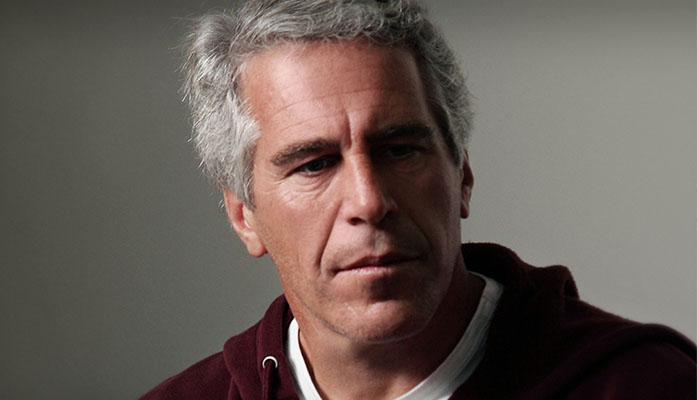
A former professor from Arizona State University (ASU) and renowned atheist physicist was peppered throughout the latest drop of Epstein files.
Former ASU professor Lawrence Krauss, a theoretical physicist and cosmologist, exchanged over 60 emails with Jeffrey Epstein. Among these emails were conversations between Krauss and Epstein strategizing Krauss’s response to sexual misconduct allegations.
In December 2017, Krauss asked Epstein how to deal with questions from BuzzFeed News about the allegations.
Epstein advised Krauss to provide a defense to the allegations in a “short concise cover letter” to be published in its entirety, possibly with an attachment to Krauss’s website that would offer more details of his defense.
After BuzzFeed News published its investigative report on Krauss in February 2018, Krauss offered Epstein a play-by-play of the initial fallout. Krauss expressed hope that a greater news story would emerge to provide cover for him, such as an indictment of President Donald Trump.
“I wonder if I will ever really recover,” said Krauss. “I wish they would indict Trump or something right now.”
Epstein told Krauss to discredit his accusers by depicting them as irrational and opportunistic, and Krauss the rational renowned scientist.
“Concentrate on your point-by-point refutation,” said Epstein. “[An] article on women agreeing on seeing flyer saucers does not make the claim real. Break the charges into ludicrous, ogling, jokes, etc. Nancy [sic] language in her tweets. Stirred up emotion.”
Krauss, who now lives in Canada, retired from ASU in 2019 after the university found merit in the sexual misconduct claims against him. Krauss was accused of grabbing a woman’s chest two years prior at an event.
In an October 2018 post announcing his retirement, Krauss claimed innocence of the charges.
“To be clear, I have never harassed or assaulted anyone and have most certainly not exhibited gender discrimination in my professional dealings at the university or elsewhere,” said Krauss.
His defense did not persuade certain other leaders within the scientific community. Krauss was removed from the board of “Scientific American” over the allegations.
In years prior, Krauss sought to distance association between himself and Epstein.
In a 2014 photo from an annual conference by his initiative at ASU, the Origins Project, Krauss can be seen smiling between Epstein and Harvard professor Steven Pinker. After Epstein’s arrest for child sex trafficking and suicide, Krauss claimed to social media skeptics that Epstein was just another donor that he’d happened to take a photo with, among others.
“Epstein was a Presidentially-approved donor to ASU Foundation, [and] his educational foundation was acknowledged at a named table,” said Krauss in an X comment in 2020. “I had photos taken standing by each table. Pinker & other scientists were randomly assigned to tables.”
However, Krauss knew Epstein more personally than he let on according to the trove of newly released Epstein files, in addition to his well-documented involvement with Epstein and prior statements to the media.
In 2011, Krauss defended Epstein following his imprisonment for 2008 charges of prostitution and prostitution with a minor. Epstein pleaded guilty to the charges; his plea deal of 13 months in prison with work-release later became controversial, as it protected him from federal charges with greater punishments.
“If anything, the unfortunate period he suffered has caused him to really think about what he wants to do with his money and his time, and support knowledge,” said Krauss in a statement to The Daily Beast. “Jeffrey has surrounded himself with beautiful women and young women but they’re not as young as the ones that were claimed. As a scientist I always judge things on empirical evidence and he always has women ages 19 to 23 around him, but I’ve never seen anything else, so as a scientist, my presumption is that whatever the problems were I would believe him over other people.”
Krauss stated, also, that his relationship with Epstein enhanced his life.
“I don’t feel tarnished in any way by my relationship with Jeffrey; I feel raised by it,” said Krauss.
The Origins Project was an initiative headed by Krauss at ASU that sought to answer where life and the universe originated. Krauss joined ASU and launched the initiative several months after Epstein pleaded guilty in 2008.
Krauss holds atheistic views and has proclaimed himself an “antitheist”: one who opposes all theistic religions.
ASU transitioned the Origins Project into the Interplanetary Initiative following Krauss’s departure. Unlike Krauss’s program, the succeeding program focuses on building mankind’s future in space.
Two years prior to joining ASU, Krauss organized a gravity-themed conference funded by one of Epstein’s foundations. That conference attended by the world’s leading physicists took place in the U.S. Virgin Islands. Notably, the conference had dinner on “Epstein’s Island.”
AZ Free News is your #1 source for Arizona news and politics. You can send us news tips using this link.
A group of students at Arizona State University hosted a public awareness event on Thursday, October 23, at the Memorial Union to highlight Antifa’s activities on campus and encourage students to confidentially report any known associates for submission to the Federal Terror Watchlist.
The event, hosted by College Republicans United (CRU), featured verified public records and official documents detailing students previously convicted of Antifa-related crimes, including multiple individuals who were active members or leaders of the Young Democratic Socialists of America (YDSA) at ASU at the time of their arrests.
“Like the Trump administration, we believe that if you see something, say something,” Kevin Decuyper told The State Press. According to the outlet, Decuyper co-founded CRU at ASU in 2018 as a student and is now the chairman of the College Republicans United national organization.
Former law enforcement officer and current Congressional candidate for Arizona’s 1st District, Paul Reevs also told The State Press, “What these students are doing, standing up and simply asking people to help them identify violent people, is courageous. We need that kind of leadership, and I want to support them when they do that.” He attended the event and spoke to students to raise awareness about Antifa-related criminal activity on and around campus.
In a release promoting the event, CRU cited Gabriel Nadales, a former Antifa member and National Director of Our America who spoke at the group’s ASU chapter in 2019 about the connection between ANTIFA and the YDSA.
According to The State Press, YDSA co-chair Isaac Burdge denied any organizational ties to Antifa, stating the group opposes fascism but does not engage in violence.
Despite Burdge’s claims that YDSA is not violent, there have been many documented cases of violence, including Benjamin Cooper, YDSA’s agitprop director at ASU, who has had multiple arrests for assaulting police.
Correction: A previous version of this story said that Gabriel Nadales was a featured speaker at the October 23rd event. Nadales did not speak at the event, but spoke to the group in 2019. The story has been udpated to reflect this.
Correction: A previous version of this story failed to cite reporting from The State Press. The story has been updated.
Ethan Faverino is a reporter for AZ Free News. You can send him news tips using this link.
Arizona State University history professor Alexander Aviña is at the center of controversy after social media posts highlighted comments he made about conservative activist Charlie Kirk and Christianity.
The account Project Constitution posted on X that Aviña had referred to Kirk as “unimportant and hateful” and called Christians “blasphemous.” The post, which quickly spread online, accused the professor of mocking faith and using his position to disparage students’ beliefs.
🚨EXPOSED: ASU Professor Calls Charlie Kirk “Hateful” and Labels ALL Christians “Blasphemous”
So let me get this straight…@ASU “history professor” Alexander Aviña just went on a rant calling Charlie Kirk “unimportant and hateful”… and then took it a step further and called… pic.twitter.com/1d7ZT0fFtm
A second post by Stu Smith also shared the clip from the podcast interview where Aviña continued to reflect on public mourning for Kirk. He compared the response to the aftermath of September 11, saying, “This feels even weirder than right after September 11th, much more intense.”
Aviña also described students whispering in his office out of concern for saying the wrong thing and criticized what he called the “fascistic revanchist right” for using the moment to “pummel the rest of us.”
ASU Prof: Kirk Mourning “Weirder Than After 9/11” — Blasts “Gringo Christians” as “Blasphemous, Sacrilegious” for AI tributes putting Kirk in heaven with Jesus@ASU history professor Alexander Aviña — whose research focuses on guerrilla movements and state violence in Latin… pic.twitter.com/S45BDK0Ujc
In the same interview, Aviña ridiculed Kirk’s global influence, questioning whether “Kirk cultural or political spaces” might emerge in Latin America, and mocked online tributes depicting Kirk in heaven with Jesus.
“Gringo Christians are some of the most blasphemous, sacrilegious people,” he said, adding, “It is extremely bizarre… constant whiplash.”
The comments prompted backlash from voices online, who accused Aviña of disrespecting Christianity and dismissing the legacy of one of the right’s most prominent activists. Both Project Constitution and Stu Smith called on ASU to hold Aviña accountable, with Project Constitution urging followers to “cancel him.”
Jonathan Eberle is a reporter for AZ Free News. You can send him news tips using this link.
Taxpayer-funded resources should not be used to tilt the scales of any election. This isn’t a difficult concept to understand. So, when Arizona State University (ASU) and PBS were exposed for colluding to help Katie Hobbs in the 2022 governor’s race against Kari Lake, we demanded accountability. We called on Arizona Attorney General Kris Mayes and Maricopa County Attorney Rachel Mitchell to launch a full investigation. After all, Arizona law is clear that universities must remain impartial and neutral in election-related activities.
In a ridiculous decision, both Mayes and Mitchell refused to take action on our complaint. But this battle is far from over.
The Illegal Use of Public Funds
This all began back in 2022 when Katie Hobbs was ducking just about everyone during her campaign for governor, most especially Kari Lake. It culminated in Hobbs’ refusal to debate Lake on Arizona PBS. From there, the process should’ve been simple. According to long-standing Arizona Citizens Clean Elections Commission (AZCCEC) rules, Kari Lake should have been provided with airtime, and the AZCCEC planned to do just that. But hours before Lake’s interview was scheduled to take place, the AZCCEC learned that Arizona PBS went behind their back to schedule an exclusive interview with Katie Hobbs—moving them to postpone Lake’s interview.
Then, last month, a series of emails came to light revealing that ASU leaders including President Michael Crow, former Arizona Republic publisher Mi-Ai Parrish, and Arizona PBS leaders allegedly colluded to jettison the debate rules to help Hobbs. This was a blatant and illegal use of taxpayer funds, and that’s why we filed a Hatch Act complaint with Mayes and Mitchell against ASU. But in a shocking and shameful decision, both decided against taking action…
Arizona State University (ASU) received $115 million to establish a new school of conservation with a globalist drive.
The millions from the Rob Walton Foundation, a sustainability nonprofit, launched the Rob Walton School of Conservation Futures on Monday within the newly renamed Rob Walton College of Global Futures.
The new school will focus on global conservation science and workforce development. Though its main operations will be out of Tempe, the school emphasizes hands-on, real-world experience within “hubs” in “conservation critical” locations including Hawai’i.
Its namesake, Rob Walton, is the eldest son of Walmart founder Sam Walton. He formerly chaired the company from 1992 to 2015 before retiring from the board last year and is heir to the Walmart fortune.
Walton said in a statement accompanying the announcement that globalist policies were necessary for conservation.
“Nature doesn’t recognize borders,” said Walton. “To protect ecosystems, we need international cooperation, innovative leadership, and a skilled workforce.”
Peter Schlosser, ASU vice president and vice provost of Global Futures, said the goal of the school is “transforming” conservation academia to yield globalist conservative outcomes.
Conservation International, a Virginia-based environmental nonprofit and one of the top beneficiaries of funding from Walton’s nonprofit, also assisted in the creation of the new school. Its chairman emeritus and founding CEO, Peter Seligmann, said globalism is the best approach for conservation.
“Solving the planet’s greatest conservation challenges requires the wisdom, innovation and leadership of people from all corners of the world,” said Seligmann.
Seligmann is a consistent donor for Democratic candidates. He sat on the the left-wing Council of Foreign Relations think tank, and served on former President Bill Clinton’s board of Enterprise for America.
The current board of directors includes Walton, GAP chairman Robert Fisher, former chairman and CEO of Northrop Grumman Corporation Wes Bush, Hollywood actor Harrison Ford, Hollywood actresses Sabrina Elba and Shailene Woodley, Apple founder Jeff Bezos’ brother Mark Bezos, actress Heather Thompson’s daughter and Nest CEO Kristina Brittenham, former Columbia president Ivan Duque, Apple vice president and former President Barack Obama’s Environmental Protection Agency administrator Lisa Jackson, fashion designer Stella McCartney, and Mars confectionary heiress Valerie Mars.
Past boards of directors included Walton as well as billionaire and Apple heiress Laurene Powell Jobs.
Walton has been heavily involved with ASU for several years. Walton co-chairs ASU’s Global Institute of Sustainability and co-founded the Rob and Melani Walton Center for Planetary Health in 2022. The latter is a research facility housed at the Tempe campus.
The research facility focuses on sustainability research concerning food, water, and energy. It houses the Julie Ann Wrigley Global Futures Laboratory, the Global Institute of Sustainability, the Rob and Melani Walton Sustainability Solutions Service (founded 2012), the College of Global Futures, the School of Sustainability, and the Institute of Human Origins.
The Rob Walton Foundation (RWF, also called the “Rob and Melani Walton Foundation”) uses its tens of millions each year to support large-scale conservation efforts, primarily in Africa. Supported projects include the African Parks, Conservation International, Blue Nature Alliance, and Legacy Landscapes Fund.
The new school named after Walton at ASU will be led by a chair, and include three professorships to supply research and education as well as full and partial scholarships through the Rob Walton Scholars Fund. On one section of the newly launched site on “expanding educational access,” the school indicates it will structure its admissions around diversity.
The page also includes an “indigenous cultures acknowledgment” recognizing prior inhabitation of the land by dozens of Native American tribes.
The school offers both undergraduate and graduate programs.
Three classes announced for the spring within the school cover an introduction to conservation taught by Sharon Hall (president’s professor in the School of Life Sciences), and two biocultural conservation field expeditions in California taught by Melissa Nelson (indigenous sustainability professor).
AZ Free News is your #1 source for Arizona news and politics. You can send us news tips using this link.