by Daniel Stefanski | Mar 17, 2023 | News
By Daniel Stefanski |
Democrat Governor Katie Hobbs’ propensity for politically motivated decisions continues to lead to drawn-out fights with the Republican-led Legislature.
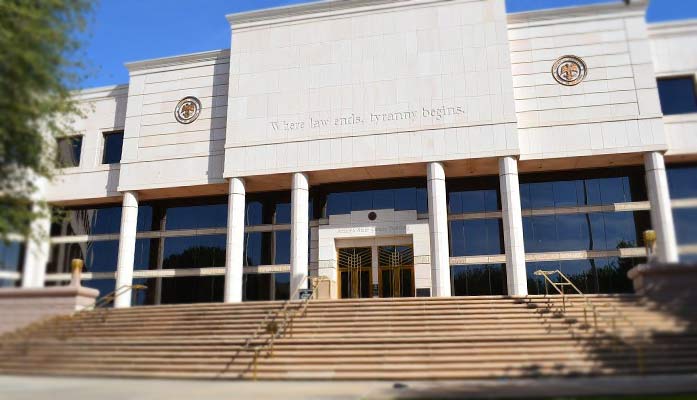
On Wednesday, Republican legislative leaders, Senate President Warren Petersen and House Speaker Ben Toma, filed an amicus brief with the Arizona Supreme Court over the governor’s controversial action to halt the execution of Aaron Brian Gunches.
A press release from the State Senate Republican Caucus stated that “the legislative leaders filed an amicus brief with the Arizona Supreme Court to support the victim’s sister, who submitted a petition for special action last week asking the court to direct the Governor to carry out the warrant issued earlier in the month to execute Gunches.”
In announcing his filing with the state’s high court, President Petersen said, “Right now, victims’ rights protected under the Arizona Constitution are being threatened by the Governor and the Attorney General. It’s incredibly disturbing to see them unwilling to enforce the law and are siding with the most vile individuals convicted of carrying out the most heinous crimes in our state. Furthermore, the Executive Branch is clearly undermining the very foundation of separation of powers by attempting to override the statutory process adopted by the Legislature and affirmed by the Judiciary. This is a dangerous precedent to set by our newly elected Governor.”
The Senate President and the House Speaker argue that “the Governor’s unilateral executive decision threatens bedrock principles of separation of powers by usurping the statutory process established by the Legislature and affirmed by the Judiciary,” that “the decision willfully defies this Court’s mandatory order – signaling to all Arizonans that the Governor is not subject to this Court’s jurisdiction and is, in fact, above the law,” that “the Governor has effectively provided a reprieve of Gunches; death sentence without complying with the statutory limitations on her limited clemency power,” and that “the Governor’s action violates Arizona’s Victim’s Bill of Rights, stripping the victim, Ted Price’s sister, of any finality in this decades-old murder case.”
Senate President Pro Tempore, T.J. Shope, signaled his approval of the court filing, writing, “I agree 100% with President Warren Petersen on this. If we are truly caring less about the victim and their family than the criminal, we are in for years of pain and high crime.”
Petersen and Toma conclude their filing with the following plea for the Arizona Supreme Court to force the state to execute the condemned murderer: “Absent clear and specific delegation of authority from the Legislature or the Judiciary, the Executive cannot rule by fiat and choose which statutes or court orders to follow. The Governor’s actions here set a dangerous precedent, opening a Pandora’s Box and inviting litigation every time she disagrees with a jury’s verdict, a court order, or other statutory mandates passed by the Legislature.”
The saga over Gunches execution started in late-2022, when former Arizona Attorney General Mark Brnovich asked the Arizona Supreme Court for a warrant of execution. After the January 2 transition of power to Katie Hobbs and new Attorney General Kris Mayes, the state desperately attempted to reverse the actions that set Gunches’ execution process into motion. These efforts proved to be unsuccessful, however, when the high court did, in fact, grant the warrant of execution, ordering the state to put Gunches to death on April 6. The governor refused to comply with the court-issued warrant, stating that the State would not be seeking to carry out the execution at this time. Hobbs’ decision triggered court filings from Maricopa County Attorney Rachel Mitchell and Petersen and Toma.
The Arizona Supreme Court is expected to take expedient action in this case with a life and a court-imposed date of execution hanging in the balance.
Daniel Stefanski is a reporter for AZ Free News. You can send him news tips using this link.
by Terri Jo Neff | Feb 19, 2023 | News
By Terri Jo Neff |
Kari Lake has announced she will once again seek review from the Arizona Supreme Court of her claims that she, and not Katie Hobbs, is the state’s legitimate governor.
It will be Lake’s third such effort since the Nov. 8, 2022 General Election, and comes after the Arizona Court of Appeals issued a Feb. 16 opinion upholding a Maricopa County judge’s dismissal back in December of Lake’s election challenge.
Lake has claimed in various legal pleadings that Hobbs’ victory by more than 17,000 votes was improperly influenced by myriad Election Day problems in Maricopa County. As a result, Lake has been seeking to have the county’s election certification voided in the governor’s race.
Her legal filings have argued that a judge should declare Lake as the rightful winner based on various evidence presented to the court. Or in the alternative, she wants an order for a new election in Maricopa County in the governor race.
Last week’s unanimous appellate opinion noted Lakes’ request for relief “fails because the evidence presented to the superior court ultimately supports the court’s conclusion that voters were able to cast their ballots, that votes were counted correctly, and that no other basis justifies setting aside the election results.”
The opinion authored by Chief Judge Kent E. Cattani and joined by Presiding Judge Maria Elena Cruz and Judge Pro Tempore Peter B. Swann came on the heels of two failed earlier attempts by Lake’s legal team to bypass the appellate court and have the Arizona Supreme Court hear the case.
Lake now has until March 20 to file a Petition for Review with the state’s high court. There is no guarantee, however, that the Justices will accept the case.
Terri Jo Neff is a reporter for AZ Free News. Follow her latest on Twitter, or send her news tips here.
by Terri Jo Neff | Jan 25, 2023 | News
By Terri Jo Neff |
The Arizona Supreme Court issued a unanimous opinion Tuesday finding that the Town of Marana violated state law by assigning the entire cost of upgraded and expanded wastewater treatment facilities to future homeowners through development impact fees.
The fees were challenged by the Southern Arizona Home Builders Association (SAHBA) under Arizona Revised Statute 9-463.05 due to the fact that existing Marana residents also benefited from the improved facilities.
The opinion authored by Justice Clint Bolick reverses a Pima County Superior Court decision and sets aside an Arizona Court of Appeals decision, both of which sided with Marana.
According to Bolick’s opinion, town officials violated state law by requiring new residents to bear the entire cost of the expanded and improved services and facilities. Instead, the statute required a proper allocation of costs be conducted through a “discrete, evidence-based findings of fact” that took into consideration the benefit to existing residents.
The case now goes back to a Pima County judge for further proceedings, at which SAHBA will be free to argue that certain expenses should not be included in development fees at all, while Marana officials may argue that certain expenses pertain exclusively to new development.
This could lead to no change to the development fees or an order for recalculation of those fees.
Court records show that until 2012, Pima County provided sewer and water service to residents of the Town of Marana. That year, after five years of effort, the town obtained operational control over a wastewater reclamation facility (WRF) from Pima County, assuming the facility’s roughly $16.4 million in outstanding debt.
In 2013, Marana acquired legal title to the WRF, including the infrastructure, land, and exclusive rights to the facility’s effluent. Owning the effluent contributes to the 100-year assured water supply required for new development, as it can be used to recharge the aquifer.
Town officials then voted to issue 20-year bonds with an annual debt service of $1.8 million to finance the acquisition of the WRF. The Town also commissioned two infrastructure improvement plans, which assigned half of the acquisition costs to future water customers and the other half to future sewer customers.
Those costs would be paid in the form of development impact fees.
The WRF’s output was initially limited to 380,000 gallons per day (gpd) but the capacity was up to 500,000 gpd by 2017 when town officials approved a Capital Improvement Project encompassing “multi-phase expansion and upgrades” to the water and sewer systems.
Phase 1, which was the subject of SAHBA’s litigation, was undertaken to increase the WRF’s capacity to 1.5 million gpd to serve both existing residents and anticipated development. It also brought Marana into compliance with the Class B+ water quality standard required by its Aquifer Protection Permit.
New water and sewer impact fees were also adopted by Town officials in 2017, still assigning 100 percent of the debt service to future water and sewer customers via development impact fees.
As previously reported by AZ Free News, SAHBA initiated its lawsuit in 2018 seeking a declaratory judgment that the development fees violated ARS 9-463.05 by disproportionately imposing the WRF and Phase 1 expenses on future developers even though current residents were also benefitting from the improvements.
In response, the Town’s attorneys argued the development fees were valid because the expansion and improvements were undertaken to serve future development. A Pima County judge agreed and granted summary judgment in favor of the Town.
According to the judge, “the Town’s chief goal in acquiring the WRF was to obtain its effluent as a water resource in order to secure recharge credits towards water rights as a means for sustaining growth by having access to a 100-year designated water supply.”
The Arizona Court of Appeals affirmed the lower court decision, ruling it was irrelevant that any upgrades and modernization to the WRF would also benefit existing residents.
The Town’s attorneys then went on to oppose having the Arizona Supreme Court consider the case, calling such review “unwarranted.” But the justices announced in April 2022 it would hear the matter, noting the case presented unresolved issues of statewide importance.
Tuesday’s opinion notes the court of appeals “committed two principal errors” in upholding the lower court’s decision in favor of Marana. First was applying a presumption that the Town’s assessment of development fees was valid. Second, the appellate court took the position that the WRF project was “entirely” for purposes of new development, even though Marana officials conceded some costs would benefit existing residents.
“In sum, we conclude that the Town violated § 9-463.05 by making future development bear 100% of the cost of acquiring the WRF; by making future development bear nearly all the cost of upgrading, modernizing, and improving the facility; and by failing to determine what could or could not be included in development fees or to make any proportionate allocation of costs between existing and future development,” the opinion states.
Terri Jo Neff is a reporter for AZ Free News. Follow her latest on Twitter, or send her news tips here.
by Terri Jo Neff | Jan 17, 2023 | News
By Terri Jo Neff |
Two major water rights cases that date back to the 1970s are being reassigned to another judge, the first such change in more than 10 years, the Arizona Supreme Court announced last week.
Judge Scott Blaney of the Maricopa County Superior Court will take over the Gila River System and Source case as well as the Little Colorado River System and Source case, both of which were first litigated in the late 1970s. He replaces Judge Mark Brain effective Feb. 4 as what is commonly known as Arizona’s Water Judge.
The cases Blaney is taking over are general stream adjudication proceedings to determine the extent and priority of water rights in the Gila River system (Maricopa County case nos. W-1, W-2, W-3, and W-4), and in the Little Colorado River system (Apache County Superior Court case no. 6417).
The Gila River General Stream Adjudication civil case began in the 1970s as a series of petitions to the Arizona State Land Department to determine, or adjudicate, conflicting surface water rights for the Salt, Verde, Gila, and San Pedro rivers.
The petitions were eventually transferred to the superior courts of the individual counties where the petitions were originally filed, but a 1981 Arizona Supreme Court order consolidated all four cases into the Gila River case. The justices also ordered the matters would be heard in Maricopa County.
Similarly, the Little Colorado River Adjudication began in the late 1970s when mining company Phelps Dodge Corp. filed a petition with the state land department to determine water rights to the Little Colorado River system and source. The litigation was later transferred to the Apache County Superior Court as the county where the largest number of potential claimants reside.
Blaney, a graduate of the University of Arizona James E. Rogers College of Law, served on the civil and family court benches of Maricopa County Superior Court since 2018. Prior to that, Blaney worked in private practice from 2003 to 2015 before becoming State Judge Advocate for the Arizona National Guard and general counsel for the Arizona Department of Emergency & Military Affairs (DEMA).
The state’s Water Judge is assisted by an appointed Special Master who hears disputes arising out of the cases, such as objections to hydrographic survey reports and other legal and factual issues designated by the judge.
Court records show the current Special Master is Susan Ward Harris, who was appointed in 2015. She has a master’s degree in hydrology from the University of Arizona’s College of Science as well as a Master of Law degree from Georgetown University.
Terri Jo Neff is a reporter for AZ Free News. Follow her latest on Twitter, or send her news tips here.
by Terri Jo Neff | Jan 7, 2023 | News
By Terri Jo Neff |
The Arizona Supreme Court ruled Wednesday that gubernatorial candidate Kari Lake must start her election challenge appeal at the Arizona Court of Appeals – Division 1, rejecting Lake’s argument for a transfer of the case in hopes of expedited handling.
The order declining Lake’s request to bypass a three-judge panel at the court of appeals in Phoenix noted “no good cause appears to transfer the matter to this court.” It also noted there had already been a scheduling order issued in case with possible oral argument slated for Jan.24.
It is a decision Lake appears to have accepted.
The defendants in Lake’s election challenge include the five members of the Maricopa County board of supervisors, the county’s two elections directors, and Recorder Stephen Richer. Katie Hobbs was also a defendant in her official capacity as Arizona Secretary of State at the time of the election.
The courts have now substituted Adrian Fontes as the defendant in his role as the new secretary of state, although Hobbs remains a defendant in her personal capacity as a contestee for governor.
Lake filed on Dec. 30 to have the Arizona Court of Appeals overturn the findings made by Judge Peter Thompson of the Maricopa County Superior Court, who denied Lake’s election challenge on Dec. 24 after a two-day trial.
Then, as reported by AZ Free News, Lake’s attorneys filed a petition the next day to transfer the appeal directly to the Arizona Supreme Court.
The three judges assigned to the panel that will hear Lake’s appeal are Maria Elena Cruz, Angela K. Paton, and Peter B. Swann.
Terri Jo Neff is a reporter for AZ Free News. Follow her latest on Twitter, or send her news tips here.