by Terri Jo Neff | Aug 30, 2022 | News
By Terri Jo Neff |
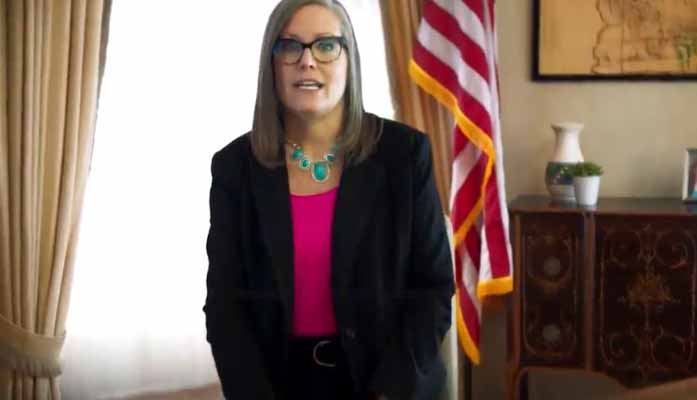
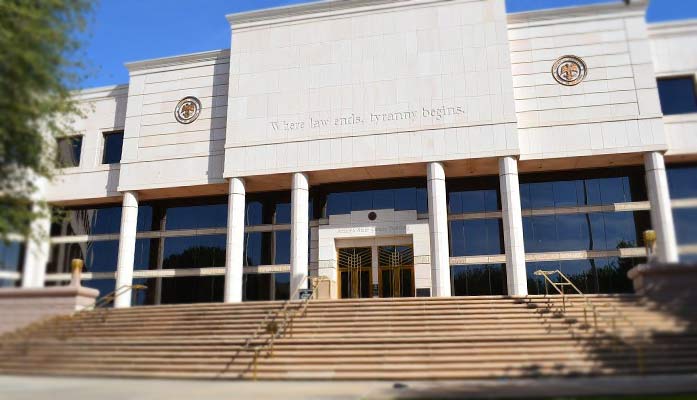
Two voter initiatives will be on the 2022 General Election ballot even though some circulators of petitions in support of those initiatives may not have complied with state law, leading the Arizona Supreme Court to publicly call on Arizona Secretary of State Katie Hobbs to fix her system.
The justices ruled last week that their only option was to allow the Voters’ Right To Know Act and the Predatory Debt Collection Protection Act to be on the Nov. 2 ballot despite the fact some of the signatures used to qualify for the ballot were obtained by circulators who did not comply with the requirements of Arizona Revised Statute 19-118.
“The Court declines to find that the Committee or any individual circulator failed to comply with § 19-118 when the SOS has prevented such compliance,” Chief Justice Robert Brutinel wrote. Doing otherwise, he noted, would “unreasonably hinder” the initiative power granted to voters in the Arizona Constitution.
Circulators are required under ARS 19-118 to register with the Secretary of State’s Office for each initiative effort they are involved with. Part of the registration process includes a notarized Affidavit of Eligibility.
However, the justices would not allow any signature challenges on the grounds of noncompliance with the affidavit requirement. The decision, Brutinel wrote, is that Hobbs’ online “Circulator Portal” is not designed to permit submission of more than one affidavit per circulator.
And it gets worse, according to Brutinel.
“By also refusing to accept manual submission of a hard copy affidavit…the SOS rendered it impossible for circulators to successfully submit a registration application as required by § 19-118…if they had already registered to circulate other petitions,” the ruling states.
Therefore, “any circulators’ lack of compliance with § 19-118 does not invalidate the signatures gathered by these circulators on the record and circumstances before us,” Brutinel wrote, denying a challenge by several groups including Protect Our Arizona, Americans for Prosperity, the Arizona Free Enterprise Club, the Center for Arizona Policy Action, and the Goldwater Institute for Public Policy and Research.
Those groups argued in several election challenges that failure of a circulator to submit the affidavit is grounds for disqualifying all the petition signatures collected by that circulator for that initiative. The same position was argued by Gov. Doug Ducey, who filed an amicus brief in each case along with Arizona Senate President Karen Fann and Arizona House Speaker Rusty Bowers.
Another voter initiative considered by the Arizona Supreme Court last week ended with a different result but still pointed to the problem with being unable to hold circulators accountable for complying with state law.
The case involved the proposed Arizona Free and Fair Elections Act which needed 237,645 validated petition signatures to make the ballot in November. The Arizona Free Enterprise Club cited more than 30 objections including the circulator affidavit issue.
The affidavits did not matter in the end, as the Free and Fair Elections effort fell shy of qualifying for the ballot by roughly 1,500 signatures. Critics of the initiative point out the importance of ensuring the initiative process “strictly complies” with the requirements set out in state law.
To do otherwise, they argue, is to call into question the legitimacy of the process.
MORE ABOUT DEBT PROTECTION ACT HERE
by Terri Jo Neff | Aug 27, 2022 | News
By Terri Jo Neff |
Arizona Free Enterprise Club (AFEC) is reveling in Friday’s Arizona Supreme Court ruling affirming that the attempt to get the Arizona Free and Fair Elections Act on the upcoming general election ballot as a voter initiative has failed.
“The ruling today vindicates what we knew all along: the radical Free and Fair election initiative lacked enough lawful signatures to qualify for the ballot,” AFEC President Scot Mussi said after the order was issued under Chief Justice Robert Brutinel’s name. “Arizona voters, the rule of law, and basic math were victorious today.”
What would have been known as Proposition 210 on the 2022 General Election ballot included numerous changes to state law drafted by the Arizona Democracy Resource Center (ADRC Action), such as a ban on legislative election audits and allowing election day voter registration.
AFEC took the lead in opposing the voter initiative, while some elections officials worried making that many hodge-podge changes to election and campaign finance laws at one time would have negative unintended consequences.
AFEC’s legal challenge alleged myriad problems with more than one-half of the 475,290 petition signatures submitted by ADRC Action. It ended with Brutinel’s order affirming Maricopa County Superior Court Judge Joseph Mikitish’s finding that the minimum 237,645 signature threshold was missed by 1,458 signatures.
The outcome is exactly what AFEC’s Mussi predicted. In a series of statements Friday, Mussi called out ADRC Action for the “rigged methodology” the group’s attorneys pushed the courts to use when calculating the number of valid signatures. He said the mathematic gymnastics was intended “to sneak their disqualified measure onto the ballot.”
“Their dubious formula cherry picked data that boosted their numbers, even including signatures that were disqualified by the counties in the random sample,” Mussi said. “None of their formula was rooted in statute or historical precedent and was a Hail-Mary attempt to resuscitate thousands of signatures that simply should not have counted.”
The justices ordered Arizona Secretary of State Katie Hobbs to rescind the prior determination that the initiative had qualified for the ballot.
by Corinne Murdock | Aug 24, 2022 | News
By Corinne Murdock |
On Wednesday, the Arizona Supreme Court invalidated signatures of a ballot initiative seeking to overhaul the state’s election processes, making it unlikely to appear on the November ballot.
Chief Justice Robert Brutinel ruled that Arizonans For Free and Fair Elections, or the Arizona Democracy Resource Center (ADRC) Action, failed to provide a valid mailing address to receive certified mail. Brutinel remanded the case back to the Maricopa County Superior Court to determine how many signatures his order impacts.
Based on the ruling — likely to invalidate tens of thousands of signatures — and sampling rejection rates, it appears unlikely that the initiative will have enough signatures to qualify for the ballot. ADRC Action submitted over 475,000 signatures, and needs just over 237,600 to qualify.
The Arizona Free Enterprise Club (AFEC) challenged the ballot initiative. In a statement to AZ Free News, AFEC President and Executive Director Scot Mussi asserted that the legal victory protected Arizonans from the harms of outside special interests.
“We are very pleased that the Supreme Court affirmed the lower court ruling that Arizonans for Free and Fair Elections failed to gather enough lawful signatures to qualify for the ballot,” said Mussi. “This radical initiative imported 60 different provisions from Washington, D.C. that would have increased fraud, harmed small business, and empowered special interests. They spent over $7 million trying to buy their way onto the ballot, and they failed.”
The Maricopa County Superior Court’s original ruling reduced valid signatures to about 10,000 short of qualifying for the ballot, which AFEC likened to being “on life support.”
Below are some of Arizonans for Free and Fair Elections’ proposed changes:
- eliminate voter ID and proof of citizenship for voter registration
- allow same-day voter registration
- bar election audits like the most recent one for the 2020 election
- raise small business taxes to increase political campaign funding
- restore private funding in election administration
- require universal vote centers
- extend in-person early voting through the day before Election Day
- require a court order to rule someone too incapacitated to vote
- implement automatic voter registration for driver’s license and state ID recipients, as well as of-age high schoolers
- allow curbside voting
- allow “nontraditional residential addresses” such as mile markers or “geographic or other identifying features” when registering to vote
- restore the permanent early voting list (PEVL)
- restore “inactive” voters to “active” status
- permit “signature-only” voter registration
- allow third parties to register voters
- reduce contribution limits
As reported previously, ADRC Action accrued over $7.6 million from a national network of Democratic dark money for this ballot initiative. Their group traces back to a national donor network called “Way to Win,” launched for the purpose of defeating Republicans in response to former President Donald Trump’s 2016 victory.
Way to Win asserted that its $110 million in funding to key states, including Arizona and Georgia, were the reason for the Democrats’ blue wave in 2020. Way to Win’s major sources of funding include George Soros’ Open Society Foundations and family, Stryker Corporation heiress Patricia Stryker, the prominent D.C. consulting firm Arabella Advisors’ Sixteen Thirty (1630) Fund, and the Tides Foundation-backed One Arizona.
Corinne Murdock is a reporter for AZ Free News. Follow her latest on Twitter, or email tips to corinne@azfreenews.com.
by AZ Free Enterprise Club | May 18, 2022 | Opinion
By the Arizona Free Enterprise Club |
Push a sympathetic message. Drum up a bunch of misguided support. And then aim for a ridiculous tax increase. That was the strategy from Red4ED after it launched a little over four years ago.
In that spring of 2018, the color red was popping up all over the place—from Facebook profile pictures to protests at the state Capitol. And it was supposedly all about increasing teacher salaries and funding for K-12 education. It was a movement that had great momentum, a sycophant media, and a political class that was terrified to stand up to them. Yet they figured out how to, in four short years, go from a political juggernaut to one of the largest and most expensive failures in Arizona political history.
Of course, defeating this multiyear assault on Arizona by Invest in Ed was a huge win for taxpayers, job creators, and the future prosperity of our state. And it would not have been possible without a combination of political miscalculations and blunders by the Red4ED decision makers and a consistent, sustained opposition from key organizations and elected officials willing to stand up to the bullies behind the movement…
>>> CONTINUE READING >>>
by Corinne Murdock | May 11, 2022 | News
By Corinne Murdock |
On Monday, the Arizona Supreme Court dismissed claims of insurrection against State Representative Mark Finchem (R-Oro Valley) and Congressmen Paul Gosar (R-AZ-04) and Andy Biggs (R-AZ-05), ruling them valid candidates for the upcoming election.
A progressive nonprofit, Free Speech for People, alleged that the three legislators weren’t qualified because they committed insurrection through their actions and speech on January 6, a purported violation of the U.S. Constitution’s “Disqualification Clause”: Section 3 of the Fourteenth Amendment.
In response to the ruling, Gosar asserted that free speech prevailed against the Democrats.
Finchem declared that the GOP continued its winning streak with this latest ruling.
The court agreed with the Maricopa County Superior Court’s ruling from last month. Judge Christopher Coury didn’t entertain whether or not the three lawmakers engaged in insurrection. Rather, the courts agreed that the plaintiffs lacked the ability to enforce it. The Arizona Supreme Court agreed with the superior court’s assessment that the U.S. House of Representatives has the sole authority to determine a candidate’s fitness to serve in Congress.
“1) Congress has not created a civil practice right of action to enforce the Disqualification Clause, and the criminal statute prohibiting rebellion or insurrection, 18 U.S.C. § 2382, does not authorize the challenge by a private citizen; 2) A.R.S. § 16-351 does not provide a private right of action to argue a candidate is proscribed by law from holding office; 3) it is unnecessary to decide if the Amnesty Act of 1872 is applicable because no private right of action exists under the United States Constitution or Arizona law; 4) the Constitution reserves the determination of the qualifications of members of Congress exclusively to the U.S. House of Representatives; 5) the doctrine of laches is not applicable at this time; 6) Plaintiffs do not satisfy the legal standards for injunctive relief; and 7) there is no need for an advisory trial. Plaintiffs timely appealed.”
The nonprofit that challenged the qualifications of Biggs, Gosar, and Finchem failed in two similar lawsuits against Congressman Madison Cawthorne (R-NC-11) and Congresswoman Marjorie Taylor Greene (R-GA-14).
In addition to disqualification of the three legislators’ candidacy, Democrats have called for an investigation into their January 6 involvement.
The leader of the activist movement challenging the results of the 2020 election, Ali Alexander of “Stop the Steal,” named Gosar, Biggs, and Finchem as three individuals who helped him organize the January 6 protest.
One of the latest actions taken on these claims came last week when the U.S. House’s January 6 Committee requested that Biggs speak with them.
Biggs refused to cooperate. He compared the committee’s intentions and tactics to those behind the Salem Witch Trials, with former President Donald Trump supporters being the target.
Corinne Murdock is a reporter for AZ Free News. Follow her latest on Twitter, or email tips to corinne@azfreenews.com.