by Corinne Murdock | Jan 4, 2023 | News
By Corinne Murdock |
It appears that Rep. Paul Gosar (R-AZ-09) wasn’t a white supremacist posing a real threat of violence after all.
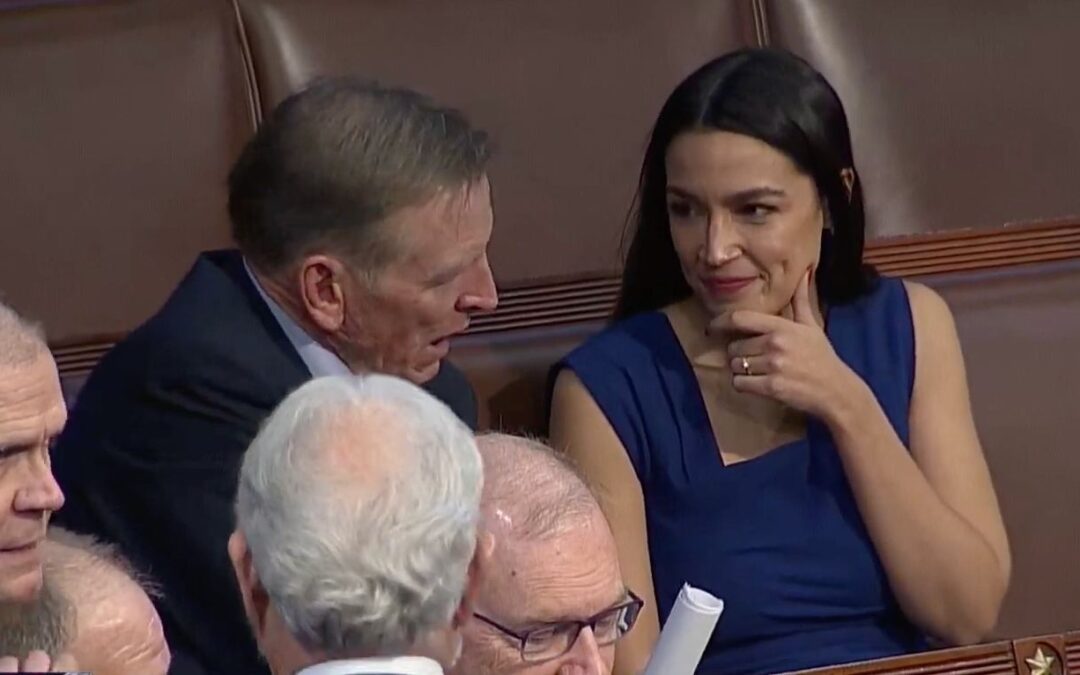
On Tuesday, Rep. Alexandria Ocasio-Cortez (D-NY-14) was captured engaging in a friendly conversation with Gosar. This interaction occurred a little over a year after she accused Gosar of white supremacy and threats of violence for posting a meme video portraying her and other Democrats as slain anime villains. Her claims of fear resulted in Gosar’s censuring and removal from two committees.
Ocasio-Cortez later clarified to reporters that the floor conversation with Gosar concerned Democrats’ support for Rep. Kevin McCarthy (R-CA-20) or Rep. Hakeem Jeffries (D-NY-08) as House Speaker. She told MSNBC that Gosar spoke to her to keep GOP leadership “honest,” dispelling McCarthy’s claim that he had Democrats’ support.
McCarthy reportedly told Republicans that he had promises of votes from Democrats to secure the speakership.
The fallout from Gosar’s meme occurred in November 2021. Ocasio-Cortez derided Gosar, insisting that the meme portrayed Gosar’s “fantasy” of killing her. She also claimed that institutions don’t protect women of color.
“White supremacy is for extremely fragile people and sad men like him, whose self concept relies on the myth that he was born superior because deep down he knows he couldn’t open a pickle jar or read a whole book by himself,” tweeted Ocasio-Cortez.
Rather than an apology, Gosar posted another meme mocking Democrats’ sensitivity.
Outcry from Democrats resulted in Gosar’s censure, which took four hours of debate to reach.
The congressman was removed from two committees: the National Resources Committee and the Oversight and Reform Committee. Gosar’s censure broke an 11-year dry spell for censures. Only two Republicans voted with Democrats to censure Gosar: Reps. Adam Kizinger (R-IL-16) and Liz Cheney (R-WY).
During the censure vote, Ocasio-Cortez claimed the meme was an incitement to violence. Since the meme’s posting, Ocasio-Cortez hasn’t been subject to any publicized attacks.
Although Gosar ultimately removed the offending video, he didn’t apologize for the meme.
Corinne Murdock is a reporter for AZ Free News. Follow her latest on Twitter, or email tips to corinne@azfreenews.com.
by Corinne Murdock | Jan 2, 2023 | News
By Corinne Murdock |
On New Year’s Day, Kari Lake asked the Arizona Supreme Court to take up her case challenging the 2022 midterm election. The request for special-action appellate review marks a final effort to prevent transition of power proceedings ahead of Governor-Elect Katie Hobbs’ inauguration on Thursday.
Lake’s team filed their appeal with the Arizona Court of Appeals last Wednesday, alleging that suppressed and illegal votes outnumbered Hobbs’ 17,100 lead. Lake is pushing for a new election.
“A new governor is scheduled to be seated under a cloud of electoral uncertainty and impropriety,” stated Lake.
The embattled GOP candidate’s team cited “extraordinary circumstances” as the reason for their request, characterizing the Election Day tabulator-printer fiasco as a “targeted attack” on voters as well as citing the upcoming swearing-in ceremony.
Lake’s appeal insisted that the court should distinguish the election content standards: namely, clear-and-convincing versus preponderance-of-evidence, the use of latches for the right to violate laws in future elections, and that unconstitutional elections would qualify as misconduct.
Lake asserted that Maricopa County officials offered “changing and conflicting testimony” that they alleged was proof of intentional malfeasance on Election Day, including chain of custody violations and improper signature review for mail-in ballots. The appeal included a remark made by the county’s counsel, Thomas Liddy, in his closing argument.
“You reap what you sow,” said Liddy, in reference to Election Day voters.
Lake claimed that controversy over this most recent election jeopardizes the republic: a seeming counter to Democrats’ claim that scrutinizing elections jeopardizes democracy.
“A significant majority of voters no longer trust the outcomes of elections in Arizona. A functioning republic cannot exist for long in these circumstances,” read the appeal.
Polls support Lake’s claim concerning election distrust. Rasmussen Reports found that 72 percent of likely voters agreed with Lake’s claims that Election Day problems resulted in disenfranchisement, with 45 percent strongly agreeing.
Tufts University polling conducted the week after the midterm election discovered that distrust in elections correlated with age. Younger voters tended to trust the legitimacy of elections more greatly than older voters, especially concerning the 2020 election. Their polling also discovered that younger generations were far less likely to identify with one specific political party, but didn’t view Democrats as “too extreme” compared with older generations.
Although Hobbs’ team points to Monday as the inauguration day, the official ceremony remains on Thursday.
Corinne Murdock is a reporter for AZ Free News. Follow her latest on Twitter, or email tips to corinne@azfreenews.com.
by Terri Jo Neff | Dec 7, 2022 | News
By Terri Jo Neff |
The task force charged with recommending special ethics rules for attorneys who work for the Arizona Attorney General’s Office and other public entities across the state will miss its December 2022 report deadline, according to Arizona Supreme Court records.
The Task Force on Ethics Rules Governing the State Attorney General, County Attorneys, and Other Public Lawyers was established by Chief Justice Robert Brutinel in February following high profile ethics complaints filed by the Arizona Board of Regents and Secretary of State Katie Hobbs against Attorney General Mark Brnovich.
Although the task force has met eight times, members requested additional time to prepare its ethics recommendations. As a result, Brutinel recently signed an order setting a new deadline of June 2023.
In Arizona, the attorney general is mandated by statute to provide certain legal advice as well as representation to various state agencies, state officials, and state employees. The same principle applies to the state’s fifteen county attorneys.
Brutinel’s creation of the Public Lawyers Task Force acknowledged there are particular ethical concerns a government lawyer may face when representing a public body, elected official, or even a government employee that other attorneys do not have to address. Similar considerations can arise for private practice attorneys who are retained to provide legal counsel to a government client.
Many of those considerations came to a head in 2020 when Brnovich and his staff attorneys were accused by Hobbs of failing to abide by the Arizona Supreme Court’s Rules of Professional Conduct. In another instance, Brnovich actually sued his own client, the Arizona Board of Regents, who in turn contacted the Arizona State Bar.
The ethics complaints against Brnovich’s staff were dismissed by the State Bar, although the attorney general himself agreed to a diversion resolution. The situation, however, drew renewed attention to the dual ethical obligations government lawyers have, particularly when required by state law to represent a specific client.
Former Maricopa County Attorney and current Justice Bill Montgomery was appointed by Brutinel to chair the task force. Among the issues the members are expected to address are:
- the process to follow if a government or public lawyer believes there is a conflict of interest in representing a public client;
- how to handle situations in which the government lawyer does not approve of, or cannot ethically fulfill, a specific course of action desired by a client;
- how the terms and conditions of legal representation should be documented between an attorney and a government client, and who calls the shots if the client is more than one person.
by Terri Jo Neff | Nov 26, 2022 | News
By Terri Jo Neff |
If government officials threaten to force you from your home because of a zoning violation, should you be able to seek a court order blocking the forced removal? Or must you wait until you are actually homeless to fight back?
That is a question the Arizona Supreme Court could consider next year, in a case out of Sierra Vista that has garnered the attention of the Goldwater Institute and private property advocates across the state.
Among the plaintiffs are several longtime city residents of a mobile home park who filed a lawsuit in early 2021 arguing that city zoning officials should not be allowed to force them to move the recreational vehicles (RVs) they live in and that anti-RV ordinances violate their constitutional rights.
A Cochise County judge and the Arizona Court of Appeals ruled there is nothing that can be done in advance to stop the city from enforcing the ordinance. The lawsuit can only proceed if the city actually moves forward with making the residents leave, according to the court rulings.
The Goldwater Institute’s Scharf-Norton Center for Constitutional Litigation took issue with the city’s position as well as the legal reasoning of the judge and appellate court. The organization has filed an amicus (friend-of-the-court) brief asking the Arizona Supreme Court to hear the case which the RVers are appealing.
Timothy Sandefur, attorney for the Institute, notes that prospective injunctive or declaratory relief against a threatened future unconstitutional government act “is a routine procedure.” As such, the amicus brief asks the justices to order the requested injunction to protect the residents.
“This case is like a hypothetical situation in which a plaintiff files a lawsuit for an injunction to prevent a defendant from converting her personal property, or building a factory that will pollute her land, and the superior court tells her the case is unripe because no theft or pollution has yet occurred—before adding, ‘come back after your property has been stolen or ruined,’” Sandefur wrote.
Under city zoning definitions, RVs are considered temporary shelters that are not allowed as permanent residences in a manufactured home subdivision. RVs are, however, permitted as permanent residences in up to 30 percent of the total spaces in a manufactured home park.
The 160-lot Cloud 9 property involved in the dispute is considered a manufactured home subdivision despite being called a mobile home park for decades. In July 2020, a notice of non-compliance gave several residents, including Amanda Root, 30 days to remove their RVs despite the fact most had lived at Cloud 9 for years and did not have funds to move elsewhere.
The city agreed to take no action on the zoning order while attorneys for the residents and the city attempted to resolve the matter. But in February 2021, the city council rejected a proposed amendment which would have allowed Root and the other impacted residents to continue living in RVs at their current locations.
A lawsuit was filed a short time later seeking an injunction preventing the city from enforcing any evictions while the case was litigated. The city’s twofold argument contended the restrictive ordinances related to RVs are constitutional and that there is no legal basis for a court injunction at that time.
Judge David Thorn of the Cochise County Superior Court denied the injunction, pointing out there was no “injury” caused by the threats of enforcement. The Arizona Court of Appeals also passed on hearing the case due to no showing of actual harm, although the appellate court noted there could be harm in the future.
The Arizona Supreme Court will decide in early 2023 whether to hear the case or to leave in place Thorn’s decision that nothing can be done until Sierra Vista officials try to enforce the zoning violations.
by AZ Free Enterprise Club | Aug 31, 2022 | Opinion
By the Arizona Free Enterprise Club |
Arizona voters can breathe a sigh of relief. On Friday, the Supreme Court handed down its decision on our Free Enterprise Club lawsuit that concluded the radical “Free and Fair” election initiative lacked enough lawful signatures to qualify for the ballot. Securing this legal victory was not an easy feat, and the final days of litigation were far more suspenseful than they should have been.
In fact, the trial court came very close to letting the other side steal victory by initially adopting their lawyer’s rigged methodology to calculate the final number of valid signatures that would have snuck the measure back onto the ballot…
>>> CONTINUE READING >>>