Attorney General Kris Mayes reaffirmed her pledge to never prosecute abortionists, regardless of state law.
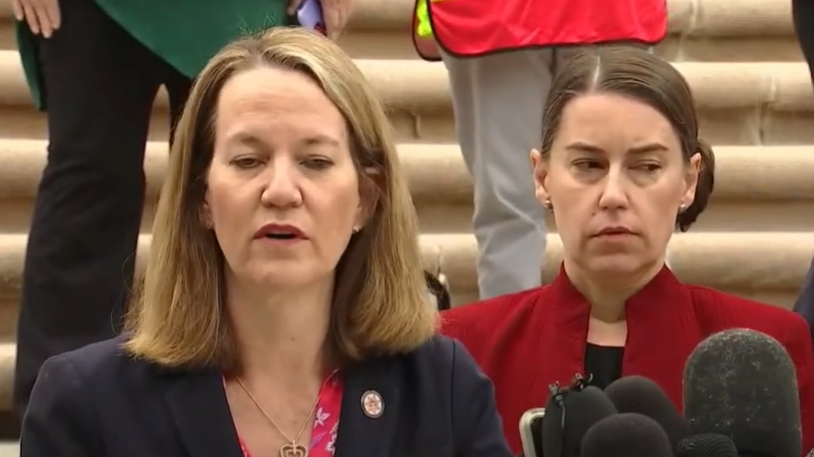
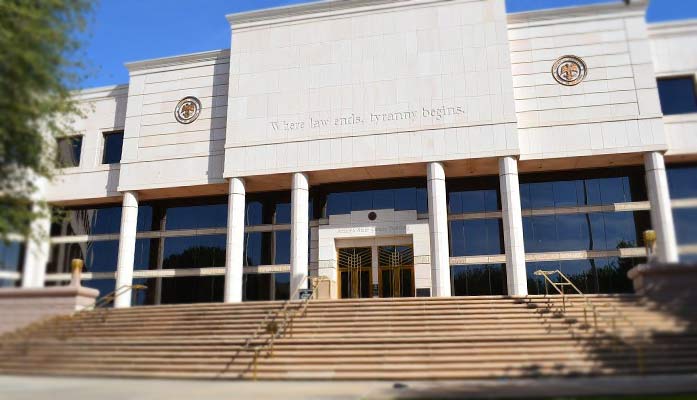
Mayes made the remarks during a press conference following the Arizona Supreme Court oral arguments in Planned Parenthood v. Mayes on Tuesday. The attorney general said that other issues were more important to her, like prosecuting drug dealers giving fentanyl to minors.
“No, we will not be doing abortion prosecutions in Arizona while I’m attorney general, ever,” said Mayes. “We have much more important issues to decide and work on in this state.”
Earlier this summer, Gov. Katie Hobbs issued an executive order that took away all prosecutorial power from the 15 county attorneys concerning abortion law, and gave it to Mayes. That move effectively nullified the possibility for prosecutions of abortionists.
Mayes opted to not dispute the court of appeals ruling in Planned Parenthood v. Mayes from last year, which determined that the 2022 law restricting abortions to 15 weeks’ gestation was to be implemented, and not the near-total abortion ban dating back to Arizona’s territorial days.
Instead, Mayes has backed efforts to expand abortion access in Arizona and other states.
On Wednesday, Mayes joined 10 other attorneys general to issue a statement of condemnation to the Texas Supreme Court. That court overturned an injunction on the state’s abortion ban awarded to a Texas woman seeking to abort her daughter.
Mayes claimed that the health and life of the Texas woman, Kate Cox, were at risk due to the Trisomy 18 diagnosis of her unborn child. Texas abortion law enables abortions in pregnancies that are considered life-threatening or presenting a risk of substantial impairment of a major bodily function. Per Texas law, medical professionals determine which pregnancies qualify for that exception.
“No one should be forced to fight in court and leave their home state just to receive the health care they need,” read the statement. “As this case shows, abortion bans pose dangerous health and safety threats wherever they are enacted. Decisions about abortion care should be made between patients and their doctors, not politicians.”
I join my fellow attorneys general in condemning the Texas Supreme Court's decision to deny abortion access to Kate Cox, a pregnant woman whose health & life were at risk as a result of a lethal fetal diagnosis. She was forced to travel out of state to receive abortion care. pic.twitter.com/DltGxPuVAq
The Texas Supreme Court overturned the injunction because Cox’s doctor couldn’t declare that her pregnancy threatened Cox’s life or major bodily functions.
“A woman who meets the medical-necessity exception need not seek a court order to obtain an abortion. Under the law, it is a doctor who must decide that a woman is suffering from a life-threatening condition during a pregnancy, raising the necessity for an abortion to save her life or to prevent impairment of a major bodily function. The law leaves to physicians — not judges — both the discretion and the responsibility to exercise their reasonable medical judgment, given the unique facts and circumstances of each patient,” stated the court. “[Cox’s doctor] asked a court to pre-authorize the abortion yet she could not, or at least did not, attest to the court that Ms. Cox’s condition poses the risk the exception requires.”
In August, Mayes joined a coalition of 20 attorneys general to challenge Idaho’s ban on minors traveling to other states to obtain an abortion. In May, Mayes joined an amicus brief challenging a Texas ruling blocking federal approval of the controversial abortion drug mifepristone.
Since taking office, Mayes has encouraged major pharmacy chains to continue to offer mifepristone regardless of legal challenges.
Corinne Murdock is a reporter for AZ Free News. Follow her latest on Twitter, or email tips to corinne@azfreenews.com.
If someone in the private sector illegally took money that didn’t belong to them and then refused to return it, what do you think would happen? They could be heavily punished with fines. They could face sanctions. They could even end up in jail, depending on the offense.
But for about a year and a half, Pinal County has been allowed to drag its feet in refunding $80 million that it illegally collected from taxpayers. It’s just another example of government officials who think they are above the law.
This all started back in 2016 when Pinal County officials proposed a $640 million transit tax hike to voters in order to fund a wide array of transportation projects throughout the region. But after unveiling the plan, the county faced strong opposition from retailers, home builders, auto dealers, and multiple taxpayer watchdog groups.
This should’ve been enough for county officials to recognize that the community didn’t support their proposal. But they were too committed to their scheme. So, what did they do?
Arizona’s top Republican legislators are coming to the aid of Abraham Hamadeh’s legal bid at the state Supreme Court.
Last week, Senate President Warren Petersen and House Speaker Ben Toma filed an amicus brief in support of Hamadeh’s latest endeavor to have the top court in Arizona’s judicial branch adjudicate the aftermath of his 2022 election for Arizona Attorney General. Hamadeh, the Republican nominee, ran against Democrat Kris Mayes, who won the contest by 280 votes after a mandatory recount.
In their brief, Petersen and Toma made three arguments for the state’s high court to consider. First, that “the Legislature has designed a robust process to uncover and correct material mistakes in election administration.” Second, that “the trial court abused its discretion by denying the contestants sufficient time to inspect all ballots and conduct discovery.” Finally, that “the petition presents questions of statewide importance requiring an expeditious resolution.”
Hamadeh issued a statement after the filing, thanking the lawmakers for their brief, saying, “I want to thank…the Arizona Legislature with the leadership of House Speaker Ben Toma and Senate President Warren Petersen for filing amicus briefs in support of our efforts to ensure the will of the people is honored. I made a promise to the people of Arizona to ensure that every legal vote is counted – I intend to keep it.”
The lawmakers’ brief answers Secretary of State Adrian Fontes’ opposition to the contestants’ efforts, accusing the Democrat election chief of “escalating rhetorical histrionics to fevered heights.” The outlined “histrionics” were “traducing the Contestants with charges of ‘weaponiz[ing] our Courts, sow[ing] unfounded distrust in our election processes, malign[ing] our public servants, and undermin[ing] our democracy – all for the purpose of trying to overturn the People’s will and topple an election.”
Petersen and Toma present two reasons why the Court should be bothered in their attempt to dissect Fontes’ “ad hominem incentive.”
The first reason given is that the Secretary’s attack is “unfounded.” The second is that “the Secretary’s rhetorical assault is gratuitous and abusive.” The brief highlights that “the churlish imperiousness with which the Secretary reflexively greets even responsible and narrow questions surrounding the administration of the 2022 general election suggests he has forgotten that he serves all Arizona electors, including Mr. Hamadeh and his supporters.”
Hamadeh’s efforts to bring transparency to his razor-thin election result have continued long after his Democrat opponent, Kris Mayes, took office in January. Mayes has continued to show little public interest in the case, allowing her attorneys to handle matters in the courtroom while she continues to revamp the Arizona Attorney General’s Office from the policies of her predecessor, Republican Mark Brnovich.
Daniel Stefanski is a reporter for AZ Free News. You can send him news tips using this link.
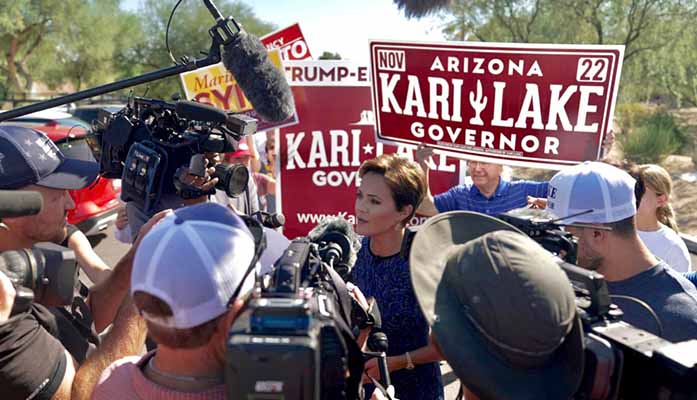
The Arizona Supreme Court granted sanctions against 2022 Republican gubernatorial candidate Kari Lake, declaring that her lawyer issued false statements to the court.
Chief Justice Robert Brutinel issued the sanctions on Thursday in Lake v. Hobbs, totaling $2,000 for that improper conduct. Brutinel rejected Gov. Katie Hobbs and Secretary of State Adrian Fontes’ request for attorneys fees sanctions. He also remanded the unresolved issue of faulty signature verification to the trial court.
Lake alleged that Maricopa County violated A.R.S. § 16-550(A); she claimed that a material number of early ballots were transmitted in envelopes containing an affidavit signature that election officials accepted despite determining that it didn’t match the signature on that voter’s registration record.
This $2,000 in sanctions narrowly concerned the conduct of Lake’s attorney, specifically the claim that additional ballots were added into the final vote count.
The court called Lake’s claims of ballot chain-of-custody claims “colorable,” remarking that Lake continued to promote these claims despite the court’s rejection of them.
Brutinel noted that there was leeway for political rhetoric, but that upholding attorney ethics remained necessary. Brutinel noted that he was careful to approve punitive measures that would appear politically vindictive.
“Sometimes campaigns and their attendant hyperbole spill over into legal challenges. But once a contest enters the judicial arena, rules of attorney ethics apply,” wrote Brutinel. “Although we must ensure that legal sanctions are never wielded against candidates or their attorneys for asserting their legal rights in good faith, we also must diligently enforce the rules of ethics in which public confidence in our judicial system depends and where the truth-seeking function of our adjudicative process is unjustifiably hindered.”
In an April fundraising email, Fontes had called for Lake to be punished in such a way as others wouldn’t file similar legal challenges in the future.
“This [lawsuit] justifies the imposition of sanctions, or some kind of admonishment, so others will not follow suit,” stated the response. “If this Court sits silent in the face of what has occurred, then those who would due [sic] our union harm will continue to malign and erode the foundations upon which our great state stands.”
Fontes celebrated the $2,000 sanctions against Lake, though they fell far short of the initial ask by his and Hobbs’ teams.
Lake’s team has continued to claim as an “undisputed” fact that over 35,500 ballots were added or “injected” at Runbeck Election Services’ processing, the third-party vendor. The court stated that this wasn’t true because election officials have disputed her claims.
“Not only is that allegation strongly disputed by the other parties, this Court concluded and expressly stated that the assertion was unsupported by the record, and nothing in Lake’s Motion for Leave to file a motion for reconsideration provides reason to revisit that issue,” stated the court. “Although Lake may have permissibly argued that an inference could be made that some ballots were added, there is no evidence that 35,563 ballots were, and more to the point here, this was certainly disputed by the Respondents. The representation that this was an ‘undisputed fact’ is therefore unequivocally false.”
Lake championed Tuesday’s ruling as an overall win, focusing on the court’s order to review her claims of faulty signature verification processes.
Here's the latest on our court case!
"AZ Supreme Court orders hearing on Kari Lake's signature verification issue, denies attorney fees."https://t.co/lNMWgQp11P
On Wednesday, the Arizona Supreme Court granted a review to gubernatorial candidate Kari Lake in her challenge of the 2022 election’s validity.
The court dismissed six of the seven issues presented by Lake. The one granted review concerned Maricopa County’s signature verification policies. Chief Justice Robert Brutinel determined that the trial court had wrongly dismissed this issue by interpreting it as a challenge to the policies themselves rather than the application of the policies.
The issue asks:
“Did the panel err in dismissing the signature-verification claim on laches, mischaracterizing Lake’s claim as a challenge to existing signature verification policies, when Lake in fact alleged that Maricopa failed to follow these policies during the 2022 general election?”
Lake alleged that Maricopa County violated A.R.S. § 16-550(A), claiming that a material number of early ballots cast in the election were transmitted in envelopes containing an affidavit signature that election officials accepted despite determining that it didn’t match the signature on that voter’s registration record.
In a press release, Lake characterized the ruling as a win. She called Maricopa County’s signature verification system “completely broken,” and claimed the county was “absolutely terrified” of transparency.
Court watchers say the court has remanded the signature verification issue to the trial court to reconsider the motion to dismiss on grounds other than laches. If the court determines there are no legally sufficient grounds to dismiss, then the court must hold a trial to review the relevant evidence to determine if an outcome determinative number of early ballots were accepted without appropriate signature verification.
While this ruling offers Lake the opportunity to review the signature process, it likely won’t change the outcome of the trial based on the lead in votes by Gov. Katie Hobbs: over 17,100. On the other hand, the court’s signal that it would allow a trial may be favorable for attorney general candidate Abe Hamdeh.
Hamadeh is recorded as losing the election to Democratic opponent, Attorney General Kris Mayes, by just under 300 votes.
"Not only is this the closest race in Arizona history, but it is also the race with the biggest recount discrepancy in statewide history. Making sure the legitimate candidate who received the most votes won is paramount for the success of democracy." https://t.co/Yy0ftm0ybu
Hamadeh appealed the election after the recount discovered that Pinal County undercounted hundreds of ballots, halving Mayes’ original lead from over 511 to under 300.
Mass failures of election machines on Election Day, specifically stemming from the printers, caused long waiting times at vote centers and, in some instances, caused voters to either be discouraged from voting or unable to vote due to time constraints. Those who did stay and were unable to cast a regular ballot due to tabulator issues were forced to cast provisional ballots. Over 17,000 voters filed provisional ballots.
Corinne Murdock is a reporter for AZ Free News. Follow her latest on Twitter, or email tips to corinne@azfreenews.com.