On Wednesday, the Arizona Senate Appropriations Committee passed budget legislation to offer tax credits to movie studios, after a previous effort on the matter failed. Legislators resurrected this effort by introducing it through a strike-everything amendment on HB2156 — its similar predecessor, SB1708, passed through the Senate but failed to make it to the House floor earlier this year. Analysis of the predecessor bill estimated that it would incur losses to the state averaging $150 million.
The legislation would establish a program to promote workforce development and expansion of the movie industry. Further, movie companies would receive credits up to 15 percent if they spend up to $10 million in production costs, 17.5 percent if they spend over $10 million up to $35 million, and 20 percent if they spend over $35 million.
According to the Nashville Film Institute (NFI), the average cost of making a feature film ranges between $100 and $150 million, though it noted that some comedy and animated feature films like those from DreamWorks average between $70 and $90 million.
AZ Free News reviewed the production costs for mainstream feature films in theaters currently; all are well over $35 million. The blockbuster hit “Top Gun: Maverick” had a production budget of $170 million (as of this report, the film has grossed over $900 million worldwide in under a month). Pixar’s latest animated film, “Lightyear,” cost about $200 million to produce. The biopic, “Elvis,” had a significantly lower cost at $85 million.
The legislation would also limit tax credits exceeding $150 million in any calendar year from being preapproved.
Nick Simonetta, a lobbyist, testified to the committee that leadership in both chambers wanted to move this bill at this time. Simonetta said that this version of the bill, HB2156, was an improvement on a predecessor tax credit bill passed by the committee in February, calling the updated bill the “Cadillac” of accountability.
“You cannot claim a credit in this state for the benefit of the program without paying taxes on the expenditures that you’re making,” said Simonetta.
Simonetta testified that HB2156 was ultimately an infrastructure bill that would create a nonexistent industry in Arizona. He referenced two different movie filming complexes being built in the Scottsdale and Buckeye areas.
“The folks investing in these facilities to build movie sound stage complexes and all the things that go with them — the buildings, the office space, the commissary, the mill space, the back lots, everything — this will be investments of hundreds and hundreds of millions of dollars, even just for the first phases of these complexes,” said Simonetta.
State Senator Sonny Borrelli (R-Lake Havasu City) joked that he was only voting for the bill with the contingency that State Senator David Livingston (R-Peoria) didn’t get a movie role.
State Senator Kelly Townsend (R-Mesa) flipped her vote this time around, having voted against the legislation’s predecessor previously. Townsend didn’t offer an in-depth explanation on her change of heart. She joked that Simonetta’s “little extra explanation” past the cut-off time for his testimony was enough to change her mind.
In the name of the #AZLEG budget & fiscal conservatism, tonight’s dinner will be provided by Dollar Tree. #StartYourOwnRumor
— Senator Kelly Townsend 🇺🇸 (@AZKellyT) June 23, 2022
The Arizona Free Enterprise Club criticized the tax credit bill, arguing that it would cost Arizonans hundreds of millions in taxpayer dollars to subsidize Hollywood liberals.
— Arizona Free Enterprise Club (@azfec) June 22, 2022
Arizona Republican Party Political Director Jeremiah Cota commented that the tax credits only sweetened the deal for Democrats, and played into “woke” agendas contrary to Arizonan interests.
If you support the refundable movie tax credits so you can "get a deal done" in Arizona's budget.
It's also fair to say you support the groomers at @Disney because you know it's woke companies like Disney who stand to gain the most from such a sweetheart deal.#AZLeg
— Jeremiah Cota #InflationStrong✊️ (@jeremiahcota) June 22, 2022
The state’s previous tax credit program for movie companies that began in 2005 bled the state of millions of dollars. At the time, Canada introduced tax incentives that pulled movie companies away from Arizona and all other states. Incentives like Arizona’s tax credit program were launched in response to Canada as a means of enticing movie companies to return to the states.
Arizona’s tax credit program lapsed officially in 2010, though it was shut down by the 2008 recession.
Corinne Murdock is a reporter for AZ Free News. Follow her latest on Twitter, or email tips to corinne@azfreenews.com.
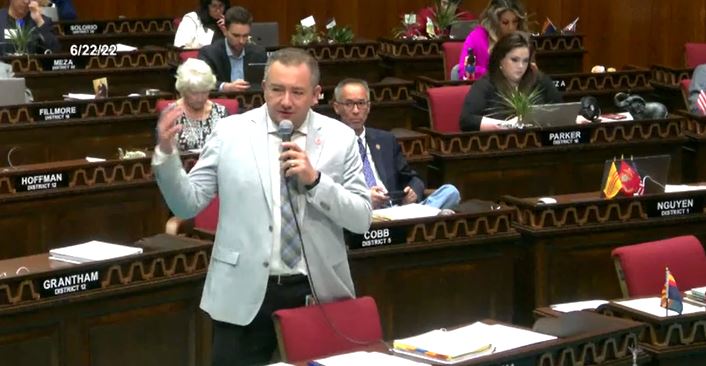
The Arizona House approved a universal expansion of the state’s school choice program on Wednesday afternoon. It now heads to the Senate for review.
The legislation, HB2853 by State Representative Ben Toma (R-Peoria), prompted protracted arguments that delayed the vote for about an hour. House Republicans managed to overcome Tuesday’s budget disputes to rally the majority to pass the bill, 31-26 along party lines. Anti-school choice activists in the gallery shouted “Shame!” repeatedly as the vote totals were read, adding to their general disruption and commentary presented throughout the hour-long debate on HB2853.
Democrats asserted that public schools weren’t fully funded, insinuating that was why they fell short in the eyes of Republicans and what they claimed was a minority of Arizona parents. They insisted that universal school choice through the state’s Empowerment Scholarship Account (ESA) Program contradicted the will of a majority of Arizona voters.
Republicans argued that school choice should be the option for all students, regardless of income or zip code. They repeated the idea that parents were the ultimate accountability for student success and outcomes, not government.
As the final vote and argument presented, Toma argued that Democrats’ logic meant that voters couldn’t ever possibly change their mind on the subject of school choice, which he insisted wasn’t true. Toma insisted that dollars should follow the students and not be the ownership of individual systems.
Toma wondered why private schools should be the exclusive domain of the wealthy, citing back to committee testimony from Drew Anderson — a South Phoenix pastor, Democrat, and beneficiary of school choice, which lifted him out of the squalor of public schools and onto a path resulting in his becoming an NFL player and consequently enabling him to lift his entire family out of poverty.
“This is giving everyone the opportunity to make full use of all their choices,” said Toma.
AZ Free News summarized the highlights of the partisan floor arguments for and against HB2853.
Democrat Arguments Against Universal School Choice:
State Representative Kelli Butler (D-Paradise Valley) characterized the bill repeatedly as “disrespecting the will of voters,” which earned reprimanding from Speaker Pro Tempore Travis Grantham (R-Gilbert). Butler doubted that beneficiaries of the ESA Program were using their funds to “learn anything,” claiming that there wasn’t proper oversight of beneficiary schools’ curriculum.
“They could be learning the most basic things and using our tax dollars,” said Butler.
State Representative Lorenzo Sierra (D-Avondale) said that public schools provided a far superior education, pointing out that 19 out of 20 Flinn Scholars went to public schools.
Sierra also predicted there would be regulations on this bill, speculating that a group of liberals would launch a school built around the 1619 Project, and that the legislature would then attempt to regulate private schools if that happened.
State Representative Judy Schwiebert (D-Phoenix) said that a vast majority of families choose a public district for their children because of their accountability and presence of school boards, calling public school curriculum “well-rounded, publicly vetted, [and] diverse.”
Ultimately, Schwiebert insisted that not all children deserved school choice.
“Technically I know we’re giving it to parents, but let’s be real about it, we’re funneling it to private schools,” said Schwiebert.
State Representative Mitzi Epstein (D-Chandler) said that school choice expansion at this scale would greatly increase cost of administration, and called parents’ access to taxpayer dollars to individualize their children’s education “inefficient.”
State Representative Andrés Cano (D-Tucson) asked his Republican colleagues to submit personal financial disclosures about their benefit to school choice.
State Representative Sarah Liguori complained that the ESA Program was corrupted because some of her wealthier “mom friends” used program funds toward their children’s education. Ligouri said that those individuals should pay for private schooling themselves.
House Minority Leader Reginald Bolding (D-Laveen) claimed that “millionaires and billionaires” would receive a check to subsidize their child’s private schooling. He claimed that private schools wouldn’t return ESA program money even if the family couldn’t cover the rest of the tuition, and that public schools would have to “pick up the slack.”
State Representative Melody Hernandez (D-Tempe) said that expanding the ESA Program would actually trap low-income families in failing schools, many of whom she said were minorities. She called the bill “immoral,” and claimed that Republicans were targeting people like her by expanding a system of oppression.
Republican Arguments For Universal School Choice:
State Representative Lupe Diaz (R-Hereford) insisted that Democrats’ arguments about the harm of school choice couldn’t be true based on the longevity and successes of school choice in Arizona’s history.
“If this program causes so much heartache and blows up public schools, then it wouldn’t have the longevity it has now,” asserted Diaz.
State Representative Shawnna Bolick (R-Phoenix) said she would’ve loved to have school choice options like this growing up, and asserted that it was a good thing that children could use ESA dollars for college education as well.
“Why should we wait until higher education to allow taxpayers to utilize these public dollars for their [children’s] education?” said Bolick.
State Representative John Fillmore (R-Apache Junction) reminded the floor that K-12 spending eats up almost half of general fund money, yet Democrats argued it wasn’t enough. Fillmore also read Arizona Department of Education (ADE) data revealing the low passage rates for children in standardized testing.
“The fact of the matter is, the schools have failed us. Parents are taking their kids out because they see this failure,” said Fillmore.
State Representative Joanne Osborne (R-Goodyear) said that every generation of her family dating back to the late 1890s graduated from Arizona’s public school systems, and that her daughter is a current public school teacher, but that those factors didn’t outweigh her care for children’s needs.
Osborne characterized HB2853 as a win for all Arizona schoolchildren, and asserted that a majority of Arizona parents want school choice. Her remark prompted commentary from the gallery.
Hopefully this time you can control yourselves and not yell in committee hearings and make a spectacle of yourselves. Such behavior is an embarrassment to my profession as a teacher. https://t.co/fQfhq0bFcv
— Paul "nothing but trouble" Boyer (@PaulDBoyer) June 22, 2022
Corinne Murdock is a reporter for AZ Free News. Follow her latest on Twitter, or email tips to corinne@azfreenews.com.
Less than 24 hours after the Joint Legislative Budget Committee published the proposed budget report late Monday, infighting broke out among Arizona’s House and Senate Republicans.
Tuesday marked lengthy budget discussions in the House Appropriations Committee, but in the Senate discussions were cut off abruptly with an indefinite recess of the Senate Appropriations Committee. Effectively, public budget talks ended before they started in half of the State Capitol.
State Senator David Gowan (R-Sierra Vista) said that the House didn’t honor its agreements to pass some bills; one of those significant ones being the Arizona Board of Regents (ABOR) continuation.
“The House has decided that they will not honor the deals we created together and move things forward. I know there’s some media out there, social stuff going on, that they’re trying to pin us and maybe leverage us. But the point is here, they blew the deal,” said Gowan.
Gowan added that he wasn’t willing to call the committee together later on in the day, either. It appears that House legislators reneged on some serious closed-door talks — enough to upset him.
“It would be pretty hard for me to want to come back and help people who wish not to honor deals. In that effort, it’s just not appropriate in what just occurred, so I want that out to the world,” said Gowan.
After moving 3 budget bills this morning, the Senate Appropriations Committee has recessed indefinitely due to House Leadership Members going back on a promise to push forward some important Senate budget bills, including the continuation of @AZRegents. @DavidGowanAZ explains⬇️ pic.twitter.com/93zaM20NfH
However, State Representative Travis Grantham (R-Gilbert) contended that he’d never heard of these deals as the House Rules Committee Chairman. He criticized Gowan’s preferences as “special interest” legislation that was “fat, bloated, […] unconstitutional,” and adverse to Republican interests. Gowan didn’t reply.
“I have never discussed a deal, agreed to a deal or been part of some secretive deal to move certain Senator’s special interest bills that are fat, bloated and in some instances likely unconstitutional,” wrote Grantham. “And further, why would we invite and pay an industry, with taxpayer dollars to come into our great state when they will ban, boycott and take away major meetings, corporations and events because of our Republican majorities and sound policies? #BadIdea”
This is interesting 🤨. I serve as the Chairman of the House Rules Committee. I have never discussed a deal, agreed to a deal or been part of some secretive deal to move certain Senator’s special interest bills that are fat, bloated and in some instances likely unconstitutional.
Those weren’t the only serious breaks from presenting a unified Republican front on the budget. Several individual Republican legislators vocalized dissatisfaction with the budget emphatically on social media and during committee votes.
As the majority, the GOP will have to resolve those opposed within its membership if it hopes to secure the budget’s passage before the new fiscal year begins next Friday, July 1.
Among those opposed to the budget are State Senator Michelle Ugenti-Rita (R-Scottsdale). She asserted that the budget wasn’t fiscally responsible in the face of a looming recession. Ugenti-Rita scorned provisions of the bill as “pet projects” for fellow members.
I can’t think of anything more fiscally irresponsible than spending recklessly on member pet projects while Arizonans struggle to keep up with crushing inflation.
— Michelle Ugenti-RITA (@MichelleUgenti) June 21, 2022
That contradicted how State Representative Regina Cobb (R-Kingman) characterized the budget during the House Appropriations Committee on Tuesday. Cobb said that the proposed budget bills would afford the state with an 8 to 10 percent cushion — enough to “weather the storm” of a pending recession, asserting repeatedly that paying off the pension debt and rollovers would remove troublesome burdens in coming years.
“Are we going to flatline tomorrow or July 1? Absolutely not, but we’ve projected it to be fiscally conservative,” said Cobb. “I think if we’re going into a recession, we’re paying off a lot of debt that could be hanging over our heads during a recession.”
State Representative Jake Hoffman (R-Queen Creek) also opposed the budget. He declared that the budget would only worsen an impending sustained recession and current, serious economic destruction. Hoffman criticized the raises to state employees and judges of up to 15 percent. Although Hoffman was the only Republican committee member to vote against the bill, the legislator said that the budget doesn’t reflect the majority’s platform.
“Everything in [our constituents’] lives are going up, and they’re not getting raises right now. If they are, they’re under the inflation rate,” said Hoffman.
Arizona Free Enterprise Club, a free market policy and advocacy organization, asserted that extraneous funding for agendas contrary to the interests of Arizonans were sprinkled into the budget. In a statement to AZ Free News, President Scot Mussi declared that the budget largely fulfilled Democrats’ wishlist.
“The proposed budget deal includes hundreds of millions in new spending, subsidies for Hollywood liberals to make movies, tax hikes for a Green New Deal transit plan in Maricopa County and special interest pork to buy Democrat votes,” said Mussi. “We should be working toward a budget that has full Republican support, not a Build Back Broke budget supported by Democrats.”
By and large, Democrats focused their comments Tuesday on lamenting the budget’s K-12 spending. Some accused the budget’s design as a “shell game.” Several noted that they didn’t like the idea of funding more border security.
One of the most vocal opponents of the budget, State Representative Kelli Butler (D-Paradise Valley), called the ongoing revenue calculations “irresponsible” during committee. Butler also said that she and a majority of Arizona voters wanted $1 billion for K-12 education. Butler accused the budget of shell games related to taxation that made education funding more vulnerable.
Despite the ongoing economic turmoil and near-universal expectation of a recession, Butler asserted that the economy was “thriving.” Butler also took issue with the fact that she was still getting briefings by midnight and memos from staff at one am early Tuesday, arguing that no legislators had time to figure out what’s all in the budget.
⚠️There may be an #azleg House Appropriations special committee tomorrow at 8am. Bills have not been made public or provided to Democrats yet, but the GOP passed a floor motion for the Approps committee to hear measures “relating to revenues and expenditures.” 🤷♀️ Stay tuned. pic.twitter.com/dSYJY9xBc9
Present at the State Capitol were educator activists with the Arizona Education Association (AEA) rallying for more teacher pay using the $5.3 billion surplus.
Those for the budget praised it for getting more things right to address the state’s current needs. One Democrat, State Representative Cesár Chávez (D-Maryvale) signaled support for the budget, pointing out during committee that the legislature had a little over a week before its deadline for the budget hits. He concurred with his Democratic peers that K-12 education needed a “true, historic investment,” but that he had a responsibility to make the budget work ahead of the deadline.
State Representative Michelle Udall (R-Mesa) offered a list of positives within the budget solving statewide problems: over $1 billion to solve water supply problems; over $1.6 billion overall increase in K12 spending, which meted out to $750 per pupil or a $23,000 increase per classroom; over $1 billion in debt payoff in unfunded liabilities and pensions; over $1 billion increase in public safety (police, fires, courts); and over $500 million to increase health care like in diabetes management training and postpartum care.
Corinne Murdock is a reporter for AZ Free News. Follow her latest on Twitter, or email tips to corinne@azfreenews.com.
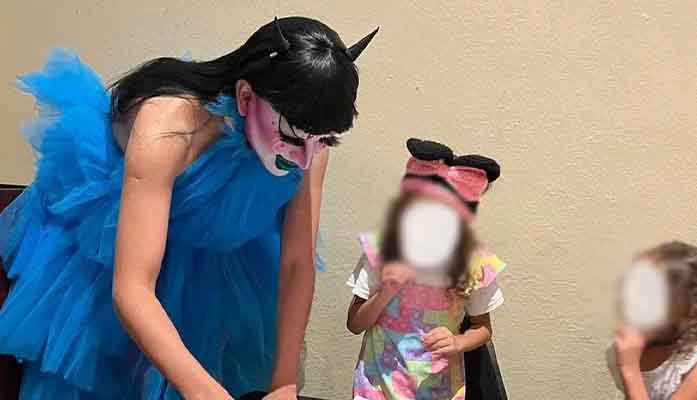
As national attention focuses on children’s exposure to Pride Month festivities, Arizona’s Republican lawmakers pledged on Tuesday to craft legislation outlawing minor attendance at drag shows.
In a joint statement, the Senate Majority team condemned the sexualization and grooming of children through drag shows:
“One of the reasons why we were elected as lawmakers by our constituents was to protect family values. If men want to dress as women, and if adults want to participate in watching these hyper-sexualized performances, they have the freedom to do so. It crosses the line when kids are subjected to these drag shows. This ignorance by public and private sectors promoting this behavior sends a message of complete and utter perversion that can have detrimental impacts on the social and emotional development of our children. We will be damned if we won’t fight like hell to protect the most innocent from these horrifying and disturbing trends that are spreading across the nation now that extremist Democrats are currently in control of our federal government.”
The Senate Majority press release noted that they were working alongside several other, unnamed states to craft the legislation. The press release lamented that children were being exposed to sexual perversion.
JOINT STATEMENT BY THE ARIZONA STATE SENATE MAJORITY TEAM: Senate Republicans Fight Back Against the Sexual Perversion Children Are Being Exposed To
Arizona has had its share of LGBTQ+-related pedophilia incidents. Just last month, a Tucson Magnet High School counselor who organized a drag show for high schoolers was arrested for having a sexual relationship with a 15-year-old student. The Senate Majority team called out this incident, arguing that nondiscrimination policies were a slippery slope that had led to total disregard for morals and values.
“Policies of ‘nondiscrimination regarding gender expression and sexual orientation’ are sending a message to society that we should disregard morals and values just to normalize these unscientific, broad, ill-defined and subjective terms, which set a dangerous precedent for our children that are too young to be exposed to such concepts,” wrote the team.
Earlier this month, children were bore witness to the Heard Museum in Phoenix’s first-ever drag show. That incident was also acknowledged by the Senate Majority team.
“Performers were seen dressed in scantily clad attire while carrying out provocative dance moves that left little to the imagination as youngsters watched,” asserted the team.
In apparent response to the Senate Majority pledge to outlaw drag shows for minors, State Representative Andrés Cano (D-Tucson) suggested that the state legislature hold a drag show. He has not acknowledged the arrest of the high school counselor in his district.
I think it’s time for a drag show at the Arizona legislature, don’t you?!
— Representative Andrés Cano (@AndresCanoAZ) June 15, 2022
State Representative Jennifer Longdon (D-Phoenix) claimed that gun shows were more harmful to children than drag shows.
“As others have said, gun shows are far more harmful for your kids than drag shows,” wrote Longdon. “Also, I LOVE drag queen story time!!!”
As others have said, gun shows are far more harmful for your kids than drag shows. Also, I LOVE drag queen story time!!! https://t.co/KQv8JMXUje
— Rep. Jennifer Longdon she/her (@JenLongdon) June 15, 2022
Research has linked early exposure to sexually explicit material with risky sexual behaviors, intimacy disorders, sexual violence and misconduct, and sexual deviancy. Most research on firearm exposure focuses on the effects and likelihood of gun violence, and not witnessing the legal use of a firearm.
Corinne Murdock is a reporter for AZ Free News. Follow her latest on Twitter, or email tips to corinne@azfreenews.com.
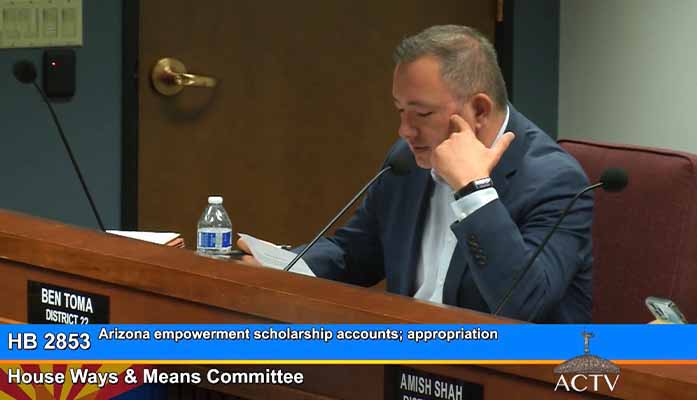
On Wednesday, the State House Ways and Means Committee passedlegislation establishing school choice for all parents who choose to use it. The 6-4 approval marks a historic advancement for expansion of the state’s school choice program, Empowerment Scholarship Account (ESA).
The legislation, HB2853, comes from State Representative Ben Toma (R-Peoria) about 11 years after the ESA Program launched.
I just introduced legislation to provide every Arizona child the ability to go to the school of their family’s choice. #HB2853pic.twitter.com/9uoU3UN7GZ
Bipartisanship was far from the committee during discussion of this bill. Democrats insisted that voters in the past rejected universal ESA expansion, that families would spend their ESA dollars frivolously or wastefully, that there weren’t enough regulations on non-public schools, and that public schools would be bled of crucial funds. Republicans insisted that post-pandemic voters support universal school choice, and that parents knew what was best for their children and would choose accordingly.
Toma challenged the idea that Arizona’s public schools were underfunded, something that Democrats like State Representative Kelli Butler (D-Paradise Valley) and Arizona Education Association (AEA) President-elect Marisol Garcia testified. Toma asked for a definitive number that constituted “fully funded.” Garcia suggested that outranking other state’s funding totals would constitute “fully funded.” In response, Toma pointed out that education funding increased by 48 percent during his tenure in the legislature, adding that much of those funds didn’t end up in teacher’s salaries.
State Representative Brenda Barton (R-Payson) concurred with Toma’s assessment, saying that in her 11 years she’s never gotten a hard answer from any public school proponents or officials of what “fully funded” meant for them.
Chairwoman Shawnna Bolick (R-Phoenix) estimated 25,000 students might utilize the ESA program if expanded under HB2853.
“If we’re helping a student get a lifeline, at the end of the day I’ll actually know we’re doing a good job as a legislature,” said Bolick.
Several Democrats insisted that they wanted to see long-term data on ESA students’ performance rates. Toma said there wasn’t a way to issue a fair comparison of those students because a majority of current users had disabilities, and comparing performance across different disabilities wasn’t an “apples to apples” comparison.
"Arizona has really been a leader on school choice …
"Some of our friends on the left are going to make the argument that the government should be the arbiter and the decider of where children go to school — and I respectfully disagree."
State Representative Pamela Powers Hannley (D-Tucson) argued that program effectiveness could still be measured through methods like sheer counts of private and charter school students.
“I think it’s important to know how many students are enrolled across the state because this is state money,” said Powers Hannley.
There are about 1.1 million charter and public school students.
State Representative Mitzi Epstein (D-Chandler) compared private schools to Walmart stores, insinuating that they were a less desirable option that communities were stuck with. Epstein also challenged why taxpayers should have to pay for children to visit the school they desire.
As a rebuttal for worry over potential private waste of public dollars, Toma pointed out the controversy over Buckeye Elementary School District paying its superintendent over $1.7 million in “additional compensation” from 2016 to 2021. Toma doubted that one individual’s misuse of ESA funds would reach that amount. He added that whenever people are involved, misuse is bound to happen.
“There are issues with any sort of system in which human beings are involved,” said Toma. “Fraud [with ESAs], if there is fraud, is less than one percent.”
In an attempt to cite waste of school funds, Butler listed allowable ESA expenditures she found objectionable, such as a bouncy castle and a tonal home gym costing thousands of dollars. Both Bolick and Toma reminded Butler that the Arizona State Board of Education (SBE) and the Arizona Department of Education (ADE) approved the handbook, clarifying further that Superintendent Kathy Hoffman’s office was responsible for writing it.
The two GOP legislators suggested that their Democratic peer take up her grievances with Hoffman.
Bolick also noted that bounce houses are within individualized education plan (IEP) parameters for curriculum-related therapies. Butler said that was besides her point. She went on to claim the state can’t afford to give every special needs child in the state their own bounce house for several hundred dollars — rather, schools should just purchase one for all special needs students. Butler called the tonal home gym “beyond the pale,” at which point Bolick cut her off for “beat[ing] a dead horse.”
Bolick and Butler contended over whether the entirety of Arizona’s 1.1 million charter and private school students would actually use ESAs.
Butler referenced access to ESA funds as “debit cards” repeatedly, to which Toma and Cobb objected. They, along with Bolick, explained to Butler that she was referring to an outdated system. They also contended with Butler’s attempted characterization of ESA funds as “thousands of dollars in a bank account.” At that point, Bolick suggested again to Butler that she seek out instruction from Hoffman about how the ESA Program works currently.
Among those to testify in favor of ESA Program expansion was Jennifer Clark, a mother of five. She explained that ESAs have helped several of her children with special learning needs like dyslexia and disabilities.
Clark further described how the public school system was currently failing her daughter with its stalled processing of her educational needs. She insisted that HB2853’s allowance for outside assessments would expedite solutions for situations like her daughter’s.
“All Arizonan families deserve equitable access to ESAs regardless of their income or zip code,” said Clark.
Drew Anderson, a South Phoenix Democrat and pastor, pointed out that the majority-white crowd protesting with the likes of Save Our Schools against the bill didn’t represent or understand the needs of minority parents — especially those in inner city schools like the Roosevelt School District.
“I don’t see anybody screaming ‘save our schools’ in south Phoenix,” said Anderson. “I hear them screaming ‘save our children.'”
Anderson described how inner-city children in his area, many from the Roosevelt School District, had to do school at McDonalds during the pandemic because they didn’t have internet at home.
The pastor then explained that one of his church members admitted to selling drugs on the side to get his siblings out of public schools. Their mother is deceased, Anderson explained, and one of the man’s younger sisters was attacked by a group of 14-year-old girls at her school.
“He had to find whatever means he could to try to get his brothers and sisters into private schools. He’s putting his freedom on the line to do that,” said Anderson. “Why is it that the rich kids can afford to go to these better schools, but these poorer kids can’t?”
HB2853 would empower parents with access to taxpayer funds already allocated for their students to apply to the schooling of their choice. The bill would appropriate $2.2 million and 26 full-time equivalent positions from the state general fund in 2023 to the ADE.
HB2853 would also enable ESA funds to be used for public transportation; computer hardware; educational technology like calculators, personal computers, laptops, tablets, microscopes, telescopes, and printers; consumable educational supplies like paper, pens, and markers; and additional disability services and education plan costs.
As for enrollment eligibility, the legislation would reduce the number of hours needed for K-12 online students to qualify by about half. It would also require students in grades 3-12 take nationally standardized tests, which may be swapped out for exams chosen by parents or qualified schools. Students with disabilities would be exempted from that examination requirement. Additionally, qualified schools with 50 or more ESA students must issue the aggregate test scores of all enrolled students or all ESA students annually.
Furthermore, the bill would expand the appeal deadline to 15 business days, and allow parents to represent themselves or designate non-attorney representatives in appeals hearings.
If passed as introduced, HB2853 includes a retroactivity clause rendering it effective as of July 1 of this year.
HB2853 angered school choice opponents. They claimed that the bill would rob public schools of their funding and award it to private schools and special interests.
No. You just introduced legislation to rob public schools at the bidding of private schools & special interests. You are expanding unaccountable entitlement programs for the wealthy, while AZ public schools remain LAST in the nation in funding 😡#NoNewVouchers#NoHB2853https://t.co/qPsD8SKZuS
At the time of press, GOP gubernatorial candidates Matt Salmon and Karrin Taylor Robson signaled support for HB2853.
Freedom is the foundation of any successful educational system.
Every parent across AZ deserves the opportunity to choose the school that best fits their children's individual needs, and they should be able to take their tax dollars with them. #HB2853https://t.co/3ISEBsFgwRpic.twitter.com/q1mHdXksvu
AZ has been a school choice leader for decades. #HB2853 will expand opportunity for every student & vault our state to the front of the educational freedom movement. As Governor, I look forward to build upon this legislation for years to come. #AZgovhttps://t.co/auSuQ52s5c
— Karrin Taylor Robson for Arizona (@Karrin4Arizona) June 15, 2022
Corinne Murdock is a reporter for AZ Free News. Follow her latest on Twitter, or email tips to corinne@azfreenews.com.