by Staff Reporter | Apr 10, 2025 | News
By Staff Reporter |
The Arizona legislature passed a bill recognizing the existence of only two genders and defining sex-based terms.
The Senate passed HB 2062 on Tuesday along party lines.
The bill from State Rep. Lisa Fink established definitions for the two genders and all related gendered terms: “boy” defined as “a human male who has not yet reached adulthood”; “father” defined as “a male parent of a child or children as defined by law”; “female” defined as “an individual who has, naturally had, will have, or would have, but for a developmental anomaly or accident, the reproductive system that at some point produces ova”; “girl” defined as “a human female who has not yet reached adulthood”; “male” defined as “an individual who has, naturally had, will have, or would have, but for a developmental anomaly or accident, the reproductive system that at some point produces sperm for fertilization of female ova”; “man” defined as “an adult human of the male sex”; and “mother” defined as “a female parent of a child or children as defined by law.”
HB 2062 also defined “sex” to mean “a person’s biological sex, either male or female, at birth.”
Governor Katie Hobbs is unlikely to approve this bill. She vetoed similar legislation last year (SB 1628), writing in a brief explanation letter that she would not harm residents of the state.
“As I have said time and again, I will not sign legislation that attacks Arizonans,” wrote Hobbs.
Hobbs has declared that individuals become the gender they believe they are, as opposed to their biological sex.
The Independent Women’s Network (IWN) — a grassroots activist group heavily involved in preserving sports participation based on biological sex — launched a campaign to urge Hobbs to go back on her past stances on transgenderism and sign HB2062 into law. One of IWN’s most prominent ambassadors is Riley Barker (nee Gaines), the collegiate swimmer turned political activist after losing to Lia Thomas, a male swimmer who identifies as a female.
“Call upon Governor Hobbs to sign this common sense, pro-woman measure into law to prevent sex discrimination in Arizona,” stated IWN. “We cannot fight sex discrimination if we cannot define ‘sex.’”
Senate Democrats argued for the reality of transgenderism. State Sen. Analise Ortiz said that males who believe they are females should be viewed as such.
“This should terrify us because trans women and girls are already a vulnerable population and this would only make them more vulnerable,” said Ortiz. “The explicit goal is to erase trans people from public life, including causing them to lose their jobs. It is wrong. We just need to respect people for who they are.”
The bill passed out of the House in February, where it also passed along party lines.
State Rep. Stephanie Simacek called the reality of gender “narrow and outdated.”
State Rep. Lorena Austin cited “her lived experience” as a “nonbinary” and “gender nonconforming” to argue against the bill. Austin claimed Christians had no right to determine what constituted gender in the law.
AZ Free News is your #1 source for Arizona news and politics. You can send us news tips using this link.
by Staff Reporter | Feb 14, 2025 | News
By Staff Reporter |
A group with ties to the terrorist organization Hamas, CAIR-AZ, was invited as honored guests of the Arizona Senate on Tuesday.
CAIR-AZ attended Senate proceedings for a proclamation honoring the deaths in Palestine, Sudan, Congo, and Lebanon.
“This is a historic step for the Muslim community and CAIR-AZ, as we have worked tirelessly to get this proclamation passed,” stated the organization in an Instagram post.
The proclamation, SR1001, declared Arizona’s recognition and mourning of the loss of lives in Palestine, Lebanon, Sudan, and Congo due to the ongoing humanitarian crises. The proclamation declared February to be “a month of remembrance and solidarity” for those countries.
Preceding the proclamation was a prayer from Omar Al-Tawil, an imam at the Islamic Community Center of Tempe and a chaplain for Muslim students at Arizona State University.
SR1001 was introduced by Senator Analise Ortiz and co-sponsored by Sens. Bravo, Diaz, Miranda, and Sundareshan. Ortiz later appeared in photos with the CAIR-AZ activists celebrating the proclamation’s passage.
Those present included Khaled Beydoun, a pro-Hamas activist and Arizona State University associate law professor; Azza Abuseif, executive director of CAIR-AZ, lead organizer of Women’s March Phoenix, and Arizona State Director of NextGen America; Tarteel Alimam, executive administrator at CAIR-AZ; Zakir Siddiqi, co-chair of the Arizona Green Party and co-owner of the WhereUBean Coffee; and former lawmaker Martín Quezada, now the lawyer for CAIR-AZ.
Also present were representatives for the activist organizations AZ AANHPI for Equity, Our Instituto, AZ PACC, Progress Arizona, One Arizona, Comunidad Maya Pixan Ixim, and CHISPA Arizona.
In a press release, CAIR-AZ took credit for SR1001’s passage.
“At a time when the world bears witness to immense suffering and injustice, it is crucial to recognize and remember those who have perished due to violence, conflict, and humanitarian crises,” said Abuseif.
The inclusion of the group resulted in ire from Arizonans witnessing the display.
“Who’s bright idea was it to let terrorist-simps spread their propaganda on the AZ Senate floor?” asked one Arizonan.
In addition to advocating for Hamas, CAIR-AZ has taken to protesting against immigration enforcement efforts. The group participated in a protest against SB1164, or the “Arizona ICE Act.” This legislation allows the U.S. Attorney General to enter into agreements with state and local law enforcement for the purpose of enforcing federal immigration laws. This would enable Arizona law enforcement to investigate, apprehend, and detain illegal aliens.
CAIR-AZ also advocated against Proposition 314, the “Secure the Border Act” approved by voters last November. The proposition requires state and local agencies to verify immigration status prior to giving out government benefits, makes it a crime for illegal aliens to apply for government benefits with false information, and enhances punishments for selling fentanyl produced outside the U.S. A portion of the proposition directing law enforcement to arrest illegal aliens remains unenforceable due to court orders in other states.
The national affiliate for CAIR-AZ, CAIR, is an entity of the Muslim brotherhood linked to Hamas activities.
CAIR leaders celebrated the October 7 terrorist attack on Israel.
AZ Free News is your #1 source for Arizona news and politics. You can send us news tips using this link.
by Daniel Stefanski | Feb 12, 2025 | News
By Daniel Stefanski |
An Arizona Democrat lawmaker is working to undermine the efforts in her state and nation to enforce the rule of law when it comes to border security and immigration policy.
Last week, Arizona State Senator Analise Ortiz announced that she had introduced the “Immigrant Trust Act.” The purpose of this bill, according to Ortiz, would be “to ensure Arizona’s immigrant communities feel comfortable seeking medical assistance, reporting crimes and completing their day-to-day activities without the fear of deportation.”
In a statement, Senator Ortiz said, “Over the last year, we have seen Republican elected officials at both the state and federal level work to make our country unwelcoming to immigrants. They have pushed racist rhetoric that has caused all immigrants – documented and undocumented – to live in fear. No one should fear that living their normal, every day life could lead to deportation.”
Ortiz added, “While the Arizona Legislature does not have authority to dictate policy at the federal level, we can ensure citizen safety right here at the State Capitol. That is why I have introduced the ‘Immigrant Trust Act’ (SB 1362), which will make the distinction between state, county and municipal law enforcement and federal immigration authorities very clear.”
SB 1362 has been introduced in the face of a drastic change in federal immigration policy, which took place immediately after President Donald J. Trump took the oath of office on January 20 at noon. Since then, the president has prioritized immigration enforcement and border security, which has outraged many on the left, who have sought to protect most of those illegally in the country.
The Democrat legislator’s lengthy statement concluded with the following charge to her colleagues: “Our community is fed up. It is past time to make Arizona a fair and welcoming state where everyone is able to participate in their communities without fear. Passing the ‘Immigrant Trust Act’ is the first step toward making that a reality.”
This bill has been assigned to the Senate Military Affairs and Border Security (MABS) Committee, which is chaired by Senator David Gowan. With Republicans in firm control of the chamber, it has little chance to pass out of the committee – if it is even heard at all.
Daniel Stefanski is a reporter for AZ Free News. You can send him news tips using this link.
by Daniel Stefanski | Jan 19, 2025 | News
By Daniel Stefanski |
Arizona Democrats returned to work at the state legislature last week – this time with smaller numbers than the previous year.
Last Monday, the Arizona Legislature revved back into action for the 57th Regular Session. Even though legislative Democrats lost ground in both chambers during the November 2024 General Election, they were still excited for the start of the year and the work ahead to stand with Governor Katie Hobbs in a divided state government.
On its X account, the Arizona Senate Democrats Caucus posted, “Today the 57th Legislature kicks-off and Democrats have set a bold agenda to make Arizona more affordable, invest in public education, secure our water future, keep government out of our private lives, and protect our right to vote.”
State Representative Consuelo Hernandez wrote, “Honored to be sworn in for my second term in the 57th legislature as your state representative in district 21! Thank you for the confidence I commit to fighting to help improve our community. Thank you for your support!”
In a press conference before the Opening Day festivities, House Democrat Leader Oscar De Los Santos said, “It is time to put working families first. That is why we will make the government work for you and not the special interests.”
State Senator Eva Diaz added, “Today is Opening Day at the State Legislature. I will continue to take action for District 22 by advocating for effective public education, quality healthcare that’s accessible and affordable, and the rights of vulnerable communities and working class families.”
Senator Analise Ortiz stated, “Today I was officially sworn in as your State Senator. Thank you, Maryvale and Glendale for your trust in me. I’m honored to go to work every day to fight on your behalf for housing we can afford, fair wages, safe communities, and fully-funded public schools.”
Representative Kevin Volk posted, “This week, I was sworn in as State Representative for District 17 in Arizona’s 57th Legislature. I’m grateful to my family, friends, and supporters, and to the voters who entrusted me with this great responsibility. It is an honor to serve.”
While Democrats are filled with optimism at the beginning of this new legislative session, they will be largely relegated to the background as Republican lawmakers control the mechanisms of the House and Senate and lead negotiations on key items during the session, such as the budget. Democrats will again provide support for Hobbs however they can from their perches in the minority and attempt to set the stage for a legislative takeover in two years, in what will be another critical election year for the State of Arizona.
Daniel Stefanski is a reporter for AZ Free News. You can send him news tips using this link.
by Corinne Murdock | Dec 17, 2023 | News
By Corinne Murdock |
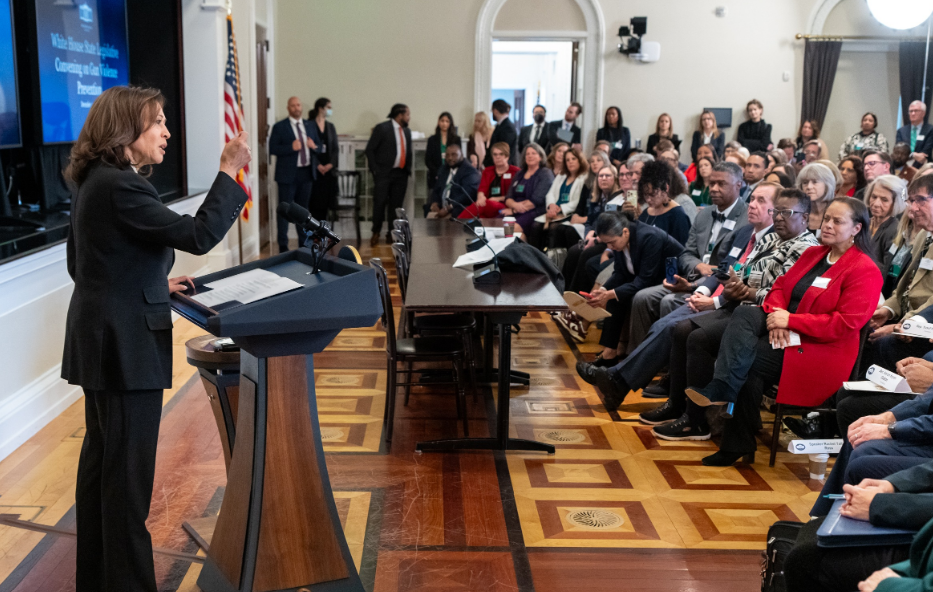
Three of Arizona’s Democratic state lawmakers convened for a strategy session on gun control with Vice President Kamala Harris on Wednesday.
State Reps. Jennifer Longdon (D-LD05), Analise Ortiz (D-LD24), and Stephanie Stahl Hamilton (D-LD21) were invited to participate in the Biden administration’s inaugural Office of Gun Violence Prevention (OGVP) and Safer States Agenda. The trio declared in a press release that gun violence constituted a public health crisis that required immediate intervention.
“Despite overwhelming public support to act, Republicans in the legislative majority have consistently refused to hear any efforts to reduce gun violence,” said the trio. “Reps. Ortiz, Longdon and Stahl Hamilton said now is the time to redouble efforts to overcome Republican intransigence, not step back from a public health crisis.”
The Safer States Agenda proposed a series of progressive, state-led initiatives: establishing an office of gun violence prevention in every state; investing in community violence intervention programs; funding community policing initiatives; implementing lethal means safety measures such as off-site storage sites and Extreme Risk Protection Orders (also called “red flag laws”); establishing victims services and trauma recovery centers for gun violence survivors; establishing a gun violence crisis response team; implementing stricter firearm storage laws; requiring reporting of lost and stolen firearms; confiscating firearms from domestic abusers; requiring universal and enhanced background checks; banning assault weapons, high-capacity magazines, and ghost guns; requiring gun dealer licensing, recordkeeping, information sharing, and physical security; and end gun manufacturer’s immunity from liability.
President Joe Biden established OGVP in September and appointed Harris to oversee it. Ortiz, Longdon, and Stahl Hamilton were three among 100 state lawmakers from across the nation invited to strategize with OGVP.
After Wednesday’s meeting, Harris said that the proposed gun control measures wouldn’t conflict with the Second Amendment.
“It is a false choice to suggest that we have to choose between either upholding the Second Amendment or passing commonsense gun safety legislation,” said Harris. “Congress must have the courage to act, but until they do, the states must lead the way.”
The Department of Justice also published two model pieces of legislation to require stricter firearms storage and mandatory reporting of lost or stolen firearms.
The director of OGVP, Stefanie Feldman, was Biden’s longtime policy director dating back to the president’s first term as vice president under former President Barack Obama. While Donald Trump was president, Feldman served as the policy director for the Biden Institute.
One of the deputy directors of OGVP, Gregory Jackson, formerly directed the Community Justice Action Fund: a nonprofit focused on gun control and criminal justice reform, and a project of the dark money network offshoot, Tides Advocacy. The other deputy director, Rob Wilcox, formerly led federal policy for Everytown For Gun Safety, the gun control organization founded by major Democratic donor Michael Bloomberg.
Corinne Murdock is a reporter for AZ Free News. Follow her latest on Twitter, or email tips to corinne@azfreenews.com.