By Ethan Faverino |
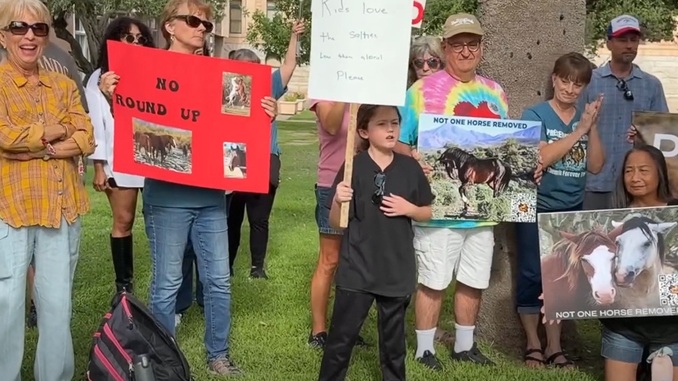
Approximately 100 wild horse advocates gathered at the Arizona State Capitol last week to urge Governor Katie Hobbs and the Arizona Department of Agriculture (AZDA) to pause planned removals of Salt River wild horses until an independent scientific review confirms the remaining herd will remain genetically healthy and self-sustaining.
The “Preserve the Herd — Follow the Science” rally brought together conservation advocates, elected officials, wildlife experts and supporters from across Arizona who argued that the state’s current management plan should be guided by independent scientific analysis before any permanent removals occur.
Under AZDA’s current management plan, the Salt River wild horse population would be reduced from approximately 271 horses today to between 120 and 125 by the end of 2030 through continued fertility control and permanent removals to sanctuaries.
Advocates said they support responsible management of the herd but contend that the proposed population target has not been supported by publicly available, independent scientific research.
“Today was not about opposing responsible management,” stated Susie Bell of Friends of the Salt River Wild Horses. “It was about demanding that irreversible decisions be supported by credible, independent science. Arizona should not remove a single healthy horse until the public is shown that the remaining herd will be genetically viable.”
Wildlife ecologist and author Craig C. Downer, who has studied the Salt River herd and its habitat, cautioned that reducing the herd to the proposed level could permanently affect its long-term health.
“It would be a big mistake for Arizona to reduce this herd to 120 horses without independent science showing that the population can remain genetically healthy and self-sustaining,” Downer said. “The total number of horses does not necessarily reflect the herd’s true reproductive strength. Managers must consider how many unrelated breeding animals would remain, whether family lines are adequately represented, the herd’s age and sex distribution, foal recruitment and the continuing effects of fertility control.”
“Once genetic diversity is lost, it can be extremely difficult — if not impossible — to restore,” Downer added. “Before any removals begin, Arizona should require an independent, transparent scientific review demonstrating that the proposed population target will preserve the herd for generations, rather than merely keeping a small number of horses on the landscape.”
Advocates also pointed to the work of Dr. E. Gus Cothran, professor emeritus at Texas A&M University and a nationally recognized equine population geneticist, who has stated that 150 to 200 horses is generally considered the minimum population necessary to help preserve long-term genetic health.
According to organizers, Cothran has also emphasized that herd viability depends on factors beyond total population size, including genetic diversity, breeding-age animals, age and sex distribution, and mortality and reproductive rates.
As a result, rally organizers are calling for herd-specific genetic testing, a population viability analysis, and an independent scientific review before permanent removals move forward.
Supporters noted that the Salt River herd has already declined by more than 40% over the past five years, dropping from approximately 450 horses to around 271, largely through fertility control and natural attrition.
Organizers argued that maintaining the current management strategy could reduce the herd to approximately 165 to 168 horses over the next five years without permanently removing healthy horses or disrupting established family bands.
“There is no emergency that justifies abandoning a management program that is already working,” said Susie Bell. “The herd is declining, fertility control is working and natural mortality is occurring. Why would Arizona choose removals before completing the science?”
Advocates also questioned how the state’s current population target was established.
According to public records cited by organizers, an initial proposal to reduce the heard to approximately 100 horses originated from what they described as an informal straw poll rather than an independent scientific population study.
Although the target was later increased to 120 to 125 horses, advocates said no independent scientific analysis supporting that figure has been publicly released.
“You should not manage a protected Arizona treasure through a straw poll conducted among cattlemen and other interests within AZDA,” Bell added. “A negotiated number is not a scientific number.”
Supporters additionally pointed to public polling indicating widespread backing for preserving the heard. Organizers cited a 2023 Public Policy Polling survey that found 78% of Arizonans opposed removing Salt River wild horses from their habitat, even when respondents were presented with environmental concerns.
Other horse advocacy organizations have reported public support protecting the herd as high as 88%.
The rally also highlighted the Salt River Horse Act (HB 2340), legislation approved overwhelmingly by the Arizona Legislature and signed into law in 2016 to provide legal protections for the herd. Governor Katie Hobbs voted in favor of the measure while serving in the Arizona Senate.
The law prohibits individuals from interfering with, capturing, or euthanizing Salt River horses without written authorization and specifies that such authorization may be granted only for humane purposes. It also clarifies that the horses are not considered stray livestock subject to standard livestock removal laws.
State Rep. Cody Reim (R-LD3), who attended the rally, said the law’s original purpose was to protect the horses — not to justify reducing the herd.
“The Salt River Horse Act was never intended to justify removing these horses,” said Reim. “It was enacted to protect the herd and prevent exactly this from happening.”
Reim also announced plans to introduce legislation that would require science-based protections for the Salt River herd.
Organizers said they have repeatedly requested meetings with Governor Hobbs and asked her administration to temporarily pause removals while independent experts evaluate the state’s proposed population target. According to advocates, those requests have gone unanswered.
During the rally, supporters displayed more than 50 written requests submitted to the governor’s office seeking meetings or assistance, alongside the response they received which organizers said demonstrated the administration’s unwillingness to engage on the issue.
Friends of the Salt River Wild Horses is asking Governor Hobbs to:
- Pause permanent removals of Salt River wild horses.
- Order an independent genetic study and population viability analysis.
- Require AZDA to publicly release the scientific data supporting the 120 to 125 horse population target.
- Continue evaluating fertility control as an alternative to permanent removals.
- Allow independent wildlife and genetics experts to review the findings before irreversible management decisions are made.
Advocates said a temporary pause would not end responsible management of the herd but would instead ensure that permanent decisions are based on transparent science and long-term genetic viability.
Ethan Faverino is a reporter for AZ Free News. You can send him news tips using this link.