Homeschooled sixth grader Aliyah Alpert fell short of winning the 2022 Scripps National Spelling Bee on Thursday, nearly becoming the first Arizonan to do so in 69 years.
The winner, 14-year-old Harini Logan of Texas, received cash prizes totaling $52,500, a commemorative medal, the championship trophy, a Merriam-Webster reference library, and $400 worth of Encyclopedia Britannica reference works.
The last Arizonan to win the Scripps National Spelling Bee was Elizabeth Hess in 1953 with the word “soubrette,” a noun signifying a coquettish or frivolous woman in comedic acting roles.
In order to make it to the finals, Alpert spelled or defined the following words correctly, in order by round: spelled “nuciform,” an adjective signifying something is like a nut in its shape; defined “malinger,” an intransitive verb indicating someone who pretends or exaggerates an incapacity or illness to avoid work; spelled “dyspathy,” a noun indicating a lack of sympathy; spelled “croupous,” a shipping fever disease affecting cattle; spelled “ostmark,” a monetary unit of the former German Democratic Republic; defined “verklempt,” an informal adjective indicating someone overcome with emotion; and spelled “trevally,” a noun signifying a variety of carangid fish species.
Alpert misspelled the word “ajivika.”
Alpert won $2,000 and a commemorative medal for her spot in the finals.
#Speller87 Aliyah Alpert from Arizona has spelled the word ajivika incorrectly. An ajivika is a member of a nontheistic religious sect founded by a contemporary of the Buddha. https://t.co/1HnC4GBueL#spellingbee
— Scripps National Spelling Bee (@ScrippsBee) June 3, 2022
Alpert faced 12 other finalists: Logan, 14-year-old Shijay Sivakumar of Texas, 14-year-old Abhilash Patel of New York, 13-year-old Sahana Srikanth of Ohio, 13-year-old Sahasrad Sathish of Illinois, 13-year-old Ekansh Rastogi of Florida, 13-year-old Nitya Kathiravan of New Jersey, 13-year-old Vihaan Sibal of Texas, 13-year-old Saharsh Vuppula of Washington, 13-year-old Surya Kapu of Utah, 12-year-old Vikram Raju of Colorado, and 11-year-old Kirsten Santos of Texas.
How many words in the Bee's official dictionary? We use only @MerriamWebster Unabridged, and the number is about 470,000! When you're watching the @ScrippsBee tonight, remember the duel is NOT between the spellers and Dr. Bailly, but between the spellers and the dictionary. pic.twitter.com/ctPbX9gC4D
— Scripps National Spelling Bee (@ScrippsBee) June 2, 2022
Corinne Murdock is a reporter for AZ Free News. Follow her latest on Twitter, or email tips to corinne@azfreenews.com.
A recent poll revealed that 97 percent of Arizona voters were concerned about the price of gas, and 80 percent were concerned with supply shortages.
Phoenix-based OH Predictive Insights released those findings on Wednesday, part of an Arizona Public Opinion Pulse (AZPOP) conducted last month over the course of a week.
9 in 10 Arizonans expect gas prices to be higher next month…again
Those who expressed concern over the gas prices weren’t hopeful about the future costs. 91 percent expected gas prices to increase by next month. That’s more pessimism than expressed in previous polls. In a March AZPOP study, 80 percent of Arizonans anticipated an increase in gas prices.
Although Arizonans share similar perspectives on the state of gas prices, they don’t agree on who’s to blame. 36 percent of Arizonans identified President Joe Biden as the reason for rising gas prices, whereas 26 percent blamed oil companies and the remaining 23 percent blamed the ongoing war between Russia and Ukraine.
“The long-term anticipated impacts from the pandemic are surfacing as it globally disrupts the supply chain, heightening concern for Arizonans as supply shortage continues to burden virtually everyone, “said @MikePNoble
Gas prices present a bipartisan issue, with both Republican and Democratic leadership expressing criticism over Biden’s handling of the rising costs.
Senator Mark Kelly (D-AZ) told KOLD that the Biden administration and Congress have options to curb the crisis, insinuating that they weren’t taking all necessary and available action.
“There are levers we can pull here to lower the cost,” stated Kelly. “I’ve asked the administration to increase production [….] They’ve done some but it’s not happening fast enough.”
Gas has become far too expensive for Arizona families.
Washington needs to move quickly to increase domestic energy production and pass my bill eliminating the federal gas tax for the rest of the year. https://t.co/9HvVfPIuFA
Concerning the supply chain crisis, 52 percent of Arizona voters reported that it impacted them directly. 43 percent said they weren’t affected directly. 86 percent of those concerned made over $100,000 a year; 90 percent were homemakers, and 80 percent were suburban women.
Over half of Arizona registered voters (52%) said they have been directly affected by the supply shortage while 43% say they have not been directly affected.
However, 80% are extremely/ very/ somewhat concerned about supply shortages.
According to the Department of Labor’s Consumer Price Index, Phoenix area prices increased 2.5 percent from February to April — a total increase of 11 percent from one year ago. Food prices increased by nearly two percent those two months, and 8.6 percent over the last year. Energy prices increased nearly 13 percent those two months, and 32.6 percent over the last year.
A Pew Research study released while the latest AZPOP study was underway revealed that the rest of the nation concurred with Arizonans that inflation is the most pressing issue.
Corinne Murdock is a reporter for AZ Free News. Follow her latest on Twitter, or email tips to corinne@azfreenews.com.
During a State Senate briefing on Tuesday, True the Vote — the election integrity nonprofit behind the research for election fraud documentary “2000 Mules” — recommended Arizona clean up its voter rolls. Just several days before, Governor Doug Ducey vetoed a bill purging non-citizens and non-Arizonans from voter rolls.
The election integrity researchers also proposed an end to the mass mailing of ballots and drop boxes, as well as an increase in penalties for voter fraud. If ending the use of all drop boxes wasn’t feasible, the researchers proposed real-time video surveillance.
The bill vetoed by Ducey, HB2617, received support from House and Senate Republicans. It would’ve required the Arizona Department of Transportation (ADOT) to submit information to the secretary of state every month regarding driver’s license or non-operating licenses issued in other states. Within 10 days, the secretary of state would then submit that information to the relevant county recorders to purge their voter rolls.
HB2617 would’ve also required the county recorder to compare their voter registration database to the Social Security Administration database on a monthly basis. Additionally, the secretary of state would’ve been required to report to the state legislature on a quarterly basis the death counts and voter registration cancellation notices issued to county recorders. Jury commissioners and managers would’ve been required to inform the secretary of state and their county recorder about individuals who indicated they weren’t U.S. citizens or living within the county.
The House and Senate may override Ducey’s veto with a two-thirds vote.
Ducey’s spokesman, C.J. Karamargin, said that the bill sponsor, State Representative Joseph Chaplik (R-Scottsdale), “knows” why Ducey vetoed the bill. Karamargin didn’t elaborate further.
In an explanatory letter, Ducey shared a concern that the legislation lacked due process for voters whose eligibility may be challenged, and that bad actors would capitalize on that aspect of the bill.
He criticized the bill’s implementation method as “vague” and lacking guidance for county recorders to execute properly. Ducey further criticized the residency determination provisions within the bill as subjective and lacking protections against false claims of non-residency.
Ducey didn’t object to the bill in its entirety. He commended the provisions directing ADOT, the secretary of state, and county recorders to communicate on proof of out-of-state licenses, new addresses, and non-citizenship.
Arizona Free Enterprise Club Vice President Aimee Yentes disagreed with Ducey’s concerns that the bill lacked due process for voters and that it would empower bad actors. However, Yentes expressed hope that they could work with Chaplik to bring a modified version of the bill more palatable to Ducey.
“This is a multi-pronged endeavor. You don’t fix all the numerous issues we have with election processes overnight or in just one session,” said Yentes.
Corinne Murdock is a reporter for AZ Free News. Follow her latest on Twitter, or email tips to corinne@azfreenews.com.
Reporters who embark on their own investigations rather than relying on Biden administration-approved information may find themselves under the FBI and DOJ microscope. The practice was common in the Obama administration, and it appears that it may be standard for the Biden administration as well.
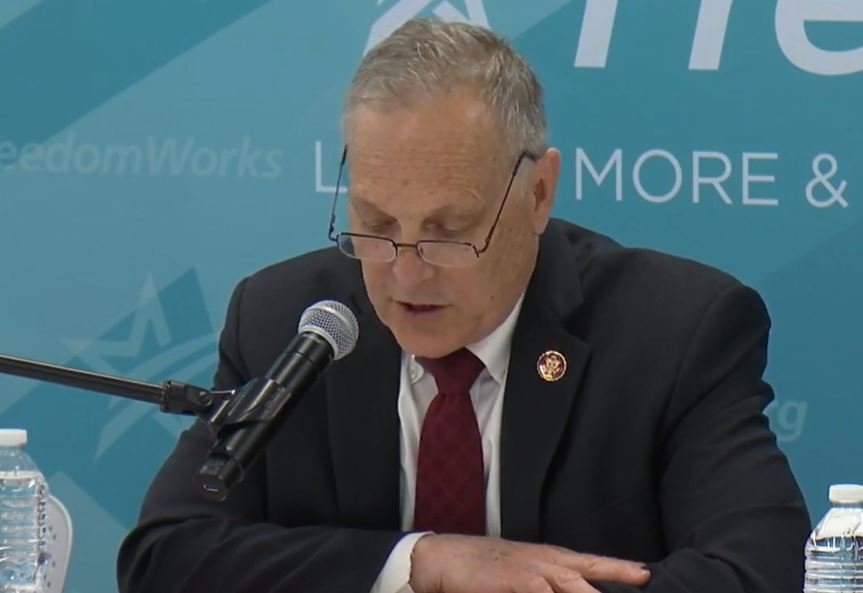
Two such investigative reporters testified earlier this month in an off-site congressional hearing chaired by Congressman Andy Biggs (R-AZ-05). Biggs and other members of the House Freedom Caucus pledged to draft legislation to ensure reporters in the future wouldn’t endure what those who testified faced under the Obama and Biden administrations.
Biggs accused Biden of “following in the footsteps” of his predecessor, former President Barack Obama, in reference to what James O’Keefe, the founder and president of the investigative reporting organization, Project Veritas, endured in comparison to what acclaimed investigative reporter Sharyl Attkisson endured under the Obama administration.
BREAKING VIDEO: Unconstitutional Pre-Dawn FBI Raid on Project Veritas Journalist Shows Armed Agents Clutching Weapons, Tossing Belongings, and Ransacking Home at Direction of Biden DOJ
The Obama DOJ surveilled Attkisson illegally for her investigation into the “Fast and Furious” Bureau of Alcohol, Tobacco, Firearms, and Explosives (ATF) scandal. “Fast and Furious” was a secret government operation of “gunwalking,” or selling firearms illegally to straw buyers in the hopes that they could be tracked to Mexican cartel leaders. The operation was deemed a failure as federal law enforcement lost track of the weapons sold. In 2010, two of their guns resurfaced at the murder scene of U.S. Border Patrol agent Brian Terry, exposing the ATF’s secret operation.
Attkisson testified that the DOJ and FBI engaged in multiple operations against her, surveilling her and her family’s computer activity while she worked at CBS News. However, the Obama administration went beyond mere surveillance. Attkisson revealed that one of the agents attempted to implant child pornography in her husband’s computer.
“Imagine how you ever get out of that. They knew we had a young daughter at home and had ‘allegedly’ conspired to do that,” said Attkisson.
She noted that agents didn’t have court orders to surveil her or infiltrate her former employers’ communications.
“Too often the whistleblowers get punished while the criminals and abusers get a pass,” observed Attkisson.
To date, the DOJ never faced penalties for surveilling Attkisson.
The hearing also featured testimony from O’Keefe. The Biden DOJ surveilled and invaded Project Veritas for their reporting on Ashley Biden’s diary. The DOJ’s actions prompted several statements from the ACLU criticizing the precedent set by the Biden administration.
O’Keefe reported that the FBI took 47 devices from his organization over their investigation into the diary. He showed a short clip of the raid. O’Keefe said that in less than a month, Ashley Biden’s lawyer, Roberta Kaplan, had her request, which he called a “political favor,” approved for a district court to issue secret subpoenas, orders, and warrants against Project Veritas with gag orders. O’Keefe explained that the court declared that he wasn’t a journalist because he didn’t receive permission from the subjects of his investigative journalism.
“We did nothing wrong other than the non-crime of investigating a story, as journalists do,” said O’Keefe. “Obviously we can’t trust the Department of Justice to define who is and who is not a journalist depending on who is in charge.”
O’Keefe requested that the Freedom Caucus convene a Bartnicki hearing, referring to the 2001 Supreme Court ruling that the First Amendment protection extends to illegally interception communications.
Watch the entire hearing here:
Corinne Murdock is a reporter for AZ Free News. Follow her latest on Twitter, or email tips to corinne@azfreenews.com.
The day after the national observance of those who took up arms and gave the ultimate sacrifice to protect this country, State Senate Democrats hijacked traditional floor proceedings to push a gun control bill to a vote. The bill, SB1546, originally didn’t advance beyond its introduction in January. On Tuesday, it failed narrowly along party lines.
The legislation contrived by Minority Whip Martín Quezada (D-Glendale) would’ve required all firearms sales and transfers to be conducted by licensed firearms dealers. If neither the seller or buyer were licensed firearms dealers, then they would have to find a licensed firearms dealer in order to complete the transaction. The licensed firearms dealer would have to run a background check on the buyer; if the buyer failed, then the dealer would have to run a background check on the seller. If the seller failed, then the dealer would have to surrender the firearm to law enforcement within 24 hours.
Of all the exemptions carved out, the legislation included a provision allowing a temporary transfer of a firearm to prevent imminent death or great bodily harm — but only to the person receiving the firearm, and only if they’re not prohibited from possessing a firearm under state or federal law.
Anyone who would violate SB1546 would be guilty of a class 5 felony, which carries a range of anywhere from six months in a mitigated sentence to two years and six months in an aggravated sentence.
Democrats excoriated Republicans for not siding with legislation they believed would curb future mass shootings comparable to the tragedy that occurred in Uvalde, Texas last Tuesday.
“We had a chance to enact common sense gun safety reform today and Republicans killed it — again. #EndGunViolenceNow,” wrote the Senate Democrats.
Every Senate Republican rejected the facts today.
Nowhere else in the world do we see mass shootings the way we do in America. The only difference is the unfettered access to guns. #SB1546 could have required background checks in Arizona and closed the gun show loophole. pic.twitter.com/X2tFBbt9eN
— Arizona Senate Democrats (@AZSenateDems) May 31, 2022
During an interview with “Conservative Circus,” State Senator Warren Petersen (R-Gilbert) rebutted Democrats’ claims. He insisted that gun restrictions only take guns out of good actors’ hands, arguing that the better solution would be to arm security and willing teachers.
“The government did not stop the shooter. There were police officers that did nothing. Gun laws did not stop the shooter. He was in a gun-free zone. He walked right through that law. Criminals do not follow gun laws,” said Petersen. “It took a good guy with a gun to stop a bad guy with a gun.”
Petersen repeated the viral false claim that an off-duty Border Patrol agent, Jacob Albarado, was the individual responsible for shooting and killing the Uvalde school shooter, Salvador Ramos. Law enforcement credited a tactical team for taking out Ramos. Albarado helped evacuate children from outside the school.
Border patrol agent Jacob Albarado, who was off duty at the time, rushed into Robb Elementary School to save his second grade daughter, his wife who is a teacher, and many others from the school shooting. @SavannahGuthrie speaks with the first responder live. pic.twitter.com/YcoV0dzenk
Over Memorial Day weekend, Governor Doug Ducey traveled to Israel, in part, to visit a desalination plant holding a proposed solution to Arizona’s ongoing drought.
Desalination removes minerals from water, making water sources like seawater into a potable resource.
Toured an extensive desalination plant in Israel. Innovations like these are part of the solution to secure our water future. In January’s state of the state, we said desalination made Israel the world’s superpower – and it’s clear to see here. pic.twitter.com/RmXRD5CdDU
The Israel trip marked a continuation of Ducey’s proposed plan mentioned in his State of the State Address last summer. At that time, Ducey introduced the idea of a $1 billion investment into Mexico for desalination. The governor has his eye on the Sea of Cortez, or the Gulf of California, bordered by the west coast of Mexico and the Baja California peninsula.
Israel’s desalination plants not only reversed their drought — they created a water surplus. Their Sorek desalination plant alone provides enough drinking water for 1.2 million people a day.
Although, it would likely be years before Arizona reaps the benefits of desalinated water. Arizona Department of Water Resources Director Tom Buschatzke predicted to KTAR that it would be another decade before the state relied on desalinated water.
Arizona has been in a long-term drought for nearly 30 years. The National Ocean and Atmospheric Administration (NOAA) estimates that about 90 percent of Arizonans are impacted by drought, or 6.4 million people. The NOAA added that 2022 marked the state’s sixth driest year in its history.
The ongoing drought was exacerbated recently by the reclassification of the Colorado River, Arizona’s largest renewable water supply, to Tier One drought status. The federal government’s reclassification reduced Arizona’s water allotment.
Cities have adapted to heed the drought. In January, the city of Scottsdale asked residents to reduce their water usage by five percent. Resident compliance may not remain voluntary: city officials communicated that their next step would make water restrictions mandatory.
During his visit, Ducey also visited with Israel Prime Minister Naftali Bennett and toured their border wall as part of the other two focuses of his trip: trade and border security.
Good to sit down with the Prime Minister of Israel Naftali Bennett to discuss how to continue to bring Arizona and Israel’s relationship to new heights. Arizona stands with Israel. @naftalibennett@IsraeliPMpic.twitter.com/0o8J0ieoC6