Democratic gubernatorial candidate Katie Hobbs, a product of private schools, revealed on Monday that she plans to reverse Arizona’s universal school choice if elected.
Hobbs appropriated pro-school choice phrasing to describe her 13-page anti-school choice plan. She omitted her private school attendance from the plan.
“Zip code shouldn’t determine the quality of public education our Arizona students receive,” wrote Hobbs. “As governor, I will always fight for students, teachers, and parents to have the resources they need to succeed.”
Zip code shouldn't determine the quality of public education our Arizona students receive. As governor, I will always fight for students, teachers, and parents to have the resources they need to succeed. Read more about my plan to do it here: https://t.co/bGY2Bn2oe3pic.twitter.com/REuHF3308W
In 1988, Hobbs graduated from Seton Catholic Preparatory High School, a private high school in Chandler. As one of the most expensive private schools in the state, SCP tuition sits around $17,700 currently, with a discounted rate for proven Catholic families of $13,300.
Arizona Democratic gubernatorial candidate Katie Hobbs just released her education plan opposing school choice.
In her education plan, Hobbs called the funds from Arizona’s Empowerment Scholarship Account (ESA) Program “vouchers.” However, the ESA Program funds are not “vouchers” — they are education scholarship accounts. Vouchers may only be used at private schools, whereas education scholarship account funds may be used for a greater variety of educational needs, such as tutoring.
“Vouchers should not have been expanded to provide an unaccountable means of enriching private schools and defunding our local public schools,” reads the plan.
In a 2019 interview celebrating her alma mater’s 65th anniversary, Hobbs toldGilbert Sun News that attending a small private school gave her the positive experience of a more intimate, tailored learning experience, such as her teachers encouraging her to discover timeless truths in classic literature.
“It really felt like a family,” said Hobbs. “You really had a chance to get to know the people that you went to school with.”
AZ Free News asked Hobbs’ campaign whether Hobbs’ children have attended any private schools. They didn’t respond by press time.
Both of Hobbs’ children attended Arizona School for the Arts, a charter school.
Hobbs’ plan also seeks to eliminate the aggregate expenditure limit (AEL). The AEL limits K-12 public schools’ expenditures every year based on the calculation of the aggregate expenditure of all districts, adjusted for student counts and inflation. The state legislature increased the AEL this past session so that schools could spend their budgets in full.
Early this morning, I joined teachers at Kenilworth Elementary to bring attention to the AEL and the school funding crisis. I continue to demand that all Arizona lawmakers get rid of an outdated rule so we can fully fund our schools and our kids can keep learning. pic.twitter.com/7bE4gnqxNR
The rest of Hobbs’ education plan pledges to establish free preschool and kindergarten, especially for low-income and minority families; reduce child care costs and increase options; increase teacher pay by up to $14,000 to match the national average; reduce teacher health care costs; increase fundings for school renovations; restore the special education cost study; increase funding for special needs care; and nearly-free, if not totally free, college education for students that live in state — whether they’re American residents or illegal immigrants protected by the Deferred Action for Childhood Arrivals (DACA) rule.
I’m a proud first-generation college graduate and can tell you firsthand just how many incredible opportunities arose due to access to a higher education.
As governor, I'll work to ensure every Arizonan has access to an affordable, world-class education.
Further, Hobbs’ pledged to increase funding to the Arizona Teachers Academy to grow enrollment; increase school funds to hire more mental health professionals and social workers; establish permanent funding for Northern Arizona University’s Teacher Residency Program; increase funding to the Arizona Department of Education (ADE) to establish new STEM grants and scholarships, particularly for women and “people of color”; expand Advanced Placement (AP) and dual enrollment programs to all schools; establish a refundable tax credit for career and technical education pursuits; fund start-up medical program costs; and establish health care training programs.
Additionally, Hobbs promised to increase oversight of charter schools through increased funding to the Arizona State Board for Charter Schools and the Auditor General. She also pledged to require charter schools to participate in the Auditor General’s annual classroom spending report, prohibit charter schools from making a profit from the sales of land and buildings, and publicize charter corporate boards through their inclusion in open meeting and public records laws.
Absent from Hobbs’ plan was any mention of additional funding for homeschooling families. Hobbs didn’t respond to our questions about that by press time, either.
Corinne Murdock is a reporter for AZ Free News. Follow her latest on Twitter, or email tips to corinne@azfreenews.com.
Arizona Department of Education (ADE) Superintendent Kathy Hoffman is facing a lawsuit for advertising links to chat rooms where minors discuss sex and gender with adults present and without parents necessarily knowing.
The lawsuit, case number CV2022-093889 filed in the Maricopa County Superior Court, requests that ADE remove the chat space from its website. Judge Peter Thompson was assigned the case.
The chat room website advertised by the ADE, Q Chat Space, targets LGBTQ+ youth 13 years and older. It offers a “quick escape” feature that masks a child’s visit to the site by redirecting from the Q Chat Space site to Google’s homepage. The adults facilitating discussions, “Q Chatters,” don’t have to be licensed professionals.
Some of the upcoming chat rooms are: “Sex and Relationships Q&A,” “FOR TRANS/NON-BINARY YOUTH: Activism and Allyship,” and “FOR TRANS/NONBINARY YOUTH: Sex Ed.”
The site has minors offer personal information when signing up, including their sexual orientation, romantic interests, gender identity, email address, birth date, ZIP code, and race.
According to the ADE, Hoffman developed the LGBTQ+ resource page with her Equitable and Inclusive Practices Advisory Council (EIPAC) before launching it last June as part of Pride Month.
The citizen behind the lawsuit, Peggy McClain, claimed that Hoffman violated the Parents’ Bill of Rights provision prohibiting any attempts to encourage or coerce minors to withhold information from their parents. McClain further asserted that the children’s data was vulnerable to hacking and could therefore be sold on the dark web to child predators, noting that some of the adult chat facilitators could be child predators as well.
“By doing the things set forth above, Katherine Hoffman is encouraging the grooming of young children,” stated McClain.
Q Chat Space is a collaborative effort of Planned Parenthood, the LGBTQ+ support network organization PFLAG, and LGBTQ+ community center organization CenterLink.
ADE also directs minors to another chat site similar to the one contested in the lawsuit: Gender Spectrum. That chat site is open to minors aged 10 and older.
Calling trans-feminine youth! Check out the live chat for trans-feminine youth on Q Chat Space on September 11. Always be your true self in a bully-free online community of LGBTQ+ teens. Check out the time in your time zone at https://t.co/johUgsFSNTpic.twitter.com/qmDoCOiC7m
On Monday, GOP gubernatorial candidate Kari Lake requested that Democratic opponent Katie Hobbs have an “open invitation” for a debate. Even if the Arizona Citizens Clean Elections Commission (AZCCEC) allows an open invitation and extends their deadline, it’s unlikely Hobbs would agree to a debate.
That’s because Hobbs again rejected a traditional debate offered by the AZCCEC on Sunday, after a previous rejection last month. The AZCCEC decided during a meeting last Thursday to grant the two gubernatorial candidates another week to come to an agreement on a debate format. Hobbs’ campaign manager Nicole DeMont responded to the AZCCEC that she couldn’t agree to any debate format featuring Lake, accusing her opponent of using the debate platform inappropriately.
“Unfortunately, debating a conspiracy theorist like Kari Lake — whose entire campaign platform is to cause enormous chaos and make Arizona the subject of national ridicule — would only lead to constant interruptions, pointless distractions, and childish name-calling,” wrote DeMont.
If the AZCCEC doesn’t grant an extension and Hobbs doesn’t change her mind, then Lake will have a televised 30-minute Q&A session with Arizona Horizon host Ted Simons on October 12 instead of a debate.
In her letter petitioning the AZCCEC for an open invitation for Hobbs, Lake claimed that Hobbs had a “paralyzing fear” of debating her.
“It’s disturbing that Hobbs, who currently serves as our Secretary of State and administrator of our elections, thinks so little of the voters and the democratic process that she would rob them of their one chance for a fair and informative debate,” wrote Lake’s campaign. “Kari Lake will not protest if Hobbs agrees to show up for the debate in the 11th hour — even if it’s the day of — and it is our hope that the Commission won’t either.”
Hobbs is the first candidate to refuse a Clean Elections debate since the AZCCEC’s inception in 2002.
Rather, Hobbs carried on with her campaign activities, which included a visit to Flagstaff to meet with Mission AZ, an organization that helps elect Democratic candidates, as well as Northern Arizona University’s (NAU) chapter of the Arizona Education Association (AEA) and Young Democrats.
Standing on the corner in Winslow, Arizona, such a fine sight to see… it’s the future Governor, my lord, slowing down to take a picture for me pic.twitter.com/Mo5NqV5M8j
The University of Arizona (UArizona) announced this week that it would establish a Center for East Asian Studies. East Asia includes China, Japan, Mongolia, North Korea, South Korea, and Taiwan. UArizona is the only higher education institution in the state with an East Asia NRC.
The U.S. Department of Education (DOE) awarded UArizona $5.9 million to launch the program under its Office of Postsecondary Education (OPE) Title IV National Resource Center (NRC) grants.
The purpose of Title VI NRCs is to instill understanding of the countries featured by the center and teach one or more of those countries’ languages. Additionally, these centers maintain relationships with foreign higher education institutions and other organizations that contribute to each center’s teaching and research.
Other East Asia NRCs are located at Columbia University, Stanford University, Ohio State University, University of California – Berkeley, University of Chicago, University of Hawaii, University of Kansas, University of Michigan, University of Pennsylvania, University of Pittsburgh, University of Washington, and University of Wisconsin – Madison.
For the 2022 fiscal year, OPE appropriated over $25.5 million in funds to NRCs.
The establishment of a center focused on East Asian studies comes about two years after the mass forced closures of Chinese government-backed Confucius Institutes: a trio consisting of the Chinese government, a Chinese higher education institute, and an American higher education institute.
Confucius Institutes pushed Chinese propaganda without academic freedom under the guise of teaching Chinese language and culture. In all, the Chinese government had a foothold in 118 higher education institutions.
Along with UArizona, Arizona State University (ASU) once had a Confucius Institute. Under changes to federal law under the Trump administration, both universities closed their institutes.
Lecture, “For Study and for the Dao: Explaining the Principles of Taiji Training,” 《为学与为道:解说太极拳的训练原理》 pic.twitter.com/RgOT9jbvAL
However, both universities have maintained their ties to China through other avenues. UArizona continues its relationship with China and their Confucius Institute partner Shaanxi Normal University through other departments, such as the Center for Buddhist Studies. Likewise, ASU continues its relationship with China’s Sichuan University.
While it had a Confucius Institute on campus, UArizona shared a comfortable relationship with the Chinese government. Three years into the institute’s founding, the university shared a news feature on their institute from CCTV: the Chinese government-controlled news station.
Corinne Murdock is a reporter for AZ Free News. Follow her latest on Twitter, or email tips to corinne@azfreenews.com.
Cards Against Humanity (CAH), the popular entertainment company, is forcing Arizonan customers’ hands on the abortion debate. If Arizonans buy from the company online, 100 percent of the proceeds go to the two abortion fund providers within the National Network of Abortion Funds (NNAF); if the Arizonan discloses that they’re pro-life, the company slaps them with a $5 surcharge.
The entertainment company informs Arizonan buyers online that Arizona is one of 22 “theocratic hellscapes” that have abortion restrictions or bans. The company claimed on their checkout page that Arizona abortion law would imprison “pregnant people.”
“100 percent of profits from orders to forced-birth Republican hellholes will be donated to the National Network of Abortion Funds,” reads a disclaimer at the top of the website.
Today we’re releasing some new packs. We're donating 100% of profits from all orders to forced-birth Republican hellholes to @abortionfunds. We’re also donating an extra $100k right now. https://t.co/KZK4hD7Yea
In addition to all proceeds, CAH donated $100,000 to NNAF. As AZ Free News reported, the two NNAF abortion fund providers in Arizona are the Abortion Fund of Arizona (AFAZ) and the Tucson Abortion Support Collective (TASC). The latter abortion fund provider is also receiving funds from the acclaimed playwright and actor Lin-Manuel Miranda of “Hamilton” fame.
In late July, the company partnered with Dynata to conduct a survey of 2,920 people’s abortion knowledge and awareness in the 22 “dystopian forced-birth hellscape” states with abortion restrictions and bans. 169 respondents (5 percent) were from Arizona.
“If you’re unfortunate enough to live in one of these forced-birth hellholes, 100 percent of profits from your order on the CAH store will be donated to the NNAF to help the people most f****d over by Republicans in your state government,” wrote the company. “And for the love of God, don’t forget to vote this fall. Okay, time for some casual sex.”
The company has been involved extensively in politics since its founding about a decade ago, but it appears that Donald Trump’s campaign and election triggered the company’s activism against Republicans.
In August 2016, CAH released limited edition “Vote for Hillary Pack” and “Vote for Trump Pack,” with each pack containing 15 jokes about the featured candidate. Proceeds for sales of both card editions went to Clinton’s campaign.
Today, we’re letting America choose between two new expansion packs about either Hillary Clinton or Donald Trump. https://t.co/AXUh3zE2tZ
Additionally, CAH launched a political action committee (PAC) called the Nuisance Committee, which put up billboards opposing Trump’s campaign. They relaunched the PAC briefly in 2017 to oppose the election of Republican congressional candidate Pete Roskam.
After Trump won, the company sold survivalist bags that came with gas masks, a can of beans, and a locket containing Trump’s predecessor, Barack Obama.
In February 2017, one of the company’s founders, Max Temkin, sent a Hitler-themed board game to all 100 U.S. senators. In the game, one team plays a liberal group working to defeat the other team playing a secretive fascist group attempting to put a “cold-blooded” leader in power. In a since-deleted tweet, Temkin shared a copy of the letter accompanying the board game gift.
“We thought you and your staff might find our game relevant as you negotiate the balance of power with the Trump White House,” read the letter. “To achieve his evil ends, Adolf Hitler required the cooperation of well-meaning men who hoped to appease and control the Nazis. Our game explores that relationship and highlights the difficulty of recognizing your own manipulation before it’s too late.”
In April 2017, the company mailed over 2,000 potatoes to Senator Ron Johnson (R-WI) for refusing to hold a town hall on health care. Johnson donated the potatoes to a local church’s network of food banks.
In December 2017, CAH bought a plot of vacant land on the southern border and retained a law firm specializing in eminent domain to thwart Trump’s attempt to complete the border wall. It was part of a greater campaign, Cards Against Humanity Saves America, where CAH collected $15 from 150,000 people.
We purchased a plot of vacant land on the US/Mexico border and retained a law firm specializing in eminent domain to make it as time-consuming and expensive as possible for Trump to build his stupid wall.
CAH was founded by eight high school friends: Max Temkin, Josh Dillon, Ben Hantoot, David Munk, Daniel Dranove, Eli Halpern, Eliot Weinstein, and David Pinsof.
Corinne Murdock is a reporter for AZ Free News. Follow her latest on Twitter, or email tips to corinne@azfreenews.com.
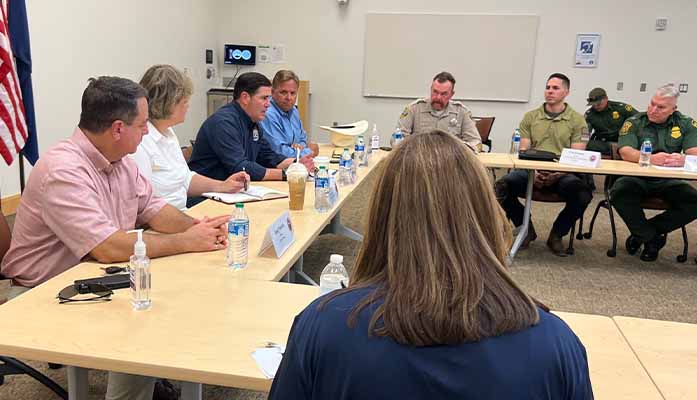
The shipping container “Border Barrier” approved by Gov. Doug Ducey earlier this summer along some previously unsecured sections of the border in Yuma County is fulfilling its promise, several officials reported Thursday.
The governor was in Yuma for an update on the effectiveness of the 130 double-stacked, state-owned containers he ordered put in place this summer to fill gaps in the U.S. border wall. His trip included an inspection of the project completed last month. The project was funded by border security legislation passed by state lawmakers earlier in the year.
The Arizona Department of Emergency and Military Affairs oversaw the project which closed off more than seven-tenths of a mile of border in Yuma County. That area of the border experienced 259,895 migrant encounters from October 2021 to July 2022 — a nearly 250 percent increase over the prior fiscal year.
Migrant traffic in those areas is now funneled to a few crossing points manned by U.S. Customs and Border Protection (CBP) and U.S. Border Patrol (USBP) personnel.
President Joe Biden promised in July “to review” border security concerns and enhance barriers along the southwest border, but no timeline was provided. This lack of action, Ducey previously explained, was the impetus for his executive order to utilize the containers as a temporary border barrier.
“Five wide open gaps in the border wall near Yuma neighborhoods and businesses are now closed off,” Ducey said Thursday. “In just 11 days, Arizona did the job the federal government has failed to do — and we showed them just how quickly and efficiently the border can be made more secure – if you want to.”
The governor also took part in a roundtable discussion in Yuma with several local, county, state, and federal officials as well as business leaders and community members. Among those providing Ducey an “update on the ground” were USBP Yuma Sector Chief Chris Clem and CBP’s San Luis Port of Entry Director John Schwamm.
Ducey noted that multiple migrants illegally crossed the border “right in front of us” the last time he stood along the border in Yuma.
“Securing the nation’s southern border is a federal responsibility,” the governor noted. “A responsibility President Biden refuses to address. So Arizona filled the gap.”
Jonathan Lines of the Yuma County Board of Supervisors visited the Yuma “Border Barrier” with the governor on Thursday. He says the containers are working, as there have been less people attempting to cross in those areas.
“The containers have helped regain operational control of our nation’s southern border,” said Lines. “Governor Ducey’s strategy has allowed law enforcement to concentrate resources and protect our communities.”
Tim Roemer, Arizona Department of Homeland Security Director and the state’s Chief Information Security Officer, emphasized that crossing into the U.S. between official CBP ports of entry is illegal.
“The cartels have been taking advantage of the gaps in the border wall to surge migrants and overwhelm law enforcement,” Roemer noted.
Also Thursday, Ducey reacted to data released by the U.S. Department of Homeland Security that 748 deaths have been reported of migrants crossing the U.S. / Mexico border since Oct. 1, 2021. That number of deaths already far exceeds the 557 deaths reported from Oct. 1, 2020 to Sept. 30, 2021.
“This is a humanitarian crisis,” Ducey said. “Migrants making the dangerous journey across the border are faced with immense heat, crime and unfortunately, sometimes death. Enough is enough. That’s why Arizona is closing the border wall gaps.”
U.S. officials have not directly acknowledged the huge increase of deaths over the current fiscal year, which many border observers attribute to a lack of immigration law enforcement by the Biden administration. However, a CBP spokesperson appeared to put all blame for the rise in deaths on the cartels.
“Transnational criminal organizations continue to recklessly endanger the lives of individuals they smuggle for their own financial gain with no regard for human life,” according to the CBP statement. “The terrain along the border is extreme, the summer heat is severe, and the miles of desert migrants must hike after crossing the border in many areas are unforgiving.”