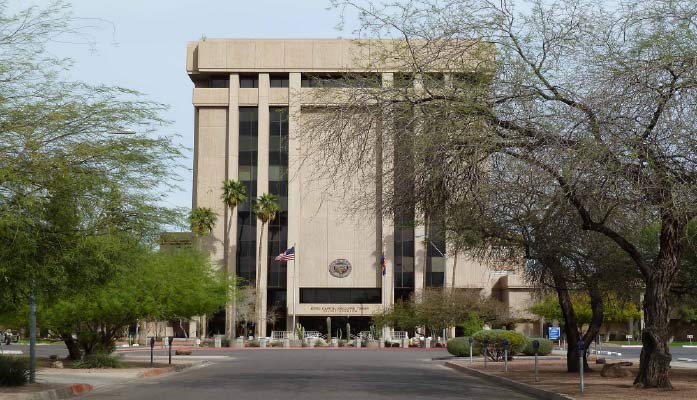
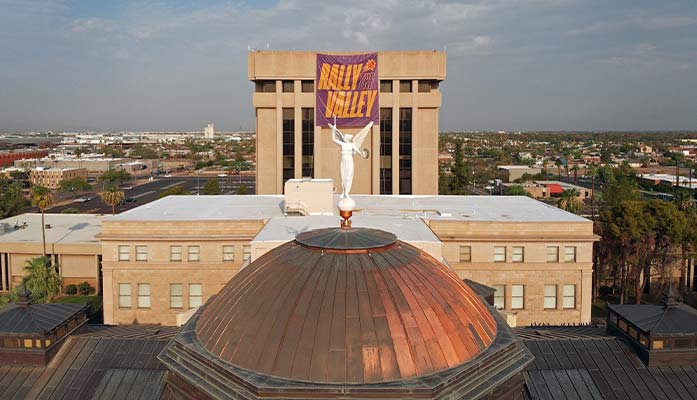
The Arizona State Board of Education (SBE) will have a bunch of new faces at its next meeting following Monday’s announcement by Gov. Doug Ducey of seven new members.
Created within the Arizona Constitution, the mission of the 11 member board is to develop successful citizens through robust public education. The SBE oversees the public school system by establishing policies, setting courses of study, and gathering data on pupil performance.
The new members chosen by the governor are:
Jason Catanese, analgebra and geometry teacher at Pueblo Del Sol Elementary School in the Isaac School District who is a former national teacher of the year for Teach For America. He is also chairman, co-founder, and executive director of the Camp Catanese Foundation.
Jenny Clark, the founder and CEO of the non-profitLove Your School which helps families navigate school options, whether in a district, charter, private, online, homeschool, microschool, or learning pod setting.
Jacqui Clay, the electedCochise County superintendent of schools who has worked as a teacher, assistant principal, and director of career technical education.. She also spent 25 years serving in the U. S. Army.
Dr. Scott Hagerman, superintendent of the Tanque Verde School District and Continental Elementary School District. His experience includes past positions with Tucson Unified School District, along with work as a principal and classroom teacher.
Katherine Haley, whose nearly 20 years of experience in public policy and philanthropy has involved expanding educational opportunities by building coalitions to advance federal policies which improve school choice and strengthen students’ workforce readiness.
Julia Meyerson, the founder and executive director of Vista College Prep charter schools in Maricopa County. A Phoenix native, Meyerson joined Teach For America after college and served as an educator in Brooklyn, New York.
Karla Phillips-Krivickas, the founder and CEO ofThink Inclusion who has more than 20 years of experience in state and federal policy. She uses her experience to advise education leaders on sound policy and best practices to advance academic achievement for students, including those with disabilities.
The outgoing members are Janice Mak and Calvin Baker, whose terms had expired back in January 2020; Lucas Narducci, Michelle Kaye, and Patricia Welborn, whose terms ran only to January 2021; and Jill Broussard and Armando Ruiz, whose terms expired in January 2022.
“Arizona is grateful to the outgoing members for their service and commitment to students’ success, and for their steady hand in guiding our educational institutions during the pandemic,” Ducey said with the announcement. “Our new board members have big shoes to fill, but I am confident that with their new energy, fresh ideas and diverse backgrounds, we will be able to continue strengthening education for our students.”
The new SBE members will join Christine Burton (January 2023) and Dr. Robert Robbins (January 2024) and as well as Kathy Hoffman who is a member due to her position as the state’s elected Superintendent of Public Instruction. Also carrying over for now is Dr. Daniel Coor as the community college representative, whose term expired in January 2021.
Ducey’s announcement included two community members for the Arizona Board of Regents, which is the governing body for the state’s three public universities: Arizona State University, Northern Arizona University and the University of Arizona.
One of the new Regents is Gregg Brewster, a senior sales executive of Brewster HealthCare Consulting who has expertise in health care, supply chain management and transportation. According to the governor’s office, Brewster is a member of the AORN Foundation Board of Directors, as well as an active participant on the Arizona State University Alumni Board.
The other new Regent is Doug Goodyear, CEO and a founding partner of DCI Group, a public affairs firm with offices in Arizona and Washington, D.C. The company has grown into of the country’s largest independently-owned public affairs firms. Goodyear has been active in the Phoenix chapter of the Young Presidents’ Organization.
The outgoing Regents are William Ridenour and Ronald Shoopman.
An Arizona State University (ASU) American government class taught that requiring an ID to vote was a voter suppression tactic. The professor drew this conclusion in a lecture slide titled, “Gates to African American Suffrage.” The professor also claimed that current methods of voter suppression included getting rid of the state’s Permanent Early Voting List (PEVL), restricting PEVL access, getting rid of mail-in voting, and closed primaries.
The Twitter account @libsoftiktok first reported on the lecture.
This is a slide in an American Government class at Arizona State University @ASU. They are promoting the false narrative that requiring an ID to vote is voter suppression. pic.twitter.com/iFTblisSom
According to the ASU course catalog, there are two different ASU “government” classes: POS 110, American Government & Politics, and POS 310, American National Government. Five different professors teach the first class: Gina Woodall, David Wells, George Watson, Scott Spehr, and Keith Hollinger. The latter class has three different professors: Watson, Mark Simpson, and Jesse Chanley.
House and Senate Republicans this session have focused on strengthening voter ID as part of their election integrity bills.
One bill that passed the Arizona legislature and was received by the secretary of state earlier this month for final approval by the governor, HCR2025/SCR1012, the “Arizonans for Voter ID Act,” will require voters to sign an affidavit with their ballot, including their birth date and any of the following early voter ID proofs: driver’s license number, nonoperating Id number, last four digits of Social Security number, or unique identifying number.
Corinne Murdock is a reporter for AZ Free News. Follow her latest on Twitter, or email tips to corinne@azfreenews.com.
Congressman Andy Biggs (R-AZ-05) and the rest of the House Committee on Oversight and Reform are probing the Federal Aviation Administration (FAA) decision last fall to ban media outlets’ drones from flying over the southern border.
On Monday, the committee announced that its ranking member, Congressman James Comer (R-KY-01), sent a response letter to FAA Administrator Steve Dickson. According to their press release, “heavily redacted documents” provided by the FAA in response to an initial committee letter revealed that an FAA headquarters manager believed that banning drones would be illegal initially. However, an “unknown U.S. Customs and Border Protection official” called the manager and convinced that person to change their mind.
“The FAA’s decision to abruptly reverse course on the legality of banning media drones raises questions about potential political interference at the agency to hide President Biden’s border crisis from the public,” read the letter. “That telephonic or other assistance apparently changed FAA’s opinion on the legality of issuing a TFR. Ultimately, the TFR was issued later that evening, raising concerns about its legality and FAA’s rationale for changing its position. These emails call into question FAA’s conduct, particularly where a TFR may have been issued improperly and for the purpose of disrupting media attention related to the border crisis. The American people have a right to transparency when it comes to President Biden’s failed border and interior enforcement policies.”
The FAA banned media drones from covering the border crisis in September.
The American people have a right to transparency when it comes to President Biden’s failed border and interior enforcement policies.
The FAA first announced its ban in mid-September of last year. At the time, media outlets were informed that the ban was a Temporary Flight Restriction (TFR) of two weeks. It’s now been a little over six months.
NEW: We’ve learned that the FAA just implemented a two week TFR (Temporary Flight Restrictions) over the international bridge in Del Rio, TX, meaning we can no longer fly our FOX drone over it to show images of the thousands of migrants. FAA says “special security reason”. pic.twitter.com/aJrjAPO2Pz
However, the FAA reversed course again after some resistance from the media. Fox News received clearance to fly its drones the next day. In a later tweet, the FAA encouraged other outlets to apply for clearance. An FAA spokesperson later told Fox News that Border Patrol requested a temporary flight restriction because drones were interfering with those flights made by law enforcement.
. @FoxNews applied this morning and has received clearance to operate from now until the end of September in the restricted airspace linked below.
The ban occurred after media outlets filmed the tens of thousands of illegal immigrants crossing the Del Rio, Texas area of the border, especially focusing on those huddled under a bridge.
The committee requested more documents from the FAA pertaining to all documents and communications referring or relating to the day of the TFR, unredacted copies of the emails given to the committee, documents and communications from Biden’s inauguration to present regarding the legality of issuing the TFR, and an explanation of the legal basis relied on by the FAA to issue the TFR.
BORDER: Illegal immigrants wait to be transported by Border Patrol after crossing the Rio Grande from Mexico into Del Rio.
Most are under the international bridge and out of public view.
It started in January when several supporters withdrew support of Hobbs’ run to be the Democratic nominee for governor following her comments about a jury’s verdict in a racial and gender discrimination lawsuit by a former staffer.
Then in her role as Arizona Secretary of State, Hobbs was shot down by a superior court judge when she tried to sidestep possible consequences for her planned shut down of the E-Qual system at a time when legislative and congressional candidates were relying on the system to get on the ballot.
Next, Hobbs was called out by Arizona Attorney General Mark Brnovich for her failure to draft an Elections Procedures Manual (EPM) which complies with state law. Without an approved EPM, elections officials across the state are unsure what protocols to follow for the 2022 election cycle.
Earlier this month, Hobbs the candidate has come under scrutiny for the recent announcement that women of color have been appointed as her campaign manager, political director, and Finance Director. Only two of the three live in Arizona, leading to questions of why Hobbs turned to out-of-staters for key campaign roles.
The latest embarrassment came last week when the Secretary, a Democrat, was thrashed by the attorney for several Democratic Party organizations after she argued that the Arizona Supreme Court should listen to her—and her alone—in defense against an effort by the Arizona Republican Party to have voting by mail declared unconstitutional.
According to Hobbs, the justices should reject a motion to intervene filed by the Arizona Democratic Party, the Democratic National Committee, the Democratic Senatorial Campaign Committee, and the Democratic Congressional Campaign Committee. It is those same voters and party leaders that Hobbs will need to get out of the gubernatorial primary in August.
The Democratic groups argue they should have standing to “protect their voters, their candidates, and their interests” as respondents in the case. The AZGOP did not object to the motion, but Hobbs has cried foul against her fellow Democrats, alleging that she is capable of adequately representing those interests.
However, Hobbs has argued that the Arizona Supreme Court has no power to even hear the constitutional challenge. The Democratic intervenors, on the other hand, agree with the AZGOP that the Court “can and should exercise its power” to adjudicate the case.
A Senate resolution to appoint Arizona’s first lieutenant governor passed the House Government and Elections Committee with bipartisan support on Wednesday, 10-3. The three to vote against the resolution were Minority Leader Reginald Bolding (D-Laveen) and State Representatives Judy Burges (R-Skull Valley) and Alma Hernandez (D-Tucson).
The resolution, SCR1024, proposed that each gubernatorial nominee would name a lieutenant governor to run on the ticket with them at least 60 days before the general election, serving as a joint candidate. If the lieutenant governor couldn’t serve in the position any longer, then the governor would appoint another individual with majority approval of the state legislature. If brought before and approved by voters this November, the constitutional amendment would go in effect in 2027.
Bolding wanted to raise the total votes needed to approve a replacement lieutenant governor to 60 percent versus a simple majority. The resolution sponsor, State Representative J.D. Mesnard (R-Chandler) responded that the state constitution determines the number of state legislature votes needed to approve an appointment. In final remarks on voting against the resolution, Bolding added that he couldn’t support the resolution because he didn’t believe voters would know what they were voting on if the resolution came before them on the ballot.
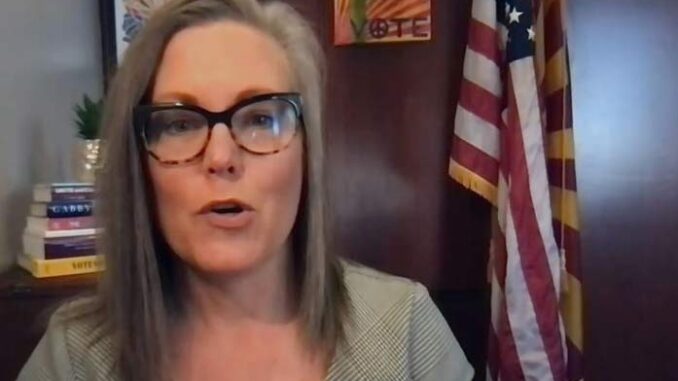
Arizona is one of five states without a lieutenant governor: Oregon, Wyoming, New Hampshire, and Maine. If Governor Doug Ducey were unable to fulfill his duties, then Secretary of State Katie Hobbs would be next in line to take over. Hobbs is running for governor this year, contending against fellow Democrats Marco Lopez and Aaron Lieberman, and may face off against Republicans Steve Gaynor, Kari Lake, Karrin Taylor Robson, Matt Salmon, or Scott Neely. The primary election will take place on August 2.
After the secretary of state, the succession for governor would fall on the attorney general, then state treasurer, and finally the superintendent of public instruction.
SCR1024 went hand-in-hand with SB1255, which passed out of the same committee with even more support, 12-1. That time, only Burges voted against the bill. SB1255 would award the lieutenant governor directorship over the Arizona Department of Administration (ADOA), allowing the individual to fill any positions not under the governor’s purview to appoint.
A special thank you to my colleagues on the House Government committee for passing #SB1255 this morning. @JDMesnard and I introduced this bill that would ask voters this November to create a Lieutenant Governor position in Arizona. Appreciate the broad bipartisan support! pic.twitter.com/b7OtgrwGfp
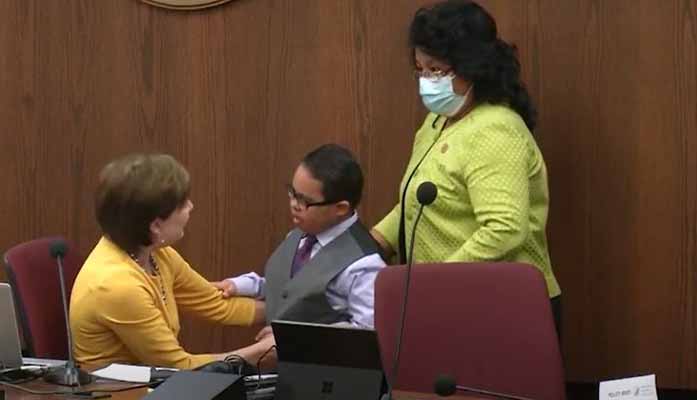
The Senate Health and Human Services Committee received a welcome surprise from 10-year-old Adam Fraleigh, when the little boy with Down syndrome thanked them for hearing his family’s testimony by hugging each senator present.
Adam’s father, John Fraleigh, brought Adam to address a bill that would include Down syndrome among the developmental disabilities recognized by the Department of Economic Security (DES) for its programs, services, and facilities. The pair matched in their attire: gray vests, light purple dress shirts, and purple ties.
Fraleigh gave a brief medical explanation of what makes Down syndrome a developmental disability. He cited the many medical procedures Adam has undergone in his 10 short years, and the likely many more ahead for the rest of his life.
“Requiring paperwork to consistently prove the effects of Down syndrome is wrong. Please pass this bill to demonstrate the understanding that Down syndrome is a disability, a cognitive disability,” said Fraleigh. “My son will require additional resources forever. With that, I’m open for questions, he’s open for hugs.”
Adam rushed over after his father’s testimony to hug each committee member, pulling them close and patting everyone vigorously on the back. He brought a welcome break from a long, packed legislative season, inspiring smiles and laughter from all in the room.
State Senator Nancy Barto (R-Phoenix) thanked Fraleigh for bringing Adam, noting that he brightened their day.
“Thank you; he brightens my day every day,” responded Fraleigh.
The bill passed the House unanimously last month.
Currently, the list of developmental disabilities under DES doesn’t include Down syndrome, but does include autism, cerebral palsy, intellectual disability diagnosis, epilepsy, or diagnosed as at-risk for developing these disabilities.
Corinne Murdock is a reporter for AZ Free News. Follow her latest on Twitter, or email tips to corinne@azfreenews.com.