Maricopa County wants to know how voters feel about this most recent general election. The survey was issued a few hours before the state certified the election results on Monday.
The Monday email from the Maricopa County Elections Department asked voters to describe their voting experience, how they voted, and if they felt informed on election procedures. The county asked voters impacted by Election Day problems the reason for their dissatisfaction, as well as where they voted. They also asked voters if vote centers rather than precinct-based locations made voting more convenient.
In some ways, this general election echoed the voter discontent and mistrust that arose following the 2020 general election. The embattled county has attempted to address the myriad claims of fraud arising from a chaotic Election Day prompted by faulty printer settings causing mass tabulator failures. The county reported last month that they’ve shared over 700 social media posts, conducted over 600 interviews, and submitted monthly newsletters to 40,000 subscribers this election.
There's been a variety of misinformation and misinterpretations of voter turn out data circulating social media. Here's a breakdown on all the data from @maricopavote's election reports:🧵
During its certification of the election results, the county specified further that faulty heat settings on retrofitted ballot-on-demand printers were to blame.
. @MaricopaVote : the faulty printer setting causing widespread tabulator issues occurred in one of two types of printers: the one retrofitted to be a ballot-on-demand printer, "Oki." County expressed confusion with its failure since stress testing went well. 71 sites impacted. pic.twitter.com/jZEmQiZXQn
The attorney general’s office questioned the county about these mass failures and reported complaints of disenfranchisement. About a week later, the day before the deadline set by Assistant Attorney General Jennifer Wright, the county answered with a report.
NEW: County responds to AG letter about Nov. election saying all laws were followed & all voters had the opportunity to legally and securely cast their ballot. Legal response: https://t.co/PItANauVz1 Details: https://t.co/07m2RlEaKH Key points: 🧵⬇️
The county’s troubles began earlier this year when doubts over the pens used for in-person voting resurfaced. The county swapped Sharpies for Pentel felt-tipped pens in July.
The changes prompted some activists to encourage rejection of the county’s protocol. Failed board of supervisors candidate Gail Golec advised voters to steal election pens in August. The county responded with a cease-and-desist letter to Golec.
More than 18K voters have successfully cast a ballot in person so far today! Minor tech issues have been resolved as well as reports of stolen pens. Please do not remove any voting materials from the polling place, including pens.https://t.co/WXsuEj0sDe
— Maricopa County Elections Department (@MaricopaVote) August 2, 2022
Election officials have reported that both the ink and felt tip pens pose problems. Occasionally, ink pen residue clogs the machines, and felt tip pen ink smears, causing ballot rejection, or the nibs break off.
Corinne Murdock is a reporter for AZ Free News. Follow her latest on Twitter, or email tips to corinne@azfreenews.com.
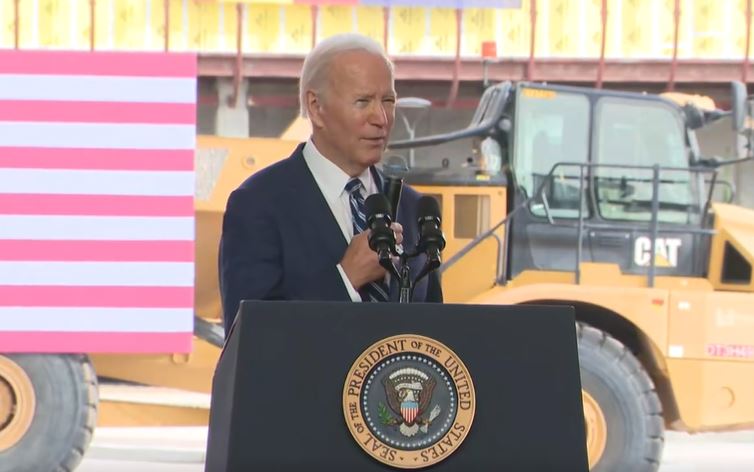
While boarding his flight to Arizona on Tuesday, President Joe Biden shared that he wasn’t visiting the border because it wasn’t important.
Biden told Fox News reporter Peter Doocy that focusing on American manufacturing was a bigger priority for him. He visited the Taiwan Semiconductor Manufacturing Company (TSMC) plant as part of his visit.
“[T]here are more important things going on,” stated Biden. “They’re going to invest billions of dollars in a new enterprise.”
AZ Free News noted earlier this week that Tuesday’s visit marked the president’s first to Arizona since assuming office. The president has overlooked the state despite being an epicenter for the ongoing border crisis.
Biden never misses an opportunity to perform his duties. Biden defends skipping border visit while in Arizona, says there are 'more important things' https://t.co/yKr5dFItyf#FoxNews
Biden’s disinterest in the southern border is further evident in his public messaging. Over this past year, he’s expressed more concern for Ukraine’s border than our own.
Watch live as I give an update on our continued efforts to pursue deterrence and diplomacy – and an update on Russia’s buildup of military troops on the border of Ukraine. https://t.co/Xt6EQUNltF
The last time the president tweeted about the southern border was to condemn border agents’ handling of illegal Haitian immigrants.
I'm heartbroken by the treatment of Haitian migrants at our border — and I acknowledge it is only the latest of many historic indignities that Haitians have faced. We will continue to offer assistance and investigate wrongdoing. I remain committed, as ever, to Haiti's future. pic.twitter.com/Cu1TlqF4EA
Biden isn’t the only Democrat who believes domestic microchip manufacturing outweighs other issues. Sens. Mark Kelly and Kyrsten Sinema both ignored controversies over the FBI raid on former President Donald Trump’s Mar-a-Lago home. Instead, the pair focused on the passage of the CHIPS and Science Act.
In a few minutes, I’ll be speaking from TSMC where President Biden is here to see how Arizona is leading the way in bringing microchip manufacturing back to America. Tune-in here: https://t.co/4iWIs0eZ3R
The border crisis only continues to worsen, with leadership shirking responsibility or jumping ship entirely. Chris Magnus, Tucson’s former police chief, resigned from his position as commissioner of Customs and Border Protection (CBP) last month.
Vice President Kamala Harris came close to visiting the site of the border crisis once, last June, after much resistance.
Since Biden took office, there have been over 4.1 million encounters with illegal immigrants (this total excludes “gotaways,” those who weren’t apprehended, for which no accurate data exists). That’s more than the total encounters under Trump and former President Barack Obama’s second term combined (about 3.9 million).
Based on average encounters at this rate, there will be over 8.8 million illegal immigrants encountered throughout Biden’s first term. That’s more than Trump, Obama, and the last two years of former President George Bush combined (about 7.9 million).
Corinne Murdock is a reporter for AZ Free News. Follow her latest on Twitter, or email tips to corinne@azfreenews.com.
The task force charged with recommending special ethics rules for attorneys who work for the Arizona Attorney General’s Office and other public entities across the state will miss its December 2022 report deadline, according to Arizona Supreme Court records.
The Task Force on Ethics Rules Governing the State Attorney General, County Attorneys, and Other Public Lawyers was established by Chief Justice Robert Brutinel in February following high profile ethics complaints filed by the Arizona Board of Regents and Secretary of State Katie Hobbs against Attorney General Mark Brnovich.
Although the task force has met eight times, members requested additional time to prepare its ethics recommendations. As a result, Brutinel recently signed an order setting a new deadline of June 2023.
In Arizona, the attorney general is mandated by statute to provide certain legal advice as well as representation to various state agencies, state officials, and state employees. The same principle applies to the state’s fifteen county attorneys.
Brutinel’s creation of the Public Lawyers Task Force acknowledged there are particular ethical concerns a government lawyer may face when representing a public body, elected official, or even a government employee that other attorneys do not have to address. Similar considerations can arise for private practice attorneys who are retained to provide legal counsel to a government client.
Many of those considerations came to a head in 2020 when Brnovich and his staff attorneys were accused by Hobbs of failing to abide by the Arizona Supreme Court’s Rules of Professional Conduct. In another instance, Brnovich actually sued his own client, the Arizona Board of Regents, who in turn contacted the Arizona State Bar.
The ethics complaints against Brnovich’s staff were dismissed by the State Bar, although the attorney general himself agreed to a diversion resolution. The situation, however, drew renewed attention to the dual ethical obligations government lawyers have, particularly when required by state law to represent a specific client.
Former Maricopa County Attorney and current Justice Bill Montgomery was appointed by Brutinel to chair the task force. Among the issues the members are expected to address are:
the process to follow if a government or public lawyer believes there is a conflict of interest in representing a public client;
how to handle situations in which the government lawyer does not approve of, or cannot ethically fulfill, a specific course of action desired by a client;
how the terms and conditions of legal representation should be documented between an attorney and a government client, and who calls the shots if the client is more than one person.
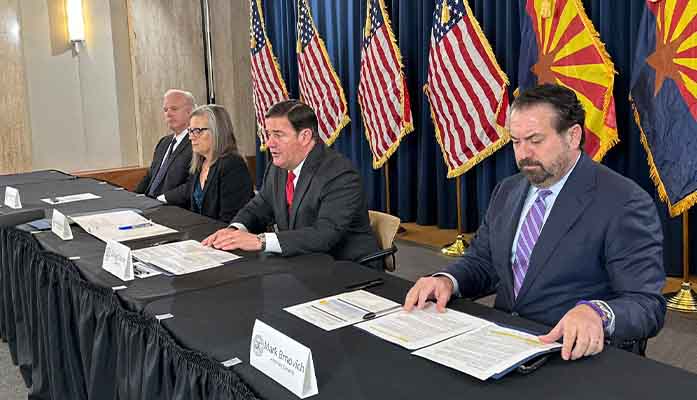
Attorney General Mark Brnovich signaled his disapproval of the election during the statewide canvass certifying the results on Monday.
Brnovich indicated his displeasure with the events of the last month after Secretary of State and governor-elect Katie Hobbs lectured Arizonans that they must combat election misinformation, conspiracies, and critics. The attorney general paraphrased a quote seemingly directed at Hobbs.
“I should note: I didn’t know we were giving speeches today, but the governor and I pursuant to statute are merely witnesses to the certification,” stated Brnovich. “I’m reminded of what John F. Kennedy said: ‘Those who ride the tiger to seek power often end up inside.’”
Arizona Attorney @GeneralBrnovich response to @katiehobbs speech on fighting election disinfo: "I didn't know we were giving speeches today, but the governor and I are merely witnesses to the certification. […] Those who ride the tiger to seek power often end up inside." pic.twitter.com/tqn1LduxmR
The quote Brnovich paraphrased came from Kennedy’s 1961 inaugural address. The former president meant it as a metaphor: people who support communist countries in the hopes of benefitting will only be overtaken by them in the end.
“To those new states whom we welcome to the ranks of the free, we pledge our word that one form of colonial control shall not have passed away merely to be replaced by a far more iron tyranny,” stated Kennedy. “We shall not always expect to find them supporting our view. But we shall always hope to find them strongly supporting their own freedom—and to remember that, in the past, those who foolishly sought power by riding the back of the tiger ended up inside.”
Following the certification, Brnovich released a statement clarifying that his presence at the certification wasn’t a signal of support for the election administration. Brnovich shared that he would continue to scrutinize the election if necessary through the end of his term.
“As we gather today to solidify the 2022 midterm election results, many Arizonans of all political persuasions continue to have doubts about our election processes,” said Brnovich. “As attorney general, I have made it one of my office’s highest priorities to defend our election laws and advocate for changes when necessary. I will continue to do so throughout the end of my term.”
Brnovich’s spokeswoman, Katie Conner, stated that people could draw their own conclusions as to what Brnovich meant when paraphrasing Kennedy.
People have varying interpretations of this, with some viewing it as a shot at Hobbs and others viewing it as a dig at election deniers. I asked spokeswoman Katie Conner what Brnovich meant. She said: "It is what it is – people can draw their own conclusions." https://t.co/n97Yu1sFHw
During Monday’s statewide canvass of the 2022 general election, governor-elect Katie Hobbs enjoined Arizonans to counter the speech of election critics.
After reading through a summary of election data, Hobbs urged Arizonans to monitor their peers’ election-related speech. She indicated that only election officials and designated experts convey truth concerning elections. Hobbs alluded to Cochise County’s certification delay, indicating that they were proliferating falsehoods, undermining democracy, and threatening to disenfranchise voters.
“As we’ve learned these past few years, protecting our democracy requires everyone’s participation to help discern truth from fiction and listen to experts seeking to uphold our laws and our republic rather than promote conspiracies,” stated Hobbs. “You can help combat and prevent these threats by getting involved. Learn from your trusted election officials and share accurate election information with your family and friends. Push back on and refuse to accept false narratives.”
Hobbs closed her speech by forewarning that the 2024 election would be equally rife with election denialism, if not worse.
“Democracy prevailed but it’s not out of the woods. 2024 will bring a host of challenges from the election denial community that we must prepare for,” stated Hobbs. “But for now, Arizonans can stand proud knowing that this election was conducted with transparency, accuracy, and fairness in accordance with Arizona’s election laws and procedures.”
Secretary of State @katiehobbs directs Arizonans to monitor election-related speech and suppress conspiracies. Fascinating timing given the recent discovery that Hobbs' office effectively controlled election-related speech online. pic.twitter.com/W7nskWV63s
When it comes to monitoring election-related speech, Hobbs has practiced what she preached.
Court filings revealed that the secretary of state’s office effectively controlled social media speech through a mediator nonprofit: the Center for Internet Security (CIS), run by a former Obama administration official. CIS manages election-related issues through their Elections Infrastructure Information Sharing and Analysis Center (EI-ISAC), which runs a communications hub between elections officials, the federal government, and social media platforms.
The secretary of state’s office, Runbeck Elections Services, and election leadership in all 15 Arizona counties are members of EI-ISAC.
Specifically: the Apache County’s Elections, Recorder, and City of Apache Junction Clerk; Cochise County’s Recorder and Elections Department; Coconino County Recorder; Gila County Elections; Graham County Elections and Recorder; Greenlee County Elections; La Paz County Elections; Maricopa County Recorder; Mohave County Recorder; Navajo County Elections; Pima County Election Department and Recorder; Pinal County Elections and Recorder; Santa Cruz County Elections; Yavapai County Elections and Recorder; and Yuma County Elections.
Nationwide, membership totals around 3,000 state and local election officials.
CIS also runs the Multi-State Information Sharing and Analysis Center (MS-ISAC), which is backed by and the cybersecurity needs go-to for the Department of Homeland Security (DHS). MS-ISAC, created in response to post-9/11 national security restructuring, got an $11 million cut from Congress’ $1.5 trillion omnibus spending bill earlier this year.
The following are MS-ISAC partners in Arizona:
State Entities: the state of Arizona, Secretary of State, Counter Terrorism Information Center, Judicial Branch, Central Arizona Project, Salt River Project
Cities: Apache Junction, Avondale, Buckeye, Bullhead City, Casa Grande, Chandler, Cottonwood, Flagstaff, Kingman, Glendale, Goodyear, Lake Havasu, Maricopa, Mesa, Peoria, Phoenix, Prescott, Safford, San Luis, Scottsdale, Sierra Vista, Surprise, Tempe, Tolleson, Tucson, Winslow, Yuma
Counties: Apache, Cochise, Coconino, Gila, Graham, Greenlee, La Paz, Maricopa, Mohave, Pima, Pinal, Santa Cruz, Yavapai, Yuma
Courts: Mohave County Superior Court,Pima County Superior Court, Pinal County Superior Court, Yuma Superior Court
Elections: Apache County Elections, Cochise County Elections, Coconino County Elections Department, Gila County Elections, Graham County Elections, Greenlee County Elections, La Paz County Elections, Navajo County Elections, Pima County Election Department, Pinal County Elections, Santa Cruz County Elections, Yavapai County Elections, Yuma County Elections
Fire: Arizona City Fire District, Central Arizona Fire and Medical Authority, City of Bullhead Fire Department, Colorado City Fire District
Higher Education: Arizona State University, Arizona Western College, Cochise College, Coconino Community College, Eastern Arizona College, Glendale Community College, Maricopa Community College, Northern Arizona University, Northland Pioneer College, Phoenix College, Pima Community College, Scottsdale Community College, University of Arizona, Yavapai College
K-12: Beaver Creek School District, Benson Unified School District, Buckeye Union High School District, Cartwright School District, Cave Creek Unified School District, Chandler Unified School District, Chino Valley Unified School District 51, Concho Elementary School District, Congress Elementary School District, Continental Elementary School District, Creighton School District, Dysart Unified School District, Flagstaff Unified School District, Fountain Hills Unified School District, J.O. Combs Unified School District, Gadsden Elementary School District #32, Gilbert Public Schools, Glendale Elementary School District, Kyrene School District, Maricopa Unified School District, Murphy School District, Paradise Valley Unified School District, Patagonia Union High School, Pendergast Elementary School District, Peoria Unified School District, Phoenix Elementary School District, Pima Joint Technical Education District, Pine Strawberry School District #12, Pinon Unified School District, Pointe Schools, Prescott Unified School District, Round Valley Unified Schools, Safford Unified School District, Sahuarita Unified School District, Scottsdale unified School District, Sierra Vista Unified Schools #68, Snowflake Unified School District, Tempe Union High School District, Washington Elementary School District, Tucson Unified School District, Western Maricopa Education Center, Whiteriver Unified School District, Wickenburg Unified School District, Yuma Union High School District
Police: Mesa Police Department, Pima County Sheriff’s Department, St. Johns Police Department, Williams Police Department, Yuma County Sheriff’s Office
Towns: Cave Creek, Florence, Gilbert, Marana, Oro Valley, Paradise Valley, Prescott Valley, Queen Creek, Sahuarita
Other: City of Apache Junction Clerk, City of Phoenix Aviation Department, Education Technology Consortium, Fort Defiance Indian Hospital Board, Maricopa County Attorney’s Office, National Law Enforcement Telecommunications System, Northern Arizona Council of Governments, Northern Arizona Intergovernmental Public Transportation Authority, Phoenix-Mesa Gateway Airport, San Carlos Apache Healthcare Corporation, Sun Tran, Tuba City Regional Health Care Corporation, Valley Metro Regional Public Transportation Authority
After the canvass, Hobbs joined the Arizona House Democratic Caucus’ retreat.
Governor-elect @KatieHobbs played a starring role in today’s House Democratic Caucus retreat. Our 29 members look forward to working closely with a Democratic Governor to move Arizona forward with inclusive solutions. Session begins Jan. 9, but the work begins now. #AZLegpic.twitter.com/2oSbhDmtsQ
On Sunday, Tucson Mayor Regina Romero announced that she contracted COVID-19 — despite being vaccinated and up to date on booster shots.
Romero clarified that her symptoms were mild.
Dear Tucsonans. Today, I tested positive for COVID. My symptoms are mild and I will be continuing to work from home in keeping with public health recommendations.
Under Romero’s leadership, the city of Tucson instituted a vaccine mandate for employees last August. Romero has characterized the vaccine mandate as a “policy” and “requirement,” though previously she acknowledged the county’s requirement of masks as a mandate.
The @cityoftucson’s vaccine policy has been overwhelmingly effective.
– 98% of our workforce is now complaint
– The number of non-compliant city workers has fallen from more than 500 workers to less than 90.
In response to the mandate, Attorney General Mark Brnovich filed a civil rights lawsuit in August (CV2022-011416). Brnovich accused the city of disparate treatment between unvaccinated and vaccinated employees. Brnovich claimed the city punished unvaccinated employees awaiting approval of their exemption or accommodation requests with unpaid suspension, denied additional sick leave to recover from COVID-19 or to quarantine if a family member contracted COVID-19, and required to undergo regular COVID-19 testing at their own expense.
However, vaccinated employees were given additional sick leave.
About 377 employees requested a medical exemption for the mandate, and 352 employees requested a religious exemption.
Brnovich’s lawsuit against the city is ongoing in the Arizona Superior Court.
Tucson’s vaccine mandate also prompted state intervention last year. Prior to the Arizona Supreme Court overturning a newly-enacted law banning state or local government from mandating the COVID-19 vaccine, Brnovich threatened to withhold over $175 million in state revenues.
(1/2) Today’s unanimous ruling by the Arizona Supreme Court should serve as a reminder to both @dougducey and our State Legislature that they are not above the AZ Constitution.
The city also required election workers to be vaccinated ahead of the special election in May. The Pima County Board of Supervisors voted in July to rescind that mandate for the primary elections. That decision followed requests from their elections officials concerned that they wouldn’t have adequate staffing with the mandate in place.
The county and city of Tucson implemented similar vaccine mandates. However, in September the Pima County Board of Supervisors rescinded its COVID-19 vaccine mandate for employees and $45 monthly penalty for unvaccinated employees. It also implemented a reward for those vaccinated employees who stay up to date on booster shots: 16 hours of paid time off every year.
A newly-enacted state law (HB2498) prohibits state and local governments from mandating the COVID-19 vaccine.
Romero has affirmed consistently that the COVID-19 vaccine is safe and effective.
“The decision to not get vaccinated does not just affect personal health, it unjustly exposes others to the risk of illness; including coworkers, members of the public, and children,” stated Romero.