While homeownership rates have remained stubbornly flat or declined in many parts of the country, Arizona has beaten the trend with one of the strongest increases in the nation, according to a new decade-long study by the New Jersey Real Estate Network.
The analysis is based on U.S. Census Bureau data tracking changes in owner-occupied housing units across all 50 states between 2014 and 2024, providing a long-term view of homeownership trends beyond short-term market fluctuations.
Arizona posted a 7.79% increase in the percentage of owner-occupied homes over that period, landing the Grand Canyon State at No. 5 nationwide for homeownership growth—the only Southwestern state besides New Mexico and Nevada to crack the top five.
New Mexico ranks first among the states with the greatest growth in homeownership, posting an 11.42% increase. Nevada follows at 9.22%, with Virginia (7.99%), Maine (7.83%), and Arizona (7.79%) rounding out the top five.
The gains in Arizona and its fast-growing neighborhoods reflect a combination of strong population growth, job creation in tech and healthcare, and relatively affordable entry-level housing compared to coastal markets—even as prices have risen sharply in recent years.
At the opposite end of the spectrum, several states saw significant drops in the share of residents who own their homes.
The states recording the steepest drops in homeownership include South Carolina (−7.56%), North Carolina (−5.79%), Michigan (−5.01%), Oklahoma (−4.96%), and Alaska (−4.20%).
“While many states saw peak homeownership rates in 2020, followed by slight decreases in recent years, this could reflect various factors, including shifts in housing markets and affordability trends, as individuals continue to navigate evolving financial landscapes,” said the New Jersey Real Estate Network spokesman.
Ethan Faverino is a reporter for AZ Free News. You can send him news tips using this link.
A record number of consumers plan to shop on “Super Saturday” this year, according to the National Retail Federation (NRF) and Prosper Insights & Analytics, signaling continued strength in final-stretch holiday spending despite months of inflation pressures.
The NRF’s annual survey projects 158.9 million Americans will shop on December 20 — the last Saturday before Christmas and historically one of the busiest retail days of the year. The organization says the figure surpasses both last year’s estimate and the previous all-time high in 2022, according to a Wednesday press release.
“As the final Saturday before Dec. 25, Super Saturday is a significant shopping event for both consumers and retailers,” said Katherine Cullen, NRF’s vice president of industry and consumer insights.
“This year’s event falls only five days before the Christmas holiday, and consumers will shop across retailers and channels in search of the final gifts on their lists and other holiday items they need to complete a memorable holiday season,” she added.
The NRF survey, conducted December 1–10 among more than 8,300 adult consumers, found that:
Roughly 45 percent expect to shop both in-store and online,
29 percent plan to shop only in stores, and
26 percent plan to shop exclusively online.
Online remains the leading destination for last-minute purchases, with 46 percent of respondents planning to buy online, followed by 33 percent indicating department stores and 26 percent citing discount retailers.
The survey also found that U.S. consumers had completed about half of their holiday shopping by early December. Respondents who still had shopping remaining cited common reasons including unresolved gift decisions, competing financial priorities, and waiting on information from friends or family.
A growing share of respondents, 31 percent, said they planned to give “experience-based” gifts such as event tickets, classes, or travel, continuing a trend NRF analysts say has strengthened over the past decade.
Beyond national forecasts, Arizona retailers are leaning into this final shopping weekend with a shift toward experience-based promotions as well rather than pure discounting. According to Dallas McLaughlin Digital Marketing, some Phoenix and Scottsdale-area businesses have rolled out in-store events, exclusive giveaways, and AI-driven loyalty programs designed to keep shoppers engaged longer and convert last-minute browsers into buyers. Local marketing analysts say experiential retail is gaining traction across the Valley as stores compete not only on price but on atmosphere and interaction, a strategy they expect to play out across Super Saturday crowds.
Looking beyond Christmas Day, the NRF noted that nearly seven in ten shoppers expect to continue making purchases after December 25 to take advantage of post-holiday discounts and to redeem gift cards.
The holiday retail season, as defined by the NRF, spans November 1 through December 31. The organization projects total holiday retail sales will exceed $1 trillion for the first time, forecasting growth between 3.7 and 4.2 percent over 2024’s totals.
Super Saturday, sometimes referred to as “Panic Saturday” in the retail industry, regularly delivers some of the heaviest foot and online traffic of the season as consumers rush to finish gift buying before Christmas. Retailers traditionally extend store hours and concentrate promotional campaigns around the date.
The Kyrene School District (KSD) will be closing six schools over the next two years due to budgetary concerns from declining enrollment.
After months of deliberations, the KSD Governing Board voted unanimously to close four elementary schools and two middle schools.
The four elementary schools closing are Kyrene de la Colina, Kyrene de la Estrella, Kyrene de las Manitas, and Kyrene Traditional Academy. The two middle schools closing are Kyrene Akimel A-al and Kyrene del Pueblo.
Kyrene de la Colina, Kyrene de la Estrella, and Kyrene de las Manitas will close in the 2026-27 school year. Kyrene Traditional Academy, Kyrene del Pueblo, and Kyrene Akimel A-al will close in the 2027-28 school year.
This consolidation will result in the boundary modification of nine schools within the district: Kyrene de la Esperanza, Kyrene de las Lomas, Kyrene del Milenio, Kyrene de la Mirada, Kyrene de la Sierra, Kyrene Altadena, Kyrene Aprende, Kyrene Centennial, and Kyrene Middle School will experience boundary changes.
The governing board projected the six closures would save the district around $5.8 million annually, thereby avoiding most of a projected $6.7 million budget deficit.
Some parents who spoke against the school closures asked the governing board to reduce the number of closures to five instead of six. Overall, most who took to the podium recognized the need for a reduction in the number of schools in the district.
Superintendent Laura Toenjes promised the district would prioritize student needs during the upcoming transition.
“This is about caring for people through change and making sure students and staff are supported every step of the way,” said Toenjes.
KSD will provide families with information on enrollment pathways and school assignments, bell schedule updates, and transportation information in January prior to the enrollment portal opening in February.
Per the Common Sense Institute Arizona, KSD’s enrollment declined by nearly 20 percent over the past six years, but its budget increased by nearly 80 percent.
Kyrene’s enrollment is down 19 percent since 2019. Over the same period of time, their total budget has increased by 79 percent. Total capital expenditures have increased by 44 percent.
A data dashboard on all district enrollment, capacity, and budgets by the Common Sense Institute Arizona shows that over half the school districts in the state have declined in enrollment since 2019.
On average, their research found school districts haven’t grown since 2008. Apart from the declining student-age population, parents are choosing alternatives to traditional public schooling. Charter school enrollment nearly doubled during the pandemic, from 2020 to 2022; a majority of private schools researched had reported enrollment growth; and homeschooling increased from two percent to an 11 percent peak during the pandemic before falling back to a new high average between six and seven percent.
Despite this significant decline in traditional public school enrollment, Common Sense Institute Arizona found, further, that these schools reported a significant increase in spending: 80 percent since 2010.
Since January, at least eight other school districts have announced school closures and consolidations: Cave Creek Unified School District (two schools), Phoenix Elementary School District (two schools), Mesa Unified School District (staff layoffs), Isaac School District (two schools), Edkey, Inc. Sequoia Village School (one school), American Heritage Academy (one school), Roosevelt Elementary School District (five schools), Amphitheater School District (proposed four schools for closure).
AZ Free News is your #1 source for Arizona news and politics. You can send us news tips using this link.
The Arizona Corporation Commission (ACC) and the North American Securities Administrators Association (NASAA) are cautioning investors to remain vigilant this Christmas season amid an increase in sophisticated fraud schemes.
Drawing on data from NASAA’s 2025 Enforcement Report and its annual survey of investor threats, the ACC identified a dozen types of scams that state securities regulators say investors should watch for as fraudsters employ new technology, including artificial intelligence (AI), to target victims.
According to NASAA’s report, state securities regulators conducted more than 8,800 active investigations in 2024, resulting in fines and restitution totaling over $259 million. The report found that while scammers increasingly use technological tools to make schemes appear legitimate, the underlying goal remains to separate victims from their money.
“The rapid growth of technology and the rise of artificial intelligence gives scam artists new tools to steal your money,” said NASAA President Marni Rock Gibson.
ACC Chair Kevin Thompson echoed Gibson, emphasizing the role of advancing technology in enabling fraud, saying in the release that AI and other tools give “scam artists new tools to steal your money,” and that many fraudulent investment pitches play on investors’ fears rather than genuine innovation.
“Fraudsters are pitching new investments that often have nothing to do with latest tech developments and instead play on the fear of missing out on the next ‘best thing,’” he explained.
The 12 investor threats outlined by the Commission’s Securities Division include:
Affinity or “Pig Butchering” schemes — long-term romance-based cons that build trust before prompting victims to invest in bogus platforms.
Deepfake impersonations — use of AI-generated video and voice clones of celebrities or contacts to solicit funds.
Phantom AI trading bots — fraudulent algorithms marketed as guaranteed return systems.
Digital asset and crypto fraud — scams involving unregistered securities and exaggerated return promises.
Fake AI equity pitches — sales of equity in fictitious AI companies or “pump and dump” schemes.
Social media lures — investment scams originating on platforms such as Facebook or X.
Short-form video hype — slick social media clips touting “get rich quick” opportunities.
Text and WhatsApp traps — unsolicited messages that pivot into fraudulent investment offers.
Targeting older investors — senior citizens are disproportionately targeted with both traditional and digital scams.
Account takeovers — phishing and AI-assisted hacks that seize control of accounts to solicit funds from contacts.
Website and app spoofing — cloned sites designed to harvest login credentials and funds.
Unregistered solicitors — individuals selling investments without proper licensing; regulators opened 944 investigations in 2024 involving unregistered sellers.
The ACC’s Securities Division encourages investors to exercise skepticism, conduct independent due diligence, and contact a trusted third party before committing funds to any investment, the commission said, quipping they should review the list of threats and “check it twice to avoid ending up with a stocking full of coal.”
Investors looking to check the license status or disciplinary history of an investment promoter can contact the Securities Division’s Duty Officer at 602-542-0662 or SecuritiesDiv@azcc.gov, or visit azcc.gov/azinvestor for more information.
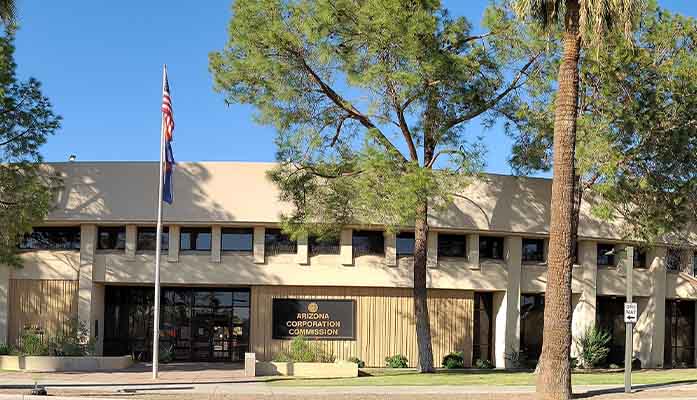
The Arizona Corporation Commission (ACC) is preparing to roll out a new online business filing system, Arizona Business Connect, which is scheduled to go live on January 12, 2026. The new platform will replace the Commission’s current eCorp system and is intended to modernize how businesses file and access corporate records in the state.
According to the ACC, Arizona Business Connect will offer updated technology, improved security features, and enhanced functionality designed to streamline the filing process and improve the overall customer experience for corporations and other business entities.
To complete the transition, the Commission will temporarily shut down the existing eCorp portal to transfer and verify a large volume of data before launching the new system. As a result, online filing and business searches through eCorp will be unavailable beginning at 5:00 p.m. Mountain Standard Time on Friday, January 2, 2026.
During this transition period, corporations will not be able to file documents or search business records online. However, the Commission says customers will still be able to submit filings using paper forms. Paper filings may be delivered in person at ACC offices in downtown Phoenix or Tucson or sent by mail or fax.
All paper documents received after the eCorp shutdown on January 2 will be assigned an effective date based on when they are received by the Commission. Those documents will not be entered into the new Arizona Business Connect system until January 12 or shortly after the portal becomes operational.
Jonathan Eberle is a reporter for AZ Free News. You can send him news tips using this link.
After this week, Arizona PBS will have one less program broadcasting the western news.
Arizona State University (ASU) declined to renew its contract with NewsHour West, a bureau in downtown Phoenix under the member station operated by ASU’s Walter Cronkite School of Journalism and Mass Communication, Arizona PBS (KAET).
NewsHour West provided western regional news, late breaking news, and a West Coast version of the news provided by the East Coast-based NewsHour.
"Native Americans have some of the highest risk factors for developing Alzheimer's. A 2024 NIH study found that 54 percent of older American Indians now have some degree of cognitive impairment, a significantly higher rate compared to the general population," @TheStephSy reports.…
The NewsHour West team consisted of Stephanie Sy, anchor and correspondent; Phil Maravilla, senior producer; Lena Jackson, deputy senior producer; Madison Staten, associate producer; and Justin Stabley, digital editor.
Back in April, Arizona PBS expanded in a different direction. The broadcasting station entered an agreement with Amazon Prime to offer free streaming to Arizona-based viewers.
The Corporation for Public Broadcasting (CPB), the private, nonprofit corporation which passes on federal funds to both PBS and NPR, announced in August that it would shut down after Congress reduced public broadcasting funds.
CPB lost around $1 billion in funding meant to fund broadcasting over the next two years.
A majority of CPB staff were laid off at September’s end; CPB said it planned to retain a skeleton crew until January, at least, to see through its remaining legal and financial obligations.
As it winds down, CPB has continued to administer its remaining millions as awards to various public broadcasting outlets and news organizations.
CPB’s demise occurred following its repeated resistance to efforts by President Donald Trump to bring the nonprofit to heel.
The Trump administration attempted to fire three CPB board members, prompting CPB to sue in April. That case is ongoing.
Then CPB refused Trump’s executive order, released in May, ordering CPB to cease federal funding for NPR and PBS. Longtime CPB President and CEO Patricia Harrison said Trump lacked authority over CPB, and that CPB was “wholly independent” of the federal government.
About 15 percent of the PBS budget relied on federal funding. The remainder comes from private donors, corporate sponsors, and nonprofits.
The NewsHour corporate sponsors are BNSF, Consumer Cellular, and Raymond James. Among the top foundation and individual funders are the Carnegie Corporation of New York, Doris Duke Foundation, Ford Foundation, Charles F. Kettering Foundation, Heising-Simons Foundation, William and Flora Hewlett Foundation, Robert Wood Johnson Foundation, John S. and James L. Knight Foundation, Judy and Peter Blum Kovler Foundation, Lumina Foundation for Education, John D. and Catherine T. MacArthur Foundation, The Andrew W. Mellon Foundation, Gordon and Betty Moore Foundation, David and Lucile Packard Foundation, Park Foundation, Laurie M. Tisch Illumination Fund, and The Walton Family Foundation.
AZ Free News is your #1 source for Arizona news and politics. You can send us news tips using this link.