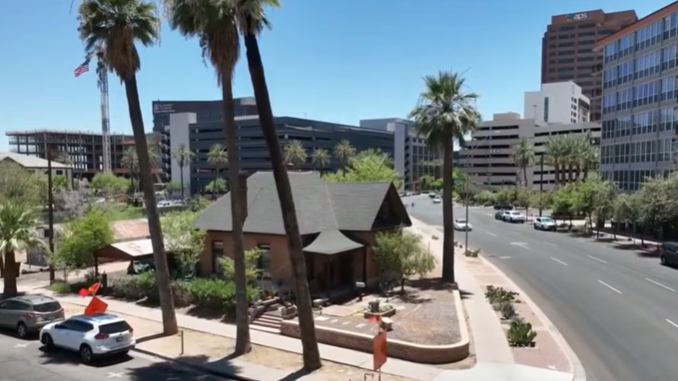
Arizona State University (ASU) has ceased its effort to take the home of an 89-year-old Phoenix man via eminent domain.
ASU sought to acquire the historic Louis Emerson House owned for more than 50 years by Robert Young. The university had intended to acquire the property as part of its new headquarters for ASU Health and its planned AI-driven medical school.
ASU dropped its eminent domain case on Friday.
The Louis Emerson House predates Arizona’s statehood by a decade. As AZ Free Newsreported last month, the property was developed in 1888 by the former adjutant general and attorney general, Clark Churchill, and its namesake came later in memory of a former owner who was a butcher with the Palace Meat Market in the early 20th century. It was Young who recovered these facts about the property and its history.
ASU had initially offered Young about $800,000 to sell, but Young declined the offer since it wouldn’t cover the cost to move the house. According to Young, accepting the offer would have meant the house’s demolition — an outcome he couldn’t accept given his desire to keep a piece of Phoenix history alive.
The Arizona Board of Regents then filed an eminent domain lawsuit to force the sale of the house with the Maricopa County Superior Court.
The ASU Health campus is projected to span 200,000 square feet, with a planned opening date scheduled for the fall of 2028.
Nearly 12,000 people signed a petition to save the historic Louis Emerson House from demolition.
ASU said in a statement that it would no longer seek eminent domain and instead allow the house to remain. ASU noted that it would adjust its construction plans to work around the home.
“ASU has been working toward a resolution with the Emerson House in downtown Phoenix, a house that sits next to land being developed for the headquarters of ASU Health,” said the spokesperson. “To honor the homeowner’s desires, the university has agreed to withdraw its court proceedings and allow the house to remain. The plans for the ASU Health site will be revised accordingly.”
Young credited John Rich, a country music singer and political pundit, for securing this victory. Rich was sworn in earlier this month by the Trump administration to serve as special envoy for American landowners.
Rich issued a statement to social media on Saturday explaining that ASU decided to drop the eminent domain case after he engaged in conversations with ASU President Michael Crow. Rich said Crow had promised to “take a look at” covering the court costs Young has undertaken to keep his home.
“Mr. Young, we took care of you, sir,” said Rich. “Big shout of to Dr. Crow, the president of Arizona State University, for having a heart and a soul and seeing this from Mr. Young’s perspective. I couldn’t ask for more. Big win for American landowners today.”
Rich also credited Turning Point Action for making him aware of Young’s plight.
Shout out to @FaithFamilyLiz from Arizona who initially helped me connect with Mr Young and his attorney. Without her help, it would have taken me much longer to win this battle. I've never met her in person, only here on X, but she was a HUGE help!🇺🇸 https://t.co/cnvBoHkJm5
Rich encouraged Americans to report unfair land grabs to USDA.gov/lawfare, the new reporting portal by the Department of Agriculture (USDA) to address lawfare waged against farmers, ranchers, agricultural producers, and other USDA customers.
AZ Free News is your #1 source for Arizona news and politics. You can send us news tips using this link.
The Federal Bureau of Investigation (FBI) is investigating a shooting that targeted a U.S. Immigration and Customs Enforcement (ICE) facility in central Phoenix after individuals fired multiple rounds at the building’s exterior.
According to the FBI’s Phoenix Field Office, the shooting occurred on July 14, 2026, at the ICE Enforcement and Removal Operations building located at 2035 N. Central Ave., near Central Avenue and Monte Vista Road.
FBI Phoenix Investigates Shooting Incident at Federal ERO Building
Anyone who witnessed suspicious activity in the area of North Central Avenue on Tuesday, July 14, in the afternoon, or who has information regarding this shooting, is urged to contact the FBI: •Call the FBI… pic.twitter.com/NBLoy0hHxF
Authorities said several rounds struck the exterior of the federal immigration facility.
No injuries were reported as a result of the gunfire, and the damage appears to have been limited to the outside of the building.
The FBI has confirmed that one or more unidentified individuals fired the shots. The agency has not announced any arrests or identified any suspects, and the investigation remains ongoing.
Later that same day, protestors gathered outside the ICE facility. However, federal investigators said there is currently no indication that the demonstration was connected to the shooting.
The FBI is asking anyone with information about the incident to come forward as investigators continue working to determine who was responsible.
Federal authorities have not released additional details regarding a possible motive. The FBI said it will continue investigating the incident and provide updates as more information becomes available.
Ethan Faverino is a reporter for AZ Free News. You can send him news tips using this link.
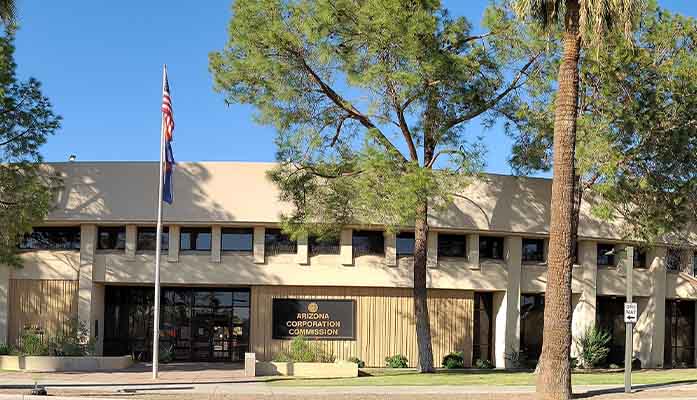
The Arizona Corporation Commission (ACC) announced they will be implementing a new identity verification requirement for users of its Arizona Business Center (ABC) online filing portal beginning July 20, 2026, as part of an ongoing effort to strengthen security and reduce fraudulent business filings.
Under the new policy account, users will be required to submit a government-issued form of identification during the registration process.
Existing account holders will also be prompted to verify their identity the first time they log into their account on or after July 20.
The Commission said the additional verification step is designed to better protect Arizona businesses from unauthorized filings and identity fraud by ensuring only verified users can file or modify business records through the online system.
Accepted forms of identification include state-issued driver’s licenses, state-issued photo identification cards, permanent residents cards or visas, passports, and passport cards.
According to the ACC, the verification process was designed to be both efficient and user-friendly, with most users expected to complete the process in just a few minutes.
Once the account has been successfully verified, users will not be required to repeat the process for that account.
The new security requirement builds on improvements made since the Arizona Business Center launched in January 2026. Commission officials said the online portal has already contributed to a decline in unauthorized business filings and identity fraud complaints, and the added verification requirement is intended to further strengthen those protections.
The Commission also announced that additional security measures are scheduled to roll out in the coming months.
Among them is the LLC Attestation of Existence, which is intended to help identify dormant or inactive LLCs while providing business owners with an opportunity to either secure their business or properly close it.
The ACC also plans to introduce an LLC Signing Authority Form, allowing business owners to formally designate individuals authorized to file documents on behalf of their LLC. Commission officials said the new form will reduce confusion surrounding filing authority and help prevent unauthorized submissions.
The Arizona Corporation Commission said the series of security enhancements reflects its continued commitment to protecting Arizona businesses while maintaining an efficient and accessible online filing system.
Ethan Faverino is a reporter for AZ Free News. You can send him news tips using this link.
A recent campaign ad from the Democrat incumbent governor cost her millions, but critics and past reporting indicate the ad is misleading and takes credit for work done by Republicans.
Gov. Katie Hobbs’ 30-second “Work” ad released last month claimed that she reduced electricity bills, cut red tape to build more affordable housing, and balanced the budget. Critics across the political spectrum assessed these claims as misleading.
Utility rates have increased by more than 25% under the Hobbs administration.
The Arizona Free Enterprise Club calculated based on Energy Information Administration data that utility rates in Arizona have increased by an average of 27% under Hobbs’ tenure. The Arizona Corporation Commission (ACC) sets rates.
The largest donor to Hobbs’ controversial inaugural fund, Arizona Public Service, also wants to increase the utility rates by 14%. That ratemaking case is ongoing with the ACC.
The Hobbs administration imposed more red tape on housing construction that had the effect of imposing a housing moratorium. A court struck down that red tape earlier this year as an unlawful overreach in agency rulemaking, a ruling which has the potential to put Arizona taxpayers on the hook for over $1 billion in compensation claims.
One developer duo, Buckeye Tartesso I and II, already filed such a claim last September with the help of the Goldwater Institute. The duo is seeking over $320 million in compensation for lost value, an amount their demand letter claimed was a compilation of conservative, not maximum, estimates.
Budget talks were repeatedly called off and subjected to a bill moratorium by Hobbs as she tried to impose what Republican lawmakers characterized as unrealistic revenue assumptions, hidden tax increases, and cost-raising policies.
In the thick of budget talks earlier this year, House Speaker Steve Montenegro (R-LD29) commented that Hobbs’ budgeting style was reminiscent of the more liberal-style budgets coming out of California: fiscal approaches which increase government size and create inconsistencies within the tax system. Hobbs held out on securing tax conformity for months to align the Arizona tax code with many of the congressional changes passed under the One Big Beautiful Bill Act
Hobbs has been accused by bipartisan critics of turning her inheritance of a $2.5 billion surplus from former governor Doug Ducey into a $1.6 billion shortfall.
Last summer, a report by the Common Sense Institute Arizona found that state spending outpaced the $3.3 billion in revenues that emerged following the passage of the flat tax in 2023.
Per the Hobbs campaign, the ad buys required millions from her campaign coffers.
Additionally, the Hobbs campaign press release implied that the Spanish-speaking version of her “Work” ad, “No Se Rinde” (“Doesn’t Give Up”), was uniform in its messaging. However, the ads contained key differences that indicated an awareness of Arizona’s split demographics.
Both opened with a characterization of Hobbs’ background as a mother who worked multiple jobs and as a social worker, but differed distinctly in their portrayals of Hobbs’ approach to governance.
The English-speaking ad, “Work,” depicted Hobbs as a budget and policy expert with key wins in electricity bill and red tape cuts, and school lunch and community college scholarship expansions.
The English ad described Hobbs as working fast food and Uber jobs to make ends meet. It included the misleading claims that Hobbs was responsible for balancing the budget without raising taxes, reducing electricity bills, and cutting affordable housing red tape, along with the valid claims that she expanded school lunches and community college scholarships.
The Spanish version of the ad, “No Se Rinde,” depicted Hobbs as a social worker with key wins in medical debt forgiveness, medical cost cuts, and salary boosts. Hobbs forgave $30 million in medical debts early on in her administration.
The Spanish-speaking ad similarly characterized Hobbs as having a background as a working mother, but only highlighted her past Uber driving work and expanded on her time as a social worker as mainly aiding female domestic violence victims. The ad further diverged in describing Hobbs as responsible for canceling tens of millions in medical debt, reducing medical costs with discounts up to 80 percent, and raising salaries.
A Centers for Disease Control report published in 2024 suggested that Latino and Hispanic women have a disproportionately higher risk of experiencing domestic violence: one in three, indicating an occurrence average up to three times higher than white women.
Close to a quarter of all Latinos in Arizona are uninsured, as are nearly half of all illegal aliens, according to a 2022 research analysis from the Latino Policy & Politics Institute. Approximately 80% of Latino families in Arizona reported financial trouble according to recent polling by UnidosUS; nearly half of Latinos across Arizona, California, and Texas reported medical debt in a 2024 UnidosUS poll.
AZ Free News is your #1 source for Arizona news and politics. You can send us news tips using this link.
The annual inflation rate in the Phoenix metropolitan area slowed to 2.8% in June, remaining below the national rate as falling energy prices and comparatively modest shelter-cost growth eased pressure on the region’s Consumer Price Index (CPI).
The Phoenix-area CPI increased 2.8% during the 12 months ending in June, down from 3% in April, according to a new Common Sense Institute (CSI) analysis of federal inflation data. National consumer prices increased 3.5% over the same annual period.
CSI attributed much of the local decline to energy prices, which fell 6.4% during June after increasing 26.5% between February and May. The earlier increase helped drive Phoenix’s annual inflation rate from 1.7% in February to 3% in April, according to CSI.
Inflation has slowed but prices are still much higher than they were five years ago.
Since June 2019, prices in the Phoenix metro have increased 33.4%, adding an estimated $1,673 per month to the budget of a typical Arizona household.
— Common Sense Institute Arizona (@CSInstituteAZ) July 15, 2026
Energy remained more expensive than it was one year earlier. The U.S. Bureau of Labor Statistics reported that Phoenix-area energy prices were up 14.1% year-over-year in June, while gasoline prices were 26.2% higher. The local energy index declined 4.4% over the two-month period ending in June, including a 10.7% decrease in gasoline prices.
Nationally, the CPI declined 0.4% from May to June on a seasonally adjusted basis, marking the largest monthly decrease since April 2020, according to the BLS national inflation report. The national energy index fell 5.7% during June, including a 9.7% decline in gasoline prices. National consumer prices remained 3.5% higher than one year earlier, while energy prices were up 15.7%.
Shelter costs also helped keep Phoenix inflation below the national rate. Shelter prices increased 1.4% year-over-year in the Phoenix area, compared with 3.3% nationally. CSI said home prices have cooled in Arizona during the past two years while national home prices continued to increase, reducing shelter’s contribution to Phoenix-area inflation.
CSI said the gap between Phoenix and national shelter inflation has narrowed during the past six months as housing markets elsewhere began to cool. When shelter costs are excluded, CPI growth in Phoenix and across the country is nearly identical, according to CSI.
Phoenix-area food prices increased 2.2% year-over-year in June. The local index excluding food and energy rose 2%, while the comparable national index increased 2.6%. CSI separately calculated that the Phoenix index for all items excluding energy increased 2% from the previous year, up from 1.7% in April.
Among the 23 metropolitan areas compared by CSI using the latest available BLS data, Phoenix recorded the fifth-slowest year-over-year inflation rate. The region had posted the fourth-slowest rate among the 14 metropolitan areas reporting April figures.
The recent slowdown follows several years of substantial price increases. CSI calculated that Phoenix-area prices have risen 33.4% since June 2019, compared with a 30.3% national increase. According to the institute, the increase is “adding approximately $1,673 in monthly expenses to the average Arizona household.”
From June 2024 through June 2026, cumulative Phoenix-area inflation was 3%, below the approximately 4% increase that would result from prices growing steadily at an annual rate of 2%, according to CSI.
CSI cautioned that changes in individual categories can have an outsized effect on the headline CPI because the index is a weighted average of price movements across goods and services. CSI identified volatile energy prices as a significant driver of both the local and national figures and estimated that alternative measures place the Phoenix area’s underlying inflation rate closer to 2% than the 2.8% headline figure.
Supportive leadership, collaborative freedom, and safe campuses are the leading reasons why thousands of Arizona educators say they don’t quit education.
A new survey from the Arizona Department of Education (ADE) polled more than 9,300 current Arizona teachers during the 2025-2026 school year on their reasons for staying in the profession.
More than 2,000 teachers (22%) completed the survey. ADE disclosed that it excluded the responses of approximately 170 teachers that were ultimately deemed ineligible upon further screening.
According to ADE interpretation of the data, a majority of these educators cited strong leadership support, the ability to collaborate with other educators, and safe campuses as among their highest priorities. Districts who meet these criteria for their teachers have better chances at higher rates of K-12 educator retention, they say.
Superintendent of Public Instruction Tom Horne said the results of the survey confirmed his sentiments on the matter, which he has vocalized in interviews with the media and implemented through ADE policy. Horne said tapping into available state funds would alleviate one key issue raised by educators in the survey: teacher pay.
“This survey confirms what I have consistently said about educators needing support from their school leadership, a collaborative and safe workplace environment, and higher pay,” said Horne. “Arizona is facing a catastrophic teacher shortage, but this survey shows there are some answers that can be implemented immediately, although more effort needs to be made to raise teacher pay. That is something I have consistently fought for and can be done without raising taxes because there is money available in the state land trust.”
93% of responding teachers said they planned to return to a teaching position for the 2026-2027 school year. 7% said they did not.
Nearly 77% of respondent teachers collectively said they felt safe and supported at their school site. Nearly 75% said they felt their school fostered a positive and collaborative environment. Nearly 74% said they felt they had autonomy to make instructional decisions for their students. Nearly 71% said they felt valued and respected by school leaders. About 70% said they felt they had access to the instructional resources and materials they needed to be successful.
Class sizes at their school were manageable according to most (nearly 700 agreed), followed by a close-second majority who said they disagreed (nearly 400), and those who strongly agreed or were neutral were close in numbers (more than 300 respectively). Those who strongly disagreed with the sentiment totaled 160.
A strong sense of belonging in the school community was present for most (more than 700 who strongly agreed), followed by a close-second majority who said they agreed (nearly 700), then those who said they were neutral (nearly 300), then those who said they disagreed (about 150), and those who said they strongly disagreed (about 60).
However, teachers indicated that they had insufficient time during their work days to complete non-instruction tasks. Close to 600 teachers said they disagreed that they had sufficient time, followed by more than 500 who strongly disagreed. 360 teachers said they agreed they had sufficient time, nearly 300 were neutral on the matter, and 150 strongly agreed.
Teacher pay came a close second for highest levels of dissatisfaction among respondent teachers. Only 38% overall said they felt their salary was competitive with similar positions in the state.
More than 500 teachers said they agreed that their salary was competitive with similar positions in the state, and 190 said they strongly agreed. More than 400 were neutral or in disagreement, respectively. More than 300 said they strongly disagreed.
AZ Free News is your #1 source for Arizona news and politics. You can send us news tips using this link.