Congressman Paul Gosar (R-AZ-09) is calling on the Department of Veterans Affairs (VA) to implement recommendations from a recent Office of Inspector General (OIG) audit that found widespread failures in the administration of the Veterans Community Care Program (VCCP), including improper eligibility determinations, inadequate documentation, and hundreds of millions of dollars in unnecessary spending.
In a letter to VA Secretary Doug Collins and Acting Under Secretary John Figueroa, Gosar urged the department to fully implement the OIG’s recommendations to improve accountability and ensure veterans receive the care they are entitled to under federal law.
The audit, released by the VA Office of Inspector General on June 17, was mandated by the Senator Elizabeth Dole 21st Century Veterans Healthcare and Benefits Improvement Act.
It examined whether the Veterans Health Administration (VHA) accurately identified veterans eligible for community care and properly informed them of their options under the VA MISSION Act.
The OIG concluded that the VA was “not effectively identifying and informing all eligible veterans about all their care options within and outside VA.”
Investigators found that some veterans who qualified for community care were never informed of their eligibility, while others who did not qualify were improperly referred to outside providers.
According to the audit, nearly one in four community care referrals—approximately 340,000 of 1.4 million consults reviewed during the first quarter of FY25—were made even though veterans did not meet eligibility requirements.
At the same time, an estimated 1.8 million veterans who received care through VA facilities lacked documentation showing they had been evaluated for community care eligibility, with more than one million cases containing no evidence that veterans had voluntarily declined the option.
The OIG estimated that inaccurate eligibility determinations resulted in approximately $440 million in unnecessary spending during the first quarter of FY25 alone. If those issues continue unaddressed, the agency estimated the cost could reach $1.7 billion annually.
The audit attributed many of the problems to inconsistent guidance from the VA’s Office of Integrated Veteran Care, scheduling system limitations that prevented staff from viewing appointment availability across all VA facilities, and a lack of access to community care scheduling data needed to help veterans make informed decisions.
Investigators also found that some veterans referred to community care could have received treatment sooner through VA facilities, while others who qualified for community care were never informed of that option.
The report warned that these shortcomings not only waste taxpayer dollars but also risk delaying medical treatment for veterans by preventing them from accessing the care options that best meet their needs.
The Office of Inspector General issued six recommendations aimed at improving the effectiveness of the Veterans Community Care Program.
The Veterans Health Administration concurred with five recommendations and concurred in principle with the sixth, submitting corrective action plans intended to address the findings.
In his letter, Gosar encouraged Secretary Collins to work with Congress to fully implement the OIG’s recommendations, strengthen oversight of the Veterans Community Care Program, and ensure it is administered with the diligence and integrity America’s veterans deserve.
Ethan Faverino is a reporter for AZ Free News. You can send him news tips using this link.
Voters will not be seeing a debate occur in the Arizona governor’s race between Gov. Katie Hobbs and Rep. Andy Biggs.
Hobbs announced formally on Tuesday that she wouldn’t be debating Biggs, though many speculated for months beforehand that would be the case regardless of who won the Republican primary.
The Democratic governor even stonewalled reporters for days after the primary before finally opening up to 12News reporters Brahm Resnik and Craig Harris on the subject.
Hobbs’ campaign manager Nicole DeMont told the outlet that the governor doesn’t find debates important.
DeMont said Hobbs’ time was better spent convincing constituents of her work through a statewide “Arizona First” tour with more than 100 open-press events and interviews.
“We respectfully decline debate invitations in this campaign because face-to-face engagement with Arizonans is more effective than a stage designed for short soundbites and political theater,” said DeMont.
DeMont’s statement confirmed what Hobbs appeared to indicate in media interviews in recent years: that she doesn’t believe debates hold much value with voters anymore.
Some have expressed concern that Hobbs engaging voters unchecked by opponents serves as a calculated echo chamber. They pointed to claims made in a recent Hobbs campaign ad, which were later characterized across the political spectrum as misleading or false.
The governor claimed in the ad to have reduced electricity bills, though utility rates have increased; cut red tape to build more affordable housing, though her administration imposed a housing moratorium that may cost taxpayers millions; and balanced the budget, though the multibillion-dollar surplus flipped into a deficit under her and it was the Republican-led legislature that convinced Hobbs to sign on after months of stalling and a legislative moratorium.
It will have been 8 years since Hobbs engaged in a debate.
In the past, the governor had fled from reporters when pressed on her willingness to debate opponents, and once claimed to have COVID-19 when expected to appear for a debate.
Although Hobbs won’t show, Biggs does plan to appear on the stage for the Clean Elections Debate in October. Drew Sexton, Biggs’ campaign senior advisor, said Hobbs’ continued rejection of debates was less about principle and more about fear of confrontation.
Sexton also said that Hobbs’ avoidance indicated moral failings that would explain the multiple rejections by lieutenant governor picks and the years-long criminal corruption investigation. Sources told The New York Times that both Jimmy McCain, John McCain’s son, and John Giles, former Mesa mayor and Republicans for Harris leader, turned Hobbs down for the role.
“The independent and persuadable voters up for grabs in Arizona deserve to hear from statewide candidates in a traditional debate setting, one that was held in every Arizona gubernatorial race since 1954 until Katie Hobbs ran for the position in 2022,” said Sexton. “Katie Hobbs can avoid the debate stage but she won’t get to avoid voters in November.”
AZ Free News is your #1 source for Arizona news and politics. You can send us news tips using this link.
The federal government expects Arizona to do more to conserve its water in the ongoing Colorado River supply crisis while other basin states face far lower restrictions.
Arizona’s elected leaders responded that the state has done more than its fair share to conserve water throughout this historic multi-decade drought, and that they would not accept this federal directive. They indicated that they may challenge the directive in court.
The Final Environmental Impact Statement on Colorado River operations, released by the Bureau of Reclamation on Friday, would require Arizonans to cut water usage by up to 77% in 2027 and 2028.
Arizona, California, and Nevada had proposed water usage reductions that would have reduced Arizona’s supply by about 31%, but the federal government rejected that proposal.
The Arizona Department of Water Resources (ADWR) said the federal decision would “devastate” Arizonans and the state’s economy. ADWR criticized the federal framework for not including reductions to the Upper Basin or sufficient use of water in those upper reservoirs.
The Colorado River Basin provides drinking water and power for more than 40 million people, and irrigation water for more than five million acres of agricultural land. A 26-year drought has reduced the basin to historically low runoff and reservoir levels.
Arizona, California, and Nevada rely on water from the Lower Basin, while Colorado, Utah, Wyoming, and New Mexico rely on the Upper Basin.
Gov. Katie Hobbs expressed hope that the Department of the Interior (DOI) would still accept the Lower Basin alternative plan, but acknowledged the federal restrictions contained “unacceptable options” that included having Arizona take on the majority of water cutbacks, which Hobbs called “draconian.”
As Rep. Andy Biggs (AZ-05), Republican nominee for governor, mentioned in his appeal to Congress for Colorado River emergency funding, Hobbs cited Arizona’s unique position as a power player in the agricultural and defense industries.
“Arizona provides the agricultural produce, critical minerals, weapons defense systems and cutting-edge semiconductors that feed America, protect America and fuel America’s high-tech economy. No other state in the Colorado River basin can say the same,” said Hobbs.
The DOI has been unsuccessful in its attempts the past six years to reach consensus with Arizona and the six other basin states concerning long-term operational guidelines. The lack of consensus didn’t stop the federal release of the environmental impact statement, since current operational guidelines expire this year and the government must begin new operations on October 1 of this year.
Danny Seiden, President and CEO of the Arizona Chamber of Commerce & Industry, condemned the DOI decision as placing a “deeply disproportionate burden on Arizona” while failing to provide a cohesive conservation solution for all basin states. Seiden said they would stand alongside state leaders to demand a fairer decision.
“[A] plan that imposes severe, enforceable reductions on Arizona while shielding senior users and allowing other states to avoid comparable mandatory commitments is neither fair nor sustainable,” said Seiden. “Arizona will do its part, as it always has, but we will not accept being treated as the system’s default shock absorber. Any sustainable path forward must recognize Arizona’s conservation record, protect the investments our state has already made, and require measurable contributions from the entire Colorado River Basin.”
Rep. Teresa Martinez, an LD16 Republican whose constituents also hail from Pinal and Pima counties, questioned who in Arizona would be expected to cut water usage, and who would be given the better end of the deal.
Martinez said the federal government is forcing communities and farmers to bail out those beginning to feel the effects of the water crisis.
“Pinal County farmers already lost their Colorado River water. That happened years ago. They took the hit without a bailout, without fanfare, and without much sympathy from anybody,” said Martinez. “Rural Arizona cannot keep being treated like the first place to cut and the last place anyone thinks about.”
Martinez said she plans to speak with LD16 community leaders, especially those within the agriculture industry, to gauge the anticipated impact of this latest decision.
AZ Free News is your #1 source for Arizona news and politics. You can send us news tips using this link.
The Common Sense Institute announced it has promoted Zach Milne to Director of Policy and Research, where he will oversee the organization’s research agenda and continue leading data-driven policy analysis focused on free enterprise and economic issues affecting Arizona.
In his new role, Milne will direct CSI’s research initiatives while continuing to produce analysis intended to inform policymakers and the public on issues related to Arizona’s economy, workforce, fiscal policy, and competitiveness.
Milne joined the Common Sense Institute after serving as an economist in the Arizona Governors Office of Strategic Planning ad Budget.
During his time with the state, he developed Arizona’s revenue forecasts, advised executive leadership on fiscal policy, and analyzed tax and budget legislation.
He earned a bachelors degree in economics and statistics, along with a master’s degree in economics from Arizona State University.
Prior to his career in economics, Milne served more than 20 years in the United States Air Force.
Please join us in congratulating Zach Milne on his promotion to Director of Policy and Research at Common Sense Institute.
As Senior Research Analyst, Zach has played a key role in establishing CSI as a trusted source of independent economic analysis through his work on housing… pic.twitter.com/LEQTq8fUYF
— Common Sense Institute Arizona (@CSInstituteAZ) July 30, 2026
Since joining CSI, Milne has helped expand the organization’s research portfolio, leading several of its signature projects, including the Free Enterprise Report and the Housing Affordability Index.
CSI Executive Director Katie Ratlief praised Milne’s contributions to the organization and expressed confidence in his leadership moving forward.
“Research that makes a difference doesn’t just analyze data. It changes the way people think about important policy issues,” stated Ratlief. “Zach has been instrumental in building both the quality of our research and the reputation CSI has earned as a trusted source of objective economic analysis. His commitment to accuracy and thoughtful approach to every project have helped position CSI as a leading voice on the policy issues that matter most to Arizonans. I look forward to seeing him continue building on that foundation in this new role.”
Ethan Faverino is a reporter for AZ Free News. You can send him news tips using this link.
Arizona voters will get to decide if public employment should have diversity, equity, and inclusion (DEI) requirements, a court has ruled.
The Maricopa County Superior Court found on Tuesday that Proposition 142 was constitutional, not in violation of the single subject rule as opponents claimed.
Proposition 142, passed by the legislature as HCR 2044, would bar the state and all political subdivisions from making preferential treatments or discriminations based on immutable traits — race, sex, color, ethnicity, or national origin — in public employment, education, or contracting. This would extend to a ban on any preferential consideration given to individuals based on race or ethnicity.
It would also prohibit public entities from requiring individuals to endorse or support preferential treatments or discriminations based on immutable traits as a condition of admission, graduation, hiring, promotion, certification, contracting, or other employment or scholarship opportunities.
Further, the proposition would prohibit requiring or soliciting a written or oral statement supporting certain race-based DEI concepts, theories, or practices, as well as any confession of race-based privilege or discussion of personal race or ethnicity or experiences with the race or ethnicity of others.
The proposition would also prohibit any requirements for employees to undergo and complete DEI trainings or courses.
Will of the People, a progressive political action committee, was behind the lawsuit to prevent Proposition 142 from appearing on the ballot. Also named as a plaintiff in the lawsuit was Joel Edman, Arizona State University’s Democracy Director for the Indian Legal Clinic’s Native Vote Election Protection Project.
Edman founded the Arizona Democracy Resource Center and the Arizona Election Protection Coalition. He was also the executive director for the Arizona Advocacy Network, where he served as a lobbyist. Edman’s wife, Marilyn Rodriguez, founded the lobbying firm Creosote Partners. It was reported in a 2019 feature on Edman by the Flinn Foundation that the two shared office space for their organizations.
The lawsuit argued that Proposition 142 would establish prohibitions already covered by state and federal laws, including the Fourteenth Amendment of the Constitution, the Arizona Civil Rights Act, and Title XII of the federal Civil Rights Act of 1964.
Further on the topic of the Constitution, the lawsuit claimed the proposition violated the right to free speech.
“The absolute bar on trainings, policies, and procedures that are designed or implemented with reference to race or ethnicity is both a content-based and viewpoint-based restriction on speech and therefore violates the First Amendment[,]” stated the lawsuit.
It also contended that the proposition had two subjects: barring preferential treatment or discrimination by the state based on immutable traits, and barring public funding for promoting programs or activities referencing DEI.
The Maricopa County Superior Court rejected those arguments, stating that the proposals were sufficiently connected because they were all rooted in limits on governmental action regarding immutable traits, and that the issue of free-speech restrictions could only be addressed should voters approve the measure.
Will of the People has also sued to stop another legislative ballot referral, HCR 2003, the “Protect Girls’ Sports in Arizona Act.”
AZ Free News is your #1 source for Arizona news and politics. You can send us news tips using this link.
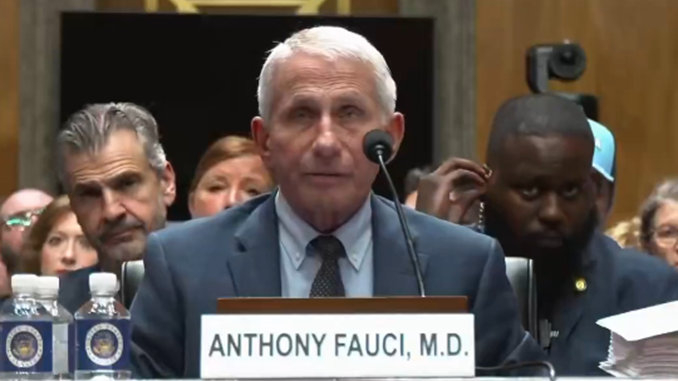
Rep. Andy Biggs (R-AZ-05) criticized former National Institute of Allergy and Infectious Diseases (NIAID) Director Anthony Fauci for invoking the Fifth Amendment more than 100 times during subpoenaed testimony before the Senate Homeland Security and Governmental Affairs Committee.
Fauci appeared Wednesday at a full committee hearing chaired by Sen. Rand Paul (R-KY), who questioned him about the federal response to COVID-19, government-funded research in China, and recently released portions of Fauci’s pandemic-era diary. Fauci repeatedly declined to answer, stating that he was acting on the advice of counsel and invoking his constitutional right against self-incrimination.
Throughout the hearing, Dr. Fauci invoked the Fifth Amendment a total of 111 times.
“I was one of the first to question the counsel Dr. Anthony Fauci was giving during the COVID-19 response in 2020, and I have been proven right about him many times over,” Biggs said.
“However, there is no victory lap because millions of American lives and livelihoods were destroyed thanks to Fauci’s insistence on his unscientific opinions,” Biggs added. “History has already judged Fauci — and will continue to do so in the years to come.”
Sen. Paul subpoenaed Fauci to appear before the committee and, ahead of the hearing, released 1,141 pages of diary entries covering Fauci’s work during the pandemic. The senator said the documents raised new questions about what Fauci knew regarding COVID-19’s origins, research conducted at the Wuhan Institute of Virology, and the effects of pandemic restrictions. Fauci maintained that the entries were consistent with his previous public statements.
Sen. Paul said the committee would vote next week on a contempt referral over Fauci’s refusal to answer its questions. The referral would need approval from the committee and the full Senate before being sent to the Department of Justice, which would decide whether to seek an indictment.
I’ve scheduled a vote next week for the HSGAC committee to vote on a resolution to certify contempt for Dr. Anthony Fauci. pic.twitter.com/XmRZKpvBTz
The dispute is complicated by the preemptive pardon issued to Fauci by former President Joe Biden on Jan. 19, 2025. The clemency warrant granted Fauci a “full and unconditional pardon” for any federal offenses he may have committed from Jan. 1, 2014, through the date of the pardon arising from his service at NIAID, on the White House Coronavirus Task Force and COVID-19 Response Team, or as chief medical adviser to the president.
Sen. Paul and several Republican senators argued that the pardon removed Fauci’s ability to claim that answers concerning the covered period could expose him to federal prosecution. Fauci’s attorneys disputed that conclusion. The pardon does not cover conduct after Jan. 19, 2025, including any potentially false statements made during later testimony, and legal analysts said federal courts have not resolved whether a pardoned witness may invoke the Fifth Amendment when questioned by Congress about pardoned conduct.
.@RandPaul: "In the red folder on your table is a copy of Section 192 of Title 2 of the U.S. Code…that section makes it a crime for a witness appearing under subpoena to refuse to answer any questions pertinent to the question under inquiry. Do you have that in front of you?"… pic.twitter.com/NTXPsvBxdM
Sen. Josh Hawley (R-MO) tested the scope of Fauci’s refusal by asking him what day it was and the colors of his tie and the carpet. Fauci invoked the Fifth Amendment in response to each question. Hawley also alleged that federal employees had worked on Fauci’s nominations for awards carrying monetary prizes. Fauci did not respond to those allegations during the hearing.
Anthony Fauci invoked his Fifth Amendment right dozens of times before Congress — then refused to answer what day of the week it was or what color tie he was wearing.
Sen. Josh Hawley cited an 1896 Supreme Court ruling that a pardoned witness can be compelled to testify because… pic.twitter.com/KxjVIIRfMy
— Fox News Politics (@foxnewspolitics) July 29, 2026
Sen. James Lankford (R-OK) questioned Fauci about closed schools and churches, missed childhood vaccinations, and diary entries concerning the Wuhan Institute of Virology. Fauci gave the same Fifth Amendment response to each subject.
Fauci accused Sen. Paul of conducting an “unhinged” campaign to have him prosecuted and said the hearing was intended to induce him to make a statement that could be used in a future criminal case. His attorney, David Schertler, called Paul’s investigation an “obsessive vendetta” and denied the allegations against Fauci. Sen. Gary Peters (D-MI), the committee’s ranking Democrat, described the hearing as one-sided and aimed at validating a predetermined conclusion.
Biggs’s statement accused Fauci of misleading Congress about research funding and the origins of COVID-19. Fauci has denied lying to lawmakers and has maintained that the research at issue did not meet the federal regulatory definition of gain-of-function research.
The cause of the pandemic remains unresolved. The FBI has assessed that a laboratory incident was the most likely origin, while the CIA reached a similar conclusion in 2025. Four other intelligence agencies and the National Intelligence Council have favored natural transmission from an animal, according to assessments summarized following the hearing.
Biggs’s opposition to Fauci’s pandemic recommendations dates to the spring of 2020. In May 2020, he and Sen. Paul co-authored an opinion column titled “Anthony Fauci wants America closed until there’s nothing to reopen,” arguing that Americans should be permitted to evaluate health risks and decide whether to patronize businesses or remain home.
Biggs also published an April 2020 column calling for the removal of economic restrictions and was appointed that month to the Congressional Task Force on Reopening the American Economy. He later advocated for reopening schools and allowing parents to decide whether their children would return to in-person instruction.
“The United States should never again fall prey to the lockdown tactics that he and others around him employed and encouraged,” Biggs said.