By Matthew Holloway |
Arizona House Minority Whip Stacey Travers (D-LD12) is pledging to renew her effort to require clergy to report suspected ongoing or future child abuse disclosed through confidential religious communications. Her legislation failed to advance this year, while the Arizona Supreme Court recently issued a ruling defining the scope of the state’s clergy reporting exemption.
Travers said she plans to pursue the issue again when lawmakers return to the Capitol in January. Her comments followed the recent Arizona Supreme Court ruling in Doe v. The Corporation of the President of the Church of Jesus Christ of Latter-day Saints, which addressed when clergy may withhold reports of child abuse under state law.
Travers introduced HB 2039 in December. The bill would have amended Arizona’s clergy reporting exemption to require members of the clergy, Christian Science practitioners, and priests to report when there is reasonable suspicion that abuse is ongoing, will continue, or may threaten other minors.
House Judiciary Committee Chairman Quang Nguyen (R-LD1) has opposed Travers’ proposals and has said he will not give the measure a hearing while he remains chairman. Nguyen, who is Catholic, said that Travers would have to wait until 2029, when he is no longer a legislator, for the bill to receive a hearing.
“I’m going to be very frank about this,” he said, “this bill has absolutely zero to do with reporting crimes because duty to report already exists in the state of Arizona, just not in the confessional booth,” Nguyen previously told LifeSiteNews. “That is all.… This is a way to go out and destroy our Church. Nothing more, nothing less.”
Congressman and GOP gubernatorial nominee Andy Biggs described the bill at the time as “a terrible attack on Catholics in Arizona by, of course, a Democrat. This bill should never see the light of day.”
Current Arizona law requires specified mandatory reporters who reasonably believe a minor has been abused or neglected to report that information. Clergy may currently withhold a confession or confidential communication when they determine that maintaining confidentiality is “reasonable and necessary within the concepts of the religion.” The exemption applies to the confidential communication itself and does not cover a clergy member’s independent observations of a minor.
HB 2039 would have narrowed that exemption. Under the proposed language, clergy could withhold information concerning abuse that had already occurred unless there was reasonable suspicion that the abuse remained ongoing, would continue, or could threaten other minors. It also would have amended Arizona’s civil clergy-penitent privilege to permit examination of a priest or clergyman concerning a confession when the clergy member determined it involved ongoing abuse.
Under the state’s existing reporting statute, failure to make a required report is generally a class 1 misdemeanor. Failure to report a statutorily defined “reportable offense,” which includes several sexual offenses involving minors, is a class 6 felony.
HB 2039 was assigned to the House Judiciary and Rules committees and received its second reading in January. It did not advance before the Legislature adjourned.
Travers said that she distinguishes between protected religious confession and circumstances in which someone discloses continuing abuse.
“There is a special case when you’re confessing to somebody in your religious organization,” Travers said, describing a confession involving a search for “absolution and contrition.”
She described an admission of ongoing child abuse made with the expectation that clergy will not report it as a “conditional” confession and said she intends to continue pursuing legislation addressing those circumstances.
Nguyen also blocked a similar proposal by Travers in 2023. At the time, Travers said the legislation grew out of the case involving Paul Adams, a Bisbee man, after he disclosed abuse to leaders of the Church of Jesus Christ of Latter-day Saints (LDS).
That case eventually reached the Arizona Supreme Court.
In its unanimous July 30 ruling in Doe v. The Corporation of the President of the Church of Jesus Christ of Latter-day Saints, the court considered whether LDS bishops were required to report Adams’ disclosures under Arizona’s mandatory reporting statute.
According to the court, Adams disclosed sexual abuse to Bishop John Herrod around 2011 and later repeated the disclosure during a meeting involving his wife. Herrod subsequently informed Bishop Robert Mauzy, who convened a church disciplinary council. Adams again disclosed the abuse during that proceeding and was excommunicated.
The abuse came to the attention of federal authorities in 2017 after the Department of Homeland Security discovered a video online. Adams and his wife were subsequently indicted. Adams died by suicide in jail before trial, while his wife pleaded guilty and was sentenced to prison, according to the Supreme Court’s opinion.
Three of the children later sued the church and several church officials, alleging in part that they failed to comply with Arizona’s reporting law.
The Arizona Supreme Court ruled that the First Amendment generally prevents courts and juries from deciding whether clergy correctly applied religious doctrine when determining that withholding a report was reasonable and necessary under their religion, absent fraud or collusion for a secular purpose.
The court also held that religious institutions are entitled to substantial deference in defining what constitutes a “confession,” a “confidential communication,” and who qualifies as clergy. The justices vacated a Court of Appeals decision and affirmed summary judgment for the church defendants.
The court emphasized that its decision concerned interpretation of Arizona law and federal constitutional protections rather than the factual merits of the children’s abuse allegations.
A separate unanimous Arizona Supreme Court ruling issued Aug. 12 further defined the limits of clergy privilege.
In Rodriguez-Ramirez v. State of Arizona, the court held that a communication between a Phoenix pastor accused of sexually abusing his co-pastor’s teenage niece and the co-pastor did not qualify as a protected “confession” under Arizona’s criminal clergy-penitent privilege.
The justices defined a confession as a confidential admission of a crime, sin, or fault to clergy for the purpose of seeking spiritual absolution, consolation, or guidance. Because the communication in that case did not meet the court’s standard, the justices affirmed the superior court’s decision allowing a secretly recorded conversation to be used in the criminal case.
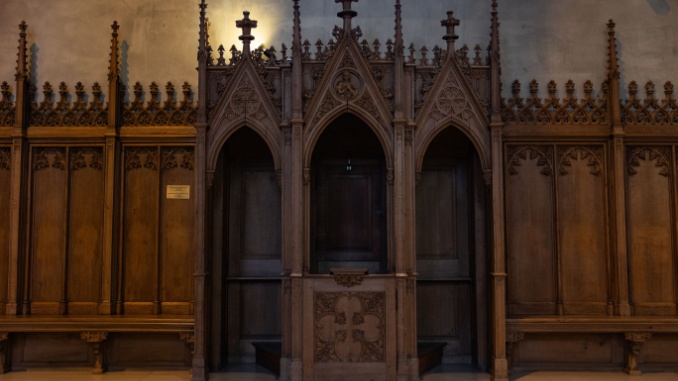
The dispute over Travers’ proposal has particular implications for Catholic priests because Catholic canon law declares the sacramental seal of confession inviolable and prohibits a confessor from disclosing what a penitent reveals during the sacrament.
The Arizona Legislature is scheduled to begin its next regular session in January, when Travers said she intends to renew the proposal.
Matthew Holloway is a senior reporter for AZ Free News. Follow him on X for his latest stories, or email tips to Matthew@azfreenews.com.