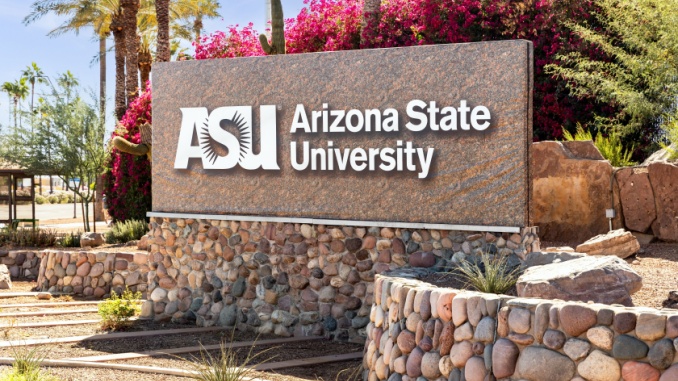
An Arizona State University (ASU) professor is making the case that Americans are wrong to view Islamic terrorists abroad as terrorists.
Associate history professor Alexander “Alex” Avina also qualified violence as a moral and natural right to resisting tyranny and oppression in the “Psychic Militancy” podcast.
“The Iranian propaganda is helping us, too,” said Avina. “You can critique Zionism, you can critique the genocide in Gaza, but can you make that next leap forward and say, these people do have an actual right to resist tyranny via armed struggle, because that’s the only way to get rid of colonialism[.]”
🚨 “Iranian propaganda is really helping us,” Sinwar’s “political theory,” and no condemnation of terrorist groups — Inside an "anti-imperialist" discussion featuring an @ASU professor
On Lara Sheehi’s Psychic Militancy podcast, Sheehi, a former GWU professor, spoke with former… pic.twitter.com/Nqw7pxIQVW
“Psychic militancy” refers to an unyielding form of resistance against political systems perceived as violent. Most adherents of this school of thought focus on resisting that which they perceive to be imperialism, settler colonialism, and capitalism.
Avina described America as a “genocidal, Epstein empire,” accusing the Trump administration of “waging mass death, and using mass amounts of violence against civilian populations” as remedies to contradictions of policy.
Avina said the present day is defined as a “socialism vs. barbarism struggle” to avoid genocide, ecological collapse, and environmental degradation.
“It feels like we’re forced into a murder-suicide pact,” said Avina.
Avina argued those in the Middle East acting on Islamic beliefs weren’t terrorists, but defenders against an existential threat against humanity.
“What we’re witnessing right now is a lot of revolutionary cunning from people who we’ve been socialized in this country to continuously misidentify as dangerous terrorists, as barbarians, as somehow antithetical to our ‘civilizational values’,” said Avina.
Avina also joined in the praise of the late Hamas terrorist leader Yahya Sinwar.
On the topic of those allegedly mislabeled as terrorists, Avina challenged the American narrative on South American drug cartels, calling it “bullshit.” Avina said the proper perspective was to understand U.S. drug demand as to blame for cartel violence in Mexico.
“If there wasn’t the world’s largest market for licit and illicit drugs north of the Mexican border, if that didn’t exist, then we wouldn’t see the type of violence we would see today,” said Avina. “[Media reporters] don’t get at the structural and historical reasons of this type of violence, and it’s because we are the world’s largest narco-state.”
Avina argued Americans need to understand “basic and historical education” that America is based on violence, torture, suffering, disappearances, and systematic murder of migrants. Avina also said the lack of support for Palestinians was rooted in racism.
“This is a history of [American] sovereignty,” said Avina. “Can you provide the historical and political coordinates for a nation that has been so thoroughly indoctrinated in racism and Islamophobia and other types of ideological edifices that prevent them from seeing that the struggle of Palestinians for self-determination is a very human one?”
Avina has previously extolled the virtues of violence within political discourse.
Last fall Avina advocated for physical attacks on the right in the “Millennials Are Killing Capitalism” podcast responding to Charlie Kirk’s assassination.
“Today I read a quote by the writer Roberto Bolano where he says there’s a time for reciting poetry and there’s a time for fists, and this is definitely a time for fists,” said Avina.
Avina is the brother-in-law of Rep. Juan Ciscomani (R-AZ-06).
The Arizona superintendent of schools is urging Gov. Katie Hobbs to lift a financial burden for schools.
Hobbs has yet to decide on a bill, SB 1142, allowing Arizona schools to participate in a new federal school tax credit opportunity. Superintendent Tom Horne says the governor needs to sign the bill, or else Arizona schools will lose out on critical funding.
The pending legislation wouldn’t come at a cost to the state, and it could potentially provide up to $6 billion more to public, charter, and private schools.
“Any school could establish such a scholarship organization to accept contributions and bring more money to the classroom,” said Horne. “It does not cost the state any money and would increase funding for education.”
Horne mentioned that another prominent Democratic governor has backed this federal program.
“This bill benefits students in public district schools, charters, and every other school setting,” said Horne. “[Gov. Hobbs] should join fellow Democrat Governor Jared Polis of Colorado in supporting this program.”
Unlike Hobbs, the Colorado governor has expressed support for school choice. One other Democratic governor, Josh Stein of North Carolina, has opted into the program.
The Democratic governors of Kansas, Kentucky, North Carolina, and Wisconsin all vetoed opting into the program.
State Sen. Shawnna Bolick (R-LD2) sponsored the bill. It passed both chambers without support from any Democratic lawmakers, and was sent to Gov. Hobbs on Wednesday.
Arizona House Democratic lawmakers said they opposed SB 1142 because it doesn’t establish enough oversight of the distribution of funds. Some characterized it as a wrongful diversion of public funds from public schools, insisting it would ultimately impact the state general fund. However, this program derives its funds from a federal tax credit.
Last year, Congress included the federal school tax credit program within the FY2025 reconciliation act (the “One Big Beautiful Bill Act”). The program launches January 1, 2027.
The federal legislation allows taxpayers to donate up to $1,700 annually to state-recognized Scholarship Granting Organizations (SGOs) that issue grants to cover eligible school expenses for certain students like books, supplies, tutoring, special needs services, computers, internet access, tuition, fees, room and board, uniforms, and transportation.
With that donation potential, Arizona schools could see up to $6 billion in extra funding. (The Arizona Department of Revenue reported over 3.5 million individual income tax returns in 2023).
Only students whose family income falls below 300 percent of their area median income would qualify for SGO grants.
The federal legislation requires SGOs to be 501(c)(3) nonprofits, provide scholarships to 10 or more students who don’t attend the same school, spend at least 90 percent of revenue on qualifying scholarships, and prioritize scholarships first for students who have received scholarships in previous years and then for siblings of such students.
Should Gov. Hobbs approve Arizona’s participation in the program, the Arizona Department of Revenue would administer the federal SGO credit and approve SGOs.
ADOR would submit a list of certified SGOs to the Secretary of the Treasury annually and post the list on the ADOR website.
AZ Free News is your #1 source for Arizona news and politics. You can send us news tips using this link.
A Phoenix-area school district instituted a new policy requiring oversight of books in the classroom.
Queen Creek Unified School District (QCUSD) began enforcing the policy in January after its governing board approved it unanimously in December.
The policy required the district to restrict general access to materials containing sexually explicit content within school and classroom libraries; develop procedures for site-level review, inventory, and parental access to the inventory list of all classroom library collections; and establish an accessible opt-out procedure for school or classroom library materials not directly related to content, curriculum, or standards.
Although Arizona law has long prohibited exposing children to sexually explicit materials, Arizona libraries and schools continued to offer books containing sexually explicit materials under the defense of the necessity of educating children on topics of sexuality and identity.
Books with sexually explicit content offered to minors in the past by school libraries throughout the state have included titles popular nationwide: “All Boys Aren’t Blue” by George M. Johnson, “Gender Queer: A Memoir” by Maia Kobabe, “The Bluest Eye” by Toni Morrison, “The Perks of Being a Wallflower” by Stephen Chbosky, “Tricks” by Ellen Hopkins, “Looking for Alaska” by John Green, “Me and Earl and the Dying Girl” by Jesse Andrews, “Crank” by Ellen Hopkins, “Sold” by Patricia McCormick, and “Flamer” by Mike Curato.
QCUSD Board member Kelli Anderson introduced the classroom library oversight policy after recognizing that district policy on oversight extended only to school library books. In a press release, Anderson reported that the primary complaint from parents concerned the books brought into classrooms.
“Before this policy, complaints about classroom books were the number one issue I heard from parents,” said Anderson. “Since it went into effect, I have received zero complaints from parents.”
Anderson said QCUSD’s action should be adopted by all other districts in the state as best practice.
“[A]fter listening to parents and reviewing our policies, it was clear there was a gap that needed to be addressed,” stated Anderson.
Arizona Women of Action (AZWOA), a parental advocacy nonprofit and Arizona chapter of America’s Women, agreed with Anderson’s assessment.
“This policy closes a major loophole and restores trust between schools and families,” stated AZWOA in a press release. “It empowers parents, supports teachers, and ensures students are learning in environments that are transparent and accountable.”
According to AZWOA, at least one parent has already reported seeing a difference in school handling of inappropriate books. That parent allegedly told AZWOA that his elementary-aged child’s school contacted him prior to the policy compliance deadline to recover a classroom library book deemed inappropriate under the new policy.
The parent also reportedly said he wasn’t aware his child had access to such materials in the classroom.
At the beginning of last summer, the Maricopa County Library District piloted a “parental choice” program at the Queen Creek library enabling parents to choose which books, if any, their child may not check out.
Months later, in September, the county removed sex education books from the children’s sections to the adult non-fiction sections at 12 of its 14 libraries.
AZ Free News is your #1 source for Arizona news and politics. You can send us news tips using this link.
Arizona’s school choice program allows participants to use funds to pay for college, per a reminder from the state’s top elected education official.
Tom Horne, Arizona Superintendent of Public Instruction, promoted this usage of Empowerment Scholarship Account (ESA) program funds in an interview with The Center Square last week.
Horne said this option was more than just a benefit to families. The superintendent made the case that higher education directly correlated to strengthening Arizona’s economy.
“We want kids to go to college,” said Horne. “The percentage of college-educated students in a state has something to do with the success of its economy.”
This is not a new allowance. Arizona law has allowed this use of school choice funds since universalization occurred in 2022 under the former governor, Doug Ducey. Arizona was the first state to open school choice to all students.
Over 102,800 students have enrolled in the ESA program for the 2025-2026 school year, as of last week.
Horne is touting the benefits of the ESA program amid attacks from various special interests.
The Arizona Department of Education (AZED) is under pressure from a major media outlet, 12News, and anti-school choice organizations over misspending rates within the program.
12News reported that 20 percent of ESA expenditures were improper purchases. AZED reported the misspending rate amounted to less than two percent.
12News argued both figures can be true depending on the context, but Horne argued that was not the case. He said the actual amount of fraudulent purchases out of all misspending was 0.3 percent.
“The people who’ve made these criticisms fundamentally did not understand. To start with, [12News] said there was 20 percent fraud,” said Horne in a KTAR interview last month. “The 20 percent figure was the percentage of purchases under $2,000 to see if they were okay or not. But only 20 percent of that 20 percent were improper. That’s four percent. And the other thing to know is, they’re not all fraud. A lot of times it’s innocent mistakes.”
While Horne continues to defend and promote the merits of the ESA program in its present form, both supporters and detractors of the program argue changes need to be made.
Horne’s primary election challenger, Treasurer Kimberly Yee, announced last month that reforms were needed to reduce improper spending, starting with a switch in the reimbursement vendor.
Regardless of the outcome of this election, either Horne or Yee may face new challenges from school choice opponents.
The benefit to pay for higher education through the school choice program, and universalization as a whole, may be limited later this year pending the outcome of a ballot initiative seeking to place an income cap on eligibility.
Under the initiative, only families earning less than $150,000 a year would qualify to enter the ESA program. That income ceiling would be adjusted annually.
Under that income cap, approximately 15 percent of current ESA students would be removed from the program.
The initiative would also further restrict the list of allowable purchases. All tutors, schools, and service providers would be required to fall under State Board of Education oversight, and pay a fee and register annually with AZED to receive ESA funds.
It would also eliminate the current ability for families to rollover funds. All unspent funds would be recouped and returned to the state. That would, effectively, end ESA students’ ability to set aside funds over the years to pay toward college.
The Arizona Education Association and Save Our Schools Arizona are behind the ballot initiative, “Protect Education Act,” filed last month (this version superseded a previous version, the “Protect Education, Accountability Now Act”).
The initiative requires nearly 256,000 signatures to make the ballot.
AZ Free News is your #1 source for Arizona news and politics. You can send us news tips using this link.
The Arizona Board of Regents (ABOR) grew by two new members last week.
On Monday, Gov. Katie Hobbs appointed Michele Halyard, an oncologist specializing in breast cancer, and Steve Peru, formerly Coconino County’s manager.
“Dr. Michele Halyard is a leader in medical education who will provide expertise to the Board as the universities work to meet the state’s healthcare needs,” said Hobbs in an announcement. “Steve Peru is a longtime public servant with decades of experience who will bring his pragmatic leadership and focus on accountability to the Board. Our public university students deserve the best, and I’m confident Michele and Steve will help ensure the continued excellence of higher education in Arizona.”
Halyard’s past and present accomplishments included in Hobbs’ announcement referenced a fellowship with the American Society for Radiation Oncology, professorship of radiation oncology, vice deanship of the Mayo Clinic Alix School of Medicine, board membership with the Arizona Community Foundation, and membership with the Arizona Bioscience Roadmap Steering Committee.
One thing not mentioned in Hobbs’ announcement was Halyard’s career-long DEI goals on reforming health care with health equity.
Halyard has spent her 40 years in medicine advocating for affirmative action and health equity in medicine, according to Mayo Clinic profiles on the doctor published in 2023 and 2024.
Halyard expressed her belief in the existence of structural racism in medicine, and its disparate impacts on patient suffering and mortality.
“I didn’t see a lot of people of color at the clinic either working or as patients, and I really thought what a shame that was because of the preeminence of healthcare that we deliver,” said Halyard. “People who, perhaps, feel shut out from the healthcare system, people who experience structural racism that prevents them from getting in for the best care, that really results in excess death, excess suffering among populations of people.”
It was under Halyard that Mayo Clinic initiated “antiracism efforts” by using affirmative action in recruiting.
Halyard’s husband is Phoenix City Councilman Kevin Robinson, a Democrat and former Phoenix Police Department assistant chief.
Peru’s historic dedication to DEI initiatives wasn’t mentioned in Hobbs’ press release, either.
Shortly after joining Coconino County as their manager, Peru took on a years-long effort by the county to recruit an individual for a DEI directorship position.
In the weeks following Trump’s inauguration last year, Peru posted a comment agreeing with another colleague’s LinkedIn post advocating for DEI in K-12 in the wake of the new administration’s policies.
Prior to joining Coconino County, Peru was the chief development and government relations officer at Coconino County Community College and former CEO and president of United Way of Northern Arizona.
Last September Hobbs appointed Jimmy McCain, the youngest son of John McCain, to ABOR. McCain’s appointment stirred controversy, not only for his conflict with Arizona legislative leaders and President Donald Trump, but with his role at a company that was a key sponsor of Hobbs’ inaugural committee.
Hobbs has also appointed Lee Stein, former assistant U.S. attorney and special assistant attorney general within the Arizona Attorney General’s Office.
The governor’s two picks for student regents have backgrounds in gun control advocacy. Their contributions to ABOR include expanding time and resources for students’ mental health.
AZ Free News is your #1 source for Arizona news and politics. You can send us news tips using this link.
A bill advancing through the Arizona Legislature would require schools to notify parents and staff within 24 hours of serious threats or incidents involving violence on campus.
House Bill 4109 was approved by the Arizona Senate Rules Committee last week and now heads to the full Senate for consideration. The measure previously passed the Arizona House of Representatives in early March by a 35–17 vote, with seven members abstaining and six Democrats joining Republicans in support.
Sponsored by Rep. Lydia Hernandez (D-LD24), the bill would require schools to notify parents and employees within 24 hours of “life-threatening violence, threats of life-threatening violence, or threats that involve a deadly weapon or dangerous instrument.”
Schools would also be required to provide information about the nature of the incident and how administrators responded.
Under the legislation, law enforcement would be required to be notified immediately following serious threats or acts of violence. Schools would also be required to confiscate any deadly weapons and hold them until police arrive.
HB 4109 would further require school districts to submit annual reports detailing campus safety incidents, including lockdowns, shelter-in-place events, evacuations, weapon-related incidents, and referrals to law enforcement. Districts would also be required to provide a summary of their safety policies.
The bill mandates that school districts adopt a formal public safety policy outlining emergency procedures and designating the superintendent as the responsible authority for implementation.
Superintendents and school board members could face misdemeanor charges for failing to comply with the law’s requirements. Superintendents may be charged if they fail to notify parents, contact law enforcement, or follow established procedures after serious threats or violence. School board members could face charges if they fail to adopt a safety policy or retaliate against individuals who report violations.
Arizona Superintendent of Public Instruction Tom Horne told The Center Square that schools in the state face ongoing safety concerns, citing 500 recorded incidents in 2025 involving students bringing firearms onto campus.
“Schools that don’t yet have police are playing Russian roulette with the lives of the students and the teachers and the staff,” he said.
Horne said the number of police officers assigned to schools has increased from 190 in 2023 to 565 and encouraged schools to work with the Arizona Department of Education to expand campus security coverage.
Horne has repeatedly urged school leaders to allow the Arizona Department of Education (AZED) to “provide them with police officers.” He added, “We pay for the police officers. It doesn’t cost them anything.”
Newsrooms: Video of Horne comments is available here: https://t.co/2VQXTI0ccR For immediate release: March 9, 2026 Contact: Communications@azed.gov
Horne says recent gun incident at elementary school shows need for added safety funds Legislature, Governor to consider more… pic.twitter.com/MObTWTELjX
— Arizona Department of Education (@azedschools) March 9, 2026
“We need to do everything we can to protect the safety of our students, teachers [and] staff,” Horne said. He added that reporting requirements would provide transparency about incidents involving weapons or threats on school campuses.
Horne blasts Democrats for voting against school safety bill Legislation would require schools to report life-threatening incidents.
State schools superintendent Tom Horne says Democrats who voted against HB 4109, a bill requiring schools to report life-threatening on-campus…
— Arizona Department of Education (@azedschools) March 26, 2026
In a statement on March 26, Horne was critical of Democrat legislators who voted against the measure, stating, “It is reckless and irresponsible for these legislators to ignore the reality that school campuses are at risk and need every resource at their disposal to protect lives.”
“It is ironic that the bill is sponsored by Democrat Representative Lydia Hernandez,” he added. “She deserves credit for this effort. I am pleased the bill passed out of committee even with the opposition from members of her own party.”