by Staff Reporter | Mar 16, 2025 | News
By Staff Reporter |
Congressman Abe Hamadeh convinced U.S. House leadership to ban circulation of Chinese Communist Party (CCP) propaganda styled as a newspaper.
China Daily will no longer be distributed at the House, per a Tuesday statement from House Administration Chair, Rep. Bryan Steil, and Select Committee on the Chinese Communist Party Chair, Rep. John Moolenaar.
“We are pleased to announce that China Daily will no longer be circulated by National News to House offices,” said Steil and Moolenaar. “We took action to directly block the Chinese Communist Party from using the halls of the People’s House to spread its propaganda. We appreciate National News’s swift cooperation on this important issue.”
“Chinese propaganda has no place in the halls of Congress. In coming weeks, China Daily will no longer be circulated by National News to House offices,” stated Chairman Steil. “There is no room for foreign influence in the People’s House. I thank Rep. Hamadeh for bringing this issue to the Committee’s attention and I appreciate National News’s swift work on this matter.”
National News included China Daily within the daily bundle of major publications provided to congressional offices, unless a particular office opted out. Per the Committee on House Administration, National News will “wind down and cease distribution” of China Daily at the Capitol.
An end to the circulation of the CCP’s paper within the House was one of Hamadeh’s first priorities upon entering Congress. Hamadeh introduced a resolution to get rid of China Daily and all other CCP-controlled publications last month.
China Daily constitutes a “foreign influence campaign” per Hamadeh’s resolution.
“China Daily is registered as a foreign agent under the Foreign Agents Registration Act of 1938 and operates as a direct propaganda outlet of the Chinese Communist Party’s Publicity Department,” stated the resolution. “[T]he distribution of foreign propaganda materials within the House of Representatives undermines institutional integrity and enables malign foreign influence operations [and] the presence of Chinese Communist Party-controlled publications in official House facilities legitimizes foreign propaganda efforts[.]”
Hamadeh’s resolution didn’t restrict the private receipt or public research access of those publications by House members and employees, however.
China Daily is an English-language newspaper owned by the CCP’s Central Propaganda Department. It has been registered under the Foreign Agents Registration Act as a foreign agent since the 1980s.
The paper maintains branch offices for “China Daily USA” in New York City, New York; San Francisco, California; Los Angeles, California; Seattle, Washington; and Washington, D.C. It also sponsors an insert, China Watch, for distribution within other American newspapers, such as The New York Times, The Wall Street Journal, and The Washington Post.
The editor-in-chief and president of China Daily USA, Tao Ji, has spent his entire career with China Daily and another offshoot, China Daily United Europe (United Kingdom).
Although Hamadeh’s resolution has yet to be adopted, the congressman’s public remarks about his legislation and China Daily spurred action within House leadership.
Shortly after Hamadeh initially introduced his bill to ban China Daily, he declared in an interview with the Epoch Times the publication to be an attempt by an enemy of the U.S. to influence its governance.
“It’s propaganda by a foreign government that’s trying to influence the highest echelons of the United States government, and it’s unacceptable,” said Hamadeh.
AZ Free News is your #1 source for Arizona news and politics. You can send us news tips using this link.
by Staff Reporter | Mar 15, 2025 | News
By Staff Reporter |
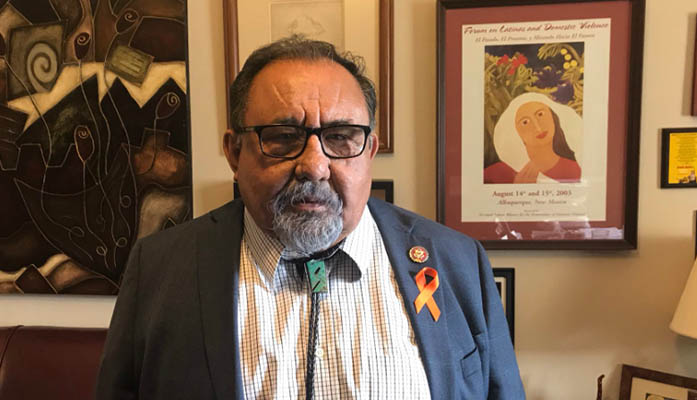
Democratic Congressman Raúl Grijalva passed away from complications with cancer on Thursday morning.
Grijalva was 77 years old at the time of his passing. The representative took up his congressional seat in 2003. This term was promised to be Grijalva’s last, per the congressman.
It appears staff didn’t get the memo about Grijalva’s passing. Hours before Grijalva’s office issued an official statement on X about his passing, Grijalva’s staff published a post criticizing the Trump administration.
The last post on Grijalva’s account prior to the announcement of his passing concerned the mass layoffs essentially halving the Department of Education (ED) workforce. Grijalva’s staff criticized President Donald Trump’s ED cleanup as “reckless,” “selfish,” and “illegal,” claiming students’ aid programs, civil rights protections, and disability supports were jeopardized.
Grijalva’s staff claimed, specifically, the ED firings would deprive 26 million students of critical funding, 12 million students of career and technical education resources, 10 million low-income students of higher education assistance, and 7.5 million Individualized Education Plan (IEP) students of special education services.
These estimates were pulled directly from the American Federation of Teachers (AFT), the affiliated international union of the American Federation of Labor and Congress of Industrial Organization (AFL-CIO). The AFT consists of over 1.3 million members and 3,000 local affiliates nationwide. However, these estimates were not based on ED layoffs but rather a complete abolition of ED — something that has not yet taken place.
The posting raises concerns over who was representing Grijalva’s constituents during his last few years in office after his announced lung cancer diagnosis in 2023 — especially due to the fact Grijalva missed a vast majority of major votes since then.
Grijalva stepped down as ranking member of the Natural Resources Democrats in December.
Not only did Grijalva step down from key leadership positions — he remained absent from Congress for most of this last legislative session and was absent for this session with the exception of the first day (69 out of 71 roll call votes, or about 97 percent of votes). Grijalva didn’t cast a vote on legislation this session, save for his vote for Democratic Rep. Hakeem Jeffries for House Speaker at the start.
Grijalva previously defended his lack of voting in remarks to the press because “Republicans are in charge” and his vote wouldn’t matter anyway.
“They’re inconsequential because the Republicans are in charge and it’s the worst performing Congress in decades, if not a hundred years,” said Grijalva.
Although Grijalva’s health was in decline amid his ongoing cancer treatments last summer, Grijalva was among the early few Democratic leaders to call on former President Joe Biden to step down from his reelection bid last year. Grijalva said it was a duty for those unfit to serve to preserve the seat for their party by dropping out of the race.
“If he’s the candidate, I’m going to support him, but I think that this is an opportunity to look elsewhere,” said Grijalva to the press. “What he needs to do is shoulder the responsibility for keeping that seat — and part of that responsibility is to get out of the race.”
These remarks to the media were reported at the time to be a sharp and inexplicable departure from Grijalva’s messaging on social media supporting Biden and criticizing naysayers of Biden’s candidacy just the week prior.
In light of the fact that Grijalva’s staff posted on X under his name hours after he died on Thursday, it seems Grijalva’s staff may have been more in charge of the office for longer than most constituents were aware.
Following the passing of Grijalva, Governor Katie Hobbs issued a proclamation calling for a special primary election to fill the vacancy for Congressional District 7 on Tuesday, July 15, 2025, and a special general election on Tuesday, September 23, 2025.
Federal law (2 U.S.C. § 8) provides that special elections to fill vacancies in the U.S. House of Representatives are held under applicable state laws.
Under A.R.S. § 16-222(B), if the next regular general election is not to be held within six months from the date of the occurrence of the vacancy, the Governor shall call a special primary election to be held 120 to 133 days after the vacancy and a special general election to be held 70 to 80 days after the special primary election.
AZ Free News is your #1 source for Arizona news and politics. You can send us news tips using this link.
by Staff Reporter | Mar 15, 2025 | News
By Staff Reporter |
A federal judge ordered the Department of Government Efficiency (DOGE) to turn over records in Arizona’s case against the Trump administration.
U.S. District Judge Tanya Chutkan, an Obama appointee, issued the order on Wednesday in State of New Mexico v. Elon Musk for the United States District Court for the District of Columbia. Arizona joined 13 other Democratic attorneys general in challenging DOGE; Attorney General Kris Mayes was the one to file the motion for discovery (re:45) that prompted Chutkan’s order.
“The American people deserve transparency and we will get it,” said Mayes of the order.
Chutkin exempted President Donald Trump from the discovery requests, and limited records to only those information and materials regarding agencies, employees, contracts, grants, federal funding, legal agreements, databases or data management systems pertaining to the plaintiff states (in addition to Arizona, this consists of California, Connecticut, Hawaii, Maryland, Massachusetts, Michigan, Minnesota, Nevada, New Mexico, Oregon, Rhode Island, Vermont, and Washington).
The requested records:
- All DOGE and DOGE Temporary Organization planning, implementation, and operational documents, and operational documents concerning: eliminating or reducing the size of federal agencies; terminating employment of federal employees or placing such employees on leave; or cancelling, freezing, or pausing federal contracts, grants, or other federal funding;
- All DOGE and DOGE Temporary Organization planning, implementation, and operational documents regarding obtaining access, using, or making changes to federal databases or data management systems;
- All documents containing lists, charts, or summaries that DOGE personnel or Musk have created, compiled, or edited reflecting the planned or completed cancellation of federal contracts, grants, or other legal agreements;
- All documents containing lists, charts, or summaries that DOGE personnel or Musk have created, compiled, or edited regarding the termination of federal employment, placement of federal personnel on leave, or regarding interviews of federal personnel for the purpose of making an assessment about whether to put them on leave or terminate their employment.
- All interagency agreements, memoranda of understanding, memoranda of action, or other similar documents between: DOGE, the DOGE Temporary Organization, one or more DOGE Teams, and/or DOGE personnel, and any federal agency, component, office and/or other federal organization;
- Identification of every individual who has served as DOGE Administrator or as the functional head of DOGE, including in an acting capacity, since January 20, 2025, and the dates served in that capacity. As part of this response, identify all individuals with authority to hire or terminate employment of DOGE personnel since January 20, 2025;
- Identification of every individual serving as DOGE personnel. For each person, identify their title; whether they are part of a DOGE Team at an agency, and if so, what agency; all individuals to whom they directly report; and (4) who hired them;
- Identification of all federal agencies for which DOGE personnel or Musk: cancelled or directed the cancellation of federal contracts, grants, or other similar instruments, or plan to do so between now and June 1, 2025, or terminated employment or placed on leave, or directed the termination of employment or placement on leave, of federal employees, or plan to do so between now and June 1, 2025. For each agency identified, identify each contract, grant, or other agreement cancelled and the number of employees whose employment was terminated or who were placed on leave pursuant to the direction of DOGE personnel or Musk, and the components of the agencies at which those employees who were terminated or placed on leave worked;
- Identification of all federal agencies for which DOGE personnel or Musk: directed the cancellation of federal contracts, grants, or other similar instruments, or plan to do so between now and June 1, 2025, or directed termination of employment or placement on leave of federal employees or plan to do so between now and June 1, 2025. For each agency identified, identify each contract, grant, or other agreement cancelled and the number of employees whose employment was terminated or who were placed on leave pursuant to the direction of DOGE personnel or Musk, and the components of the agencies at which those employees who were terminated or placed on leave worked;
- Identification of the databases and data management systems at federal agencies to which DOGE personnel have obtained access or plan to obtain access between now and June 1, 2025. For each database and data management system identified, summarize the training received and security measures taken by DOGE personnel prior to accessing each system; DOGE’s purpose in accessing each system; the actions taken by DOGE personnel after accessing each system; and whether any data from the system has been transmitted outside the agency.
Chutkan ordered the release of the records within 21 days of the order (April 2, 2025).
AZ Free News is your #1 source for Arizona news and politics. You can send us news tips using this link.
by Staff Reporter | Mar 13, 2025 | News
By Staff Reporter |
When 26-year-old Erzsi Moffatt first sought out a volunteer opportunity at Hope Pregnancy Resource Center in Flagstaff, Arizona, she had no idea it would lead to something much bigger. What started as a role helping parents access essential family care quickly evolved into a larger mission—one that she and her 24-year-old brother, Jedidiah Lyons, would take statewide. Recognizing the overwhelming need for baby essentials, they founded The Dandy Project, a nonprofit dedicated to making parenthood more accessible by providing car seats, strollers, diapers, and other necessities to families in need.
How It All Started
While seeking to volunteer at Hope Pregnancy Resource Center in Flagstaff, Arizona, Erzsi Moffatt found herself in a position to be able to work as their Boutique Manager. Since 1977, the center has provided free and confidential services, including pregnancy tests, ultrasounds, STI testing, and options counseling. It also offers parenting classes, maternity and baby supplies, and resources to help parents navigate unplanned pregnancies with confidence and support.
In this role, she assisted clients by providing essential supplies such as formula, diapers, baby equipment, and more. As she became more involved, she invited her brother, Jedidiah Lyons, to volunteer at the center, where he began teaching workshops on life skills, like budgeting and resume building.
During their time there, Erzsi and Jedidiah witnessed firsthand the meaningful impact of these services, seeing how the center’s support helps struggling parents and their children thrive.
Erzsi’s husband, Stephan, a golf professional in the community, received a career opportunity that required their family to relocate to Phoenix. While excited for her husband’s growth, Erzsi couldn’t help but feel sad to close her chapter at Hope Pregnancy Resource Center.
After sharing the news with her brother, Jed, they discussed wanting to leave a lasting contribution before departing and were reminded of the center’s long waitlist for car seats. Recognizing an opportunity to help, Jed—an entrepreneur with a background in assisting others in starting businesses—suggested they tackle the issue using surplus overstock sales, a process retailers use to cut costs on online returns and excess inventory.
Putting their heads together, they identified a vendor that allowed them to source car seats and other baby essentials at a fraction of their retail value, helping to significantly reduce the waitlist and support families in need.
Knowing that many other Pregnancy Resource Centers like Hope existed across the state, Erzsi and Jed decided to take their concept and start their own non-profit. In September 2023, they founded The Dandy Charitable Foundation, also known as The Dandy Project—a 501(c)(3) public charity with a mission to “protect, empower, and support those who do the same for the next generation.”
We had the opportunity to sit down with the brother-sister duo to learn more about their journey and the impact they hope to make.
Q: What made you decide to take on this endeavor?
Erzsi: We realized that we already had the resources to start helping families right away and trusted that we’d figure out the rest as we went. Jed and I have always embraced challenges and followed our own path, so we saw this as an opportunity to put that mindset to good use. At the very least, we knew we could make somewhat of a difference for families in need so that was reason enough to start.
Q: What inspired the mission statement for The Dandy Project, and how did you shape it?
Erzsi: Well, Jed and I spent a lot of time discussing what we wanted The Dandy Project to achieve, and we kept coming back to the growth we witnessed in clients at Hope as they navigated their journeys to parenthood. Seeing them rise to the challenge and transform through the experience is what ultimately inspired us to take on this endeavor.
As we reflected on the most impactful aspects of that growth, we realized it all came down to the ability to protect, empower, and support their own family—especially in unexpected circumstances. That understanding became the foundation of our mission.
Q: Your mission statement encompasses a broad range of support. Can you share specific ways The Dandy Project fulfills this mission in practice?
Jed: Hope Pregnancy Resource Center operates in the non-urban community of Flagstaff, Arizona. While it’s not exactly rural, it still faces unique challenges that a metropolitan center wouldn’t. We had a solid understanding of the operational needs at Hope, but knowing that many other centers existed across the state, we wanted to leave room to develop additional programs as we built relationships and identified broader needs.
I personally believe we fulfill our mission best by alleviating the financial burden that comes with having a baby. Through our program, we’re able to provide a car seat, stroller, crib, and six months’ worth of diapers and wipes to a client—all at no cost to them. What would typically cost around $1,800, we’re able to source for just $100 per client, making a significant impact on struggling families.
Q: Who does The Dandy Project primarily serve, and what does a typical client look like?
Jed: We’re fortunate that our programs are very cost-effective, which allows us to operate on a no-questions-asked basis for client intake. If someone applies for support, we provide whatever resources we have available—so ultimately, we serve anyone who is expecting or already has children.
When we partner with organizations, we focus primarily on rural communities, which means much of our outreach serves Arizona’s Native American populations. However, the clients who come to us directly come from all walks of life, and most are based in the Phoenix metro area.
Q: What is the process for clients to receive supplies from The Dandy Project?
Erzsi: Clients can apply for support directly through our website, DandyProject.org. Since we store the items in our garage and local unit, we personally drop them off to local clients ourselves.
However, distributing supplies to our community partners across the state is a bit more complex. In our first year, we were truly bootstrapping our distribution system—relying on friends, family, and our personal vehicles to transport supplies to the rural communities we serve.
Last year, we celebrated our first anniversary with a banquet, and thanks to fundraising from that event—along with additional support from a fundraiser hosted by Calvary Oro Valley Church in Tucson—we were able to purchase a used Ford E350 cargo van. This has made our distribution process significantly more cost-effective and efficient.
Q: After 18 months in operation, how would you measure the impact The Dandy Project has made so far?
Erzsi: We’re proud to share that in 2024 alone, we directly supported over 312 families and reached more than 1,000 additional families through our community partners. Seeing the tangible difference we’ve been able to make in such a short time has been incredibly exciting.
Q: What’s next for The Dandy Project?
Erzsi: Right now, we primarily operate in the northern part of the state, but we’re eager to expand further into southern Arizona, particularly the greater Tucson area. Looking ahead, I hope to become The Dandy Project’s first official employee and take our model even further, maybe reaching families even beyond Arizona.
Q: How can people get involved and support The Dandy Project?
Erzsi: Financial donations are always needed, and we are an Arizona Qualified Charitable Organization (QCO). This means that anyone filing for the 2024 tax year can take advantage of the QCO tax credit, reducing their tax liability dollar for dollar—up to $420 for individual filers or $840 for those filing jointly.
Our most immediate need is always volunteers. If you or someone you know frequently travels to communities like Flagstaff, Show Low, or Prescott, we would be incredibly grateful for your help in delivering supplies to our community partners. Your support—whether financial or hands-on—makes a real difference for families in need.
AZ Free News is your #1 source for Arizona news and politics. You can send us news tips using this link.
by Staff Reporter | Mar 13, 2025 | Education, News
By Staff Reporter |
A new dashboard tracks the school closures taking place throughout Arizona.
The dashboard comes from the Common Sense Institute (CSI), a nonpartisan organization which primarily produces research on Arizona’s economy.
Since January, those schools which have closed or consolidated operated in the Maricopa, Navajo, and Yavapai counties within the following school districts: Cave Creek, Phoenix Elementary, Mesa Unified, Isaac, Edkey Inc. – Sequoia Village, and American Heritage Academy. Schools closed or consolidated included Lone Mountain Elementary School, Desert Sun Academy, Dunbar School, Heard School, George Washington Academy, and American Heritage Academy Camp Verde.
Data for the dashboard came from the Auditor General and Arizona Department of Education.
CSI also published a line graph chart detailing spending, inflation, enrollment and student proficiencies in math and reading from 2010 to 2024. This data came from the Arizona State Library, Arizona Department of Education, and Joint Legislative Budget Committee.
CSI director of policy and research, Glenn Farley, said the dashboard data indicates a pattern of declining public school enrollment rather than indefinite growth. Per this dashboard, school enrollment peaked over a decade ago.
“Arizona’s public school system was built on the assumption that enrollment would continue to grow indefinitely, but the reality has changed,” said Farley. “With district enrollment peaking over a decade ago and alternative schooling options gaining traction, closures are a natural consequence of a system adjusting to new realities.”
CSI’s dashboard reflects a severe disparity between public school spending, enrollment, and student proficiencies in math and reading. While spending increased by 80 percent since 2010, math and reading proficiencies dropped by 13 and nine percent, respectively, and enrollment dropped by one percent.
Spending far outpaced inflation, growing at over twice the rate: while spending increased by 80 percent, though inflation increased by only 36 percent.
CSI also found that the school-aged population departed from the total population trend around 2020 due to demographic changes. Combined enrollment in public kindergarten programs declined 13 percent since the 2010-11 school year, while total public school enrollment grew three percent.
The state’s school choice program, the Empowerment Scholarship Account program, grew to over 87,200 students as of Monday.
CSI clarified that demographic decline wasn’t the sole reason for changes in the school-aged population. CSI reported that charter school enrollment nearly doubled from 2020 to 2022, 55 percent of surveyed private schools experienced enrollment growth in the 2021 to 2022 school year, and homeschooling grew from two to 11 percent of the population during the pandemic (though that number dropped to around six percent in recent years).
An accompanying CSI report declared the disparities in funding, enrollment, and outcomes were signs of disconnect with the current state of enrollment and capacity.
“Charter, private, and home schools have continued growing, but Arizona’s district public school enrollment peaked over a decade ago,” read the CSI report. “A massive injection of new funding and resources over the past few years has led to significant new spending and expansion by these schools, though, which are now having to deal with the consequences of this disconnect between enrollment and capacity.”
AZ Free News is your #1 source for Arizona news and politics. You can send us news tips using this link.