A recent op-ed in the Arizona Republic by the Arizona Center for Economic Progress argued that the legislature’s budget “doesn’t add up” and that Arizona needs a “reality check.” We agree a reality check is in order, but definitely not the kind being offered.
The argument, which has become the standard refrain from the Left on tax policy, is that Arizonans have enjoyed too many tax cuts over the years (the fault of Republican lawmakers), and that this has left the state anemic in revenues and starved of the ability to provide essential government services.
But the average middle-class, tax-paying resident would probably scratch their head at this. They still have roads to drive on. The police still come when they call (except maybe if they live in Tucson). There are still bureaucrats employed to receive their tax filings and permit fees.
No matter how much the Left likes the story that government is running on fumes, people don’t believe it – and their intuition is right, because none of the actual data supports it. The reality is the very opposite. Arizona’s state budget has been ballooning for years. Our welfare programs have never been more riddled with fraud. And governments of every size in the state just keep sizing up. But most concerning about the myth that state government is poor and taxpayers are too rich is that it belies a philosophy that every Arizonan should find alarming…
On Monday, House Republicans put forth what they called a balanced budget of $17.9 billion.
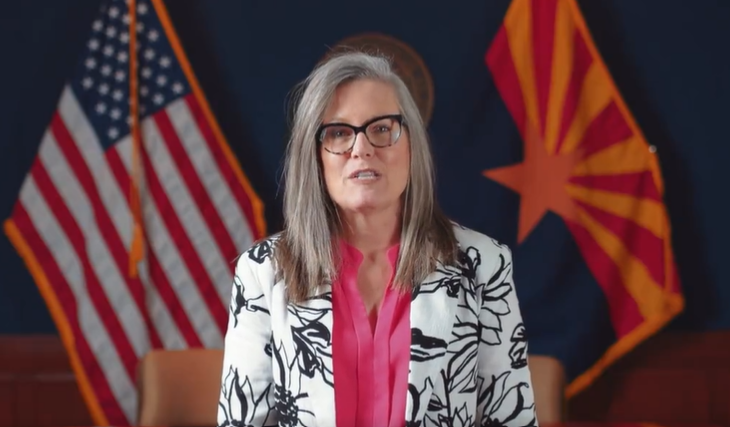
By Tuesday, Gov. Katie Hobbs said the proposal was all but dead.
The leaders of both chambers characterized their budget as uniquely reflective of total conformity with federal tax law — no other states adopted the entire slate of tax cuts — which Hobbs doubted could be accomplished. They estimated tax relief would amount to $1.5 billion over the next three years, and Republicans claim working families would feel the most benefit from the cuts.
“Politics are easy; governing is harder. We chose governing,” said Sen. President Warren Petersen (R-LD14). “We’re moving a budget that cuts taxes, funds core services, shrinks government, includes priorities both sides have raised, and gives Arizona a full path to finish the session.”
As budget talks have failed to progress in a meaningful way, the legislature stagnates under the weight of a bill moratorium.
In a statement issued Tuesday, Hobbs did acknowledge Republicans for working with her to adopt certain components of her preferred budget like middle class tax cuts and reductions to childcare cost. However, she disputed Republican leaders on their claims of fiscal responsibility.
She accused Republicans of siding with “billionaires, data centers, and special interests” as well as “kicking Arizonans off their healthcare and taking food off their tables.” The governor said she won’t engage in negotiations further unless they adopt her preferred budget.
Contentious aspects of the Republican-proposed budget included cuts to state agency budgets, and SNAP and Medicaid program funding.
“Until they also engage in good-faith negotiations rather than attempting to force through a partisan budget, I will be closely monitoring the situation in the coming days to determine whether the legislative majority is willing to negotiate in good-faith bipartisan negotiations and have the bill moratorium lifted,” said Hobbs.
NEW: @GovernorHobbs reacts to the newly released Republican budget: “Just like in Washington, they’re paying for tax breaks for billionaires, data centers and special interests by kicking Arizonans off their healthcare and taking food off their tables.” pic.twitter.com/8UlFIqa5S1
Hobbs also discussed the budget talks during a press conference for a separate topic on Tuesday, Reentry 2030. Hobbs tentatively praised Republicans for some concessions on their part, but generally was critical of them for balking at her $18.7 billion spending plan. A key part of that plan Hobbs hopes to win through in budget talks concerns draining the public land trust to boost K-12 education funding.
“I’m glad to see the Republicans have shown their budget proposal, there’s some things I’m encouraged about in their proposal, but across-the-board agency cuts is not one of them,” said Hobbs. “I’m hopeful that we can get back to the table and start having real conversations about a budget that works for Arizona.”
Legislative leaders have said Hobbs’ proposal is a nonstarter because the Public Land Trust was intended for long-term funding. Hobbs’ plan intends to renew funding through the yet-approved Proposition 123. Senate President Petersen said Hobbs’ plan wasn’t feasible and would push the state $1.5 million further into debt.
“We’re spending about $800 million less than what the governor has proposed, and the governor has proposed to raise taxes,” said House Speaker Montenegro (R-LD29) in an interview with Fox News.
“[H]er math doesn’t work,” said Petersen.
Hobbs has vetoed tax conformity efforts and walked away from budget negotiations multiple times since the start of the year.
The legislature began hearing budget bills on Tuesday during a joint hearing of the Senate and House Appropriations Committees.
AZ Free News is your #1 source for Arizona news and politics. You can send us news tips using this link.
Democrats keep attacking President Donald Trump’s Big Beautiful Bill Act of 2025, as a tax cut for the rich. But the data show that the average family GAINED roughly $2,000 on their lower tax bill for this year. Every Democrat in Congress voted no, even as they complained of a “middle-class affordability crisis.” Maybe that’s because $2,000 is peanuts to rich and famous limousine liberal Democrats. But not for the rest of us.
The goal of the Trump tax cut was simple: strengthen the economy with lower tax rates and let working and retired Americans keep more of what they earn. The early evidence confirms this is exactly what has happened. Initial IRS data shows that almost HALF of filers have already taken advantage of the bill’s middle‑income tax provisions.
Income taxes have become such an ingrained part of American life that many workers barely notice how much is snatched from their paychecks – payroll taxes, federal income taxes, state income taxes, etc. We see the net amount and forget the gross amount is what we actually earned. Because less is now taken out, the Trump tax cut functions like a pay raise.
So who is getting a pay raise from the One Big Beautiful Bill? Three major provisions were deliberately crafted to help working‑class and middle‑class Americans keep more of their hard‑earned dollars.
First, the law eliminated income tax on tipped wages, subject to certain caps. For millions of waiters, waitresses, bartenders, baristas, barbers, hairstylists, DoorDash drivers, tour guides, casino dealers, and counter staff at casual restaurants, this means a substantial share of their income is no longer taxed. In some of these occupations, tips make up more than half of total earnings, so the impact is enormous. These workers may lead rich and fulfilling lives, but none of them qualify as Trump’s “rich friends.”
Second, the bill eliminated federal income tax on overtime pay, again with income limits. This provision frees hourly workers from being taxed when they put in extra hours. Put differently, eliminating tax on overtime reduces the number of hours each day that hourly workers labor not for themselves or their families, but for the government. Given how many Americans are paid hourly, this provision overwhelmingly benefits people who are not wealthy.
Third, the tax bill reduces the tax RATE you pay. This incentivizes more work because the reward for getting a job and working more hours is more money.
Through March 25, more than 85 million individual tax returns had been filed. Of those, 37.5 million — 44% — saw an immediate reduction in their tax bill.
The bill also created a forward‑looking benefit for children: Trump Accounts. These accounts help young Americans begin investing early, giving them a head start on saving for education, starting a business, or building long‑term financial security. Children born between Jan. 1, 2025, and Dec. 31, 2028, are eligible for a $1,000 federal contribution, and early tax data shows strong enthusiasm. Roughly 2.6 million returns established Trump Accounts for more than 4 million children, and nearly one million qualified for the federal contribution.
When we account for all of these tax benefits, what we find is that far from being “tax cuts for the rich,” the One Big Beautiful Bill’s tax provisions actually reduced the tax bill paid by the middle class by roughly 14%. Meanwhile, the SHARE of federal income taxes paid by the richest 10% rose from 70% to 77% and the top 1% share rose from 38% to 40%.
If the rich are now paying a larger share of the tax pie, how is the Trump tax cut “a giveaway to the rich?” Maybe the left calls the Trump tax cut “One Big Ugly Tax Bill” because they want every one of us – not just the rich – to pay more taxes.
Stephen Moore is a contributor to The Daily Caller News Foundation, a senior fellow at America First Policy Institute, and a cofounder of Unleash Prosperity.
January’s jobs report smashed expectations and signals a turning point in the labor market where job creation catches up with broader economic conditions. The report shows 130,000 jobs created, the unemployment rate falling to 4.3%, and labor force participation rising.
Economic growth last quarter was above 4% and is projected to be 4% again this quarter. The Dow Jones recently reached 50,000, as I predicted last fall. And gas prices and inflation are low.
Now workers are starting to feel the benefit in terms of associated job creation and wage growth. The jobs report shows workers’ real wages continuing to significantly rise, a stark contrast to their declines during the Biden administration.
An added bonus: Parasitical federal government jobs continue to decline, falling 34,000 last month and more than 10% since Donald Trump took office. Government jobs too often padded previous employment reports when the relevant metric should be productive private-sector job creation.
Strong labor-market, economic, and financial-market growth doesn’t happen in a vacuum. It’s the result of good public policy that empowers Main Street over big government.
Exhibit A is last year’s Republican tax cuts. These tax cuts prevented the largest middle-class tax hike in history from occurring. They empowered small businesses by restoring and making permanent 100% immediate expensing and locking in a 20% deduction on earnings. These tax cuts are game changers for job creators, incentivizing them to expand, hire, and raise wages.
Despite delivering one of the most consequential tax cuts in modern American history, however, Republicans are somehow trailing Democrats on the issue of taxes, according to new Fox News polling. Even though every single Democrat voted against them.
This isn’t just backwards. It’s political malpractice fueled by a media ecosystem that has abandoned facts in favor of Democratic talking points. Voters have been told again and again — by headlines, by cable news panels, by progressive activists masquerading as journalists — that Republicans are the party of “tax breaks for billionaires.”
In reality, these are middle-class tax cuts that actually make the tax code more progressive.
A stronger economy, rising 401(k) balances, and higher living standards will help blunt the impact of this misinformation and convert some independents. But small businesses and conservatives have a responsibility to spread the word to right this polling wrong.
Every small business with a tax-savings story needs to speak up in their communities, with their employees, and on their social media, explaining how these tax cuts have helped them survive and thrive. That’s the least they can do in return for these tax savings.
Meanwhile, conservatives need to start singing from the same page on these uniting economic issues. A strong opportunity, affordability, and standard-of-living message, combined with a focus on deporting violent criminals and sanity on culture issues, is the winning approach Republicans need to boost their polling and hold onto Congress this fall.
The first step is connecting the dots between small-business tax cuts, job creation, and affordability.
Alfredo Ortiz is a contributor to The Daily Caller News Foundation, CEO of Job Creators Network, author of “The Real Race Revolutionaries,” and co-host of the Main Street Matters podcast.
The Republican majority at the Arizona House and Senate are advancing legislation to ensure full income tax conformity.
The state remains without conformity since Gov. Katie Hobbs rejected a solution by the Republican-led legislature amounting to $1.1 billion. Republicans are trying to bring another solution to the table with HB 2785. It’s unclear if Hobbs will pull up a seat for it.
Earlier this month, Hobbs vetoed legislation that would have aligned Arizona tax code with many of the congressional changes passed last summer under the One Big Beautiful Bill Act.
The governor accused Republicans of giving tax breaks to special interests and increasing taxes on working senior citizens. Hobbs said she would only agree to the Democratic minority’s Middle Class Tax Cuts Package.
“I urge you to rethink your partisan political theater and send the Middle Class Tax Cuts Package to my desk,” said Hobbs. “We should not hold tax cuts for over 88 percent of Arizonans hostage in order to force through tax breaks for special interests. Other questions of tax conformity must be decided through budget negotiations, following the precedent set by Governor Ducey.”
Unfortunately for the governor, the Arizona Department of Revenue (ADOR) had already advised Arizonans on how to file under federal tax law changes.
Several days before the governor issued her veto, ADOR notified lawmakers of the impossibility of altering their forms during the filing season. This latest bill from Republicans would codify ADOR’s instructions to taxpayers. Senate Finance Committee Chairman J.D. Mesnard (R-LD13) said the bill wasn’t the preferred approach since it wouldn’t provide as much relief to working families.
“The Department of Revenue has already told taxpayers how to file, and we are compelled to make sure the law and that guidance align, especially since the Department has publicly advised taxpayers not to wait to file,” said Mesnard. “Doing nothing would only guarantee more confusion and force families and businesses to fix the government’s mistakes later. We will never support a plan that requires taxpayers to amend their returns because state leaders failed to act when it mattered. It would be completely unjust.”
Without conformity, Arizonans have no way of knowing the accuracy of their filings. It’s likely taxpayers will need to refile, and even possibly pay more than they are prepared to pay.
House Speaker Steve Montenegro (R-LD29) said Hobbs was to blame for the present burden of impossible compliance facing Arizona taxpayers. The speaker said the governor has refused to communicate further with Republican leadership on conformity.
“Arizona taxpayers are being asked to file on forms that do not clearly match state law, while the Governor offers no answers and no alternative plan,” said Montenegro. “We asked for clarification privately. We asked publicly. We sent a detailed letter. We received silence. With tax season underway, waiting is not an option. This legislation exists because executive inaction left taxpayers exposed, and the Legislature has a responsibility to step in and restore clarity.”
Senate President Warren Petersen (R-LD14) said it was Hobbs’ agency that introduced the deductive provisions for wealthier filers to which she objected.
“It’s unfortunate the Governor has chosen not to work with us. The Legislature is stepping in to provide certainty by conforming state law to the tax forms her DOR has already released, including the State and Local Tax Deduction,” said Petersen. “The Governor would call that provision a tax break for the rich. We do not support the SALT deduction, but her agency has already included it on the forms, leaving the Legislature no choice but to address it. Tax reform was meant to make filing simpler and more predictable, not create confusion, anger, and frustration for Arizona taxpayers.”
AZ Free News is your #1 source for Arizona news and politics. You can send us news tips using this link.