by Staff Reporter | Apr 19, 2026 | News
By Staff Reporter |
Attorney General Kris Mayes is pushing a false narrative about Gov. Katie Hobbs’ leadership prowess, says Senate President Warren Petersen.
Mayes criticized Petersen over his recent interview remarks revealing the governor has refused to meet with legislative leadership to continue budget negotiations.
“Short memory,” said Mayes in a post with a picture of a 2021 headline describing former Republican governor Doug Ducey’s refusal to sign bills until a budget was approved.
The Republican representing LD14 retorted that Ducey continued to negotiate pending approval of the budget.
Unlike Ducey, Petersen said Hobbs hasn’t been willing to meet with the leaders of the Republican-led legislature at all unless they conform to her plan.
“Ducey didn’t walk away from the negotiating table like Hobbs did,” said Petersen. “We continued to meet with him even though he implemented a bill moratorium. Not the same.”
On Monday, Hobbs said she would veto all bills until Republicans publicized their budget plans.
“I’m ready to talk, but I can’t negotiate with politicians who refuse to show the public their plans,” said Hobbs. “The legislative majority needs to put forward their budget proposal and then join me in good faith negotiations so we can pass a bipartisan, balanced budget like we’ve done the past three years.”
Petersen explained in a Wednesday interview with KTAR that Hobbs wanted to balance the budget based on potential future funding to be accrued from the renewal of Proposition 123 — when, if ever, that comes to pass.
The proposition, passed by voters in 2016, pulled $300 million in annual revenue for K-12 funding from the State Land Trust Permanent Fund. It expired last summer, and the legislature still hasn’t agreed on a replacement renewal plan to put before the voters.
“[Hobbs] basically wanted us to balance something off of Prop 123, something that would have to pass later. We said that was irresponsible, and so she threw a temper tantrum and walked away from budget negotiations,” said Petersen.
Last month the Arizona Senate President and Arizona House Speaker issued a joint statement accusing the governor of “distorting the facts” on budget negotiations.
Part of Hobbs’ plan would “dramatically increase” the funds pulled from Arizona’s Public Land Trust, halving it over the next 20 years and jeopardizing the trust’s intended function to fund K-12 education in the long-term.
“This is not a solution. It is a long-term raid on a critical resource,” said the pair. “We’ve put forward a responsible plan that cuts taxes for working families and funds schools without gimmicks. She walked away from the table because her math doesn’t work.”
What’s more, the president and speaker said the governor’s proposed budget would add $1.5 million more in debt.
Hobbs’ communications director, Christian Slater, offered a different view of their budget plan. He claimed the governor’s proposed budget would lower costs, invest over $1.5 billion in public education, cut taxes for the middle class, and end tax breaks for data centers.
“[Republicans] know [their budget proposal is] unbalanced, unserious, and puts billionaires and special interests ahead of everyday working families,” said Slater. “Legislative Republicans must come clean with the people of Arizona and stop hiding their partisan and unbalanced budget from public scrutiny.”
AZ Free News is your #1 source for Arizona news and politics. You can send us news tips using this link.
by Matthew Holloway | Apr 3, 2026 | News
By Matthew Holloway |
Arizona Governor Katie Hobbs has signed a bipartisan emergency measure to repeal the state law recognizing César Chávez Day, following the legislature’s action on Monday.
House Bill 2072, sponsored by Rep. Lisa Fink (R-LD27), removes statutory recognition of the March 31 holiday honoring the late union leader following New York Times reporting on allegations that he sexually abused women and minors during his tenure.
The bill passed the Arizona House with a 48-8 vote and cleared the Arizona Senate with a 29-1 vote, with State Sen. Sally Ann Gonzales (D-LD20) casting the sole dissenting vote.
“Once these reports came to light, there was no excuse for leaving this honor in Arizona law,” Fink said. “The women and children Chavez harmed should not have to watch the state continue honoring his name. Repealing this law is the proper response. It respects the victims he left behind and removes a state honor that should not remain in place.”
The legislation advanced following recent reporting on allegations involving Chávez during his tenure as president of the United Farm Workers.
“Arizona law should not honor a man tied to sexual abuse against children and violence against women,” House Speaker Steve Montenegro (R-LD29) said in a statement. “The House acted today because victims deserve better, the truth cannot be ignored, and state honors carry meaning.”
Montenegro urged Hobbs to sign the bill, stressing bipartisan support in both chambers of the legislature.
Hobbs said in a statement on Wednesday that she is “deeply troubled by the recent revelations about César Chávez.”
“After learning the troubling news, I decided not to recognize César Chávez Day this year and have signed legislation to repeal the observance of March 31st as César Chávez Day. While I know signing this bill won’t erase the pain, my thoughts are with the victims and everyone affected. I’m working with community leaders to find meaningful ways to honor and celebrate our farmworker community and their continued contributions to the state of Arizona. “
Addressing the Arizona farmworkers Chávez once represented, Hobbs said, “I am incredibly grateful for our hardworking farmworkers. Their resilience is evident in the lettuce fields of Yuma and the orange-picking farms of Mesa. Arizona’s farmworkers are the backbone of our state’s economy. I remain committed to supporting them and ensuring their contributions are recognized with dignity and respect.”
A March 2026 report by The New York Times detailed allegations from multiple women who said Chávez engaged in sexual misconduct, including claims that he “used his power within the organization to exploit women and girls.”
House Republicans stated in a release that “Arizonans should not be forced to celebrate a figure whose legacy is now under serious question,” adding that the measure reflects “a responsibility to ensure state-recognized holidays align with values supported by the public.”
The emergency legislation, an amended version of HB 2072, repeals sections of the Arizona Revised Statutes that establish the holiday and includes an emergency clause that makes the repeal effective immediately upon the governor’s signature. The bill text specifies that it “repeals section 1-301, Arizona Revised Statutes,” which designates César Chávez Day as a state holiday.
In a March 30 letter to Governor Hobbs, Gonzales urged a veto of the measure, arguing the emergency clause is unconstitutional.
“House Bill 2072 is not an emergency, and it lacks the constitutionally required section that explains why it is necessary to preserve the public peace, health, or safety,” Gonzales wrote. She added that the bill “denies the people of Arizona their constitutionally protected right to direct democracy via referendum.”
Gonzales also called on state leaders to pursue recognition of farmworkers’ contributions through an alternative designation, writing that lawmakers should consider “renaming Dr. Cesar Estrada Chavez Day” rather than eliminating it entirely.
Despite those objections, the bill received the supermajority required for an emergency clause.
Matthew Holloway is a senior reporter for AZ Free News. Follow him on X for his latest stories, or email tips to Matthew@azfreenews.com.
by Matthew Holloway | Apr 1, 2026 | Economy, News
By Matthew Holloway |
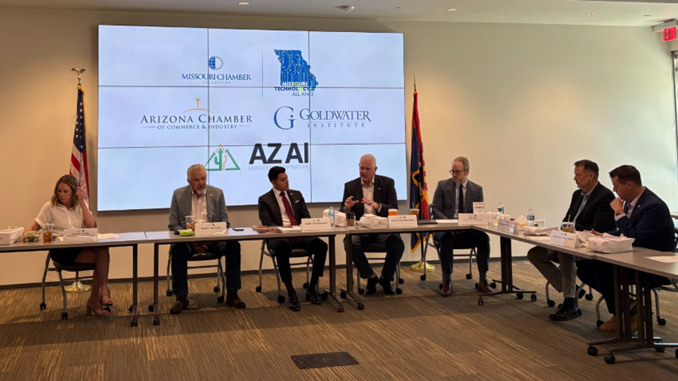
The Arizona Chamber of Commerce & Industry and the Goldwater Institute hosted a delegation of Missouri policymakers in Phoenix to discuss economic competitiveness, innovation, and pro-growth policy, according to a joint release.
The meeting focused on Arizona’s approach to building a competitive environment for emerging industries and long-term economic growth.
The discussion followed the Chamber’s recent launch of its AZ AI Leadership Initiative, which aims to strengthen Arizona’s position in emerging technologies and the broader digital economy.
Arizona has seen rapid expansion in AI and data center infrastructure, driven by growing demand for computing power and cloud services. Major investments from companies such as Taiwan Semiconductor Manufacturing Company (TSMC), which is constructing advanced semiconductor fabrication facilities in Phoenix, along with large-scale data center developments by Google and Meta Platforms in Mesa, and Amazon Web Services in Goodyear, have helped position the state as an emerging hub for both semiconductor production and AI-related computing capacity.
Participants included legislative leaders, policy experts, and representatives from the Arizona Commerce Authority, who shared insights into the state’s policy framework and economic development strategies.
“Arizona’s growth didn’t happen by accident,” said Courtney Coolidge, executive vice president of the Arizona Chamber of Commerce & Industry. “It reflects deliberate policy choices that prioritize certainty, competitiveness, and a regulatory environment where businesses can invest, innovate, and scale.”
Arizona lawmakers participating in the meeting included House Speaker Steve Montenegro (R-LD29), Majority Leader Michael Carbone (R-LD25), Rep. Jeff Weninger (R-LD13), Rep. Justin Wilmeth (R-LD2), chair of the House Artificial Intelligence and Innovation Committee, Senate President Pro Tempore T.J. Shope (R-LD16), and Senate Majority Whip Frank Carroll (R-LD28).
“Arizona has made a conscious decision to lead on innovation rather than wait for other states to set the pace,” Montenegro said. “That kind of alignment and forward-looking policy environment allows industries to grow and scale here.”
Lawmakers and policy leaders highlighted sectors including advanced manufacturing, semiconductors, aerospace, autonomous systems, and emerging technologies as areas where Arizona has seen sustained growth.
“Arizona’s success in attracting major investment is tied directly to our focus on advanced manufacturing, infrastructure, and supply chain strength,” Carbone said.
Weninger pointed to Arizona’s regulatory and tax structure as a factor in business investment.
“Companies are looking for certainty,” Weninger said. “Arizona’s predictable regulatory environment and competitive tax structure give businesses the confidence to invest and expand.”
Participants also discussed the role of infrastructure, water policy, and land use in supporting statewide growth. “We’ve been intentional about making sure economic development isn’t concentrated in one region,” Shope said.
Carroll said Arizona’s approach to economic development has positioned the state for continued expansion, particularly in emerging industries.
Wilmeth emphasized the importance of flexibility in regulating new technologies. “We’ve taken a thoughtful approach to emerging technologies by avoiding premature regulation,” he said.
Victor Riches, president and CEO of the Goldwater Institute, said policy certainty and deregulation remain key factors in supporting innovation.
“As emerging technologies continue to reshape industries, policy certainty and deregulation matter more than ever,” Riches said. “Arizona needs to ensure an environment where innovation can move forward.”
The Missouri delegation included state senators and policy advisors, including Sen. Travis Fitzwater, Sen. Maggie Nurrenbern, Sen. Karla May, Sen. Barbara Anne Washington, Sen. Jamie Burger, policy advisor to Gov. Mike Kehoe, Johnathan Shifflett, and representatives from the Missouri Chamber of Commerce, Karen Buschmann, and Jared Hankinson.
The meeting explored how elements of Arizona’s economic policy framework could be adapted in other states and how interstate collaboration could support broader economic growth.
Matthew Holloway is a senior reporter for AZ Free News. Follow him on X for his latest stories, or email tips to Matthew@azfreenews.com.
by Matthew Holloway | Mar 21, 2026 | News
By Matthew Holloway |
Arizona legislative Republicans criticized Gov. Katie Hobbs after she stepped away from budget negotiations, raising concerns about her proposed plan involving the state’s Public Land Trust Fund, according to a joint statement released by GOP leadership.
Arizona Senate President Warren Petersen and House Speaker Steve Montenegro said in a statement that Hobbs “chose to walk away from budget negotiations despite a path forward being within reach.”
At issue is the governor’s proposal to increase distributions from Arizona’s Public Land Trust Fund, which supports K-12 education and is protected under the Arizona Constitution. According to the statement, legislative budget analysts estimate the proposal would reduce the fund from approximately $9.7 billion to $4.7 billion over the next 20 years.
The Republican leaders explained that the proposal calls for a 10.9 percent annual distribution over 20 years, compared to a previous structure of 6.9 percent over 10 years. They also raised concerns about the assumptions underlying the plan, including projected long-term investment returns.
“At the center of this dispute is her proposal to dramatically increase withdrawals from Arizona’s Public Land Trust, a voter-protected fund designed to support K-12 education for generations. This is not a solution. It is a long-term raid on a critical resource,” Petersen and Montenegro said.
“The Governor wants to drain a voter-protected education fund, pile on $1.5 billion in new debt, and rely on numbers that simply don’t add up,” they added. “We have shown the Governor’s Office a balanced budget with tax conformity. We’ve put forward a responsible plan that cuts taxes for working families and funds schools without gimmicks. She walked away from the table because her math doesn’t work. Arizonans deserve better than headlines and blame-shifting.”
The joint statement also criticized the broader budget framework, alleging it includes approximately $1.5 billion in new debt, higher taxes and fees, and revenue projections they described as unrealistic.
Republican leadership stated they had presented an alternative budget proposal that they described as balanced and including tax conformity, though details of that proposal were not included in the release.
The lawmakers said they intend to continue working on a budget plan in the coming weeks.
Hobbs’ office has not yet publicly responded to the statement as of publication, but in a post to X following its release, she wrote, “As Governor, and the sister of public school teachers—I know how important strong public schools are for Arizona families. I’m proud to keep fighting for our students, educators, and classrooms, because a great public education is key to expanding opportunity and the Arizona Promise.”
Petersen and Montenegro concluded their statement saying, “While the Governor plays political theater, Arizona families are dealing with real consequences. This impacts your cost of living, your paycheck, your kids’ classrooms, and whether Arizona remains affordable for the families who live here. A temper tantrum won’t balance the budget, and it is not leadership to rely on voters to pass the funding we need after the fact. We’re ready to get this done. The question is whether she is.”
Matthew Holloway is a senior reporter for AZ Free News. Follow him on X for his latest stories, or email tips to Matthew@azfreenews.com.
by Staff Reporter | Feb 19, 2026 | News
By Staff Reporter |
A legislative committee advanced a bill to take away some of Attorney General Kris Mayes’ authority over the Arizona Department of Public Safety (DPS) on Monday.
House Speaker Steve Montenegro (R-LD29) said in his committee explanation of the bill that Mayes’ recent “political theatrics” had “endangered” law enforcement officers, therefore justifying the existence of this legislation. Mayes said in a January interview that individuals had legal justification for shooting ICE and other law enforcement agents based on Arizona’s “Stand Your Ground” law.
In a press release, Montenegro said Mayes no longer deserved the responsibility of providing legal protection to DPS.
“Attorney General Mayes does not get to put officers at risk with reckless talk and then expect DPS to trust her office for legal protection,” said Montenegro. “The House censured her, and we are taking the next step. HB 2993 gives DPS the authority to hire counsel it trusts, without political strings attached. It also moves $5 million out of the Attorney General’s control and into GIITEM, the mission that targets gangs, cartels, and transnational criminals. Arizona is choosing officer safety and enforcement over Mayes’ political games.”
Nick Debus with the attorney general’s office wrote down their office’s opposition to the bill during the committee hearing on Monday, but did not appear to testify against the bill.
The bill passed along party lines, with Democrats against and Republicans for the proposed legislation. Those Democrats who explained their vote did not address the “why” behind the bill — Mayes’ provision of a legal defense for shooting law enforcement — but rather the taking of CPCF Funds from the attorney general’s office.
State Rep. Lorena Austin (D-LD9) said Montenegro’s bill was also political posturing by impeding the administration of another democratically elected official.
“I don’t think this is a way to instill trust in our public entities, I think when someone is doing a good job regarding consumer protections we should continue to let them do those things,” said Austin.
Likewise, Minority Whip Quanta Crews (D-LD26) expressed concerns that depleting the CPCF Fund would result in further harm to consumers. State Rep. Kevin Volk (D-LD17) said the current economic climate made this “tit for tat” legislation more harmful than helpful.
Republicans argued the legislation killed two birds with one stone: mitigating wasteful spending as illustrated by recent consumer fraud actions while freeing law enforcement of their reliance on an individual who had jeopardized their safety.
State Rep. John Gillette (R-LD30) said Mayes was guilty of “frivolous spending” related to consumer fraud actions. As an example, Gillette cited the consumer protection lawsuit filed last year against the Reynolds Corporation for its labeling on bags intended to collect recycling because they’re not suitable for recycling. Mayes’ press release on the lawsuit did acknowledge the bags came with a warning that they were not suitable for recycling but intended as temporary containers for sorting and collecting recyclable materials.
“We spent millions of dollars for this lawsuit to go absolutely nowhere. I can think of no better use of that money than to give it to law enforcement,” said Gillette. “Let’s get the drugs, the criminals, the bad people off the streets so we can live freely.”
State Rep. Alexander Kolodin (R-LD3) said Mayes had created a “permission structure” for committing violence against law enforcement.
“When you’re telling people how to kill me and you’re going to let me get away with it, that’s not going to create that trust and confidence that’s necessary for effective representation,” said Kolodin.
The Arizona House passed a resolution censuring Mayes over her remarks on justified shootings earlier this month.
AZ Free News is your #1 source for Arizona news and politics. You can send us news tips using this link.