by Matthew Holloway | Nov 14, 2025 | News
By Matthew Holloway |
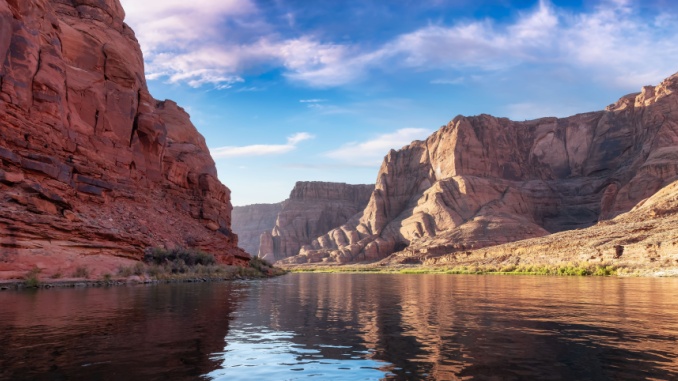
Arizona’s top elected leaders — Democrats and Republicans alike — have joined forces to demand federal action after the seven Colorado River Basin states missed a critical deadline to finalize post-2026 water-sharing rules. In a letter to Interior Secretary Doug Burgum, they warned that refusal by upper basin states to commit to verifiable conservation has pushed the negotiations to a breaking point.
The letter, dated November 11, 2025, highlights Arizona’s role as a leader in water conservation and criticizes upper basin states for refusing to commit to verifiable reductions, which the signatories say have stalled a seven-state agreement needed to sustain the river amid ongoing droughts.
The seven Colorado River Basin states—four in the upper basin (Colorado, Utah, Wyoming, New Mexico) and three in the lower basin (Arizona, California, Nevada)—missed a federal deadline on November 11th to submit a consensus plan for sharing water shortages after 2026, when current operating guidelines expire. Federal officials, including the Bureau of Reclamation, have urged the states to reach an accord to avoid potential court intervention or unilateral action by the Trump administration.
In the letter, the Arizona leaders commended Burgum’s efforts over the past year to develop a framework preserving the century-old 1922 Colorado River Compact, which allocates water among the states. They emphasized the river’s critical role in fueling Arizona’s advanced technology ecosystem, world-class agriculture, military bases, and communities home to millions, including 22 of the basin’s 30 Native American tribes.
“Arizona’s cutting-edge semiconductor industries and IT infrastructure are making it possible for the onshoring of manufacturing operations that are critical for maintaining American technological leadership,” the letter states. It notes that Yuma County, one of the world’s most sophisticated agricultural regions, produces over 90% of the winter leafy greens supplied to the United States and Canada each year.
The signatories stressed that Arizona’s allocation is vital not only to the state’s citizens but to national economic growth and independence. They warned that the upper basin states’ refusal to offer “meaningful, verifiable conservation commitments” over the last two years risks these foundations of growth.
Arizona has positioned itself as a basin-wide leader in water efficiency, the letter asserts, partnering with California and Nevada to propose creative and significant post-2026 operating criteria. Under most scenarios, Arizona’s plans would conserve 1.5 million acre-feet of water per year, representing more than 27% of the state’s entitlement in most years. This follows more than 3 million acre-feet in efficiencies already offered by the lower basin states since 2023 to stabilize Lakes Mead and Powell.
In contrast, the letter points out that upper basin states have repeatedly refused to implement any volume of binding, verifiable upper basin reductions. “This extreme negotiating posture—four of the seven Basin States refusing to participate in any sharing of water shortages—has led to a fundamental impasse that is preventing successful development of a 7-State consensus plan for management of the Colorado River,” it reads.
The group urged Burgum to use his authority to ensure that any alternative considered by the Department of the Interior “contains measurable and enforceable conservation requirements” for the upper basin, guaranteeing the resource remains available for Arizona’s contributions to the economy and national security.
Signatories to the letter include Governor Katie Hobbs (D), Senate President Warren Petersen (R-LD14), House Speaker Steve Montenegro (R-LD29), Senate Democratic Leader Priya Sundareshan (D-LD18), and House Democratic Leader Oscar De Los Santos (D-LD11).
A joint statement from the seven states and federal officials acknowledged the missed deadline. Still, it affirmed a shared recognition of the basin’s challenges, with negotiators committing to continuing talks despite the setback. Lake Mead’s surface elevation stood at 1,057 feet as of recent measurements, with commenters noting that’s just 37 feet above levels that could trigger a “devastating” crisis for Arizona, including potential mandatory cuts to urban and agricultural users.
The full text of the letter is available here.
Matthew Holloway is a senior reporter for AZ Free News. Follow him on X for his latest stories, or email tips to Matthew@azfreenews.com.
by Jonathan Eberle | Nov 12, 2025 | News
By Jonathan Eberle |
A federal court has upheld Arizona’s sex offender registration requirements, marking a significant legal win for state lawmakers who intervened to defend the statutes after Attorney General Kris Mayes declined to do so.
In Doe v. Sheridan, plaintiffs sought to overturn Arizona’s lifetime registration and reporting rules for certain convicted sex offenders. The lawsuit challenged requirements that mandate lifetime inclusion on the state’s sex offender registry, reporting of residential changes, and disclosure of online identifiers. Critics of the law argued the measures were overly burdensome and unconstitutional.
Arizona Attorney General Kris Mayes did not defend the state’s position in the case, prompting Senate President Warren Petersen and House Speaker Steve Montenegro to step in on behalf of the legislature. They argued the laws are essential for transparency and community safety.
U.S. District Judge Stephen McNamee ruled last week to uphold the statutes, finding the state’s registration and monitoring system constitutional. Petersen said the ruling reinforces key safeguards for families.
“When the Attorney General didn’t defend Arizona’s public safety laws, we refused to allow the safety of our children to be jeopardized,” Petersen said in a statement. “This ruling makes clear that tracking convicted sex offenders is not only constitutional – it is necessary to protect families and prevent new victimization.”
Under the ruling, Arizona will continue to require lifetime registration for qualifying sex offenders; require prompt reporting of address and online identity changes; and maintain public tools that allow law enforcement and families to monitor registered offenders.
Petersen called the outcome “a victory for every parent in Arizona,” adding that legislative leaders will continue to act to protect communities when others decline to defend state law.
Jonathan Eberle is a reporter for AZ Free News. You can send him news tips using this link.
by Matthew Holloway | Nov 11, 2025 | News
By Matthew Holloway |
Arizona GOP leaders are in court defending three abortion restrictions they say protect women and deter coercion after Attorney General Kris Mayes declined to defend the state laws. The Plaintiffs, supported by the Center for Reproductive Rights, argue that the statutes defy the 2024 constitutional amendment legalizing abortion up to fetal viability.
The lawsuit, Isaacson v. Arizona, was filed in May 2025 by Phoenix obstetrician-gynecologist Dr. Paul Isaacson, a Proposition 139 supporter. Isaacson was joined by Dr. William Richardson and the Arizona Medical Association in the lawsuit, which challenges:
- A “reason ban” barring abortions based solely on fetal abnormalities (non-lethal or otherwise), gender, or race.
- A “two-visit requirement” requiring a second clinic visit and 24-hour delay after viewing an ultrasound.
- A telehealth ban prohibiting diagnosis, prescription, or mailing of abortion medication via phone or video.
Isaacson dropped a related federal case in April 2025 to advance this state challenge and was joined by the Arizona Medical Association and two other OB-GYNs.
Senate President Warren Petersen and House Speaker Steve Montenegro intervened to defend the laws, represented by attorney Emily Gould of Holtzman Vogel, after AG Kris Mayes declined to defend them, according to KJZZ. In June 2023, Governor Hobbs signed an executive order centralizing abortion-related prosecutions in the Attorney General’s office, a move Mayes said underscores their shared commitment to “fight … to protect the rights of Arizonans to make their own private medical decisions without interference.”
The case is before Judge Greg Como in Maricopa County Superior Court, who denied a motion for dismissal from Petersen and Montenegro, and ordered a three-day evidentiary hearing to explore the laws’ impact on abortion in Arizona.
Defendants’ witness, Phoenix OB-GYN Dr. Steven Nelson—who manages miscarriage care but has not performed abortions—backed the telehealth ban, stressing in-person exams detect coercion via nonverbal cues like facial expressions in trafficking scenarios. Gould, representing Petersen and Montenegro, cited American College of Obstetricians and Gynecologists data and argued that at least 10% of abortion patients later report coercion. Nelson urged limiting telehealth to emergencies, as it “prohibits all of this,” and said he would provide such services only in the most dire cases.
Plaintiffs’ Wednesday witnesses—including Isaacson and experts from the Center for Reproductive Rights and ACLU—argued the laws burden low-income and rural patients with over two-hour drives and confidentiality risks in abusive settings. They argued that pre-abortion ultrasounds are unnecessary for early dating with reliable menstrual tracking. Experts clashed on the 24-hour delay’s health value, with one testifying that it undermines women’s autonomy and timely care.
Isaacson claimed the restrictions “create unnecessary barriers to essential reproductive health care,” echoing concerns from the Arizona Medical Association about access for vulnerable groups.
On ultrasounds, Nelson countered these arguments and described them as “essential to dating” pregnancies, estimating 60% of patients misjudge gestational age due to implantation bleeding. He noted ultrasounds pinpoint asymptomatic ectopic pregnancies, often undetected until seven weeks, requiring specific interventions. Nelson suggested local physicians could handle initial visits to ease rural travel burdens.
On day two of the hearing on Thursday, Judge Como indicated he may treat the record as sufficient for a permanent injunction, with closing arguments pending, according to Courthouse News. The hearing was set to continue on Friday, but as of Monday, no additional information was publicly available regarding the case.
Matthew Holloway is a senior reporter for AZ Free News. Follow him on X for his latest stories, or email tips to Matthew@azfreenews.com.
by Jonathan Eberle | Oct 22, 2025 | News
By Jonathan Eberle |
Arizona House Republicans have taken legal action to defend a decades-old state law governing birth-certificate amendments after Attorney General Kris Mayes failed to confirm whether her office would appeal a recent federal ruling striking the statute down.
Speaker of the House Steve Montenegro announced Monday that the Arizona House Republican Caucus, alongside Senate President Warren Petersen, filed a motion in U.S. District Court seeking to intervene as defendants for the purpose of appealing the decision and requesting a stay pending appeal.
The move follows U.S. District Judge James Soto’s September 30 ruling, which permanently enjoined enforcement of A.R.S. § 36-337, the provision requiring proof of a “sex change operation” before the state can amend the sex marker on a birth certificate. The injunction orders the Arizona Department of Health Services to revise its regulations within 120 days and to allow amendments based on a doctor’s attestation of a “sex change.”
“Arizona’s laws are not optional,” Montenegro said in a statement. “When a federal court rewrites a statute, the Legislature has a duty to defend it. If the Attorney General won’t defend Arizona’s laws, we will. The ruling now opens the door for anyone to change the sex marker on a birth certificate with just a doctor’s note, erasing decades of statute and undermining the integrity of vital records.”
According to the motion, Republican leaders made repeated inquiries to the Attorney General’s Office beginning October 1 about whether the state would appeal. After more than two weeks without a definitive answer, House and Senate leaders moved to intervene to ensure that the state’s position would be represented before the Ninth Circuit Court of Appeals.
The legislative leaders argue that Arizona law gives them authority to defend state statutes when their constitutionality is challenged and that the Attorney General’s inaction effectively leaves the law undefended. Their filing asserts that the federal court’s ruling misapplies equal protection principles and conflicts with recent Supreme Court guidance in United States v. Skrmetti—a 2025 case addressing gender-related classifications under the Constitution.
The lawmakers also requested an immediate stay of the injunction, warning that allowing it to take effect could cause “irreparable harm” to the state by forcing the issuance of amended birth certificates that could later be invalidated if the appeal succeeds.
This legal dispute comes months after Governor Katie Hobbs vetoed HB 2438, a bill sponsored by Rep. Rachel Keshel (R-LD17) that would have barred any changes to the sex marker on birth certificates, reinforcing the same policy now at issue in court.
If granted, the intervention would allow the Arizona Legislature’s top Republicans to pursue an appeal directly to the Ninth Circuit in defense of the statute—marking a rare instance of state lawmakers stepping into a role traditionally held by the Attorney General.
Jonathan Eberle is a reporter for AZ Free News. You can send him news tips using this link.
by Jonathan Eberle | Oct 10, 2025 | News
By Jonathan Eberle |
Arizona House Republican leaders are demanding answers after learning that the Chief Medical Officer of the state’s Medicaid program, AHCCCS, has been serving with an expired medical license.
According to records from the Arizona Medical Board, Dr. Theresa Costales, a psychiatrist appointed as Chief Medical Officer in January 2025, failed to renew her license, which was due April 9. The statutory grace period ended on August 9, leaving the license fully expired. Despite this, Dr. Costales continues to advise on state health policies that impact more than 2 million Arizonans.
House Speaker Steve Montenegro called the lapse “a failure of oversight” by Governor Katie Hobbs’ administration. “A lapse like this should never happen in a healthcare agency responsible for millions of people,” he said. “The public deserves accountability when even the most basic standards aren’t met.”
House Majority Leader Michael Carbone echoed the concern, noting that license verification is a simple process. “Any citizen can look this up in minutes. That it slipped through the cracks at the highest level of medical leadership is completely unacceptable.”
House Majority Whip Julie Willoughby, who is also a healthcare professional, questioned whether key policy decisions were made without proper credentials in place. “You cannot have a Chief Medical Officer without an active license—it’s that simple,” she said. She raised particular concern about the recent rollout of the controversial Home and Community-Based Services (HCBS) assessment tool, asking whether decisions tied to the program were made under expired authority.
Republican leaders also pointed to other state agencies, such as the Department of Corrections, that explicitly require valid medical licenses for their top medical positions. They argue AHCCCS should be held to the same standard, given its role in overseeing care for vulnerable populations.
Speaker Pro Tempore Neal Carter said the situation undermines public confidence. “Governor Hobbs’ administration has failed once again to ensure competence and accountability in state government. This isn’t a small oversight—it undermines trust in one of Arizona’s largest healthcare agencies.”
Jonathan Eberle is a reporter for AZ Free News. You can send him news tips using this link.