by AZ Free Enterprise Club | Jun 8, 2026 | Opinion
By the Arizona Free Enterprise Club |
For generations, Arizona’s wide-open land has supported ranchers, farmers and the communities that helped build our great state.
Then, the climate activists came along.
Armed with nothing more than junk science from climate “experts” like Al Gore and Alexandria Ocasio-Cortez, they got busy imposing costly green energy mandates on states across the country—and Arizona’s political and corporate elites eagerly fell in line. Our state’s utilities committed themselves to achieving “Net Zero” emissions by 2050, a goal that will cost ratepayers billions of dollars while doing little to meaningfully impact the environment.
But higher utility bills are only part of the cost.
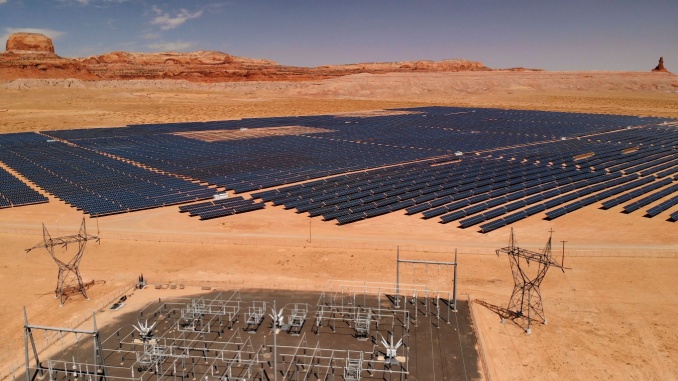
Not wanting to disappoint some of her largest campaign contributors, Arizona Governor Katie Hobbs has been quick to bend the knee to the Green New Scam time and time again. Now, these decisions are not only hitting families in the wallet, but they are transforming our state’s beautiful countryside into an industrial playground for massive, foreign-backed solar and wind developments.
Under Hobbs, the Arizona State Land Department has increasingly operated like a business partner for the solar industry instead of a steward of Arizona’s public lands. The agency now maintains detailed maps identifying the “best” locations for solar development across the state, effectively helping direct industrial solar companies toward Arizona’s most desirable land.
But surely, they must be doing the same for other industries?
Nope…
>>> CONTINUE READING >>>
by AZ Free Enterprise Club | May 14, 2026 | Opinion
By the Arizona Free Enterprise Club |
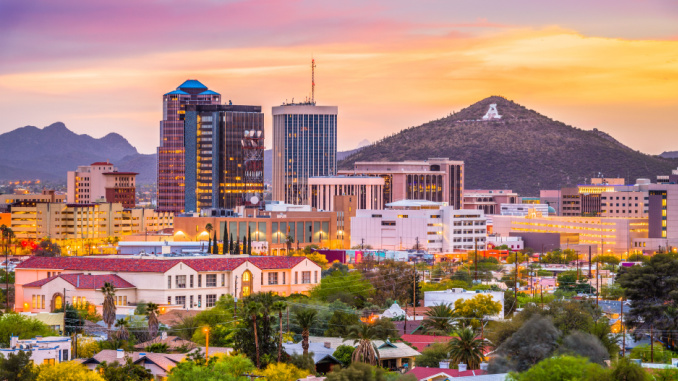
This November, Tucson voters are being asked (again) to approve a 25-year franchise agreement between Tucson and Tucson Electric Power (TEP). Franchise agreements are generally standard arrangements that allow utilities to use public rights-of-way for poles, wires, and infrastructure. But there is nothing standard about this deal. Bundled with it is an “Energy Collaboration Agreement” that will quietly embed climate policy into Tucson’s governance for the next quarter century. Voters should read the fine print (and the price tag) before checking the box.
If Tucson voters are having déjà vu reading this proposal, it’s because it is awfully similar to what they have already said no to. In May 2023, Proposition 412 put a nearly identical TEP franchise agreement before the public, and voters rejected it by a 55-45 margin. That deal included a new 0.75% “community resilience fee” on top of the existing 2.25% franchise fee, with proceeds earmarked for undergrounding utility lines as well as funding the city’s Climate Action Plan. Despite voters already telling the city they don’t want it, city leaders and TEP have assumed residents really just want a more expensive version of the same thing – rebranding and trying to ream through for a second time the same agenda but at a cost of $64 million instead of $56 million.
What the franchise agreement really does is help TEP maintain infrastructure, expedite permitting, and improve outage response. But TEP can still operate without a franchise agreement, meaning this vote is not about whether Tucson continues receiving electricity. Instead, it creates the legal foundation for a broader political partnership between the city and the utility…
>>> CONTINUE READING >>>
by Matthew Holloway | May 5, 2026 | Economy, News
By Matthew Holloway |
Arizona Senate Republicans announced on Monday that they passed a $17.9 billion budget for fiscal year 2027 that includes $1.45 billion in tax relief over four years and spends approximately $800 million less than Governor Katie Hobbs’ proposal.
The budget, approved by the Legislature and sent to Hobbs, is based on updated April revenue projections that showed a $200 million decrease in available resources.
According to Senate Republicans, the plan includes a series of tax changes intended to provide cost-of-living relief, including eliminating state taxes on tips and overtime pay, increasing the standard deduction, allowing full deductions for child-care expenses, increasing the dependent tax credit by $25, and creating a $6,000 deduction for seniors age 60 and older with retirement or pension income.
The proposal also includes conformity with federal tax policy changes associated with Donald Trump’s tax cuts, which the Senate said would ensure Arizona taxpayers do not need to refile their 2025 state tax returns.
“This is a serious, disciplined budget that puts Arizona families first,” Senate President Warren Petersen (R-LD14) said in a statement. “We cut taxes, protect essential services, and base every decision on real April revenue projections — not wishful thinking.”
He added, “In divided government, we faced the math, eliminated waste through targeted reforms, and delivered real results without raising taxes or growing government.”
The budget maintains current funding levels for K-12 education and public safety, preserves the voter-protected K-12 State Land Trust, and limits overall spending growth to 1.9 percent.
To address the projected shortfall, Senate Republicans said the plan includes policy changes aimed at reducing spending, including enhanced eligibility verification in public assistance programs such as the Arizona Health Care Cost Containment System (AHCCCS) and the Supplemental Nutrition Assistance Program (SNAP), a 5% reduction in agency operating budgets excluding public safety and child welfare agencies, and the repeal of certain tax credits and subsidies, including solar incentives.
The budget does not reduce base pay for Arizona Department of Public Safety troopers or firefighters and does not modify existing data center incentives previously signed into law.
The plan also includes $4.75 million in emergency funding for the Department of Public Safety, which Senate Republicans said the agency had requested and that the governor had previously vetoed as a standalone bill.
The Arizona Senate Republican Caucus said the budget reflects the constraints of divided government and relies on no new taxes or fees.
“This budget reflects the reality of divided government,” Petersen said. “While Democrats were on the floor today saying we need to raise taxes, we are instead delivering historic tax relief without burdening taxpayers. Your business and your wallet are on the ballot this fall. Vote wisely.”
The proposal now awaits Hobbs’ action.
House Speaker Steve Montenegro (R-LD29), Petersen, and other legislative Republican leaders are scheduled to hold a press conference on Tuesday at 1 p.m., according to a media advisory, to highlight the budget and urge Hobbs to sign the legislation.
Matthew Holloway is a senior reporter for AZ Free News. Follow him on X for his latest stories, or email tips to Matthew@azfreenews.com.
by AZ Free Enterprise Club | Apr 30, 2026 | Opinion
By the Arizona Free Enterprise Club |
Last year, Katie Hobbs, by executive order, established a “task force” headed by her Office of “Sustainability” to develop a report on energy affordability and reliability. This month, her task force submitted their plan which would do the opposite of that: make energy more expensive and less reliable. This shouldn’t come as a surprise considering the “task force” called by Hobbs is made up of solar special interests, environmental activists, her own agencies, and utilities that have all committed to going Net Zero anyway.
Instead of reading 81 pages that brings nothing new to the table, the only questions that need to be asked (and answered) about the report are below.
Does it call for new natural gas generation? Not really.
Does it call on utilities to keep our coal plants open? No, they want to shut them down and “repower” them to “clean” energy.
Does it pave the way for new nuclear? Not until the mid-2040s, at the earliest.
What, then, does it advocate doing? Subsize special interests by blanketing state trust land and government buildings with even more solar, wind, and battery storage. The very thing causing utility rates to increase and leading to blackouts…
>>> CONTINUE READING >>>
by Matthew Holloway | Apr 11, 2026 | News
By Staff Reporter |
Arizona House Republicans are raising concerns about Governor Katie Hobbs’ recently released state energy plan, arguing it prioritizes solar development and government programs over housing availability and energy affordability.
In a press release, the Arizona House Republican Caucus said the plan advances policies that emphasize utility-scale solar projects, expanded renewable energy deployment, and the use of state-owned land for energy infrastructure.
The criticism follows the rollout of the governor’s broader energy strategy, which includes 31 recommendations developed by the Arizona Energy Promise Task Force to address rising energy demand, data center growth, and utility costs across the state.
According to House Republicans, the plan promotes solar development on state land, including areas near existing communities, rooftop solar installations on government buildings, and participation in virtual power plant programs.
Republican lawmakers cautioned that these proposals could affect the availability of land for residential development. Citing data from the Common Sense Institute, they noted that the Hobbs administration has “identified land closest to existing residential areas as ‘best’ for solar development,” adding that approximately 276,000 acres of state land within 10 miles of incorporated cities and towns could support up to 200,000 housing units.
House Majority Leader Michael Carbone (R-LD25) said the administration’s plan emphasizes renewable energy projects and related investments while raising concerns about impacts on housing supply and costs to taxpayers.
He explained in a statement, “Hobbs is calling this an all-of-the-above energy plan. It’s not. It’s a solar-heavy political plan that puts green industry insiders ahead of taxpayers, pushes utility-scale solar onto state land that could support badly needed housing, and says nothing about lowering gas prices for Arizona families. When Hobbs says ‘all of the above,’ what she means is more wind and solar.”
The governor’s office has described the energy plan as part of a broader effort to address affordability and reliability while bringing together stakeholders from utilities, industry, and government.
In separate announcements, the Hobbs administration has highlighted programs focused on lowering energy costs, including efficiency upgrades and rebate initiatives designed to reduce utility bills for Arizona households.
Carbone criticized Hobbs’ energy plan, stating, “You cannot claim to have an energy plan for Arizona while ignoring gasoline prices, fuel supply, and the infrastructure needed to keep this state moving. This report does not confront boutique fuel problems, does not address refinery or pipeline capacity, and does not even include the industry that supplies the fuel Arizona families and businesses rely on every day. That is not all of the above. That is selective politics dressed up as policy.”
He added, “Her report is long on politics and short on answers. It does not lower costs. It does not increase housing supply. It does not put taxpayers first. House Republicans are focused on affordability, reliability, and policies that serve Arizona families, not a narrow political agenda.”
Matthew Holloway is a senior reporter for AZ Free News. Follow him on X for his latest stories, or email tips to Matthew@azfreenews.com.